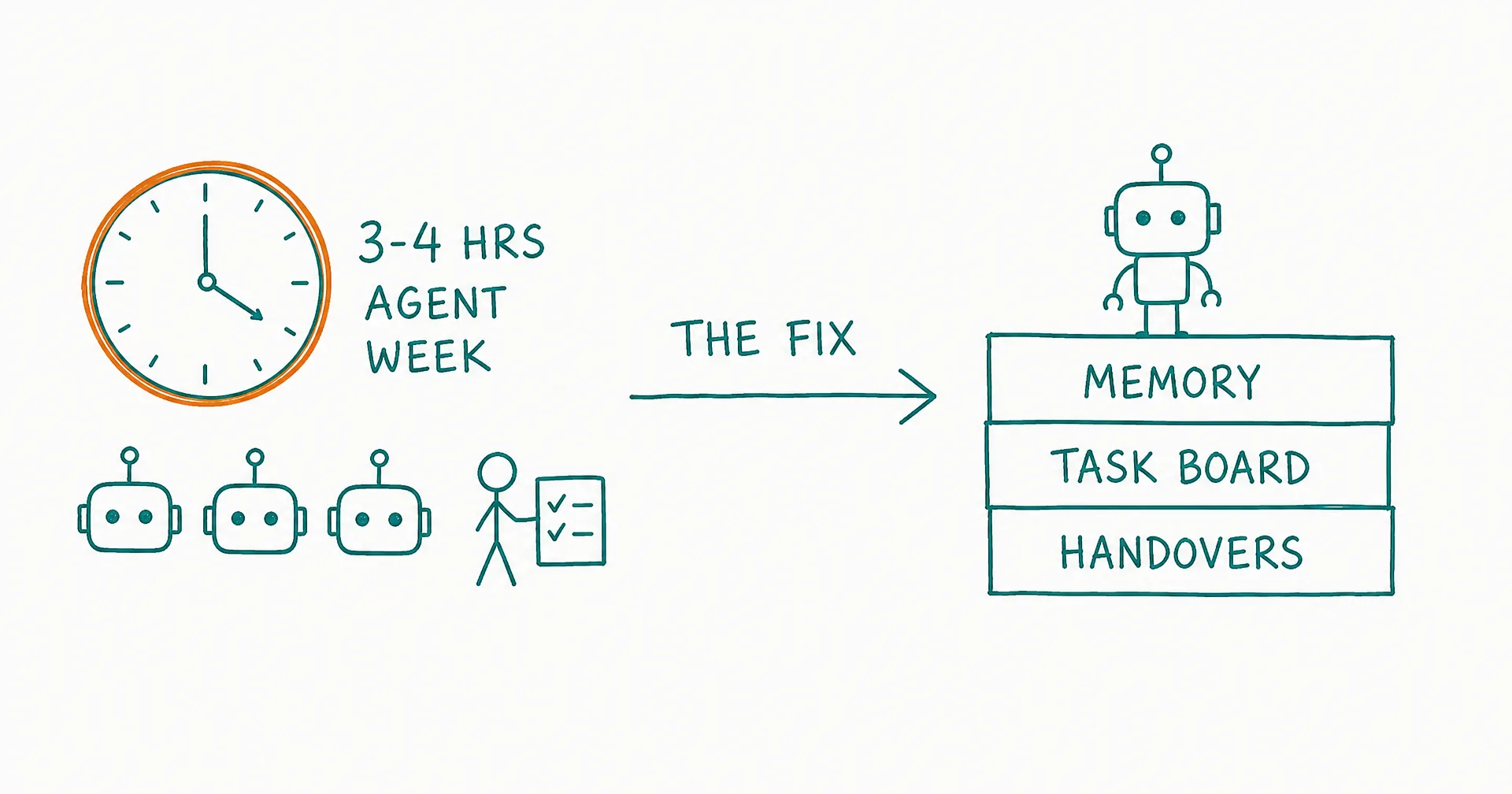
The most useful sentence published about running AI agents in production did not come from a lab or a critic. It came from one of the most bullish agent operators in SaaS, Jason Lemkin, whose SaaStr runs more than 20 agents and describes its team as about 60 percent AI: “Right now, managing AI agents is about as much work as managing humans. Just different work.”
That January 2026 post resurfaced across newsletters this week, and it deserves the second wave, because it contains the numbers everyone else’s pitch decks omit.
On this page · 6 sectionsOpen
- The best public dataset on agent management overhead comes from SaaStr’s Jason Lemkin: 20-plus deployed agents, a team he describes as about 60 percent AI, and 15 to 20 hours per week actively managing five AI SDRs, which he generalizes to 3 to 4 hours per agent per week.
- His comparison point: a human rep takes 4 to 6 management hours per week. Agents did not eliminate management; they changed what the hours contain.
- The hours go to quality checks, prompt refinement, adding training material, reviewing drafts, escalation handling, and targeting adjustments, per Lemkin’s own breakdown.
- Attention correlates with performance in his data: weeks with more management produced 10 to 20 percent better response rates; less attention meant B-plus output instead of A-plus.
- The overhead is not fixed. Most of what fills those hours is context re-supply and state-keeping, which is precisely what memory, task boards, and shift handovers exist to absorb.
- The honest math: agents at 3 to 4 management hours per week still win on cost, but the win is smaller than the set-and-forget pitch. Buy the management layer, not just the agent.
§ 01The numbers, dated and labeled
A disclosure before the data: we build CellCog, an AI employee platform, so we have an interest in how this conversation resolves. The figures below are Lemkin’s own self-reported operator numbers, not an audited study, and we treat them as such.
| Figure | Value | Source and date |
|---|---|---|
| Agents deployed | 20-plus | SaaStr, January 5, 2026 |
| Team composition | about 60 percent AI | SaaStr, July 23, 2025 |
| Active management, five AI SDRs | 15 to 20 hours per week | SaaStr, November 20, 2025 |
| Generalized planning figure | 3 to 4 hours per agent per week | SaaStr, January 5, 2026 |
| Human rep comparison | 4 to 6 hours per week | SaaStr, January 5, 2026 |
| Initial training period | at least 30 days intensive | SaaStr, January 5, 2026 |
One precision note that most coverage drops: the 15 to 20 hours was measured on five AI sales agents specifically, then offered as general planning guidance for any agent. It is a good number. It is not an audited average across all 20-plus.
§ 02What fills the hours
Lemkin’s own breakdown of the weekly work is the most valuable part, because every item on it is a symptom rather than a chore:
- Preparing and uploading contact lists
- Daily quality checks on output
- Weekly performance review and prompt refinement
- Adding training materials, proof points, calls, and FAQs
- Reviewing draft replies for valuable prospects
- Monitoring conversations and routing them to humans
- Adjusting targeting based on conversion, and removing messaging that drew negative feedback
Read that list again as a diagnosis rather than a schedule. Uploading lists and adding proof points is a human carrying context the agent does not retain. Weekly performance review is a human holding standards the agent has no memory of. Routing and escalation is a human being the routing table. Almost none of it is judgment work that requires a person. It is state-keeping, done by hand, because the agent has no state of its own.
That is why the comparison to managing humans lands so well and misleads so easily. A human rep’s 4 to 6 hours is genuine management: coaching, priorities, deal strategy. An agent’s 3 to 4 hours is mostly re-supply.
§ 03Attention is an input, not an overhead
The second finding in Lemkin’s data is the one that should change how people budget. He reports that weeks with more human attention produced response-rate improvements of 10 to 20 percent, more meetings, and better outcomes. When attention dropped, the agents kept running and delivered what he calls B-plus instead of A-plus work.
So the hours are not a tax on a fixed output. They are a lever on a variable one. Which means the cheap version of agent deployment, buy it, prompt it, walk away, does not produce a smaller result at the same quality. It produces a quieter, worse result that nobody is watching. That is the failure mode that makes AI initiatives die without a postmortem: not a crash, a slow drift into mediocre output that no one reviews because reviewing was what got cut.
§ 04The same lesson at 100 times the scale
This is not just a small-company pattern. Reuters’ reporting on Meta’s cancelled AI-native restructuring documented the identical shape at enormous scale: internal posts describing unchecked agents taking large-scale disruptive actions, major technical and security incidents up 40 percent year over year, and time spent firefighting them up 70 percent. Meta had the capability. What it apparently lacked, at the scale it was attempting, was the structure that keeps agent output legible and bounded.
Lemkin’s version of that structure is manual and honest: checkpoint moments requiring human approval, escalation thresholds, priority scoring, operating schedules for noncritical agents, and an explicit decision not to inspect every output. Every one of those is a management primitive being rebuilt by hand, per deployment, because the agent did not come with one.
§ 05What actually removes the overhead
Take the weekly list item by item and ask what structural feature makes it unnecessary:
| Weekly manual work | The structure that absorbs it |
|---|---|
| Re-supplying context, proof points, training material | Persistent memory that carries across runs |
| Chasing what got done and what did not | A task board with real statuses and results |
| Re-explaining where things stand each session | Shift handovers written by the worker, not the manager |
| Watching every action for the risky one | Approval rails: classify actions, gate only the consequential |
| Being the routing table between agents | Delegation between employees, with an audit trail |
None of that removes the human. It moves the human up a level, from operating the agent to directing it: setting outcomes, ruling on the escalations, reading the record. That is the distinction we mapped in AI agent vs AI employee, and it is exactly what span of control work says determines how many workers one person can actually supervise.
§ 06The honest math
Even at 3 to 4 hours per agent per week, the economics of agents usually still work. That is the thing critics miss when they quote the number as a gotcha. But two things are simultaneously true, and the vendors only say one of them:
- The set-and-forget pitch is false. Every serious operator’s numbers say so, including operators as bullish as Lemkin.
- The overhead is mostly structural, not inherent. It scales down when the platform carries state, and it stays flat when the platform makes you carry it.
So when you are comparing platforms, do not compare the agent. Compare what happens between runs. Ask where the memory lives, who writes the handover, what the board looks like on Monday morning, and which actions wait for you. The answers to those four questions are the difference between 3 to 4 hours per agent per week and a fraction of it.
The full cost picture, including the parts nobody bills you for, is in our seven-layer cost framework.
Q1Where do these numbers come from?
Jason Lemkin’s SaaStr posts, primarily ‘Right Now, Managing AI Agents is About as Much Work as Managing Humans’ (January 5, 2026) and his six-month AI SDR results post (November 2025). They are self-reported operator numbers, not an audited study, and we date and label them accordingly.
Q2What do the management hours consist of?
Per Lemkin’s breakdown: daily quality checks, weekly performance review and prompt refinement, uploading contact lists, adding training materials and proof points, reviewing draft replies for valuable prospects, monitoring and escalating edge cases, and adjusting targeting based on conversion.
Q3Didn't the agents still produce good results?
Yes, and that is the point of using his data: this is a bullish operator. His AI SDRs built 500,000 dollars in pipeline in their first weeks, and his inbound agent is credited with over a million dollars closed in 90 days. The overhead numbers are what it cost to get that.
Q4What is the difference between managing an agent and managing an AI employee?
State. An agent starts each run from zero, so a human carries the context, the standards, and the follow-through. An AI employee holds its own memory, task board, and handover chain, so the human’s job shrinks from operating to reviewing: setting direction, approving the consequential, and reading the audit trail.
Q5Does this mean agents are not worth it?
No. Even at 3 to 4 hours per agent per week, the economics usually work. It means the set-and-forget pitch is false, and the honest comparison includes management time. Platforms that carry that layer structurally change the math.