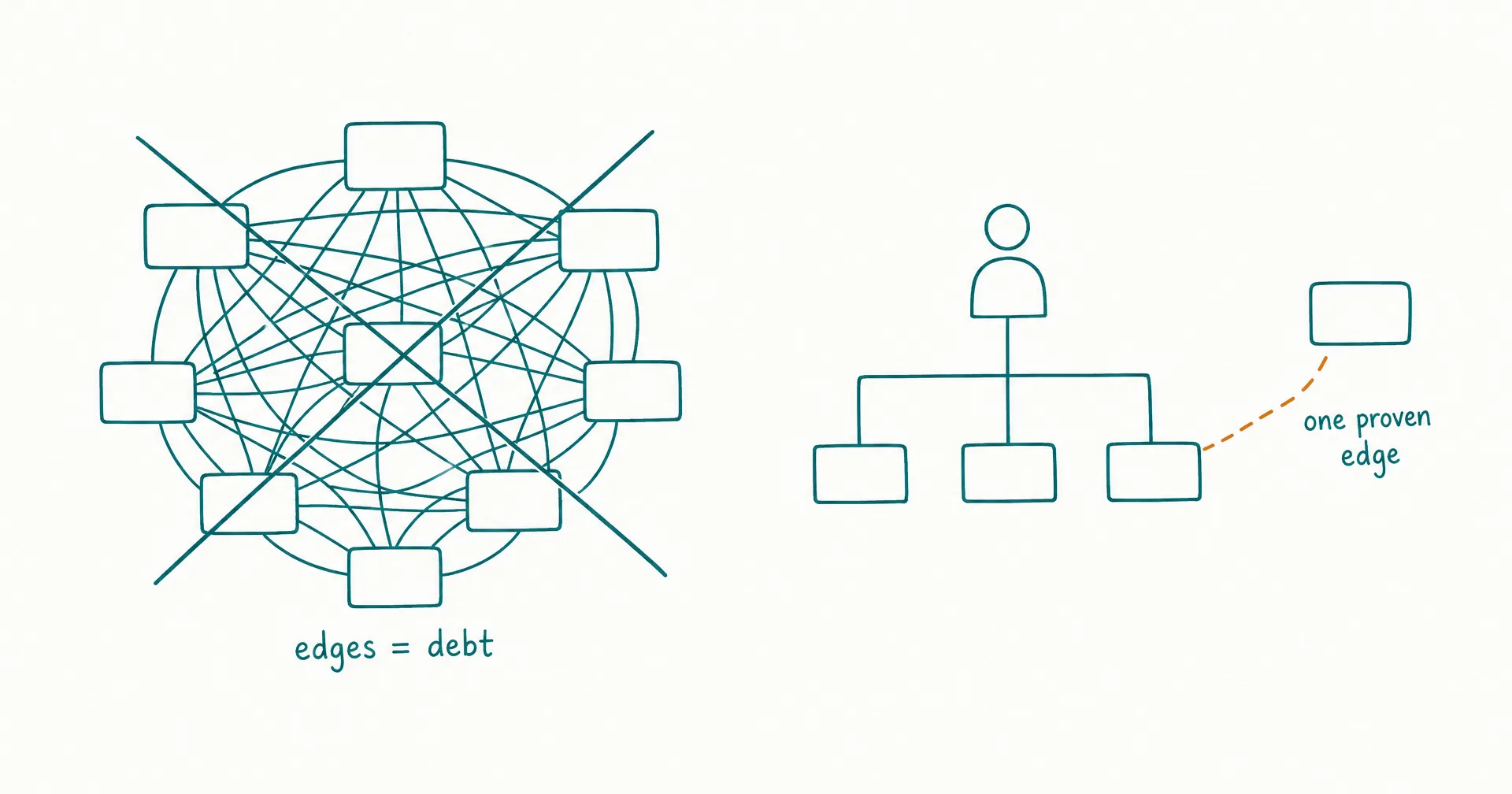
Build an AI organization by starting with one outcome-owning AI role, proving its operating contract, and adding another role only when a stable responsibility boundary reduces work for the organization as a whole.
The objective is not the largest agent org chart. It is the smallest human-AI operating model that produces more accepted work without moving the same burden into delegation, context packaging, review, reconciliation, incident handling, and supervision.
Every role needs an accountable human, defined outcome, source boundary, authority envelope, task state, interface, evaluation, escalation route, and retirement rule. Every connection between roles needs a typed handoff and one owner of closure.
The practical AI employee definition explains the standing-role unit. Several of those units become an organization only when their responsibilities, interfaces, and shared outcomes form a governed operating system.
On this page · 17 sectionsOpen
- What Is an AI Organization?
- Why Do AI Organizations Create Coordination Debt?
- What Principles Should Govern the Organization Design?
- Which AI Organization Structure Should You Choose?
- How Do You Choose the First AI Employee?
- How Do You Write an AI Organization Role Contract?
- How Should Work Move Through the Organization?
- How Do You Govern Shared Context and Memory?
- How Do You Define Human Oversight and Escalation?
- How Should You Draw the AI Organization Chart?
- How Should the Organization Respond When One Role Fails?
- How Do You Measure Whether the AI Organization Works?
- What Does an AI Organization Cost?
- What Does CellCog’s Public AI Organization Show?
- What 60-Day Rollout Should You Use?
- Which AI Organization Red Flags Should Stop Expansion?
- Build the Smallest Organization That Reduces Work
- Start with one AI employee that owns one recurring, measurable, reversible outcome. An organization begins after the first role is operational, not after several agents are named.
- Add a role only to resolve a measured capacity, capability, permission, independence, or management constraint.
- Design responsibilities before reporting lines. Every outcome should have one directly responsible owner and one accountable human.
- Treat delegation as a state transition: assignment, acceptance, execution, review, return, escalation, and closure must be visible.
- Separate shared sources from role-specific working memory; broad shared memory can spread stale data, sensitive context, and errors.
- Measure coordination debt through manager time, handoff failure, stale tasks, duplicate work, reopened work, exception rate, and cost per accepted system outcome.
- CellCog’s July 2026 public org chart is a useful first-party operating example, not proof that the same structure or metrics will transfer to another organization.
§ 01What Is an AI Organization?
An AI organization is a governed system in which humans, AI employees, deterministic workflows, and software services hold explicit responsibilities and coordinate work toward business outcomes.
| Component | Organizational job | Minimum contract |
|---|---|---|
| Human executive or sponsor | Sets purpose, risk tolerance, budget, and final accountability | Decision rights and escalation |
| Human manager or supervisor | Accepts work, approves actions, handles exceptions | Review capacity and response time |
| AI manager | Decomposes, assigns, tracks, reviews, and escalates bounded work | Manager outcome and evaluation |
| AI specialist | Produces a defined artifact or action | Role, tools, permissions, acceptance |
| Workflow/state machine | Enforces stable sequence, validation, and transactions | States, transitions, retries, terminal rules |
| Shared source | Supplies approved policy, business, and reference truth | Owner, version, access, retention |
| Task system | Records ownership and current state | IDs, status, parent/child relation, evidence |
| Control plane | Enforces identity, permissions, approvals, budgets, and stop | Policy outside model judgment |
An org chart shows reporting relationships. An operating model shows how decisions, state, authority, evidence, and exceptions move.
It is not a collection of chatbots
Ten assistants waiting for prompts do not create an organization. They may be useful tools, but no persistent responsibility or coordination system exists.
The organizational test is:
- who owns each recurring outcome;
- how work arrives;
- where open work lives;
- what authority the role receives;
- how one role requests work from another;
- who accepts the final result;
- when a person intervenes; and
- how the role is paused or retired.
It is not an anthropomorphic metaphor
Titles such as Chief of Staff, manager, analyst, writer, or sales representative are useful only when they map to real operating contracts.
A “manager” that sends messages but cannot see workload, evaluate output, resolve exceptions, or close a task is a router with a human title.
It is a socio-technical system
The organization includes people, policy, software, data, suppliers, customers, and affected parties - not only models.
The NIST AI Risk Management Framework Core connects technical AI decisions to organizational purpose, risk tolerance, roles, documentation, human oversight, deployment context, monitoring, incident response, and decommissioning. That is a better design frame than copying a human hierarchy into prompts.
§ 02Why Do AI Organizations Create Coordination Debt?
Every role can add capability and new edges.
More workers create more interfaces
With n roles, the maximum number of pairwise communication relationships is n x (n - 1) / 2.
| Roles | Possible pairwise relationships |
|---|---|
| 2 | 1 |
| 3 | 3 |
| 5 | 10 |
| 8 | 28 |
| 10 | 45 |
Not every organization uses every pair. The formula shows why an unstructured “everyone can talk to everyone” model becomes hard to govern.
Manager layers can move work rather than remove it
An AI manager may save a human from assigning 20 tasks and create new work:
- reviewing decomposition;
- correcting misroutes;
- reconciling conflicting outputs;
- answering escalations;
- inspecting approvals;
- tracing failures;
- resolving loops;
- tuning multiple roles; and
- maintaining shared sources.
Count net supervision, not messages avoided.
Context degrades at boundaries
Every delegation compresses a goal, evidence, constraints, and decisions into a packet. Missing one exception or source caveat can change the result.
A broad generalist may avoid that loss. The general-purpose versus specialized AI agent comparison helps determine when permission separation, independent verification, tool focus, capacity, or parallelism earns the edge.
Failures can cascade
A specialist may return a false claim. A manager may accept it. Another role may store it in shared memory. A publisher may send it externally.
Containment requires role-specific authority, validated inter-role input, provenance, budgets, independent checks where needed, and the ability to pause the full chain. The multi-agent system failure-mode model traces how local defects propagate through plans, handoffs, memory, reviews, retries, and external actions.
§ 03What Principles Should Govern the Organization Design?
Use 8 principles before drawing the chart.
1. Outcomes before titles
Write “accepted weekly acquisition review by 10 a.m. Monday” before “Growth Analyst.”
The outcome defines the work unit, acceptance, schedule, value, and owner. The title helps people navigate.
2. One directly responsible owner
Each open outcome needs one role responsible for closure. Several agents can contribute; one owns the state.
If a task moves to another role, record whether ownership transfers or only a sub-task is delegated.
3. One accountable human
Human accountability does not require approving every low-risk action. It requires a named person who owns the role’s purpose, authority, thresholds, exceptions, incidents, and continuation.
Do not assign one person 12 agents without calculating supervision load.
4. Minimum viable authority
Give each role only the systems, objects, data, actions, recipients, values, and times needed for its outcome.
Use the AI employee permission and approval framework to separate read, prepare, approved action, bounded independent action, and blocked states.
5. Explicit interfaces
Every recurring delegation needs:
- capability name;
- required input;
- accepted output schema;
- source/artifact references;
- authority supplied;
- deadline and budget;
- acceptance test;
- failure and escalation;
- status events; and
- closure owner.
A free-form message can carry context but should not be the only state record.
6. Shared sources, scoped working memory
Policy, approved product facts, current offers, and operating procedures may be shared sources. A role’s scratch work, customer context, secrets, and unverified observations should remain scoped.
Use a governed memory lifecycle for provenance, scope, correction, retention, and deletion across role context.
The shared versus role-specific AI memory guide turns that principle into an architecture: human-owned shared sources, team/project stores, isolated role memory, task-local context, gated writes, and retrieval-time checks.
7. Evidence before authority
Advance a role after representative outcomes, negative tests, escalation, reliability, cost, and worst-error gates pass.
Use a bounded pilot for the first decision. Repeat regression gates after material role, tool, source, memory, model, or policy changes.
8. Design for removal
Every role needs:
- pause;
- credential revocation;
- queued-task handling;
- open-work reassignment;
- memory and data treatment;
- artifact and evidence export;
- dependent-role notification; and
- human fallback.
If removing one role makes the organization unintelligible, the interfaces are too implicit.
§ 04Which AI Organization Structure Should You Choose?
Use the simplest of 4 patterns that fits the work.
| Pattern | Shape | Best for | Main risk |
|---|---|---|---|
| Assistant per human | Each person supervises one or more AI roles | Local augmentation and clear accountability | Duplicate tools, sources, and policy |
| Functional pod | Human lead + related AI specialists | Department outcomes with shared context | Handoffs and manager bottleneck |
| Manager-specialist | AI manager coordinates AI workers under human sponsor | High-volume decomposable work | Manager error and privilege concentration |
| Shared service | Central AI role serves several teams | Research, analytics, content, or operations capability | Queue conflict and weak business context |
These four patterns are practical design options, not an industry standard.
The AI organization chart pattern guide turns these 4 structures into drawable role boxes, typed edges, source and permission overlays, human accountability points, capacity annotations, and failure paths.
Assistant per human
A sales leader has a research employee; a marketer has a content employee; an executive has a briefing employee.
This pattern keeps human ownership obvious and local context rich. It can create duplicated integrations, source copies, evaluation methods, and vendor spend.
Use when adoption is early and cross-role coordination is limited.
Functional pod
A human functional owner supervises 2-5 related AI roles. For example, a growth pod might contain research, analysis, content, and operations roles.
The pod needs one shared goal set, role-specific outcomes, a common work queue, bounded memory, and clear cross-role interfaces.
Use when the department owns cohesive outcomes and one person can review the exceptions.
Manager-specialist
An AI manager decomposes goals, assigns tasks, monitors progress, reviews returned artifacts, handles routine questions, and escalates exceptions to a human.
OpenAI’s agent-building guidance describes a manager pattern in which a central agent controls workflow and calls specialists as tools. The human organization still needs to evaluate manager decisions and bound every role’s authority.
Use the AI manager feasibility and control test before delegating that coordination loop; it separates bounded assignment and review from the goals, permissions, exceptions, and accountability that must remain human-owned.
Use when tasks are decomposable, volume is meaningful, role outputs are independently gradable, and the manager’s synthesis can be tested.
Shared service
A research or data employee receives requests from several teams.
Use:
- request schema;
- prioritization rule;
- capacity and deadline;
- requester permissions;
- accepted output;
- data isolation;
- service owner; and
- escalation.
Without service rules, the shared role becomes an opaque queue.
§ 05How Do You Choose the First AI Employee?
The first role should prove the operating layer without requiring the future organization to exist.
Select a seed role
Choose a role with:
- recurring digital work;
- one visible outcome;
- enough representative cases;
- accessible approved sources;
- bounded reversible authority;
- measurable acceptance;
- one supervisor;
- plausible value; and
- a natural extension only if demand appears.
The outcome-first hiring guide turns this into a role charter, task analysis, evaluation pack, permission contract, and final choice.
Avoid “manager first”
A manager without proven workers or stable interfaces manages abstractions. Start with an individual-contributor role and learn:
- how work arrives;
- what context is needed;
- which exceptions recur;
- what the human reviews;
- which work can be delegated;
- what capacity constraint appears; and
- whether another role would reduce total effort.
Promote or add management only after real coordination demand exists.
Define the expansion trigger
Examples:
- backlog exceeds the agreed service time for 3 review periods;
- one work subtype consumes more than 30% of capacity;
- tool or permission conflict causes repeated failure;
- independent review catches a material error class;
- human delegation time exceeds the automation business case; or
- a stable artifact boundary appears across at least 20 tasks.
These are illustrative thresholds. Use your baseline and workload.
§ 06How Do You Write an AI Organization Role Contract?
Each role needs both an employment-style charter and a system contract.
Role charter
| Field | Required answer |
|---|---|
| Purpose | Why this role exists |
| Recurring outcome | Accepted unit and cadence |
| Supervisor | Accountable human |
| Customers | Who receives the work |
| Sources | Approved systems and records |
| Decisions | What the role may decide |
| Actions | Read, prepare, approve, execute, blocked |
| KPI set | Outcome, quality, effort, reliability, risk, cost |
| Escalation | Trigger, recipient, packet, response time |
| Dependencies | Roles, workflows, and services required |
| Retirement | Pause, transfer, export, delete, revoke |
The charter should fit on 1-2 pages before deeper policies and test cases are attached.
Responsibility matrix
Use direct verbs:
- owns;
- decides;
- prepares;
- reviews;
- approves;
- executes;
- verifies;
- escalates;
- records; and
- closes.
Avoid “supports” where the outcome needs a clear owner.
Capacity contract
Define:
- expected volume;
- task size;
- priority classes;
- maximum concurrent work;
- deadline;
- timeout;
- retry limit;
- cost ceiling;
- backlog alert;
- overflow owner; and
- shutdown behavior.
Unlimited AI labor is not a valid capacity assumption. Model, tool, rate, budget, review, and exception capacity remain finite.
Authority contract
Map every role to enforced identities and actions. Titles do not grant authority.
One AI manager may be allowed to assign tasks and read completion summaries while being unable to send customer messages, change campaign budgets, access payroll, or grant credentials.
§ 07How Should Work Move Through the Organization?
Use a common task lifecycle.
Required task states
| State | Meaning | Accountable next actor |
|---|---|---|
| Proposed | Work exists but is not accepted | Requester/manager |
| Assigned | Named role requested to own or contribute | Assignee |
| Accepted | Role confirms scope, inputs, and capacity | Assignee |
| In progress | Work and evidence are accumulating | Assignee |
| Waiting | Dependency or approval blocks progress | Named dependency owner |
| Review | Artifact is ready for acceptance | Reviewer |
| Rework | Specific failure returned | Assignee |
| Escalated | Exception requires higher authority | Human/manager |
| Completed | Acceptance criteria passed | Closure owner |
| Canceled | Work intentionally stopped | Canceling authority |
“Sent” is not an ownership state.
Distinguish delegation from handoff
In a delegation, the parent role retains final outcome ownership and asks another role for a sub-result.
In a handoff, responsibility for the defined outcome transfers and the receiving role explicitly accepts it.
Record which occurred. Otherwise both roles may assume the other owns closure.
The AI employee collaboration guide implements that distinction through parent and child task state, request and response packets, artifact versions, authority, review, retry, escalation, evidence, and one closure owner.
Use versioned artifacts
Results should exist as identifiable artifacts, not only conversational messages:
- research brief;
- analysis table;
- draft;
- source ledger;
- approved message;
- CRM change set;
- code change;
- dashboard;
- decision record; or
- incident report.
Reference artifact ID and version in the task state.
Preserve escalation packets
An escalation should include:
- task and owner;
- decision required;
- current state;
- relevant facts and sources;
- attempted actions;
- risk or deadline;
- options;
- recommendation;
- authority needed; and
- response destination.
The human should not reconstruct the case from the full transcript.
§ 08How Do You Govern Shared Context and Memory?
Organization knowledge needs ownership.
Create source tiers
| Tier | Example | Write authority | Use rule |
|---|---|---|---|
| Authoritative | Approved policy, price, contract, system record | Named human/system owner | May govern decisions |
| Approved reference | Product facts, playbook, templates | Content/process owner | Use with version/date |
| Working artifact | Draft, analysis, task output | Assigned role | Validate before reuse |
| Observation | Email, web page, conversation | No automatic authority | Treat as untrusted input |
| Retained evidence | Trace, approval, incident, result | Controlled system | Audit and learning only |
Do not let a working observation silently overwrite authoritative policy.
Separate organization, role, and task context
- Organization: stable mission, policy, approved facts, identity.
- Role: responsibilities, sources, customers, KPIs, recurring playbooks.
- Task: current goal, inputs, state, evidence, decisions, deadline.
The hierarchy reduces irrelevant context and makes correction scope visible.
Control shared-memory writes
Require provenance, source date, scope, sensitivity, owner, confidence, and retention. Restrict which roles can publish shared knowledge.
An AI worker may propose a memory update; a policy owner or deterministic validation may need to approve it.
Propagate correction
When an authoritative fact changes:
- update the source;
- identify dependent role context;
- invalidate affected working artifacts;
- notify owners;
- rerun relevant regression cases;
- correct downstream records where needed; and
- preserve the change evidence.
Shared memory without correction propagation makes organization-scale error durable.
§ 09How Do You Define Human Oversight and Escalation?
Human oversight should be workload-calculated and action-specific.
Assign decision rights
| Decision | Default owner |
|---|---|
| Business goal and budget | Human executive |
| Role creation and retirement | Human sponsor |
| Permission and data policy | Human control owner |
| Routine task decomposition | AI or human manager within policy |
| Low-risk reversible execution | AI role after evidence gate |
| Consequential or exceptional action | Qualified human |
| Incident severity and external response | Human incident owner |
| Residual-risk acceptance | Authorized human leader |
Legal and organizational requirements may require different allocation. Treat this as an operating starting point.
Calculate supervision demand
Weekly supervision hours = routine review + approvals + exception handling + correction + coordination + incidents + role maintenance.
Do not divide agent count by manager count and call it span of control. Two agents with 30% exception rates can consume more attention than 10 stable read-only roles.
Use the human span-of-control workload model to convert task volume, review sampling, exception rate, approval demand, correction time, concurrency, and response deadlines into a defensible portfolio limit.
Set escalation service levels
Define response expectation by consequence:
- urgent security or data incident;
- high-impact external action;
- blocked customer work;
- time-sensitive approval;
- ordinary ambiguity; and
- non-urgent improvement.
The AI role should know what to do while waiting: pause, continue safe work, route elsewhere, or expire the task.
Keep override and appeal
Humans need to:
- interrupt;
- deny;
- edit;
- override;
- reopen;
- reassign;
- roll back;
- correct memory;
- revoke access; and
- retire the role.
The action and reason should remain visible for learning and accountability.
§ 10How Should You Draw the AI Organization Chart?
Draw responsibility, authority, and work flow - not only reporting lines.
Use four layers
| Layer | What the chart should show | Question it answers |
|---|---|---|
| Accountability | Human sponsor and risk owner | Who can authorize, accept risk, and stop? |
| Management | Human or AI coordination roles | Who decomposes, assigns, reviews, and escalates? |
| Execution | AI specialists, humans, workflows, services | Who produces each artifact or action? |
| Sources/controls | Systems of record, memory, identity, policy, logs | What constrains and proves the work? |
Traditional charts often omit the fourth layer. For AI organizations, that layer determines whether a role’s title corresponds to real and bounded action.
Label every edge
Use different edge labels:
- reports outcome to;
- delegates sub-task to;
- hands ownership to;
- reviews;
- approves;
- provides source to;
- executes through;
- escalates to; and
- can stop.
One unlabeled arrow can hide several incompatible relationships. Reporting to a manager does not automatically mean the manager approves every action, shares every source, or owns every incident.
Attach an edge register
For each recurring connection, record:
| Edge field | Example |
|---|---|
| Source role | Growth Manager |
| Target role | Research Specialist |
| Relationship | Delegates sub-task; manager retains final outcome |
| Input | Question, scope, approved sources, deadline, budget |
| Output | Cited research artifact with uncertainty |
| Authority | Public web and approved internal documents; no external action |
| Acceptance | Required claims linked; conflicts surfaced; format valid |
| Failure | Return input-required, failed, or escalated with evidence |
| State owner | Growth Manager |
| Review cadence | Monthly and after interface change |
The register makes the organization testable. It also reveals duplicate edges and roles that receive work without an acceptance contract.
Mark human accountability points visibly
Place a human marker at:
- role creation;
- material permission change;
- sensitive data approval;
- high-impact external action;
- exception outside policy;
- incident severity decision;
- residual-risk acceptance;
- organization redesign; and
- role retirement.
The marker can represent policy ownership rather than manual review on every task. The objective is to prevent the org chart from implying that accountability evaporates inside the hierarchy.
Version the organization
Store:
- chart version;
- effective date;
- role versions;
- changed edges;
- permission changes;
- source changes;
- evaluation impact;
- open work migration;
- approver; and
- rollback.
A new manager, shared memory, connector, or delegation route is an architecture change. Rerun affected role and interface tests before treating old performance as current.
§ 11How Should the Organization Respond When One Role Fails?
An organization needs containment and recovery at the role and system levels.
Classify the failure
| Failure class | Example | Immediate containment |
|---|---|---|
| Outcome | Incomplete or incorrect artifact | Reject, reopen, preserve evidence |
| Authority | Prohibited action attempted or executed | Stop role, revoke access, inspect downstream effect |
| Data | Sensitive context exposed or retained | Isolate, preserve incident evidence, start privacy/security response |
| State | Duplicate, lost, or falsely completed task | Freeze affected queue and reconcile system of record |
| Memory | False or malicious content becomes shared | Block writes, identify dependents, correct source |
| Coordination | Loop, misroute, timeout, or ownership gap | Cap chain, reassign to named owner |
| Supplier/tool | Model, API, connector, or platform failure | Use fallback, pause dependent work |
| Human oversight | Approval or escalation missed | Suspend action tier and review response capacity |
The category affects who acts and which evidence must be preserved.
Contain the blast radius
The incident owner should be able to:
- stop the affected role;
- stop a task or complete chain;
- revoke or rotate credentials;
- suspend shared-memory writes;
- freeze external action;
- identify dependent tasks and artifacts;
- preserve logs and versions;
- assign incomplete work to a human; and
- communicate with affected owners.
If the system can pause only every role at once, containment may be unnecessarily expensive. If it cannot pause the chain at all, the organization is not governable.
Trace downstream dependencies
Maintain provenance from source to artifact to action. When an upstream result fails, query:
- which tasks consumed it;
- which shared memory stored it;
- which artifacts cite it;
- which roles received it;
- which external records changed;
- which customers or stakeholders saw it; and
- which decisions depended on it.
Without dependency visibility, the team cannot know whether an error is local.
Define re-entry gates
Do not reactivate the role after changing the prompt and rerunning the failed task once.
Require:
- root-cause record;
- affected component and version;
- corrected case;
- regression cases;
- negative control;
- permission or source revalidation;
- dependent-role test;
- owner approval;
- monitoring change; and
- limited re-entry mode.
Severe failures may require returning from bounded action to shadow or draft mode. The incident-response playbook for AI employees covers the complete contain, revoke, review, and recover loop.
Learn at the organization level
A failure in one role may reveal an interface or policy defect shared by several roles.
Review:
- other roles using the same tool;
- other edges using the same packet;
- shared sources and memory;
- common model or prompt template;
- supervisor workload;
- approval service;
- logging;
- supplier component; and
- incident runbook.
Fix the common layer before scaling the local workaround.
§ 12How Do You Measure Whether the AI Organization Works?
Measure system outcomes and coordination, not worker activity.
Outcome metrics
- accepted outcomes by function;
- first-pass quality;
- business value or capacity;
- service time;
- missed work;
- customer or stakeholder effect; and
- cost per accepted outcome.
Coordination metrics
| Metric | Formula or signal | What it reveals |
|---|---|---|
| Handoff integrity | Complete accepted packets / handoffs | Context/interface quality |
| Misroute rate | Incorrect assignments / assignments | Capability discovery |
| Unaccepted task age | Time assigned but not accepted | Ownership gap |
| Reopen rate | Reopened / completed | False closure |
| Duplicate-work rate | Duplicate outcomes / started | State failure |
| Manager intervention | Manager minutes / accepted system outcomes | Coordination debt |
| Human exception load | Exception minutes per week | Supervision capacity |
| Cascade severity | Maximum downstream effect of upstream error | Containment |
An organization can increase output and still fail if coordination cost or worst-case risk grows faster.
Role health metrics
Use a role-level scorecard for accepted outcome, quality, escalation, reliability, cost, and risk, built on the AI employee KPI framework. Add organization-level measures for edges and shared state.
Decision cadence
Review:
- weekly during early operation;
- monthly after stable performance;
- after material model, tool, source, memory, permission, or policy change;
- after incident;
- before adding a role; and
- before expanding a manager’s span.
Each review should decide keep, repair, narrow, expand, reorganize, or retire.
§ 13What Does an AI Organization Cost?
Organization cost is more than the sum of subscriptions.
Complete cost formula
Organization TCO = role/platform usage + setup + integrations + sources/memory + human review + correction + coordination + monitoring + incidents + vendor/internal operations.
Calculate the complete base-role cost, then add coordination cost for every recurring edge.
Illustrative monthly example
| Cost layer | 1 role | 4-role pod | 8-role organization |
|---|---|---|---|
| Platform and usage | $1,000 | $4,000 | $8,000 |
| Role setup amortization | $500 | $2,000 | $4,000 |
| Review and correction | $1,200 | $3,600 | $6,000 |
| Coordination/manager time | $200 | $1,800 | $4,500 |
| Monitoring and controls | $400 | $1,000 | $2,000 |
| Expected failure exposure | $300 | $1,200 | $3,000 |
| Illustrative total | $3,600 | $13,600 | $27,500 |
These are illustrative assumptions, not CellCog or market prices. They show coordination growing faster than role count in an unmanaged design.
Use system accepted-outcome cost
Cost per accepted system outcome = total organization cost / accepted final outcomes.
Do not count 5 specialist artifacts as 5 business outcomes when they combine into one accepted campaign or report.
Fund the control plane
Budget for identity, permission administration, source ownership, task state, evaluation, logging, alerts, incident response, export, and periodic redesign.
An agent organization without operating infrastructure shifts these costs to invisible human labor.
§ 14What Does CellCog’s Public AI Organization Show?
CellCog provides a dated first-party example.
Current structure
As of July 24, 2026, CellCog’s public AI Organization page showed:
- 1 human founder;
- 9 active CellCog AI Employees;
- a Chief of Staff;
- a Head of Growth;
- a Head of Marketing;
- a Sales Lead; and
- 5 sales representatives reporting to the Sales Lead.
The page says the founder coordinates through managers rather than briefing every worker.
Reported evolution
CellCog says its Sales Lead began as an individual contributor on June 27, became a manager on July 7, and onboarded 5 representatives hired July 7-8.
This is a useful design pattern: prove an individual role, add capacity after demand appears, and move routine coordination to a manager. The dates and narrative are first-party.
Reported operating metrics
CellCog reports 6x outbound throughput and a 1.5% bounce rate after the team formed. These are not independently audited customer results and should not be treated as typical ROI.
The page does not publish the full baseline, volume, accepted-outcome rate, human hours, correction, cost, response distribution, or incident history needed for a complete transferable business case.
Product mechanics
CellCog AI Employees are publicly described with roles, goals, KPIs, permissions, inboxes, schedules or wake conditions, task boards, memory, handovers, approvals, and delegation.
Evaluate those objects against your organization contract. A public org chart shows that CellCog uses the pattern; it does not prove that every role, permission, handoff, or supervision workload fits your environment.
§ 15What 60-Day Rollout Should You Use?
Build the organization one verified edge at a time.
Days 1-15: design and baseline
- choose one outcome;
- write one role contract;
- measure current workflow;
- map sources, data, tools, and authority;
- define task states;
- build evaluation cases;
- assign the human supervisor;
- set budget and stop rules; and
- test sandbox controls.
Days 16-30: pilot the seed role
Run replay, shadow, draft, and approved-action modes as appropriate. Measure accepted outcomes, review, correction, escalation, reliability, cost, and worst error.
At day 30, choose go, revise, switch, or stop.
Days 31-45: stabilize one role
- run live bounded work;
- collect exceptions;
- add regressions;
- improve source ownership;
- test recovery;
- calculate supervision;
- export evidence; and
- identify whether a stable expansion trigger exists.
Do not add a second role merely because the first one passed.
Days 46-60: add one boundary
Add one specialist, shared service, or manager only if a measured constraint exists.
Define the new edge, test assignment and acceptance, validate authority separation, measure context loss, run failure cases, and compare system outcomes with the 1-role baseline.
If accepted outcomes or supervision do not improve enough, remove the new role.
§ 16Which AI Organization Red Flags Should Stop Expansion?
Stop adding roles when coordination is no longer explainable.
Ownership red flags
- multiple roles claim the same final outcome;
- no role accepts assigned work;
- “sent” is treated as completion;
- manager and specialist both assume the other owns closure;
- human accountability is described as “the team”; or
- open work cannot be reassigned after a role stops.
Authority red flags
- roles share broad credentials;
- a manager can grant permissions;
- approval lives only in a prompt;
- delegated data exceeds the task need;
- one role can execute another’s prohibited action;
- revocation cannot stop queued work; or
- high-impact action lacks an independent check.
Evidence red flags
- role messages are the only task record;
- artifact versions are unclear;
- upstream sources disappear in synthesis;
- failures cannot be attributed to one role or edge;
- corrections do not update shared sources;
- dashboards count messages or tasks rather than accepted outcomes; or
- a failed gate is averaged away by higher activity.
Economic red flags
- management time is excluded;
- every agent output is counted as business value;
- future roles subsidize current platform cost without funding;
- retries and duplicate work are not metered;
- vendor support is treated as free and permanent;
- cost is not segmented by role and system outcome; or
- no exit budget exists.
§ 17Build the Smallest Organization That Reduces Work
Start with one outcome, one AI employee, one human supervisor, and one evidence ledger. Add one role only after the current system exposes a stable constraint and the new edge has a clear owner, interface, authority, evaluation, and removal path.
Before approving each expansion, compare the proposed chart with the current one and state exactly which backlog, exception, permission conflict, verification gap, or management burden will improve. Then set the improvement threshold and the date on which the new edge will be removed if it does not deliver. Organization design should remain reversible.
Keep the prior one-role or smaller-team configuration as the comparison baseline.
Explore CellCog’s live AI Organization as a dated operating example, then evaluate CellCog AI Employees against your own source, task, permission, supervision, cost, and outcome contracts. The right organization is not the one with the most workers. It is the one whose accepted output rises faster than coordination debt.
Q1How many AI employees should an organization start with?
One. Prove one recurring role and calculate its supervision, controls, accepted outcomes, and total cost. Add another role only when a measured capacity, capability, permission, independence, or management constraint justifies a stable interface.
Q2Can an AI employee manage other AI employees?
Technically, a manager agent can decompose, assign, track, review, and escalate work. Use it only when those decisions are bounded and evaluated, worker roles have separate authority, and a human remains accountable for the organization’s purpose and risk.
Q3Should AI employees use human job titles?
Use a title when it helps people understand responsibility, but attach an exact outcome, authority, sources, metrics, and escalation. A human title without an operating contract hides rather than clarifies the system.
Q4Should every department have its own AI team?
No. Early teams often benefit from assistant-per-human or shared-service patterns. Create a functional pod only when the department has enough recurring work, coherent sources, stable boundaries, and human review capacity.
Q5How do you prevent AI managers from becoming bottlenecks?
Limit their span by exception rate and review workload, not worker count. Give workers clear acceptance contracts, let low-risk routine work close without manager intervention where appropriate, and measure manager minutes per accepted system outcome.
Q6Is CellCog's AI organization a customer case study?
No. It is CellCog’s first-party account of its own current organization as of July 2026. Treat the structure and self-reported metrics as vendor evidence that should be verified and tested against your role, not as independent or typical customer proof.