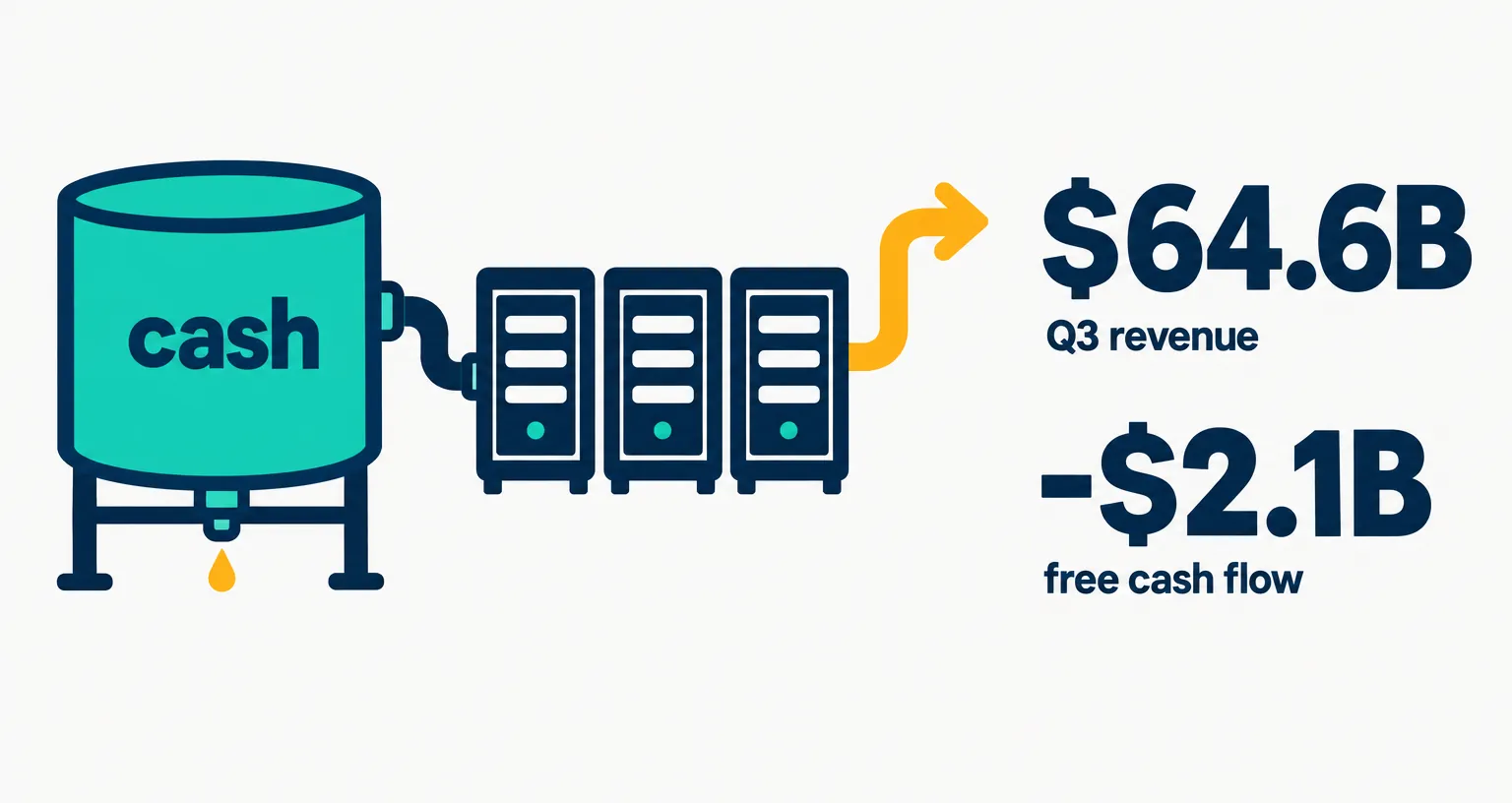
Meta reported record revenue of $64.60 billion for the third quarter of 2026 on October 21, up 26% from a year earlier, and negative free cash flow of $2.12 billion. Operating cash flow was $32.79 billion; capital expenditures were $34.91 billion. The AI build-out now costs more than the business throws off in cash.
On the call, Mark Zuckerberg spent most of his time on Muse, Meta’s personal AI agent: more than 10 million people in the US and Canada set one up in about six weeks. The release opens with his framing: “Our investments are paying off, the core business is strong, and we’re seeing velocity across the board.”
 Meta’s revenue for the third quarter of 2026 was a record $64.60 billion, up 26% year over year.
 Capital expenditures of $34.91 billion outran $32.79 billion of operating cash flow, leaving free cash flow at negative $2.12 billion.
 Costs include a $9.89 billion charge for Meta’s agreement with 52 state attorneys general; excluding it, diluted EPS would have been $7.40.
 Zuckerberg said more than 10 million people in the US and Canada set up Muse agents in about six weeks, with shopping the top use.
 Meta narrowed 2026 capex to $135 billion to $145 billion and gave no 2027 number yet.
§ 01The quarter in numbers
| Item | Q3 2026 | Q3 2025 |
|---|---|---|
| Revenue | $64.60B | $51.24B |
| Costs and expenses | $51.61B | $30.71B |
| Operating margin | 20% | 40% |
| Diluted EPS | $3.83 | $1.05 |
| Capital expenditures | $34.91B | |
| Operating cash flow | $32.79B | |
| Free cash flow | Negative $2.12B | |
| Headcount | 66,775 (down 15%) |

Two things pulled the margin from 40% to 20%. Costs include a $9.89 billion charge for Meta’s agreement with 52 state attorneys general over teen mental health litigation; excluding it, Meta says diluted EPS would have been $7.40. The rest is spending on AI infrastructure. Ad impressions rose 10% and the average price per ad rose 14%, so the ad machine itself kept growing.
§ 02The spending outlook
The release narrows 2026 capital expenditures to $135 billion to $145 billion, from $130 billion to $145 billion, and raises full-year expenses to $175 billion to $179 billion to include the legal charge. Fourth-quarter revenue is guided at $73 billion to $76 billion.
For 2027 there is no number yet. Meta says it is “still developing our budget and capacity plans for next year,” but expects “to continue investing aggressively to support both our core business and emerging AI initiatives.”
§ 03What Zuckerberg said about Muse
From the call, as summarized by MarketBeat and Fortune:
- Adoption: more than 10 million people in the US and Canada set up Muse agents in roughly six weeks, and about 25% of them use it on a given day.
- Use: shopping is the most common use case, with an average purchase above $200, including travel.
- Money: Meta plans future revenue from commerce fees, subscriptions, APIs and business services,.
The release names the milestones Zuckerberg counts: “launching Muse and Muse Wonder, our first frontier model.” Our records cover both: what Muse is and Muse Wonder’s price and benchmarks.
§ 04What it means
Meta is the clearest case so far of a company paying for AI agents out of an ad business: revenue grew 26%, and capital spending still outran operating cash. The Muse numbers are the first adoption figures Meta has given for a personal agent, and shopping leading the use cases matches the fight we recorded when Amazon blocked Muse from shopping.
Meta also announced a new class of non-voting Class C stock, distributed in an effective two-for-one split expected to begin trading in late January 2027.
§ 05Sources
- Meta, Meta Reports Third Quarter 2026 Results, October 21, 2026.
- Meta, investor events (call webcast).
- MarketBeat, Meta Q3 earnings call highlights, October 21, 2026.
- Fortune, Meta Q3 earnings coverage, October 21, 2026.
Q1What was Meta's free cash flow in Q3 2026?
Negative $2.12 billion: operating cash flow of $32.79 billion against capital expenditures of $34.91 billion.
Q2What is Meta's 2026 capex guidance?
$135 billion to $145 billion including principal payments on finance leases, narrowed from $130 billion to $145 billion.
Q3Why did Meta's operating margin fall to 20%?
Costs rose 68% to $51.61 billion, including a $9.89 billion legal charge and higher AI infrastructure spending; the margin was 40% a year earlier.
Q4What did Meta say about 2027 spending?
No number yet. Meta said it is still developing next year’s budget and capacity plans and expects to keep investing aggressively in its core business and AI.
Q5How does Meta plan to make money from Muse?
On the call Meta named commerce fees, subscriptions, APIs and business services as future revenue sources.