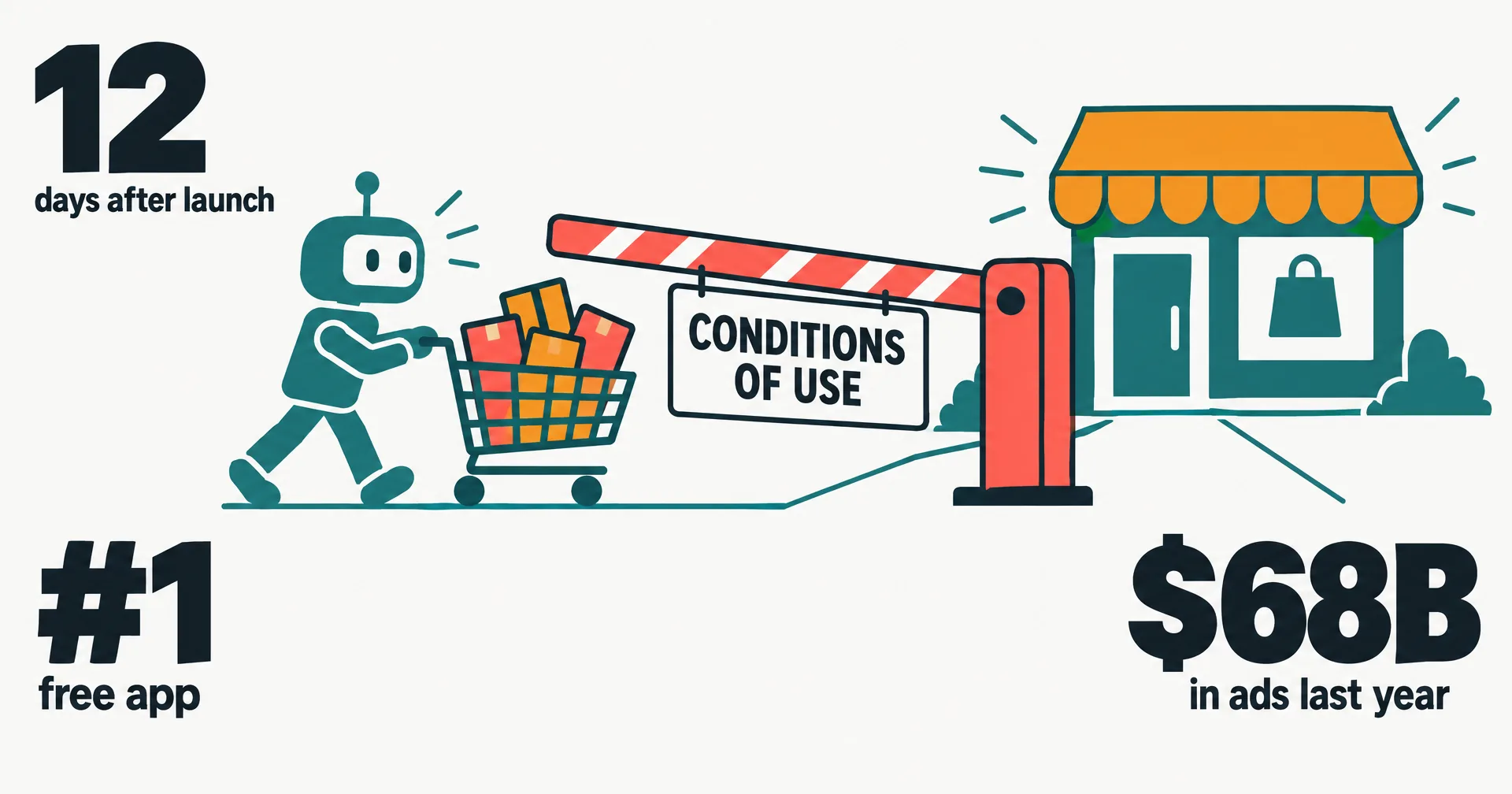
Twelve days after Meta launched Muse, and three days after Muse became the most downloaded free app in the United States, the biggest store on the internet put a gate in front of it. The record below is dated to the minute where a primary allows it: what Amazon said, what Meta has not, what the court decided in August, and what Amazon’s own terms have said about agents since 2025.
On this page · 10 sectionsOpen
- What happened Sunday night
- What Meta has said, which is what it said on September 8
- The court, and why the popup cites terms
- The terms were already written
- The house agent and the visiting agent
- The headlines, graded
- What this means if you sell online, or run an agent
- What we are watching for
- The record
- Sources
 As of Sunday night, September 20, 2026, people asking Meta’s Muse to shop on Amazon.com see a popup: ‘Continued access by an unauthorized AI agent violates Amazon’s Conditions of Use, to which our customers have agreed.’ GeekWire reported it at 11:05 PM Pacific with an Amazon statement; The Verge and PCMag followed Monday morning. Meta had not responded to any of the three by 13:30 UTC.
 Amazon’s three objections, in its own words to GeekWire: Meta did not tell Amazon that Muse would access its store; the agent does not identify itself when it browses; and ‘it appears to capture and store customer credentials’. Amazon says it asked Meta to exclude Amazon voluntarily first, is ‘in direct conversation with Meta’, and declined to say whether it would sue.
 Meta has said nothing new. Its September 8 launch post, which never names Amazon, is the only Meta text in play: Muse ‘can open a browser, fill out forms, and negotiate on their behalf’, a Sentinel approves everything it sends, and ‘Muse has no visibility into people’s passwords or payment methods’. Amazon’s objection is not that Muse sees the password; it is that Muse walks in with it, unannounced.
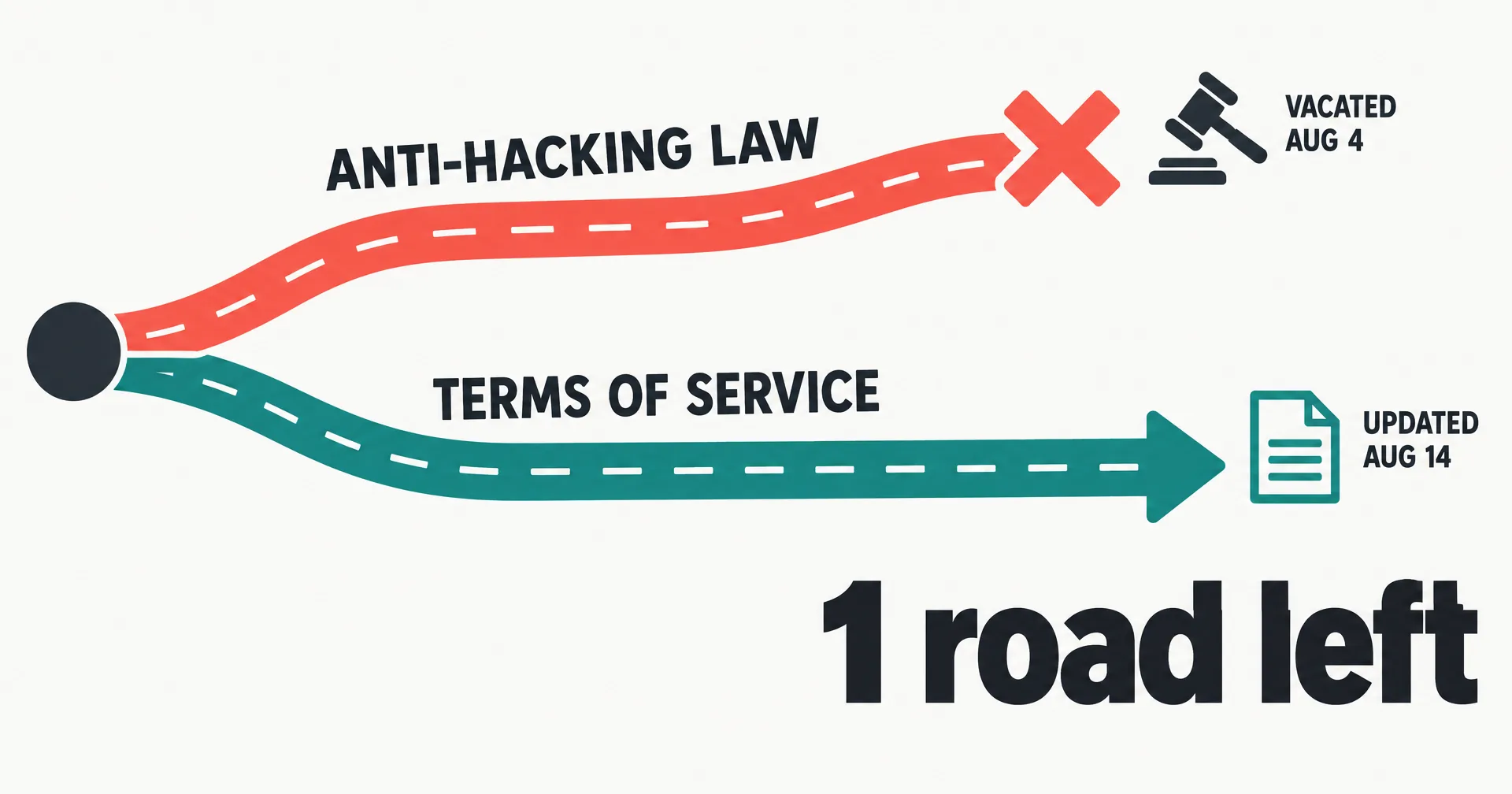
 The popup cites terms, not hacking law, and the reason is dated August 4, 2026. That day the Ninth Circuit vacated Amazon’s injunction against Perplexity’s Comet browser: ‘the user (not Perplexity) accessed Amazon using the Assistant as an AI tool’, so the anti-hacking statutes did not reach the agent. The opinion left one door open in a footnote: Amazon’s ‘ability to regulate access to Amazon.com via private terms of service for its users’. Rehearing was denied September 10.
 The terms were ready. Amazon’s Conditions of Use carry an Agent Terms section, present in a December 2025 archived copy dated May 30, 2025: an agent must identify itself in every request with ‘Agent/[agent name]’ in its user-agent string, must not mimic human keystrokes or pass CAPTCHAs, and may not access Amazon at all ‘if we have requested that the Agent refrain’. The page now reads ‘Last updated: August 14, 2026’, ten days after the ruling.
 Amazon’s own agent is the yardstick it is holding Muse to. Buy for Me, launched April 2025, buys from other brands’ sites and, per Amazon, ‘identifies itself and lets brands opt out’; Rufus became Alexa for Shopping on May 13, 2026. Amazon’s analogy is delivery apps and travel agents, which buy for customers with the merchant’s agreement. Meta’s counter, never stated, is the court’s: a browser the user drives is the user.
 Three days before the block, Meta opened muse.ai/platform so businesses could bring their own connector to Muse: describe your service, Meta reviews, appear in the directory. That is the front door. Amazon has just shown what happens at the back door, and every business that sells online now has the same choice to make before an agent makes it for them.
§ 01What happened Sunday night
GeekWire’s Todd Bishop published at 11:05 PM Pacific on September 20 (06:05 UTC September 21) that Amazon has cut Muse off from shopping on Amazon.com on customers’ behalf, “after attempting unsuccessfully to get the Facebook parent company to voluntarily exclude the e-commerce site from the experience”. People asking Muse to shop on Amazon now see a popup: “Continued access by an unauthorized AI agent violates Amazon’s Conditions of Use, to which our customers have agreed.”
Amazon’s spokesperson gave GeekWire two sentences. “We think it’s fairly straightforward that third-party applications that offer to make purchases on behalf of customers from other businesses should operate openly and respect service provider decisions about whether or not to participate.” And: “Agentic third-party applications such as Muse have the same obligations, and we’ve requested that Meta remove Amazon from the experience.” Amazon added that “it is in direct conversation with Meta about the issue”; “Asked whether it would consider taking legal action, the company declined to comment”.
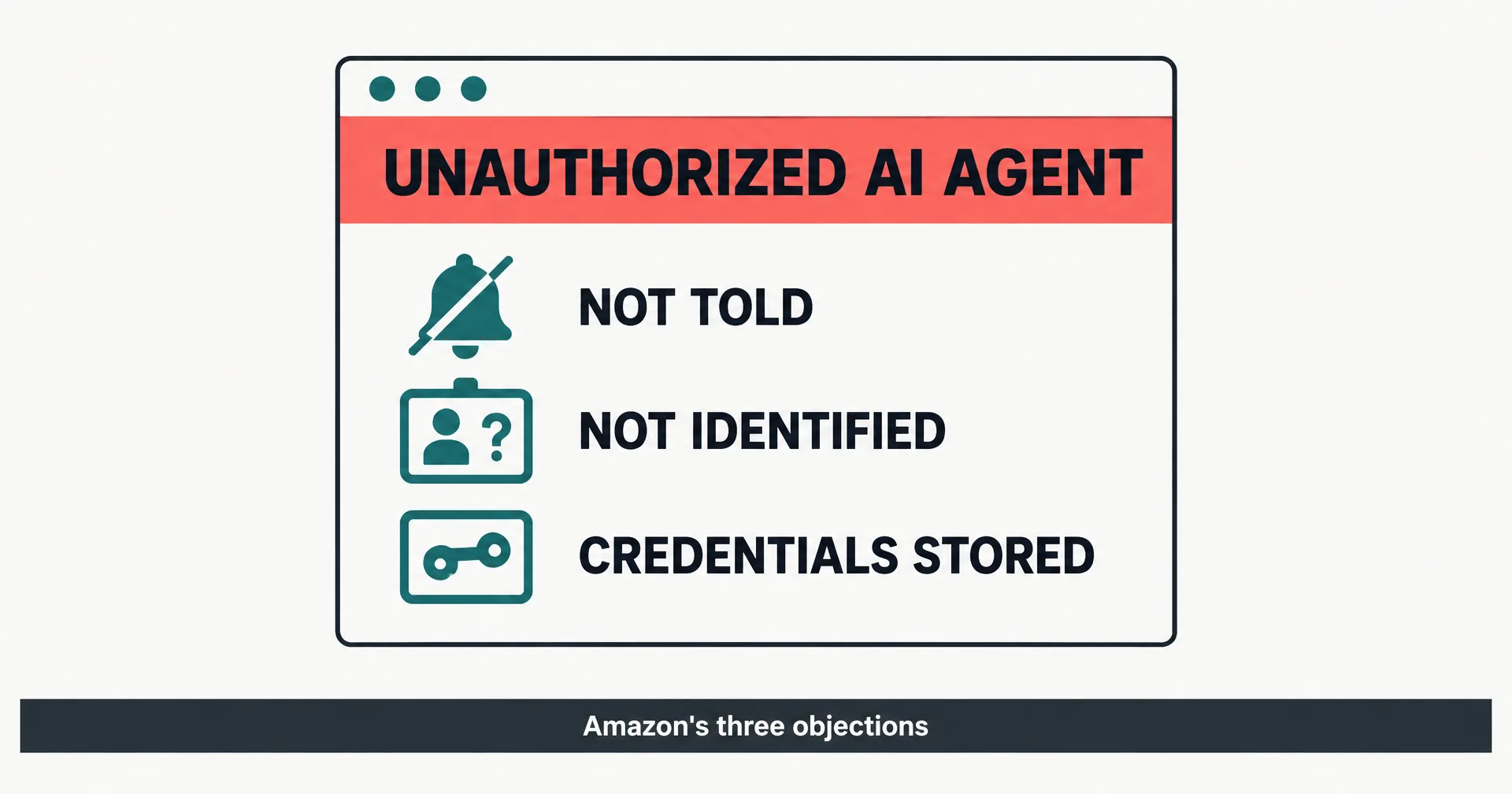
Amazon’s complaint has three parts, all from the GeekWire account. Meta “didn’t tell Amazon that Muse would access its store”. The agent “doesn’t identify itself when it browses”. And “it appears to capture and store customer credentials”, which Amazon says could create privacy and security risks; Muse can reach account pages and order history if a customer asks, which Amazon reads as an undisclosed third party moving through customer accounts. The two companies are not strangers: “Amazon products have been purchasable inside Facebook and Instagram since 2023”, and “Meta signed a multibillion-dollar deal in April to run agentic AI workloads on Amazon’s cloud”.
| When | What | Source |
|---|---|---|
| Sep 8, 19:00 | Meta launches Muse; the post never names Amazon | about.fb.com, article:published_time |
| Sep 18 | Muse is the number one free iPhone app in the US; Meta opens muse.ai/platform to developers at 23:03 | Our records |
| Sep 20, Sunday night PT | Amazon’s popup appears for Muse users on Amazon.com | GeekWire, Amazon image |
| Sep 21, 06:05 | GeekWire publishes with Amazon’s statement; Meta “did not immediately respond” | GeekWire, page stamp 11:05 PM PT |
| Sep 21, 07:04 | GeekWire updates the piece | GeekWire, page stamp 12:04 AM PT |
| Sep 21, 09:21 | The Verge: “We have reached out to Meta for comment” | The Verge |
| Sep 21, morning | PCMag: “Meta has yet to respond to PCMag’s request for comment” | PCMag |
| Sep 21, 13:30 | No Meta statement found on its newsroom, on X, or in any outlet | Read in Chrome |
§ 02What Meta has said, which is what it said on September 8
Meta has not answered GeekWire, The Verge or PCMag, and its newsroom and executives’ X accounts carried nothing on Amazon by 13:30 UTC. The only Meta text that speaks to the dispute is the launch post of September 8, and it reads differently now. Muse “can open a browser, fill out forms, and negotiate on their behalf”. A Sentinel agent runs beside it: “Nothing Muse does reaches the internet unless the Sentinel approves it”. And on credentials: “Muse has no visibility into people’s passwords or payment methods”, they go into secure storage so Muse can use them without seeing them, and at checkout Link’s wallet “generates a one-time-use card so your real card details stay hidden”.
Read against Amazon’s three objections, the launch post answers a different question. Meta’s design is about what the agent can see; Amazon’s objection is about what the store can see. A vault the agent cannot read still opens the account, and a browser that behaves like a person is the thing Amazon’s terms forbid.
§ 03The court, and why the popup cites terms
The wording of the popup is a legal choice, and its date is August 4, 2026. That is when the Ninth Circuit, in Amazon.com Services v. Perplexity AI (No. 26-1444), vacated the preliminary injunction Amazon had won in March against Perplexity’s Comet browser. Amazon had sued in November 2025 under the Computer Fraud and Abuse Act and California’s analogue. The panel’s summary is one sentence: “the user (not Perplexity) accessed Amazon using the Assistant as an AI tool”. Reading the statute Amazon’s way, the court said, “would transform the CFAA from an anti -hacking statute into an expansive misappropriation statute”. Rehearing was denied September 10.
The opinion also said what it was not deciding. Footnote five: “This outcome does not impair Amazon’s ability to regulate access to Amazon.com via private terms of service for its users.” Six weeks later the popup does not accuse anyone of hacking. It says the customer agreed to the Conditions of Use, and the Conditions of Use are where Amazon’s rule for agents lives.
| Date | Event | Source |
|---|---|---|
| Nov 4, 2025 | Amazon sues Perplexity over Comet under the CFAA and CDAFA, N.D. Cal. 3:25-cv-09514 | Court file |
| Mar 2026 | District court grants Amazon a preliminary injunction | Ninth Circuit opinion |
| Aug 4, 2026 | Ninth Circuit vacates: the user, not Perplexity, accessed Amazon; terms of service unaffected | Ninth Circuit opinion |
| Aug 14, 2026 | Amazon’s Conditions of Use page carries its current Last updated date | amazon.com, read in Chrome |
| Sep 8, 2026 | Muse launches, browsing services “the way you would” | Meta |
| Sep 10, 2026 | Ninth Circuit denies Amazon’s petition for rehearing | GeekWire |
| Sep 18, 2026 | Muse reaches number one; Meta opens the connector platform | Our records |
| Sep 20, 2026 | Amazon’s popup appears for Muse users | GeekWire |
§ 04The terms were already written
Amazon did not write a rule for Muse this week. Its Conditions of Use carry a section titled Agent Terms, and an archived copy of the page from December 2025, itself stamped “Last updated: May 30, 2025”, already contains it word for word. The core: “No Agent may access, use, or interact with Amazon Services unless, at all times, it identifies itself” and follows the technical requirements, and “no Agent may access, use, or interact with Amazon Services if we have requested that the Agent refrain”. The technical requirements are specific. In every request an agent must “identify that the request is from an Agent and disclose the name of the Agent” with an Agent/[agent name] user-agent string; it must not conceal what it is, including by “mimicking the speed or pattern of human keystrokes” or completing CAPTCHAs; it must answer truthfully when asked whether it is a computer; and it must not circumvent measures Amazon uses to control agents.
The live page reads “Last updated: August 14, 2026”, ten days after the appeals court pointed at terms as Amazon’s remaining road. We compared the Agent Terms in the two versions and found no change in that section; what did change on August 14 is not marked on the page. The older license clause is also there, unchanged since long before agents: no “use of data mining, robots, or similar data gathering and extraction tools”.
| Amazon’s rule | Amazon’s account of Muse |
|---|---|
| Identify as an agent in every request, Agent/[name] in the user-agent string | “doesn’t identify itself when it browses” |
| Stop when Amazon asks the agent to refrain | Amazon asked Meta to exclude Amazon voluntarily; the popup followed |
| Do not mimic human speed or patterns, do not pass CAPTCHAs | Muse’s launch post: it uses a service “through a browser the way you would” |
| Operate openly, like delivery apps and travel agencies do with merchants | Amazon: Meta did not tell Amazon the store was in scope |
§ 05The house agent and the visiting agent
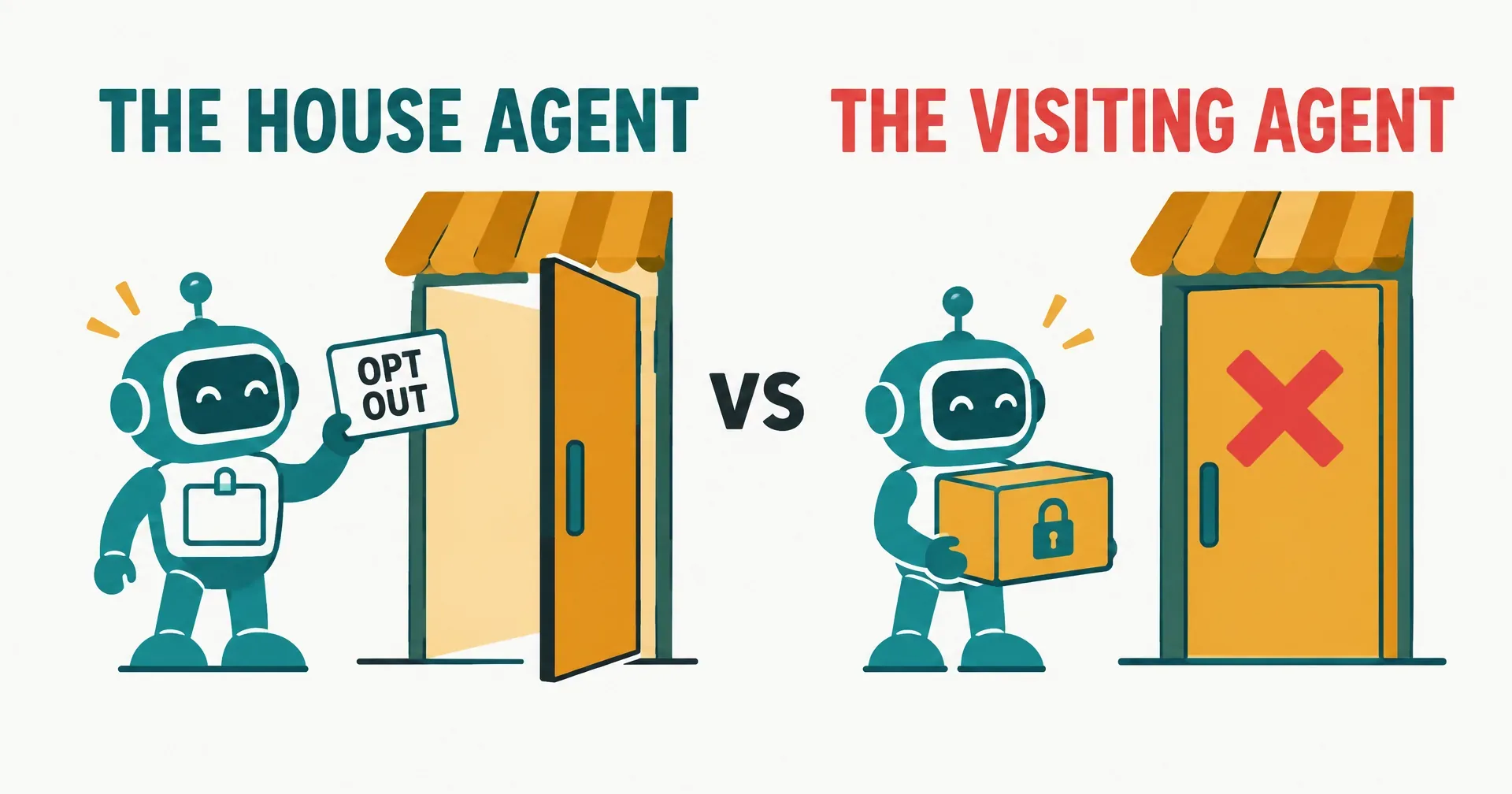
Amazon has agents of its own, and they are the yardstick in its statement. Buy for Me, launched in April 2025, buys products from other brands’ sites when Amazon does not sell them; Amazon says the number of products available through it “increased from 65K at launch to over half a million presently”, and, in GeekWire’s account, points out that “Buy for Me identifies itself and lets brands opt out”. Rufus, its shopping assistant, was renamed: “On May 13, 2026, Rufus was renamed Alexa for Shopping”.
| Date | Products available through Buy for Me |
|---|---|
| Apr 2025 (launch) | 65,000 |
| Nov 2025 | more than 500,000 |
So the test Amazon is applying is one it says it passes itself: say what you are, and take no for an answer. The picture is not symmetrical, and GeekWire says why: Amazon “generated more than $68 billion in ad revenue last year”, a business that depends on people seeing sponsored products while they browse. An agent that browses for them does not see ads. Meta’s unstated reply is the court’s: a browser the user drives is the user. Amazon’s reply to that is the contract the user clicked.
§ 06The headlines, graded
| Claim | Status |
|---|---|
| Amazon blocked Muse from Amazon.com | Confirmed by Amazon’s statement and popup, via GeekWire; The Verge and PCMag carry the same statement |
| Amazon is suing Meta | Not stated. Amazon declined to comment on legal action and said it is in direct conversation with Meta |
| Muse stores Amazon passwords | Amazon says it “appears to capture and store customer credentials”; Meta’s launch post says Muse cannot see them and they sit in secure storage. Both can be true |
| This is illegal under hacking law | The Ninth Circuit said the opposite on August 4 for Perplexity’s agent; the popup cites contract terms instead |
| Amazon wrote new rules to stop Muse | The Agent Terms predate Muse by more than a year; the page’s August 14 date is unexplained |
| Meta refused to comply | Meta has said nothing; Amazon says it asked and the popup followed |
| Amazon bans all AI agents | Its terms admit agents that identify themselves and stop when asked; its own Buy for Me identifies itself |
§ 07What this means if you sell online, or run an agent
Amazon’s move is the first time a store of this size has enforced an agent rule against the most popular agent in the country, and it did it with a popup, not a filing. Two things follow for everyone smaller. First, the rule Amazon wrote is the rule that will spread: identify yourself, use the door the business opened, stop when asked. It costs an agent nothing to follow and it is the only defensible position once a court has said the user, not the vendor, is the one at the keyboard. Second, the door matters more than the rule. Three days earlier Meta opened muse.ai/platform so a business can bring its own connector to Muse and be reviewed and listed; that is the front door, and a business that builds it decides how the agent arrives. A business that does not build it gets the browser, and a business large enough gets to say no to the browser.
For an AI employee the consent question runs the other way. It works on its own employer’s accounts, with tools the owner granted, so the store it shops at is its own; where it reaches another company’s service, Amazon’s three rules are the right rules for it too. What Amazon is asking of visiting agents is what an owner already gets from an employee: it says what it is, it uses the access it was given, and every command that reaches the world passes a rail the owner controls.
§ 08What we are watching for
- Meta’s first statement, and whether it argues the user-is-the-user line from the Perplexity ruling or removes Amazon from Muse.
- Whether Amazon files anything, and under which theory; footnote five points at contract.
- A change to Muse’s browser behavior: an agent user-agent string, or a Muse connector on muse.ai/platform submitted by Amazon itself.
- Other large retailers copying the popup, and whether Shopify’s promised Shop Pay integration for Muse moves the other way.
- Amazon’s Conditions of Use page date, and any diff to the Agent Terms.
§ 09The record
As of September 21, 2026, 13:40 UTC: page opened. GeekWire’s page stamps read “Sep 20, 2026 at 11:05 pm” and “September 21, 2026 at 12:04 am” Pacific; its X posts are id-clocked at 06:05:46 and 06:11:35 UTC. The Verge’s page carries “Sep 21, 2026, 9:21 AM UTC”. Amazon’s Conditions of Use were read in Chrome at 13:31 UTC (Last updated: August 14, 2026) and compared with the Wayback Machine capture of December 6, 2025 (Last updated: May 30, 2025). Meta’s launch post was read in Chrome at 13:31 UTC; the word Amazon does not appear on it. The Ninth Circuit opinion was read from the court’s PDF. No Meta statement existed in any primary we could reach.
§ 10Sources
- Todd Bishop, GeekWire, Amazon blocks Meta’s Muse AI assistant in new standoff over agentic shopping, September 20, 2026, 11:05 PM Pacific; read September 21, 2026.
- Ninth Circuit, Amazon.com Services, LLC v. Perplexity AI, Inc., No. 26-1444, opinion filed August 4, 2026; read September 21, 2026.
- Amazon, Conditions of Use, last updated August 14, 2026, and the Wayback Machine capture of December 6, 2025; both read September 21, 2026.
- Meta, Introducing Muse, September 8, 2026; read September 21, 2026.
- Amazon, How Amazon is using generative and agentic AI to transform the shopping experience, and Buy for Me, April 3, 2025; read September 21, 2026.
- Jess Weatherbed, The Verge, Amazon doesn’t trust Meta’s Muse AI agent, September 21, 2026; read September 21, 2026.
- Our own records: Muse Connector Platform, September 18, 2026; What is Muse, September 8, 2026.
Q1Is Muse blocked from Amazon entirely, or only from buying?
Amazon’s statement to GeekWire is about shopping on customers’ behalf, and the popup appears when Muse tries to use the store. Amazon also says Muse can reach account pages and order history if a customer asks it to, which it frames as an undisclosed third party moving through accounts. Whether Amazon’s block distinguishes browsing from checkout is not stated in any primary we read; Amazon says the two companies are in direct conversation.
Q2Did Meta break Amazon's rules?
Amazon’s terms say an agent must identify itself as an agent in every request and must not access Amazon once asked to stop. Amazon says Muse does neither and that Meta was asked to exclude Amazon. Meta’s position on the rules has not been published; its launch materials describe Muse using services through a browser the way a person would, and the Ninth Circuit accepted a version of that argument for Perplexity under the anti-hacking statutes, while noting that contract terms are a different question. Who is right under the contract has not been tested in any court we can find.
Q3How does this differ from the Amazon v. Perplexity case?
Perplexity was sued under the Computer Fraud and Abuse Act and California’s analogue in November 2025; Amazon won a preliminary injunction in March 2026 and lost it on August 4 when the Ninth Circuit ruled that the user, not Perplexity, was the one accessing Amazon. The court denied rehearing on September 10. The Muse popup does not allege hacking; it cites the Conditions of Use, the path the appeals court said remained available.
Q4What is a business supposed to do about agents shopping on its site?
Decide which door they come through. Amazon’s answer is a published rule, an identification requirement, a block for agents that ignore both, and its own agent that identifies itself and lets brands opt out. Meta’s answer for businesses is the connector platform it opened on September 18: bring your API, Meta reviews it, the agent arrives through a door you built. The browser-as-a-human path is the one that leaves the business with no say, and Amazon has just shown that a large enough business will say no anyway.
Q5What does this mean for AI employees?
An AI employee works for a business on that business’s own accounts, granted by its owner, so the consent question Amazon is raising does not arise the same way; the tools it reaches are the ones it was hired with. Where an AI employee reaches another company’s service, the same rule Amazon wrote applies to it: identify yourself, use the door the other side opened, respect a no. On CellCog every command an employee runs is classified before it runs and the owner sets the line it may not cross alone, which is the same discipline applied from the agent’s side.