Microsoft AI published its diagnostic orchestrator, MAI-DxO, in the journal Science on October 22, 2026. The system works a medical case the way a physician does: it asks questions, orders tests and only then commits to a diagnosis, and Microsoft reports it beat practising physicians on both accuracy and, in some settings, cost.
Mustafa Suleyman, who leads Microsoft AI, put the headline on X: “Our MAI Diagnostic system is now 1.7x more accurate than physicians in the ED, even when they have access to the web to look things up.” This page reads the AAAS release on the paper and the authors’ version of the paper, and separates what was measured from what was claimed.
On this page · 7 sectionsOpen
 Microsoft AI’s diagnostic orchestrator, MAI-DxO, was published in Science on October 22, 2026, tested on 304 hard NEJM teaching cases and 325 emergency department admissions.
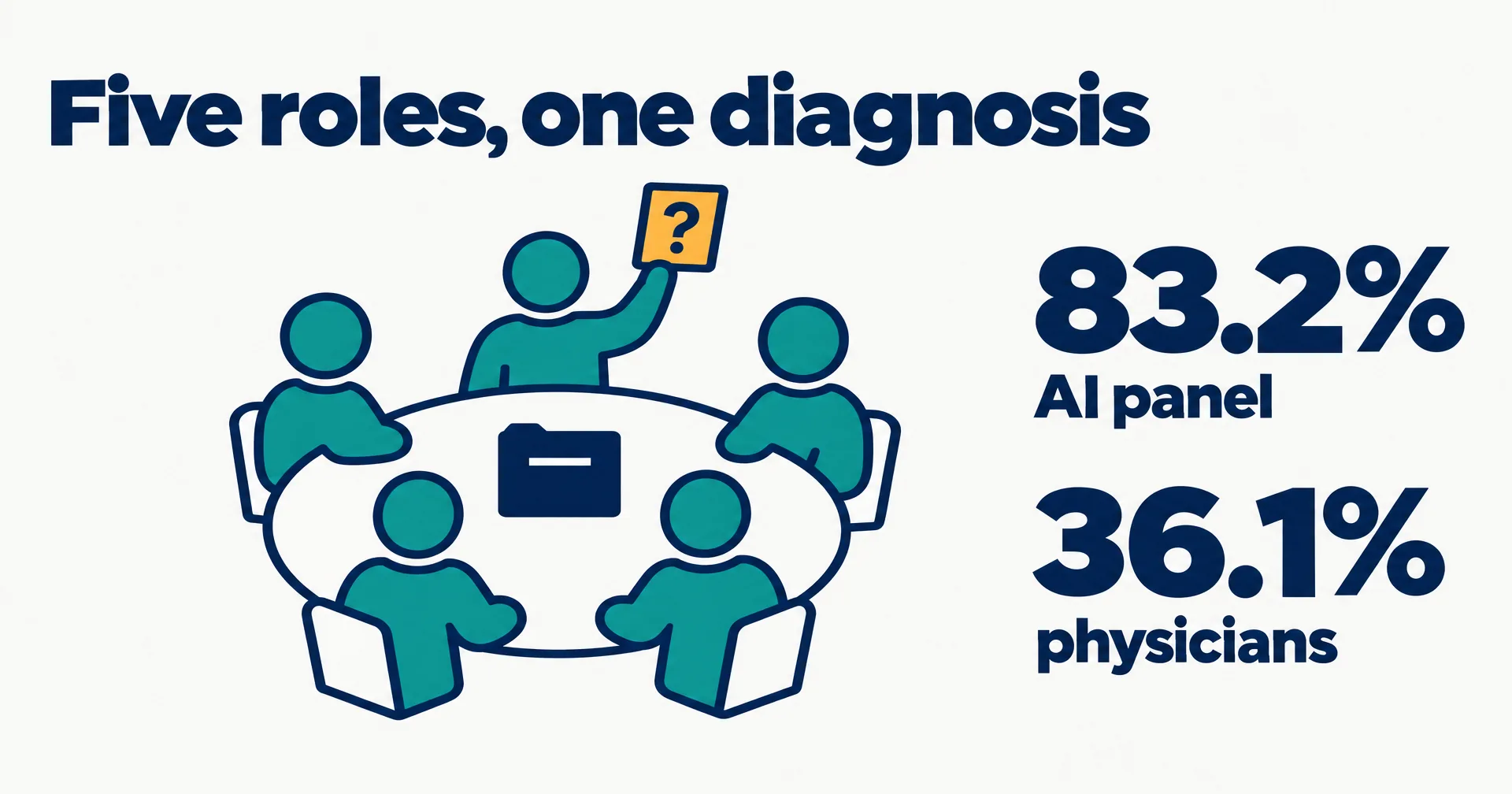
 Running on GPT-5, it reached 83.2% accuracy on the NEJM cases, against 36.1% for physicians who could use reference tools and 22.3% for physicians without them.
 On emergency cases it reached 80.3% against 46.79% for physicians, the 1.7x figure Mustafa Suleyman posted, but at about $4,980 a case versus $3,400 for the doctors.
 The system is one model playing five roles in a virtual panel: a hypothesis keeper, a test chooser, a devil’s advocate, a cost steward and a checklist.
 It is a text-only benchmark, not a clinical trial; the authors say real-world testing and patient outcomes are still needed.
§ 01How the test works
The authors built the Sequential Diagnosis Benchmark from 629 cases: 304 clinicopathological conference cases from the New England Journal of Medicine, which are rare and hard teaching cases, and 325 emergency department admissions from the MIMIC-IV-ED dataset. A physician or an AI starts with a short case summary and must ask for history, exam findings or tests one step at a time. A separate language model, the Gatekeeper, answers from the case record, and every test carries an estimated price.
That set-up matters for the numbers. Accuracy is scored per case, and cost is the estimated price of every test ordered on the way to the answer, so a system can buy accuracy by ordering more.
§ 02The results
| Cohort | Who | Accuracy | Estimated cost per case |
|---|---|---|---|
| 304 NEJM cases | Physicians, no reference tools | 22.3% | $3,049 |
| 304 NEJM cases | Physicians, with reference tools | 36.1% | $4,725 |
| 304 NEJM cases | Best single physician | 51.8% | Not stated |
| 304 NEJM cases | GPT-5 on its own | 78.9% | $8,409 |
| 304 NEJM cases | MAI-DxO, GPT-5 | 83.2% | $5,430 |
| 304 NEJM cases | MAI-DxO, ensemble | 84.5% | $8,945 |
| 325 emergency cases | Physicians | 46.79% | $3,400 |
| 325 emergency cases | GPT-5 on its own | 76.6% | Not stated |
| 325 emergency cases | MAI-DxO, GPT-5, no budget | 80.3% | $4,980 |
The 1.7x in Suleyman’s post is the emergency cohort: 80.3% against 46.79%. On the NEJM cases the gap is wider, about 2.3x against physicians with reference tools (our arithmetic). Depending on the budget it was given, the orchestrator ranged from 79.6% accuracy at $1,303 a case to 84.5% at $8,945, per the AAAS release.
Cost is where the headline needs care. On the NEJM cases the GPT-5 orchestrator was both more accurate and cheaper than the physicians’ $4,725. On the emergency cases, the unconstrained run cost about $4,980 a case, more than the physicians’ $3,400; the cheaper settings gave up some accuracy.
§ 03Five roles, one model
MAI-DxO is not a new model. It is one model prompted to act as a panel of five physician roles that argue over the case before each step, which the paper calls a Chain of Debate.

| Role | Job |
|---|---|
| Dr. Hypothesis | Keeps the three most likely diagnoses and updates their odds after each finding |
| Dr. Test-Chooser | Picks up to three tests per round that best separate the leading diagnoses |
| Dr. Challenger | Plays devil’s advocate, looks for anchoring bias and tests that could disprove the leader |
| Dr. Stewardship | Pushes for cheaper equivalent tests and vetoes low-yield expensive ones |
| Dr. Checklist | Checks test names and keeps the panel’s reasoning consistent |
The design is the transferable part. A single GPT-5 call reached 78.9% on the NEJM cases at $8,409; the same model, made to argue with itself through these roles, reached 83.2% at $5,430. The paper reports gains from the panel across models from several labs, not only OpenAI’s.
§ 04What it does not show
The authors are direct about the limits. In the release, “the authors argue that further evaluation is needed to establish its effectiveness in real-world clinical practice and its impact on patient outcomes.” The cases are text only, with no physical exam, imaging or pathology slides, and the paper notes: “We note again that NEJM-CPC cases are difficult cases, selected for subspecialty interest and instructional potential”.
- Costs are standardized estimates, not real bills.
- The Gatekeeper can generate plausible findings for tests the case record does not describe.
- The comparison is with individual generalists, not specialist teams.
- The study measures diagnosis, not treatment or outcomes.
§ 05Why a role panel matters beyond medicine
The finding that one model gets more accurate when it is split into roles that challenge each other is not specific to medicine. We build AI employees and run a mode, Agent Team, where several agents check each other’s findings before an answer goes out, so the result is close to our own work. Nothing here makes CellCog a medical tool, and it is not one.
§ 06Update log
- October 22, 2026: page opened from the Science publication, the AAAS release and the authors’ paper.
- October 22, 2026: explainer scene added.
§ 07Sources
- AAAS release on the Science paper, October 22, 2026: eurekalert.org
- Nori et al., Sequential Diagnosis with Language Models, authors’ version: erichorvitz.com
- Earlier preprint, June 2025: arXiv 2506.22405
- Mustafa Suleyman, post on X, October 22, 2026
Q1What is MAI-DxO?
Microsoft AI’s Diagnostic Orchestrator: one language model prompted to act as a panel of five physician roles that debate a case, choose tests and decide when they are sure enough to answer.
Q2Where does the 1.7x claim come from?
The emergency department cohort: 80.3% accuracy for the orchestrator against 46.79% for physicians, a ratio of about 1.7. On the NEJM cases the gap is about 2.3x against physicians with reference tools.
Q3Can hospitals use it now?
Microsoft has not announced a clinical product from this paper. The study is a benchmark on written cases; the authors call for real-world evaluation and outcome data first.
Q4Which model did it run on?
The headline results use OpenAI’s GPT-5. The paper also tests the orchestrator on models from Anthropic, Google, Meta, DeepSeek and others, and reports gains across them.
Q5What are the main limits?
Cases are text only, with no physical exam, imaging or pathology slides; the NEJM cases are rare teaching cases; costs are estimates; and an AI gatekeeper can fill in plausible findings the source records lack.