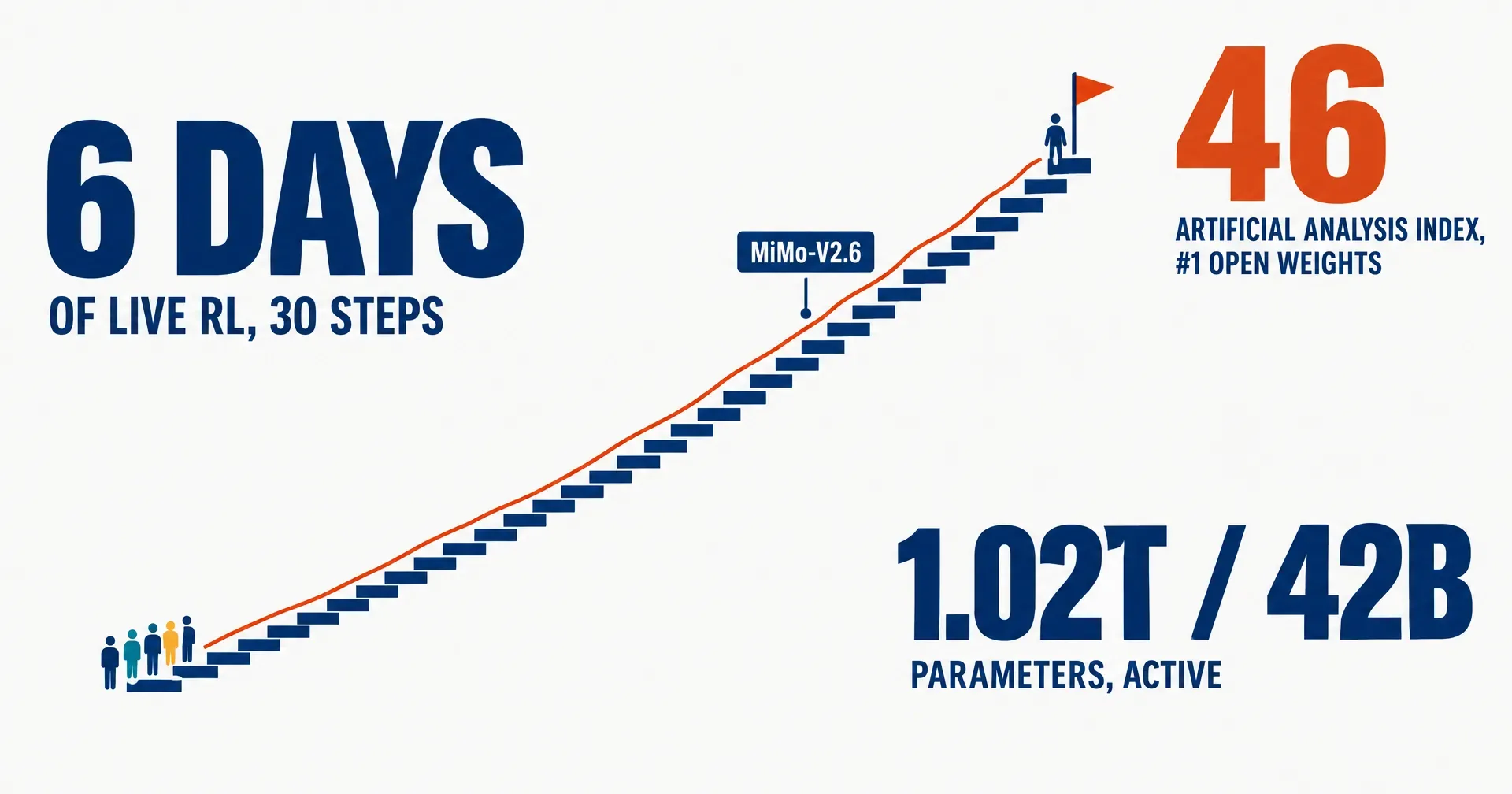
Xiaomi released and open-sourced MiMo-V2.6 on September 21, 2026, and the number that matters is 46. That is the score Artificial Analysis gives MiMo-V2.6-Pro on its Intelligence Index, a 1.02-trillion-parameter mixture of experts with 42B active parameters, which puts it first among the 114 open-weight models the index tracks, level with Grok 4.7, and seven points behind Claude Fable 5.1 and GPT-6 Astra. The price did not move: Pro stays at $0.435 per million input tokens and $0.87 per million output tokens, the V2.5 rate. Xiaomi’s launch is unusual in a second way. The reinforcement-learning run that produced the models ran in public over six days, and the company shipped the technical report, more than 7,000 RL environments and the training framework with the weights, under MIT. This is the record of what Xiaomi published, what it measured, and what still has to be checked by someone else. Times are UTC.
On this page · 10 sectionsOpen
 Xiaomi released and open-sourced the MiMo-V2.6 series on September 21, 2026: the Hugging Face repositories were created at 15:39 UTC, the API rows appeared on OpenRouter at 20:07 UTC and the announcement thread on X went out at 20:51 UTC. Three models: Pro, Flash and a 9B distillation, all under MIT.
 The spec, from the model cards: MiMo-V2.6-Pro is a sparse mixture of experts with 1.02T total parameters and 42B active per token (4.1%); Flash is 309B total with 15B active (4.9%). Both take text, image, video and audio in, run a 1M-token context, and ship a five-layer speculative decoder.
 Artificial Analysis scores MiMo-V2.6-Pro 46 on its Intelligence Index, first of 114 models in its open-weights class, level with Grok 4.7 and one point above GLM-5.3, two above Kimi K3. Claude Fable 5.1 and GPT-6 Astra sit at 53, seven points ahead. Xiaomi’s own page says the same in one sentence.
 The price did not move. On Xiaomi’s own endpoint, Pro costs $0.435 per million input tokens and $0.87 per million output tokens, Flash $0.14 and $0.28, the V2.5 rates. A Pro UltraSpeed variant costs ten times Pro. On output, Pro is about 3.1 times cheaper than Step 5 Preview and about 29 times cheaper than Claude Opus 5.
 The training run happened in public: in under six days, Pro and Flash each completed 30 reinforcement-learning steps, about 750,000 trajectories in total, at costs Xiaomi puts at $2.62 million for Pro and $850,000 for Flash. Each step used 1,568 prompts; the MoE router was frozen to keep it stable.
 Xiaomi’s own table puts Pro on par with Claude Opus 5 and GPT-5.6 Sol on most agent rows and behind on the hardest ones: DeepSWE v1.1 71.9 (Opus 5 74.0), AutomationBench 53.1 (Opus 5 50.3), Terminal Bench 4.0 34.9 (Opus 5 49.0), ExploitBench 47.9 (Sol 78.5). Every number in that table is Xiaomi’s.
 What is open: weights, a 44-page technical report, more than 7,000 RL task environments, the RL framework and the harnesses. What is not yet: an independent reproduction of the benchmark table, a third-party host other than OpenRouter and Vercel, and any word on a V2.6 base checkpoint. This record updates as they land.
§ 01What Xiaomi shipped
The news page opens plainly: “Today, we are officially releasing and open-sourcing the Xiaomi MiMo-V2.6 series.” The Hugging Face repositories were created at 15:39 UTC on September 21, the OpenRouter rows at 20:07 UTC, and the X thread at 20:51:03 UTC, after a gallery teaser at 17:52.
| Item | MiMo-V2.6-Pro | MiMo-V2.6-Flash | MiMo-V2.6-Distill-Qwen-9B |
|---|---|---|---|
| Architecture | Sparse MoE, 1.02T total, 42B active per token | Sparse MoE, 309B total, 15B active per token | Dense 9B, a fine-tune of Qwen3.5-9B |
| Context window | 1M tokens | 1M tokens | Not stated on the card |
| Input | Text, image, video, audio | Text, image, video, audio | Text |
| Backbone | Hybrid sliding-window and global attention, 256 routed experts, 8 active | Same design, 48 layers | Qwen3.5 |
| Encoders | 681M-parameter vision encoder, 308M audio tokenizer plus 127M patch encoder | Same | None |
| Speculative decoder | 5-layer multi-token-prediction drafter | Same | None |
| License | MIT | MIT | MIT |
| Weights | Hugging Face, ModelScope | Hugging Face, ModelScope | Hugging Face |
The active-parameter share is the design bet: 4.1% of Pro and 4.9% of Flash wake per token, which is what lets a trillion-parameter model serve at $0.87 a million out. The 9B model is a different thing, a supervised fine-tune of Alibaba’s Qwen3.5-9B on MiMo-generated agent trajectories, shipped as a single-GPU agent model rather than a small V2.6.
§ 02The price did not move
| Model | Input | Output | Cache read |
|---|---|---|---|
| mimo-v2.6-pro | $0.435 | $0.87 | $0.0036 |
| mimo-v2.6-flash | $0.14 | $0.28 | $0.0028 |
| mimo-v2.6-pro-ultraspeed | $4.35 | $8.70 | $0.036 |
Xiaomi’s page says it in one line: the series “adopts the same API pricing as the V2.5 series”, and claims that “at the same intelligence level, its price is only 1/20 to 1/60 that of overseas models.” Against the one frontier price we can read on the vendor’s own page, that arithmetic lands inside the claim: Claude Opus 5 lists $25.00 per million output tokens, about 29 times Pro’s $0.87. UltraSpeed, the faster serving variant, costs exactly ten times Pro and is where the up-to-20x speed claim lives.
| Model | Output per 1M tokens | Source |
|---|---|---|
| MiMo-V2.6-Flash | $0.28 | Xiaomi’s endpoint on OpenRouter, September 22 |
| GLM-5.3-Flash | $0.50 | Z.ai’s endpoint on OpenRouter, September 20 |
| DeepSeek V4.1 Flash | $0.60 | DeepSeek’s off-peak list price, September 10 notice |
| MiMo-V2.6-Pro | $0.87 | Xiaomi’s endpoint on OpenRouter, September 22 |
| Step 5 Preview | $2.70 | StepFun pricing page, September 20 |
| Kimi K3 | $15.00 | Moonshot’s pricing page and its own OpenRouter endpoint |
| Claude Opus 5 | $25.00 | Anthropic pricing page, September 22 |
Two days earlier StepFun made the same argument for Step 5 Preview at $2.70. Pro undercuts it by about 3.1 times at a higher independent score, which is the whole reason the Pareto-frontier language on both launch pages is not marketing. The frontier really did move twice in one weekend, and both times on cost.
§ 03Where 46 sits
The one independent number on this page is the Artificial Analysis Intelligence Index. Its model page for Pro, read September 22, ranks it first of 114 in its class and describes it as “amongst the leading models in intelligence and reasonably priced when comparing to other open weight models of similar size.” Speed is 124.5 output tokens a second, twelfth in class; verbosity is high.
| Model | Index | Weights |
|---|---|---|
| Claude Fable 5.1 (max with fallback) | 53 | Closed |
| GPT-6 Astra (max) | 53 | Closed |
| Claude Opus 5 (max) | 51 | Closed |
| Muse Spark 1.3 (max) | 48 | Closed |
| Grok 4.7 (xhigh) | 46 | Closed |
| MiMo-V2.6-Pro | 46 | Open, MIT |
| GLM-5.3 (max) | 45 | Open |
| Kimi K3 (max) | 44 | Open |
| Gemini 3.8 Flash (high) | 41 | Closed |
| DeepSeek V4.1 Flash (max) | 39 | Open |
Xiaomi’s own page says the same thing without spin, which is rare on a launch page: Pro scores 46, “surpassing Kimi K3 and Qwen3.8 Max to become the most powerful open-source model available”, and “there is still a gap when compared with the strongest closed-source models Claude Fable 5.1 and GPT-6 Astra.” Seven points is that gap. It is the smallest an open-weight model has had on this index since the labs started publishing to it.
§ 04Benchmarks, from Xiaomi’s own table
The model card carries a 17-row table against MiMo-V2.5-Pro, Claude Opus 5, GPT-5.6 Sol and Claude Fable 5. The rows that matter to agent builders, in Xiaomi’s numbers:
| Benchmark | V2.6 Pro | V2.6 Flash | V2.5 Pro | Claude Opus 5 | GPT-5.6 Sol |
|---|---|---|---|---|---|
| DeepSWE v1.1 | 71.9 | 67.9 | 19.0 | 74.0 | 73.0 |
| AutomationBench v1.0.6 | 53.1 | 52.3 | 16.0 | 50.3 | 45.8 |
| Toolathlon-Verified | 76.9 | 73.6 | 49.1 | 80.6 | 74.9 |
| GDPval-AA 2.1 | 1673 | not reported | 1107 | 1708 | 1588 |
| Terminal Bench 4.0 | 34.9 | 28.8 | 1.5 | 49.0 | 39.9 |
| OSWorld-Verified | 82.0 | 80.8 | not reported | 83.4 | 83.0 |
| JobBench | 62.0 | 61.2 | 25.0 | 65.7 | 45.4 |
| CyberGym | 94.0 | 95.1 | 40.0 | not reported | not reported |
| ExploitBench | 47.9 | 25.3 | 16.6 | 70.0 | 78.5 |
The pattern is consistent with the index: within two points of Opus 5 on DeepSWE, ahead of both rivals on AutomationBench, and clearly behind on the two rows that reward long autonomous sessions, Terminal Bench 4.0 and ExploitBench. The jump from V2.5-Pro is the other story in the table: 19.0 to 71.9 on DeepSWE and 1.5 to 34.9 on Terminal Bench 4.0 inside one version number. Three caveats, all visible on the card. Every column is Xiaomi’s run, the rivals included. Two rows, MiMo Code Bench and MiMo Cyber Bench, are Xiaomi-built benchmarks with no closed-model comparison on most cells. And Flash’s 309B total on the card reads 310B in the technical report; a rounding difference, noted because we carry both.
§ 05Six days in public
The most interesting part of the launch is not a number in the table. Xiaomi ran the reinforcement-learning phase as a public event and published the curve.
| Item | MiMo-V2.6-Flash | MiMo-V2.6-Pro |
|---|---|---|
| RL steps | 30 | 30 |
| Prompts per step | 1,568 | 1,568 |
| Trajectories, both models | about 750,000 | about 750,000 |
| Wall time | under six days | under six days |
| Training cost, RL phase | about $850,000 | about $2.62 million |
| Training-task pass rate, relative gain | +25% | +12% |
| DeepSWE v1.1 along the curve | 48.8 to 65.7 | 58.4 to 72.6 |
The page frames the run with a line from the classics: “Where the path is flat and close, travelers are many; where it is rugged and distant, few reach the end.” The engineering behind the line is in the report: a fully asynchronous training loop, the MoE router frozen against expert drift, a groupwise agentic grader that ranks passing solutions against each other instead of scoring pass or fail, and a defense against reward hacking built from adversarial evaluation and cross-checked verifiers. One honesty note on the curve: the news page’s DeepSWE endpoints, 65.7 for Flash and 72.6 for Pro, differ slightly from the card’s reported scores of 67.9 and 71.9. The card’s numbers are the ones Xiaomi puts in the comparison table; both are Xiaomi’s.
§ 06What is open, and what is not
| Item | Status |
|---|---|
| Weights | Live, Pro and Flash and the 9B distillation, MIT, Hugging Face and ModelScope |
| API access | Live on Xiaomi’s platform, OpenRouter (three ids, created 20:07 UTC September 21) and Vercel AI Gateway (changelog September 21) |
| Technical report | Live, 44 pages, on the Pro model card |
| RL environments, framework, harnesses | Released, per the X thread: “Reproduce, verify and build on the work.” |
| Independent evaluation | Artificial Analysis index 46; no independent reproduction of the benchmark table yet |
| Base checkpoint | None published; Pro and Flash are the post-RL checkpoints |
| Launch event | None; a news page, a product page, a gallery and an eight-post X thread |
§ 07Where CellCog stands
Our conflict, declared: we build CellCog, a platform where a business hires AI employees that keep memory and work as a team, and we choose the models underneath them. Today that is Claude Fable 5.1 at Core and Max, Gemini 3.8 Flash at Flash, and Claude Opus 5 for our creative agent. We do not route to Xiaomi. We read MiMo-V2.6 the way an operator reads it: the first open-weight model within seven points of the frontier on an independent index, at a price that makes day-long agent runs cheap, with a license that lets it run on our own hardware. That combination gets tested on our infrastructure, and this page records the result either way.
§ 08What we are watching for
- An independent run of the agent table. Any third party reproducing the DeepSWE, Terminal Bench or AutomationBench rows on the released weights. Artificial Analysis’s index is one number; the table is Xiaomi’s.
- Hosting beyond the first two. Further hosts listing the MIT weights at their own prices, which is where a vendor’s list price meets the market.
- The base checkpoint. Xiaomi shipped post-RL weights; a base release would make the public RL run reproducible end to end, which is what the released environments and framework imply.
- Xiaomi’s next step count. The curve stops at 30 steps in under six days. Whether the company keeps training and re-releases is the test of the self-improvement framing.
- Our own routing. If MiMo-V2.6 is better on our axes at its price, we test it and this page records the result. If it is not, this page records that too.
§ 09Update log
This is a living page; when the story moves, the update lands here.
As of September 22, 2026, 07:30 UTC: page opened. Xiaomi’s news page and product page read in a browser; the model cards and the technical report read from Hugging Face at 07:05 UTC; the X thread read in a browser and clocked from post ids (20:51:03 UTC, September 21); Artificial Analysis and OpenRouter read at 07:09 UTC; Anthropic’s pricing page read at 07:19 UTC.
§ 10Sources
- Xiaomi MiMo, MiMo-V2.6: Scaling Up Reinforcement Learning for Self-Improvement, news page, read September 22, 2026, 07:09 UTC; the page carries no visible date, the updates log labels the release September 22 China time.
- Xiaomi MiMo, MiMo-V2.6 product page, read September 22, 2026.
- Hugging Face model cards: MiMo-V2.6-Pro-RL (created 15:39:33 UTC, September 21), MiMo-V2.6-Flash-RL, MiMo-V2.6-Distill-Qwen-9B; technical report PDF, 44 pages.
- Xiaomi MiMo on X: announcement thread (20:51:03 UTC, September 21), open-source post (20:51:08 UTC), gallery teaser (17:52:19 UTC). Times computed from post ids.
- Artificial Analysis, MiMo-V2.6-Pro model page, read September 22, 2026, 07:09 UTC.
- OpenRouter, xiaomi/mimo-v2.6-pro endpoints, Xiaomi’s own provider row, read September 22, 2026.
- Vercel, MiMo V2.6 models now available on AI Gateway, September 21, 2026.
- Anthropic, Claude pricing, read September 22, 2026.
- StepFun, DeepSeek, Moonshot and Z.ai prices as read for our Step 5 Preview record on September 20, 2026.
Q1Is MiMo-V2.6 open source?
The weights of MiMo-V2.6-Pro, MiMo-V2.6-Flash and MiMo-V2.6-Distill-Qwen-9B are released under the MIT license on Hugging Face and ModelScope, alongside a technical report, the RL training environments (Xiaomi says more than 7,000), the RL framework and the agent harnesses. Xiaomi has not published a V2.6 base checkpoint; the released Pro and Flash are the post-RL checkpoints.
Q2How does MiMo-V2.6-Pro compare with Kimi K3 and GLM-5.3?
On the Artificial Analysis Intelligence Index, read September 22, 2026: MiMo-V2.6-Pro 46, GLM-5.3 45, Kimi K3 44. Xiaomi’s news page says Pro passes Kimi K3 and Qwen3.8 Max to become the strongest open-weight model available. On price, Pro’s $0.87 output is far below Kimi K3’s $15.00 on Moonshot’s own API and above GLM-5.3-Flash’s $0.50 on Z.ai’s endpoint.
Q3What is the 9B model?
MiMo-V2.6-Distill-Qwen-9B is a supervised fine-tune of Qwen3.5-9B on MiMo-generated agent data, released as an SFT checkpoint under MIT. On Xiaomi’s numbers it lifts the base model from 32.0 to 44.6 on SWE Pro and from 5.0 to 30.3 on AutomationBench v1.0.6. It is a single-GPU agent model, not a smaller version of the V2.6 architecture.
Q4What are the caveats in Xiaomi's benchmark table?
Every score is Xiaomi’s own run, including the rival columns; two of the coding and cyber rows (MiMo Code Bench, MiMo Cyber Bench) are Xiaomi-built benchmarks with no rival numbers on the closed models; and the news page’s DeepSWE training-curve endpoints (65.7 for Flash, 72.6 for Pro) differ slightly from the model card’s reported scores (67.9 and 71.9). The one independent number on this page is the Artificial Analysis index.
Q5What did the training cost?
Xiaomi puts the six-day public RL run at about $850,000 for Flash and $2.62 million for Pro, 30 steps each, roughly 750,000 trajectories in total, with 1,568 prompts per step. That is the reinforcement-learning phase only; pre-training and mid-training costs are not on the page.
Q6Should I move my agents to MiMo-V2.6?
Test it if you want a frontier-adjacent open-weight engine you can host yourself, or the cheapest omnimodal 1M-context API at this score. Hold if your tasks look like the rows where it trails most, long terminal sessions and exploit work. If your agents run on CellCog, the engine is a setting: our tiers run Claude Fable 5.1 at Core and Max and Gemini 3.8 Flash at Flash today, we do not route to Xiaomi, and a model at this price and score gets tested on our infrastructure.