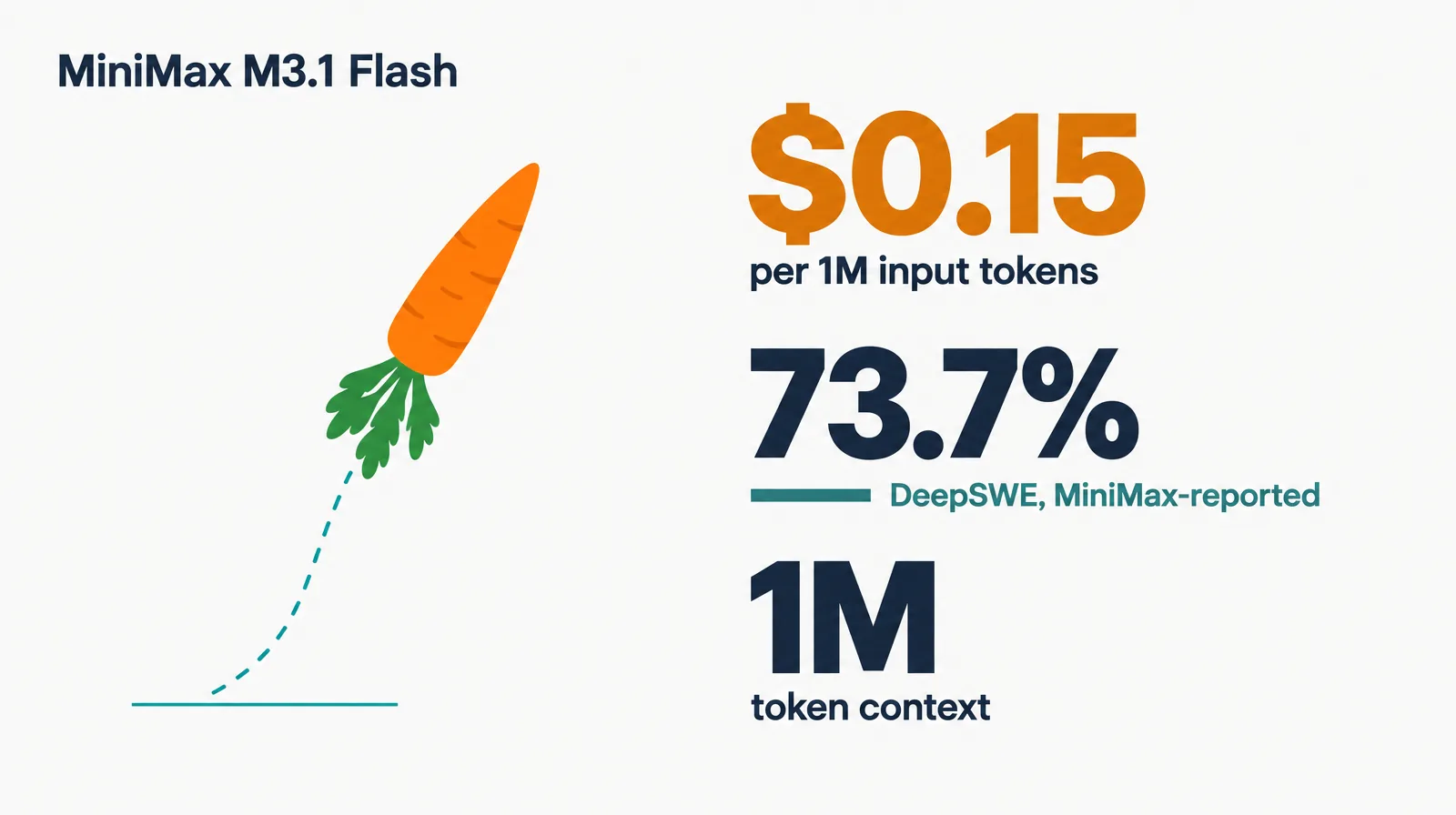
MiniMax released M3.1 Flash on October 19, 2026, and confirmed it is the model that ran on OpenRouter as Space Bunny Alpha. Its release post at 11:56 UTC lists an API price of $0.15 per million input tokens and $0.60 per million output tokens, a 1,000,000-token context, and weights on October 23. Five minutes later OpenRouter put it back as a free listing for 72 hours.
The benchmark numbers are MiniMax’s own and nobody has rerun them yet. This page separates what MiniMax published, what OpenRouter measured, and what is still open. A disclosure first: we build CellCog, an AI employee platform; our agents run on Claude Opus 5.5 and we do not route to MiniMax.
On this page · 6 sectionsOpen
 MiniMax released M3.1 Flash on October 19, 2026 and said Space Bunny Alpha, the anonymous OpenRouter model, was an earlier version of it.
 API price: $0.15 per million input tokens and $0.60 per million output tokens, with cache reads at $0.015. OpenRouter lists it free for 72 hours first.
 In MiniMax’s own table it scores 62.2 on Automation-Bench, ahead of DeepSeek V4.1 Flash 1017 at 60.5, and 73.7 on DeepSWE, behind that model’s 77.0.
 It takes a 1,000,000-token context with text, image and video input, and OpenRouter allows up to 524,288 output tokens.
 MiniMax says the weights arrive on October 23 and its docs call M3.1 Flash an open-weight model. No license has been published yet.
 OpenRouter says MiniMax upgraded the model during stealth: first token 1.95 to 1.22 seconds, 70 to 100 tokens a second, errors 1.4% to 0.7%.
§ 01What MiniMax released
MiniMax’s post says Space Bunny “was an earlier version of M3.1 Flash” and claims the new model runs “at 1/3 the cost of M3 and 3x the speed.” Its developer docs list MiniMax-M3.1-Flash beside MiniMax-M3, which stays available, and describe it as “An ultra-efficient open-weight model for everyday work.” Thinking depth is set with an effort parameter.

| Item | Value |
|---|---|
| Maker | MiniMax |
| Teaser | October 19, 09:21 UTC |
| Release post | October 19, 11:56 UTC |
| Context | 1,000,000 tokens |
| Max output on OpenRouter | 524,288 tokens |
| Input | Text, image and video; text out |
| API price per 1M tokens | $0.15 input, $0.60 output, $0.015 cache reads |
| OpenRouter | Free for 72 hours, then the same rates |
| Weights | October 23, per MiniMax |
| Where | MiniMax API, M Plan, MiniMax Code desktop, OpenRouter |
| Earlier name | Space Bunny Alpha, OpenRouter stealth from September 23 |
§ 02The benchmarks, as MiniMax reported them
MiniMax published one comparison table and three score-versus-cost charts with the release. The rows below are copied from that table. Every number is vendor-reported, and the table compares against GPT-5.6 Sol and Claude Opus 5, not the newer GPT-6.1 Sol and Opus 5.5.
| Benchmark | M3.1 Flash | DeepSeek V4.1 Flash 1017 | Kimi K3 | GLM-5.3 | GPT-5.6 Sol | Opus 5 |
|---|---|---|---|---|---|---|
| Automation-Bench v1.0.6 | 62.2 | 60.5 | 46.7 | 48.8 | 45.8 | 50.3 |
| DeepSWE v1.1 | 73.7 | 77.0 | 67.5 | 66.9 | 73.0 | 74.0 |
| Terminal Bench 4.0 | 38.1 | 42.3 | 12.6 | 37.9 | 39.9 | 51.8 |
| OSWorldV2 | 61.7 | not reported | 58.3 | not reported | 65.7 | 70.6 |
| Agents’ Last Exam | 29.6 | not reported | 28.3 | not reported | 30.6 | 32.2 |
| BabyVision with tools | 91.0 | 92.5 | 85.7 | not reported | 88.9 | 94.1 |
| HLE without tools | 43.4 | 42.6 | 43.5 | 42.3 | 49.5 | 55.6 |
Three things to read before quoting these. First, M3.1 Flash leads only the agent-automation rows; on coding and terminal work DeepSeek’s October 17 checkpoint scores higher, and Opus 5 tops most rows. Second, the Automation-Bench figure appears as 62.2 in the table and 62.8% at maximum effort in MiniMax’s cost chart, which runs the benchmark through Claude Code; OpenRouter’s launch thread cites 72.5% on a variant it calls AutomationBench-AA. Third, Opus 5.5 does appear in MiniMax’s Agents’ Last Exam chart, above M3.1 Flash.
§ 03Cheaper per token, and cheaper per task by MiniMax’s count
The per-token list price is half of M3’s: OpenRouter lists M3 at $0.30 in and $1.20 out per million tokens. MiniMax’s one-third claim is about cost per task, which also depends on how many tokens the model spends. Its Automation-Bench chart puts every M3.1 Flash effort level, from low at 52.8% to max at 62.8%, left of the $0.05-per-task line, and its Agents’ Last Exam chart prices a full run at $111.
Those cost figures come from MiniMax’s charts, not from a third party, and the free OpenRouter window means early users will not see a bill for three days.
§ 04From Space Bunny to M3.1 Flash
Space Bunny Alpha appeared on OpenRouter on September 23 with no named maker. Tokenizer tests posted that day pointed to the MiniMax family, which our Space Bunny record tracked through the reveal. OpenRouter says it was the platform’s top model for 10 straight days and processed 56.7 trillion tokens there before it “hopped off OpenRouter on Oct 5”. MiniMax counts more than 200 trillion tokens across leaderboards.
The released model is not exactly the stealth one. OpenRouter says feedback from the anonymous run let MiniMax fix bugs and ship upgrades mid-stealth:
- Time to first token fell from 1.95 to 1.22 seconds.
- Throughput rose from 70 to 100 tokens a second.
- The error rate halved, from 1.4% to 0.7%.
§ 05What is still open
- The weights. MiniMax says “Model weights will arrive on Oct 23.” OpenRouter says later this week. No license or Hugging Face repository yet; MiniMax’s newest repository there is from August.
- Independent numbers. No third-party run of the released model exists yet. Browser Use and Artificial Analysis tested DeepSeek’s checkpoint within days; expect the same here.
- Other hosts. Together AI has teased a listing; MiniMax reposted it.
- The stealth prompts. OpenRouter’s stealth listing allowed the provider to retain prompts without training on them. MiniMax has not said what happens to data from the anonymous weeks.
§ 06Sources
- MiniMax: M3.1 Flash release post, October 19
- MiniMax: Space Bunny teaser, October 19
- MiniMax: benchmark table and charts, October 19
- MiniMax developer docs: text generation
- OpenRouter: stealth model reveal thread, October 19
- OpenRouter: M3.1 Flash free listing
Q1Is MiniMax M3.1 Flash free?
For now on OpenRouter: it went up as a free listing on October 19 for 72 hours. After that the listed rates are $0.15 per million input tokens, $0.60 per million output tokens and $0.015 per million cached input tokens, the same as MiniMax’s own API.
Q2Is Space Bunny Alpha the same model as M3.1 Flash?
MiniMax says Space Bunny was an earlier version of M3.1 Flash. OpenRouter says user feedback during the anonymous run let MiniMax fix bugs and ship upgrades before launch, so the released model is not byte-for-byte the stealth one.
Q3When are the M3.1 Flash weights coming?
MiniMax says October 23. Its docs already describe M3.1 Flash as an open-weight model, but no license or Hugging Face repository has been published yet.
Q4How does M3.1 Flash compare with DeepSeek V4.1 Flash 1017?
On MiniMax’s own table it leads on Automation-Bench (62.2 vs 60.5) and Humanity’s Last Exam without tools (43.4 vs 42.6), and trails on DeepSWE (73.7 vs 77.0), Terminal Bench 4.0 (38.1 vs 42.3) and BabyVision (91.0 vs 92.5). No independent run exists yet.
Q5What context window does M3.1 Flash have?
1,000,000 tokens on MiniMax’s API and on OpenRouter, which also allows up to 524,288 output tokens. It accepts text, image and video and returns text.