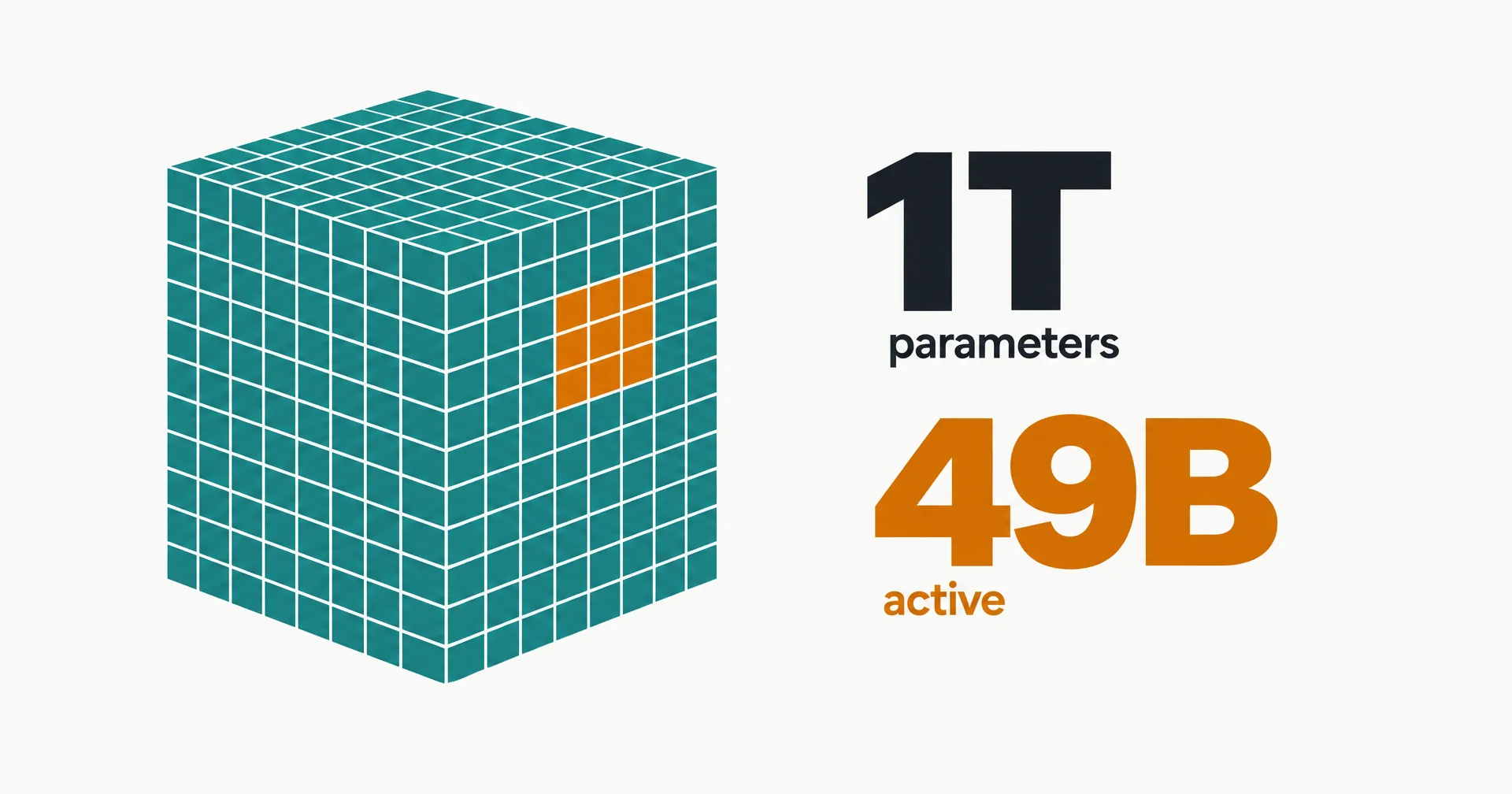
Mistral AI launched a public preview of Mistral Large 4 on October 6, 2026: a natively multimodal mixture-of-experts with about 1 trillion parameters and 49 billion active, which Mistral calls its largest and most capable model to date. Its in-house nickname is le Chonk. The preview API is live in Mistral Studio, and in Mistral’s words, “Weights drop end of this month.” This page reads Mistral’s announcement (12:00 UTC), its model page, its API pricing page and its post on X (13:06 UTC), as of October 6, 2026.
Update, October 29, 2026. The weights are out. Mistral posted on X at 14:21 UTC: “Today, we release the weights of a new and improved Le Chonk, advancing the open frontier for agentic coding and cybersecurity.” The release is not the October 6 preview frozen: Mistral says three more weeks of reinforcement learning went in, with gains that show “no signs of saturation.” The details are in the next section.
On this page · 12 sectionsOpen
 Mistral launched a public preview of Mistral Large 4 on October 6, 2026: a natively multimodal mixture-of-experts with about 1 trillion parameters and 49 billion active.
 The weights shipped on Hugging Face on October 29, 2026 under the Mistral Ecosystem Open-Weight License, a modified MIT license; selling it to others as a hosted model service needs a separate commercial license.
 On Mistral’s numbers it scores 61.7% on DeepSWE v1.1 and 59.9% on AutomationBench, with a Coding Agent Index of 49.8%, ahead of DeepSeek V4 Pro 0813 and Qwen3.8 Max.
 Mistral’s headline claim is security: 93% on Cybench and 82% on a reproduce-and-patch test where, it says, Claude Opus 5.5 and GPT-6 Astra score near zero because they refuse.
 It was trained from scratch on 3,800 Nvidia Grace Blackwell GPUs in Mistral’s own European datacenters, with training data in more than 160 languages.
 On Mistral’s own October 29 numbers it leads open models on FrontierCode 2.0 at 19.7% and Terminal-Bench 4.0 at 41%; on the October 6 DeepSWE v1.1 table, Kimi K3 and DeepSeek V4.1 Flash scored higher than its 61.7%.
§ 01November 5: Studio puts Le Chonk to work
On November 5, 2026 Mistral expanded Mistral Studio, its enterprise platform, with managed agents and apps plus new workflow, enterprise-context, observability and evaluation features. The pitch is that Large 4 is the brain and Studio is where a business runs it. Mistral splits the work three ways: “An agent investigates and acts, a workflow coordinates execution and approvals, and an app gives employees a way to use these systems.”
| Piece | What it does, per Mistral |
|---|---|
| Managed agents | Multi-step agents with skills, code sandboxes, subagents and hooks; Mistral runs the runtime |
| Workflows | Fixed steps, agent reasoning and human decisions in one process |
| Apps | A way for employees to use the agents and workflows |
| Mistral MCP server | Build with Mistral Vibe or another coding agent, then deploy to Studio with one command |
| Deployment | Mistral cloud, your own VPC, on-premises, or a mix |
Mistral names ABANCA, Accenture, Alten, BNP Paribas, Capgemini, CMA CGM and Tata Consultancy Services as customers and partners already running Studio in production. Its own example is an incident agent that follows the team’s runbook, “asks for approval before taking sensitive actions” and posts findings in Slack. No new prices or benchmark numbers came with the release.
§ 02October 29: the weights and the new numbers
The model card describes a 1 trillion-parameter multimodal mixture-of-experts with 49 billion active parameters per token (52 billion counting embeddings and output layers), a 1M-token context, reasoning effort set per request to low, medium or high (high is the default), and an embedded DSpark speculative-decoding draft head that Mistral measured at up to 1.9x higher throughput. Mistral publishes an FP8 checkpoint and an NVFP4 checkpoint for Blackwell GPUs, and it runs on vLLM, SGLang and llama.cpp.
The license is the Mistral Ecosystem Open-Weight License, which the card calls “a modified version of the MIT license.” It allows use, modification and resale, with one condition: a licensee that “operates a Model as a Service business” must sign a separate commercial license before commercial use. Internal use and use through Mistral’s own products are exempt. That answers the open question on this page since October 6, when the model page said only Open.
| Model | FrontierCode 2.0 |
|---|---|
| Mistral Large 4 | 19.7% |
| DeepSeek V4.1 Flash | 19.3% |
| GLM-5.3 | 17.8% |
| Kimi K3 | 17.3% |
| GLM-5.3 Flash | 14.2% |
| Beam 1.0 | 2.9% |
FrontierCode 2.0 is Cognition’s private benchmark of whether a repository maintainer would merge an agent’s change, so the lead is 0.4 points over DeepSeek V4.1 Flash on a test outsiders cannot rerun. The other numbers Mistral published with the weights, all its own or cited from Artificial Analysis:
- Terminal-Bench 4.0: 41%, up 13 points from the preview’s 28%, with 30% fewer output tokens. GLM-5.3 posts 40% on the same chart.
- Artificial Analysis Coding Agent Index: 48%, “effectively tied” with GLM-5.3, using 47% fewer tokens per task on average.
- Artificial Analysis Intelligence Index v5: 26, which Mistral calls the highest among western open-weight models; the leading Chinese open models score higher.
- Cyber: 51% on the Artificial Analysis Cyber Index, and a 96.6% average refusal rate on malicious cyber requests.
- Agents: 97.1% of attacks resisted on the B3 Agent Security Benchmark (93.3% in preview), 84.5 on BrowseComp and 73.3% on FinWorkBench.
- Human preference: in Surge Code’s blind comparisons graders preferred it over GLM-5.3, Kimi K3 and DeepSeek V4.1 Flash, and preferred Claude Opus 5.5 over it.
§ 03What Mistral launched
| Item | Mistral Large 4 |
|---|---|
| Status | Public preview, API only |
| Architecture | Granular mixture-of-experts, hybrid instruct and reasoning |
| Total parameters | About 1 trillion (1.05 trillion on the model page) |
| Active parameters | 49 billion |
| Vision encoder | 1.6 billion parameters (text and image input) |
| Context window | 1 million tokens |
| Languages in training data | More than 160 |
| Model id | mistral-large-4 |
| API features | Structured outputs, function calling, document Q&A, batch, agents and built-in tools |
| Price (Standard tier) | $0.68 input, $0.07 cached input, $2.09 output per million tokens |
| Weights | By the end of October 2026 |
| License | Listed as Open on the model page; terms not yet named |
Mistral frames the release as Europe’s open-weight answer to the Chinese labs. It says Large 4 is competitive with the strongest open models in the world while “significantly outperforming any open-weight model developed in the US or Europe.” Mistral Large 3, the model it replaces at the top of the catalog, shipped under Apache 2.0. The Large 4 model page says only Open, so the license terms are one of the things to read when the weights land.
§ 04What it costs
Mistral prices the preview above Large 3 but well below its own Medium 3.5. The rival rows below are host list prices on OpenRouter, not the labs’ own price sheets, so read them as a guide to what developers pay today rather than a vendor quote.
| Model | Source | Input | Cached input | Output |
|---|---|---|---|---|
| Mistral Large 4 | Mistral | 0.68 | 0.07 | 2.09 |
| Mistral Large 3 | Mistral | 0.50 | 0.05 | 1.50 |
| Mistral Medium 3.5 | Mistral | 1.50 | 0.15 | 7.50 |
| DeepSeek V4 Pro 0813 | OpenRouter | 0.66 | not listed | 1.98 |
| Qwen3.8 Max 0902 | OpenRouter | 2.00 | not listed | 6.00 |
| Kimi K3 | OpenRouter | 0.95 | not listed | 14.00 |
Read plainly: an output token on Large 4 costs about 39% more than on Large 3 and about 28% of what Medium 3.5 charges, and the preview sits within a few cents of DeepSeek V4 Pro 0813’s OpenRouter listing. One caution: Mistral’s model page shows $1.36 input and $4.18 output beside the Standard figures, exactly double, and the pages we read do not say whether today’s price is a preview rate. Large 4 was not yet listed on OpenRouter when we checked at 13:26 UTC.
§ 05The benchmarks Mistral published
Every number in this section is Mistral’s. Mistral says some rows come from outside evaluators: the coding rows use numbers reported by Artificial Analysis, the legal and finance comparisons come from vals.ai, and the coding-quality ratings come from a blind study run with Surge AI. We had not yet seen those evaluators’ own pages for the preview when we wrote this.
| Benchmark | Mistral Large 4 | What Mistral says around it |
|---|---|---|
| DeepSWE v1.1 | 61.7% | Artificial Analysis number |
| SWE-Atlas-QnA | 59.4% | Artificial Analysis number |
| Terminal-Bench 4 | 28.3% | Artificial Analysis number |
| Coding Agent Index | 49.8% | Ahead of DeepSeek V4 Pro 0813 and Qwen3.8 Max |
| AutomationBench (657 workflows) | 59.9% | Ahead of Kimi K3, MiMo-V2.6-Pro and DeepSeek V4 Pro |
| AA-Briefcase | 1,393 Elo | Ahead of DeepSeek V4 Pro |
| Dense 200 (visual grounding) | 42% | GPT-6 Astra scores 41% |
| Cybench (40 challenges) | 93% | One of the highest open-weight scores reported |
| Reproduce-and-patch test, AA Cyber Index | 82% | Highest of any model |
| Lakera B3 attack resistance | 93.3% | No higher score seen among competitors |
| KORA Benchmark | 1.691 of 2 | Highest Mistral measured among open models |
| Surge AI blind coding rating | 3.74 of 5 | Second of five; Claude Opus 5 led at 4.22 |
In the post’s text Mistral also says Large 4 ranks among the top five models overall on the Artificial Analysis Cyber Index and beats GPT-6 Astra on vals.ai’s legal and finance tasks, without giving those numbers in the text.
§ 06Where it sits against other open models
Reflection AI published its own table a day earlier for its Beam model, with competitors’ scores it says came from Artificial Analysis and DataCurve. Setting Large 4’s numbers beside those rows shows where Mistral’s claim lands. These are two companies’ tables, not one test run.
| Model | DeepSWE v1.1 | AutomationBench | Source |
|---|---|---|---|
| DeepSeek V4.1 Flash | 74.2 | 54.8 | Reflection |
| Kimi K3 | 68.0 | 46.7 | Reflection |
| Mistral Large 4 | 61.7 | 59.9 | Mistral |
| GLM 5.3 | 61.0 | 48.2 | Reflection |
| Qwen 3.8 Max | 51.0 | 39.8 | Reflection |
| Reflection Beam | 44.4 | 37.0 | Reflection |
On DeepSWE, Large 4 lands level with GLM 5.3 and behind Kimi K3 and DeepSeek V4.1 Flash, both from Chinese labs. It is well ahead of Beam, the open model a US lab announced the day before. On AutomationBench it posts the highest number in this set, but Reflection labels its column the public split while Mistral describes 657 workflows, so treat that row as indicative. The picture matches Mistral’s own wording: the strongest open model from the US or Europe by its numbers, competitive rather than leading worldwide.
§ 07The cybersecurity pitch
Mistral leans hardest on security. Its argument is that defenders need a model that will do vulnerability work under their own policy: “Several leading closed models, including Claude Opus 5.5 and GPT-6 Astra, score near zero on the same test because they refuse to perform the task.” That 82% against near zero is a refusal gap, not a skill comparison, since the closed models were never scored on the work itself.
Two more details sit beside it. Until the weights ship, Mistral says it is red-teaming with cybersecurity leaders, vetted partners and state authorities “who will access the same model with reduced moderation and expanded cyber capabilities.” And its safety section reports the other edge: on malicious cyber prompts from JailbreakBench, StrongREJECT and AgentHarm, Large 4’s average refusal rate is higher than every open model Mistral compared. Mistral’s pitch, in short, is a model that does defensive work and turns down attacks, run on private cloud or on premises under the customer’s own rules.
§ 08How it was built
Mistral trained Large 4 from scratch on 3,800 Nvidia Grace Blackwell GPUs in its own datacenters in Europe, and serves the preview on the same hardware. It says a significant share of the training data was multilingual, across more than 160 languages.
Post-training is reinforcement learning at scale. At about 3,000 GPUs, Mistral says one training run produces roughly 33 billion tokens a day, about 16 billion of them trainable completions after filtering. It also says “The reinforcement learning run behind this preview is still in flight, and the model is showing no signs of saturation,” so the model behind the preview API will keep changing. Large 4 is the first milestone funded by the €3 billion Series D Mistral announced on September 8, and the base for a new set of specialized Mistral models.
§ 09What this means if you run agents
For teams that must keep data in Europe, Large 4 is Mistral’s largest open-weight model yet, and Mistral says it runs a European deployment end to end under European law. For everyone else it adds another strong open option beside DeepSeek, Kimi, GLM and Qwen, at a price close to DeepSeek V4 Pro. Two practical notes. A mixture-of-experts model still has to hold all of its weights in memory to serve, so 49 billion active parameters cut compute per token, not the hardware needed to load about a trillion parameters. And a preview is a moving target: the training run is still going, the price may be a preview rate, and the license is unnamed.
CellCog runs on Anthropic’s Claude models (Claude Opus 5.5 on most tiers; Claude Fable 5.2 on Agent Max and Creative Max since November 11, 2026), not on Large 4. We track open-weight releases because they set the floor on price and are the option for teams that must run models on their own hardware.
§ 10What we are watching
- Hosted prices for the open weights, now that anyone can serve them: OpenRouter and cloud listings, and whether Mistral’s own $0.68 and $2.09 move.
- The architecture and post-training details Mistral promised with the weights.
- Outside evaluations, now possible on the weights: independent runs on Terminal-Bench, DeepSWE and the Artificial Analysis pages behind the coding and cyber numbers.
- Hosts and price: when Large 4 reaches OpenRouter and the clouds, and whether $0.68 and $2.09 hold after the preview.
§ 11Update log
As of October 29, 2026, 14:40 UTC: weights released on Hugging Face (FP8 and NVFP4) under the Mistral Ecosystem Open-Weight License. Added the October 29 section (specs, license terms, FrontierCode 2.0 table and chart, Mistral’s new benchmark numbers), updated the key points, FAQ and watch list.
As of October 6, 2026: page opened at the public preview.
§ 12Sources
- Mistral AI, “Le Chonk brings the brains. Studio puts it to work.”, November 5, 2026
-
Mistral AI on X, Studio post, November 5, 2026
-
Mistral AI, “Introducing Mistral Large 4”, October 6, 2026
- Mistral AI docs, Mistral Large 4 model page, read October 6, 2026
- Mistral AI, API pricing, read October 6, 2026
- Mistral AI on X, launch post, October 6, 2026
- Reflection AI, “Introducing Beam”, October 5, 2026
- OpenRouter, model list and prices, read October 6, 2026
- Mistral AI, “Mistral Large 4 (Le Chonk) is now open weight”, October 29, 2026
- Hugging Face, Mistral-Large-4-1T-A52B model card and license, read October 29, 2026
- Mistral AI on X, weights post, October 29, 2026
Q1Is Mistral Large 4 open source?
Open weight, since October 29, 2026. The license is a modified MIT license, not a standard open-source one: internal use and Mistral’s own products are exempt, but a business that offers the model to third parties as a hosted service needs a separate commercial license.
Q2How big is Mistral Large 4?
About 1 trillion total parameters (1.05 trillion on Mistral’s model page) with 49 billion active per token, plus a 1.6 billion parameter vision encoder and a 1 million token context window.
Q3How much does Mistral Large 4 cost?
$0.68 per million input tokens, $0.07 cached and $2.09 output on Mistral’s Standard tier. The model page also shows $1.36 and $4.18, exactly double, and the pages we read do not say whether the lower figure is a preview rate.
Q4How does it compare with Kimi K3 and DeepSeek?
On Mistral’s numbers it beats Kimi K3 and DeepSeek V4 Pro on AutomationBench and leads DeepSeek V4 Pro 0813 on the Coding Agent Index. On DeepSWE v1.1, Reflection AI’s published table puts Kimi K3 at 68.0 and DeepSeek V4.1 Flash at 74.2, above Large 4’s 61.7.
Q5Does CellCog use Mistral Large 4?
No. CellCog runs on Anthropic’s Claude models (Claude Opus 5.5 on most tiers; Claude Fable 5.2 on Agent Max and Creative Max since November 11, 2026). We track open-weight models like Large 4 because they set the floor on price and are the option for teams that must run models on their own hardware.