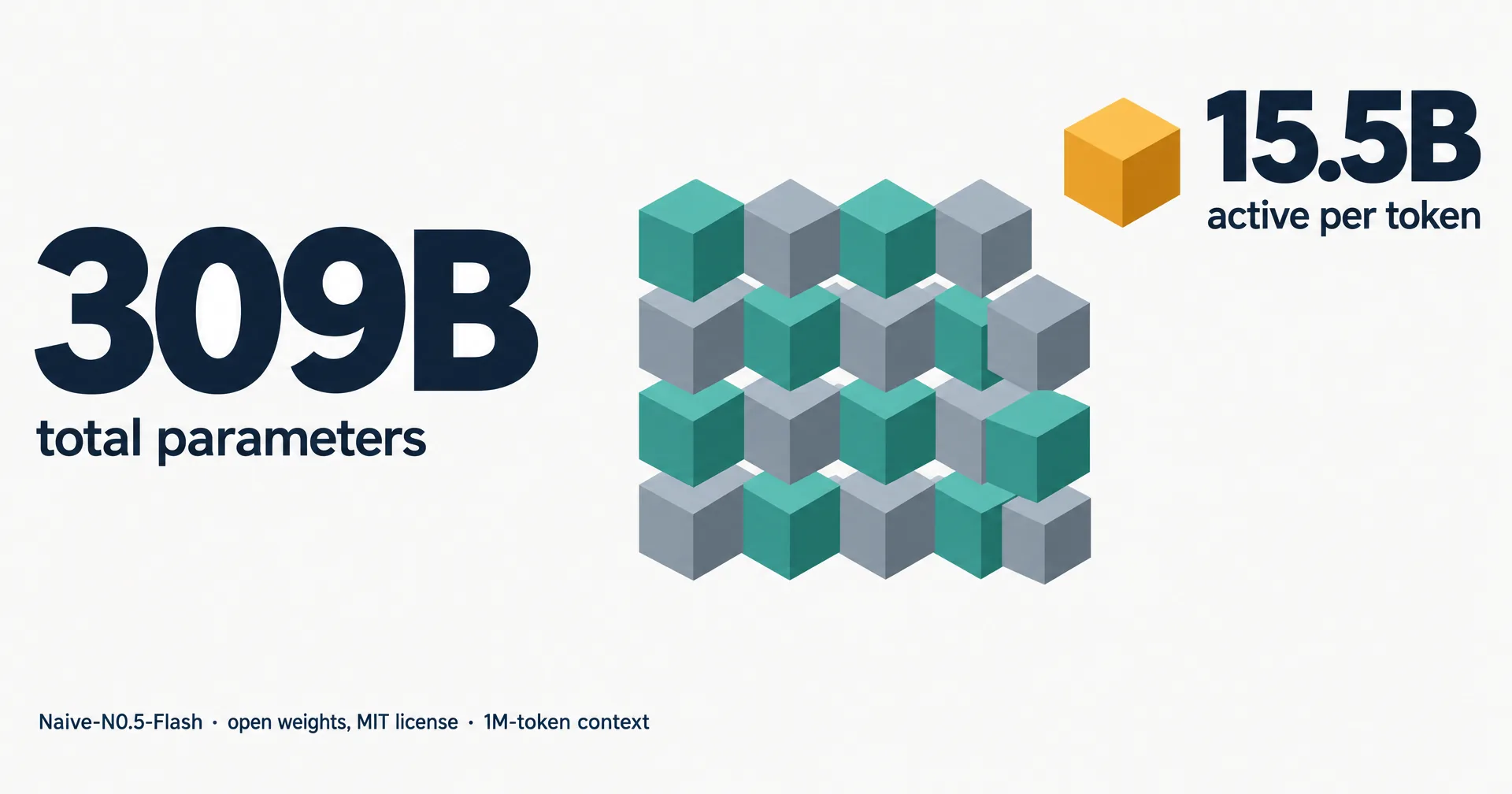
A Beijing lab that did not exist eight months ago opened the weights of a 309-billion-parameter coding model on September 27, 2026, and said the most interesting thing about it is who built it. NaiveAI’s launch post opens with “Building Frontier AI with AI”, and its research page says: “At NaiveAI, we broke with human-centered R&D from day one.”
This page is the record: what NaiveAI released, what its own benchmark charts show and leave out, what “built with AI” covers, and what is still unverified. A disclosure first: we build CellCog, an AI employee platform, and we do not route to Naive-N0.5-Flash.
On this page · 9 sectionsOpen
 NaiveAI released Naive-N0.5-Flash on September 27, 2026: a 309B mixture-of-experts model with 15.5B active parameters, a native 1,000,000-token context and no full-attention layers.
 The weights and inference code are open under the MIT license. An API is announced at $0.10 input, $0.40 output and $0.01 cached input per million tokens, but it was not live when we checked.
 NaiveAI says AI models designed the attention architecture and tuned training and inference, with humans setting direction. Its NaiveRT runtime was built in six days across 151 documented trials.
 The runtime is the headline number: 50 tokens a second per user in Standard mode, up to 2,000 in Ultrafast mode, and a peak of 2,122 tokens a second on 8 GPUs.
 Every score is self-reported. It leads NaiveAI’s chart on NL2Repo-Bench, PaperBench and MLE-bench-30, sits third on SWE-bench Pro at 73.6 behind Opus 5.5 at 89.9, and ties last on ProgramBench.
§ 01What NaiveAI released
The model card and the research post agree on the specs. NaiveAI’s X post adds: “Weights are open today under MIT license.” The weights appeared on Hugging Face at 14:14 UTC and the launch post went out at 16:29 UTC.
| Item | Value |
|---|---|
| Maker | NaiveAI, Beijing |
| Released | September 27, 2026 |
| Architecture | Mixture of experts, 309B total, 15.5B active |
| Context | 1,000,000 tokens, native |
| Attention | 39 sliding-window layers plus 9 DeepSeek Sparse Attention layers, no full attention |
| Base model | Xiaomi MiMo-V2.5 |
| Extra training | 3.25 trillion tokens |
| License | MIT, weights and inference code |
| Weights on disk | About 315 GB in FP8 |
| API price, announced | $0.10 input, $0.40 output, $0.01 cached input per million tokens |
| API status | Not live; no OpenRouter listing |
On the API, the post is careful: “API access will also be provided, with pricing set at $0.10 / $0.40 / $0.01 per million tokens for input, output, and cache reads, respectively.” Until it opens, running the model means your own FP8-capable NVIDIA GPUs.
§ 02The coding scores, as NaiveAI reports them
Every number here comes from NaiveAI’s own charts, run with Claude Code 2.1.207 as the harness, with rival scores copied from each vendor’s published material. Nobody has reproduced them yet. Read that way, the model is strong for its active size and not the leader.
| Benchmark | Naive-N0.5-Flash | Top score on the chart | Its place |
|---|---|---|---|
| SWE-bench Pro | 73.6 | 89.9, Opus 5.5 | 3 of 6 |
| DeepSWE v1.1 | 67.8 | 75.4, Muse Spark 1.3 | 7 of 13 |
| Terminal-Bench 2.1 | 86.7 | 90.6, DeepSeek V4.1 Flash | 7 of 9 |
| ALE-CLI | 32.4 | 34.3, Opus 5.5 | 4 of 12 |
| FrontierSWE v1 | 78.2 | 88.2, Fable 5 with fallback | 3 of 5 |
| NL2Repo-Bench | 71.9 | 71.9, Naive-N0.5-Flash | 1 of 5 |
| ProgramBench | 17.5 | 37.0, Opus 5 | Tied last of 7 |
The telling comparison is the other open flash model on the chart. DeepSeek V4.1 Flash beats it on DeepSWE (74.2 to 67.8), Terminal-Bench 2.1 (90.6 to 86.7) and ProgramBench (20.3 to 17.5); Naive-N0.5-Flash wins NL2Repo-Bench (71.9 to 64.0).
§ 03The AI research scores
This is where NaiveAI claims a lead, and where the comparisons are thinnest. The PaperBench rivals come from MiniMax’s M3 page (Opus 4.7, GPT-5.5, Gemini 3.1 Pro), and the MLE-bench-30 rivals from Google’s Gemini 3.6 Flash model card, so none of the newest frontier models appear.
| Benchmark | Naive-N0.5-Flash | Best other score on the chart |
|---|---|---|
| PaperBench | 63.2 | 58.5, Opus 4.7 |
| MLE-bench-30 | 73.7 percent | 66.9 percent, Sonnet 5 |
| PostTrainBench | 37.5 | 41.8, GPT-5.6 Sol |
| SOL-ExecBench, higher is better | 72.81 | 67.56, Recursive Superintelligence |
| NanoChat AutoResearch, lower is better | 0.9051 | 0.9109, Recursive Superintelligence |
| NanoGPT SpeedRun seconds, lower is better | 73.8 | 77.5, Recursive Superintelligence |
The last three rows were run with NaiveAI’s in-house AutoResearch harness against scores Recursive Superintelligence published for an undisclosed model.
§ 04What “built with AI” covers
NaiveAI describes the split plainly: “Human researchers set direction, define constraints and criteria, and make critical decisions.” For this model, it says AI explored the hybrid attention design and optimized training, inference and deployment, and that “Human researchers provided guidance and made key decisions.”
Two cases carry the claim. The first is NaiveRT, the runtime behind the 2,000 tokens a second figure. It cut one speculative decoding round from 12.3 ms under SGLang to 3.4 ms, and “NaiveRT was built in six days by human researchers working with AI models, across 151 documented optimization trials.” The second is AutoWM, a world model the lab says Naive-N0.5-Flash built after 400 hours of research across 15 rounds, scoring 77.43 on WorldArena-1 Track 1 against a best published score of 73.64 at the time.
The research post also says the model is trained for AI R&D, “opening a path toward recursive self-improvement (RSI)”. That is a direction, not a result: the cases show AI doing engineering and research work under human direction, which is the same half of the loop we wrote about in the two kinds of self-improving AI.
§ 05The lab behind it
NaiveAI was founded in February 2026 by Dai Jifeng, an associate professor in Tsinghua University’s Department of Electronic Engineering, and has fewer than 100 employees, per Implicator’s summary of a report in The Information. That report put its funding at $400 million across three rounds at a $1.42 billion valuation, with Tencent, IDG Capital, MPCi and HSG named as investors, and noted: “Naive AI has not confirmed the financing.” The same coverage says MiroMind, where Dai was a technical adviser until January, stated in April that its technology and intellectual property remain its own and reserved legal action. That dispute is unresolved.
The model itself starts from Xiaomi’s open MiMo-V2.5 base, the family whose V2.6 release we covered on September 22.
§ 06What we are watching for
- The API. A live endpoint at the announced price, and an OpenRouter listing.
- Independent scores. Any third-party SWE-bench Pro, Terminal-Bench or DeepSWE run on the open weights.
- Newer rivals on the R&D charts. PaperBench and MLE-bench-30 runs against current frontier models, not last generation’s.
- MiroMind. Any legal step over the IP dispute.
§ 07The tracker
| Question | Status |
|---|---|
| Weights | Open, MIT, on Hugging Face |
| API | Announced, not live |
| Benchmarks | Self-reported only |
| Funding | Reported, unconfirmed by NaiveAI |
| IP dispute with MiroMind | Unresolved |
§ 08Update log
- September 27, 2026, 20:20 UTC. Page opened six hours after the weights appeared. Specs from the model card and research post; scores read from NaiveAI’s two benchmark charts; launch post time checked against its id.
§ 09Sources
- NaiveAI research post: Naive-N0.5-Flash
- Naive-N0.5-Flash on Hugging Face
- NaiveAI launch post on X, September 27
- Implicator: Naive AI funding report, September 18
Q1Who is NaiveAI?
A Beijing startup founded in February 2026 by Dai Jifeng, an associate professor in Tsinghua University’s electronic engineering department. The Information reported $400 million raised across three rounds at a $1.42 billion valuation; NaiveAI has not confirmed those figures.
Q2What does built with AI mean here?
NaiveAI says AI models wrote code, ran experiments and analyzed results for the architecture, training and inference work, while human researchers set direction and made the key decisions. It documents two cases: the NaiveRT runtime and an AI-built world model called AutoWM.
Q3Is Naive-N0.5-Flash based on another model?
Yes. NaiveAI says it builds on Xiaomi’s open-weight MiMo-V2.5 base model, replacing its global-attention layers with DeepSeek Sparse Attention and training a further 3.25 trillion tokens.
Q4Can I run Naive-N0.5-Flash myself?
Yes, if you have the hardware. The model card says it needs FP8-capable NVIDIA GPUs and the weights take about 315 GB, before memory for inference.
Q5Does CellCog use Naive-N0.5-Flash?
No. CellCog routes its AI employees to models we have tested on our own workloads. A new open model gets a record here first and a routing decision only after it earns one.