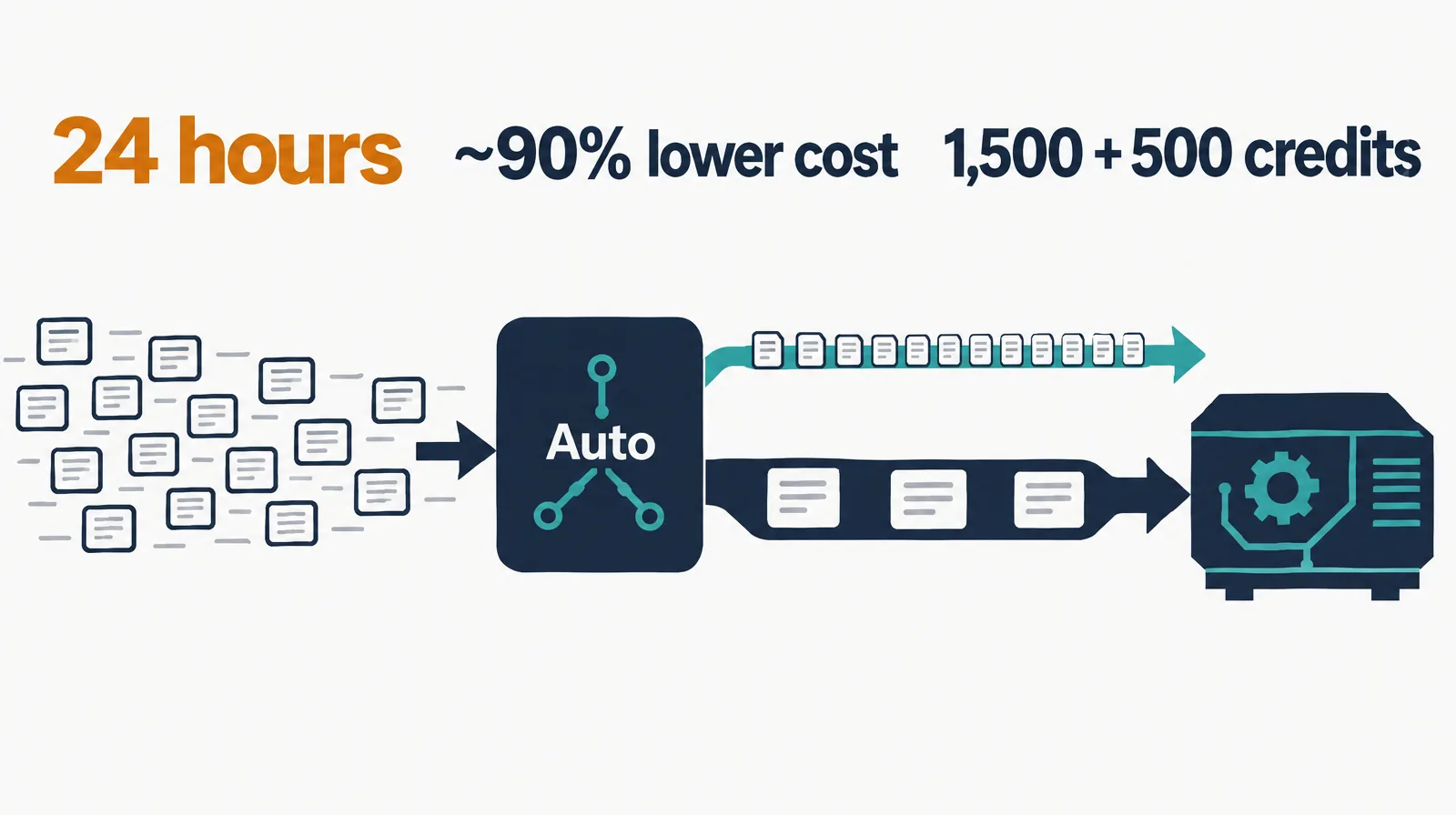
Notion rebuilt its agents on October 19, 2026, and the headline is time: a Notion agent can now work on one task for more than 24 hours, up from five minutes. Co-founder Akshay Kothari’s post bundles that with an upgraded model router called Auto, a way to pay with an existing ChatGPT plan, an admin dashboard for AI spend, and a new credit system that splits every seat’s AI allowance into two pools.
The router is the part that pays for the rest. Notion says Auto “delivered similar results to Opus 5.5 and Astra at about 90% lower average cost” across more than 20 common use cases, so credits go about 10 times further. Its head of AI framed the trade in a team meeting Kothari quotes: “To support long-running threads in a way that wouldn’t blow through credits, we knew we needed to pair them with significant efficiency gains.” The details are on Notion’s blog, its credits help page and its pricing page.
On this page · 6 sectionsOpen
 Notion rebuilt Notion Agent and Custom Agents on October 19, 2026, its sixth agent harness. A single task can now run for more than 24 hours, up from five minutes.
 Its upgraded Auto router sends easy work to cheap models and hard work to capable ones. Notion says it matched Opus 5.5 and Astra on 20+ use cases at about 90% lower average cost.
 Business and Enterprise seats now get two monthly pools: 1,500 Standard credits when Notion picks the model and 500 Select credits when you pick it or run Custom Agents. Neither rolls over.
 Notion’s own estimate for a simple task is 5 credits on Auto against 50 on Opus 5.5; a complex task is 25 against 150. Fable and Astra bill to the workspace’s paid Notion credits.
 New workspaces get the system now; existing ones move on November 2. ChatGPT Plus, Pro and Go accounts can now pay for the personal Notion Agent, and Enterprise bring-your-own-key is in alpha.
§ 01What changed, in one table
| Change | Before | After |
|---|---|---|
| Longest single agent task | Five minutes | More than 24 hours |
| Tools agents can reach | A few dozen earlier this summer | Hundreds, via MCPs and connectors |
| Model choice | Pick a model, or Auto | Upgraded Auto, about 90% lower cost on Notion’s tests |
| Custom Agent run cost | Baseline | About 30% less in Notion’s testing |
| App speed | Baseline | Up to 50% faster on web and mobile |
| Paying with outside AI | Not offered | ChatGPT Plus, Pro or Go in the personal Notion Agent; Enterprise bring-your-own-key in alpha |
Under the hood, Notion lists durable execution (each session on a queue-backed worker so work survives restarts), its agents getting their own computer and browser to run short scripts instead of spending tokens, context compaction, and a “Review for me” mode in which a separate model checks whether an action is safe before the agent takes it. Notion puts infrastructure uptime above 99.9%.
§ 02The new credit system

Business and Enterprise seats now carry two monthly allowances. Standard credits, 1,500 a month, pay for anything where Notion picks the model. Select credits, 500 a month, pay for work where you pick the model or run a Custom Agent for yourself. Business is $20 per seat a month on monthly billing. The pools are separate, cannot be combined or moved between members, and do not roll over; when one runs out, that work pauses until the reset unless an admin opens the workspace’s purchased Notion credits.
Read those numbers as the design of the system. On Notion’s own estimates, a member who leaves everything on Auto can run about 60 complex tasks a month on Standard credits alone; the same member choosing Opus 5.5 by hand would spend 150 Select credits per complex task and run out after three. Some work skips both pools entirely: Fable and Astra, workspace-funded Custom Agents, and agents run through the API all bill to the workspace’s paid Notion credits. AI Meeting Notes starts drawing on Standard credits on December 1, 2026, about 10 per hour-long meeting.
One rule matters for teams that share agents. By default a shared Custom Agent spends its owner’s Select credits, “even when other people use it,” until an admin moves it to a workspace budget. A popular agent built by one person can drain that person’s month.
§ 03How it compares to an AI employee
Notion is positioning itself as the shared memory for every agent: Kothari calls the MCP “the fastest-growing product in Notion history,” and the post names ChatGPT, Claude, Grokbot and Muse as agents that can use Notion as context. That is a different job from the one an AI employee does.
| Notion Custom Agent | CellCog AI employee | |
|---|---|---|
| Where it lives | Inside a Notion workspace | Its own secure computer with a file system, browser and saved logins |
| What it reaches | Notion plus hundreds of MCP tools | 1,500+ apps, the web, code, and its own inbox and phone |
| Model | Auto, or a model you pick | Claude Opus 5.5 on every tier |
| How it is paid | Owner’s Select credits, then workspace credits | Pay for the work, not the hire (see pricing) |
| Memory | Notion pages | Its own memory and handover notes, plus tools like Notion |
The two fit together more than they compete: a CellCog AI employee can connect to a Notion workspace as one of its tools and keep its trackers current.
§ 04What Notion has not shown
The cost claims are Notion’s own measurements: “about 90% lower average cost” and the matching quality claim come from its internal tests, summarized on its Knowledge Board, not from an outside run. The credit math also depends on Notion’s per-task estimates, which it says vary by scenario. Kothari’s closing line is honest about the pace: “Nobody has the AI era fully figured out, including us.”
§ 05What we are watching for
- How existing workspaces react when they move to the two-pool system on November 2.
- Whether ChatGPT-plan billing extends to Custom Agents, as Notion says it will.
- Independent tests of Auto against hand-picked frontier models.
§ 06Sources
- Notion, Agents, rebuilt to do more for less, Akshay Kothari, October 19, 2026, 10:00 PT. Read directly.
- Notion Help, Manage your AI credits and How AI credits work for Custom Agents, read October 20, 2026.
- Notion, Pricing, read October 20, 2026.
Q1What is Notion's Auto?
Notion’s model router. It reads each task and sends it to the model that best balances quality, speed and cost, and re-routes if a model stops making progress.
Q2What is the difference between Standard and Select credits?
Standard credits pay for work where Notion picks the model (Auto). Select credits pay for work where you pick a model yourself or run a Custom Agent for your own use. They are separate pools and cannot be combined.
Q3What happens when my credits run out?
Work that uses that pool pauses until the monthly reset, unless an admin lets you continue on the workspace’s purchased Notion credits.
Q4Who pays for a shared Custom Agent?
By default the agent’s owner, from their Select credits, even when others use it. An admin can switch the agent to a workspace budget of Notion credits.
Q5Can I use my ChatGPT subscription in Notion?
Yes, ChatGPT Plus, Pro or Go, in your personal Notion Agent. Notion says Custom Agents are not covered yet.
Q6Does CellCog run on Notion?
No. CellCog AI employees run on Claude Opus 5.5 on their own computers, and they can connect to Notion as one of their tools.