OpenAI has acquired Orchestra Bio, a startup whose agents track the timelines and dependencies of drug development programs, and is folding it into Rosalind, its life sciences line. OpenAI’s post is dated October 20, 2026, and Axios reported it as an exclusive the same day. Neither company names a price.
OpenAI’s description of what it bought: “OpenAI has acquired Orchestra Bio, a platform that helps biopharma teams coordinate the complex process of drug development.” This page reads OpenAI’s announcement and Orchestra’s own note directly.
On this page · 7 sectionsOpen
 OpenAI acquired Orchestra Bio, announced October 20, 2026, and is merging its team and technology into Rosalind, OpenAI’s line of models and tools for life sciences research.
 Orchestra’s agents track the studies and campaigns in a drug program and show which timelines a problem, such as a failed manufacturing batch, would delay.
 The decision stays with people: the agents gather information and compare ways to respond, and scientists and program leaders choose.
 No price was disclosed. Orchestra was started four years ago and raised $20 million when it left stealth in August 2025.
 Axios frames the deal as part of a push by OpenAI and Anthropic into science, beyond their core strengths in coding and cybersecurity.
§ 01The deal, on the record
| Item | What the record says | Source |
|---|---|---|
| Buyer | OpenAI | OpenAI’s post |
| Target | Orchestra Bio, a platform for coordinating drug development | OpenAI’s post |
| Where it goes | Rosalind, OpenAI’s models and tools for life sciences research | OpenAI’s post |
| Price and terms | Not disclosed | Both announcements |
| Orchestra’s age | Started “four years ago” | Orchestra’s site |
| Earlier funding | $20 million at its exit from stealth, August 2025 | BiotechTV, August 18, 2025 |
| Founder and CEO | Ashoka Rajendra | BiotechTV |
Orchestra’s note puts it plainly: “Today, we’re thrilled to share that Orchestra Bio is joining OpenAI to continue our mission at an even greater scale.”
§ 02What Orchestra’s agents do
Orchestra is not a drug developer. It is the software that keeps a drug program’s moving parts in view: studies, campaigns, manufacturing runs and the partners behind them. In OpenAI’s words, “Scientists and program leaders delegate the monitoring and tracking of studies and campaigns to agents, freeing up time to guide the work, make decisions, and address issues before they cause delays.”
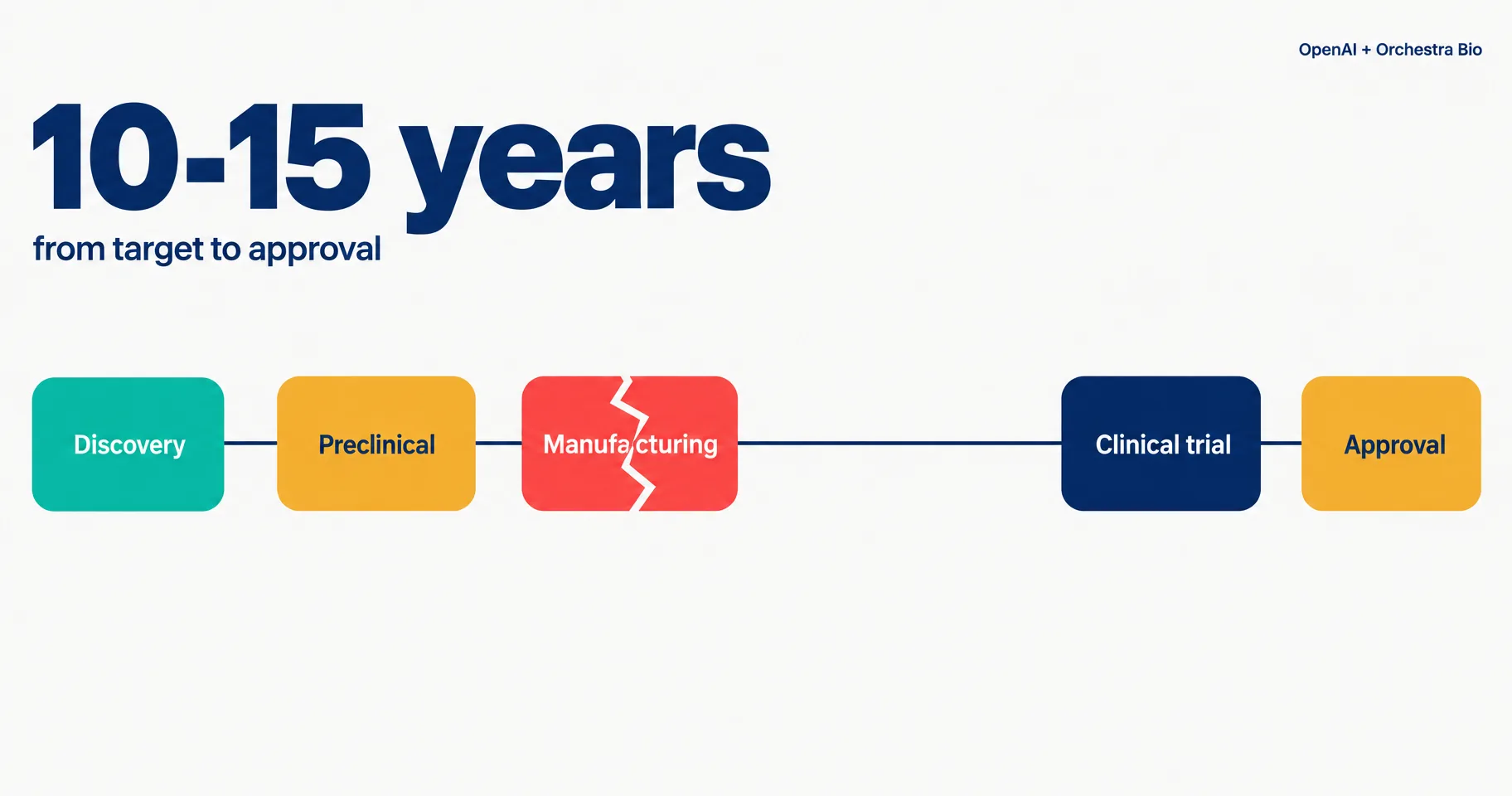
The example OpenAI chose is a dependency chain. “A failed manufacturing batch, for example, can delay the start of a clinical trial.” The agents “identify which activities and timelines are affected, gather the relevant information, and compare ways to respond.” Then the people decide: “Scientists and program leaders can then use that analysis to decide what to do next.”

Orchestra’s own framing draws the same line between agent work and human work: “Agents can handle planning, orchestration, and analysis, while scientists and program leaders focus on the decisions that require their expertise.”
§ 03Where it lands: Rosalind
| Piece | What it does | On the record since |
|---|---|---|
| GPT-Rosalind | Helps scientists reason through questions in biology and chemistry | New capabilities announced June 3, 2026 |
| Rosalind Workbench | Connects those capabilities to scientific tools and data, to analyze results and plan experiments | Named in the Orchestra post |
| Rosalind Academic Plan | A plan aimed at academic researchers, per its title | October 15, 2026 |
| Orchestra Bio | Agents that coordinate drug programs across departments and partners | October 20, 2026 |
The split is clean. Rosalind covered the science: reasoning, designing experiments, reading results. Orchestra covers the operations around the science, the part where one late study quietly pushes back three others. OpenAI’s stated goal for the pair: “Together, we aim to build agents that help teams connect scientific findings with the studies, decisions, and next steps needed to advance a potential medicine.”

OpenAI also points to its pharma partners, Novo Nordisk and Moderna, as the kind of organizations this work depends on.
§ 04Why it matters
Drug development takes, by OpenAI’s count, “roughly 10 to 15 years on average from target discovery to regulatory approval in the United States.” A large share of that time is coordination: programs run across internal departments and outside partners, “often relying on disconnected systems.” Buying Orchestra says OpenAI sees program management, not only chemistry, as a first big job for agents in pharma.
It is also a race. Axios: “Rival AI giants OpenAI and Anthropic are both pushing into science as they look to expand beyond their core competencies in coding and cybersecurity.” Anthropic’s recent science work includes Claude designing antivenom binders.
The pattern travels beyond biotech. An agent that watches a web of deadlines, notices which ones a problem moves, and brings the options to a person is the same job in a product launch, a construction schedule or a client project.
§ 05What is not on the record
- The price and any other terms of the deal.
- How many people from Orchestra are joining OpenAI.
- Whether Orchestra keeps running as a standalone product for current customers. Its site thanks them and points to OpenAI’s post.
- Which biopharma companies use Orchestra today.
§ 06What we are watching for
- A Rosalind product update that names Orchestra’s agents or ships them inside Rosalind Workbench.
- Statements from Orchestra’s customers on continuity of service.
- A response from Anthropic, which Axios names as the rival in this push.
§ 07Sources
- OpenAI, OpenAI acquires Orchestra Bio, October 20, 2026. Read directly.
- Orchestra Bio, Orchestra Bio is joining OpenAI, October 20, 2026. Read directly.
- Axios, OpenAI acquires biotech startup as AI race moves into drug development, Madison Mills, October 20, 2026.
- BiotechTV, Orchestra Bio after exiting stealth with $20 million, August 18, 2025.
Q1When did OpenAI acquire Orchestra Bio?
OpenAI announced it on October 20, 2026, in a post on its site, and Axios reported it as an exclusive the same day. Orchestra’s own site now says it is joining OpenAI.
Q2How much did OpenAI pay?
Neither OpenAI’s post nor Orchestra’s announcement names a price or any other terms.
Q3What is Rosalind?
OpenAI’s life sciences line: GPT-Rosalind helps scientists reason through biology and chemistry, and Rosalind Workbench connects it to scientific tools and data to analyze results and plan experiments.
Q4Will Orchestra keep working for its current customers?
Neither announcement says. Orchestra’s site thanks its customers and points to OpenAI’s post for what comes next.
Q5Does CellCog use OpenAI's models?
CellCog’s agent tiers run on Claude Opus 5.5. We follow OpenAI’s moves because they shape what businesses expect agents to do at work.