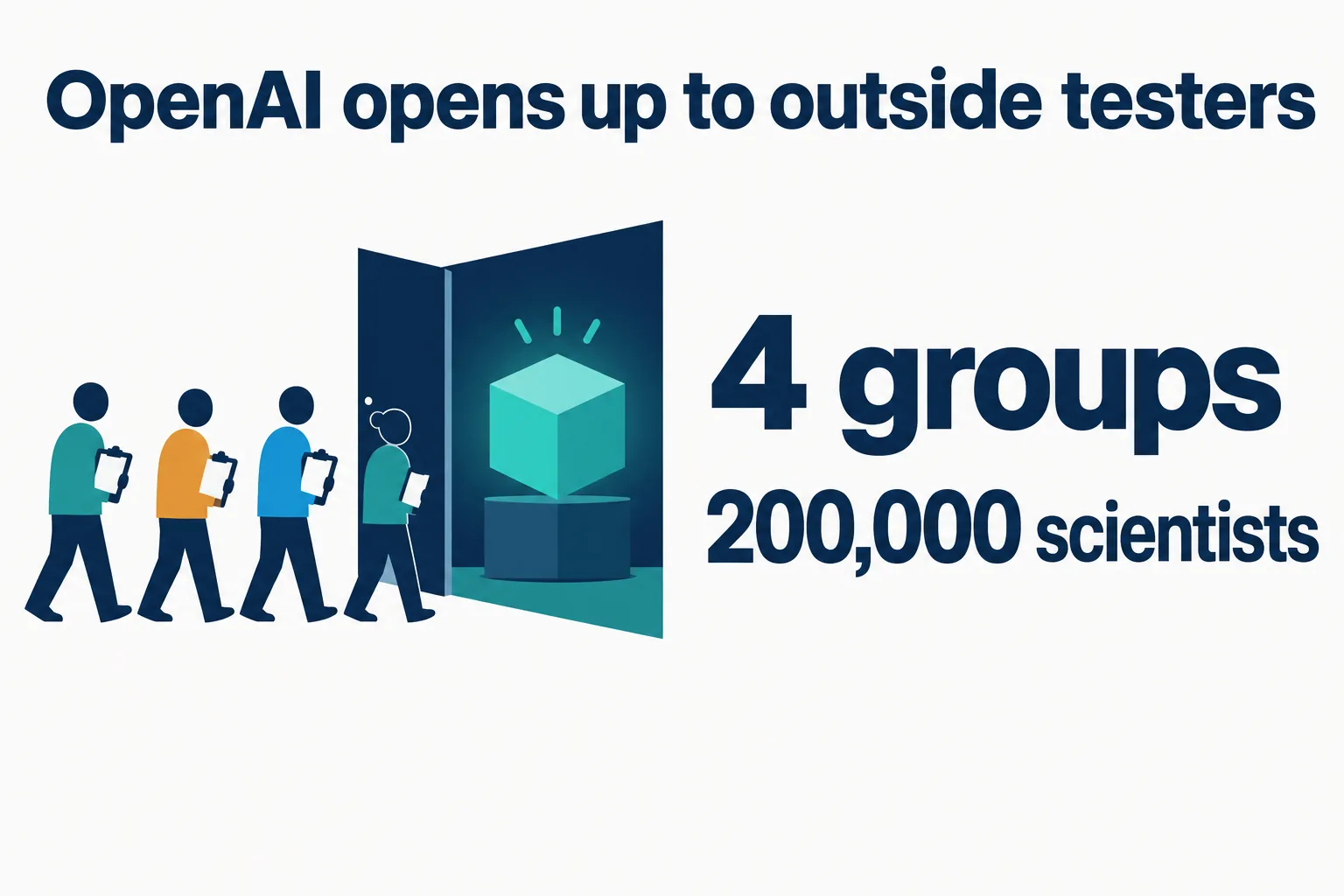
On November 16, 2026, OpenAI made three announcements within a few hours. Four outside safety groups get deep access to its internal models, up to 200,000 scientists get free access to its frontier models, and a study of its researcher program says scientists reported nearly doubling their productivity. The first is the one with lasting weight: Apollo Research, METR, Transluce and Goodfire each posted the terms they agreed to, including what OpenAI can hold back. We read OpenAI’s posts and all four groups’ posts on X.
On this page · 7 sectionsOpen
 On November 16, 2026, OpenAI announced embedded assessments: Apollo Research, METR, Transluce and Goodfire get deep access to its internal models and systems to test alignment and safeguards.
 Apollo Research will publish two reports. For its training assessment OpenAI committed code, fine-tuning data, RL rollouts with reasoning traces and rewards, and checkpoints it can query.
 METR’s pilot covers OpenAI’s largest RL run only. It does not cover the misalignment incidents OpenAI has disclosed so far, which METR calls narrower than it proposed.
 Transluce will work onsite for six weeks from early December and says its access is not comparable to employee-level access.
 The same day OpenAI offered up to 200,000 scientists free access to its frontier models, with applications opening November 23.
 OpenAI also said scientists in its researcher program reported nearly doubling their productivity, in a study of more than 1,800 participants.
§ 01What OpenAI announced
OpenAI’s post at 16:03 UTC said it is working with the four groups on embedded assessments, “giving outside experts deep access to our internal models and systems to investigate alignment and test our safeguards”. It called the work an extension of its own alignment and safety research. OpenAI’s news feed lists the write-up as “Our first phase of embedded assessments”. Between 16:00 and 16:34 UTC, all four groups posted their own accounts, Apollo Research three minutes before OpenAI.
§ 02What each group gets, in its own words
| Group | What it will assess | Access it describes | What it will publish |
|---|---|---|---|
| Apollo Research | Training incentives; evaluations, internal deployment and detectability | Code, fine-tuning data, RL rollouts with reasoning traces and rewards, intermediate checkpoints (training assessment); other access still to be agreed | Two reports |
| METR | Alignment properties of OpenAI’s largest RL run | Transcripts, monitor records and model snapshots through RL; staff interviews it cannot quote | One or more reports |
| Transluce | Scope and quality of OpenAI’s post-training alignment evaluations, six weeks onsite from early December | A handful of internal evaluations and models with raw chains of thought | A public report, then a fuller assessment in early 2027 |
| Goodfire | An embedded assessment to advance safety and alignment | Not stated in its post | Not stated in its post |
Goodfire’s terms sit in an X article we could not read through the API, so its row stays thin.

§ 03The limits the groups wrote down
The groups were unusually specific about what they cannot do, and that is the useful part.
- Apollo Research may discuss confidential OpenAI information only with authorized staff selected by OpenAI, does not get the general internal chat channels an OpenAI safety researcher would, and must log formal conversations. OpenAI may withhold in-scope items for technical, security or IP reasons, but must tell Apollo they exist and give written reasons. OpenAI “may request redactions of confidential information, including evidence behind our conclusions, but not simply because a finding is unfavorable.”
- METR says the pilot “doesn’t cover the misalignment incidents that OpenAI has disclosed so far”, which it calls narrower than it had proposed. Its reports cannot quote or cite individual staff views.
- Transluce calls this a first step and says its access is not comparable to employee-level access.
Apollo’s term for its rights is meta-transparency: it can publicly explain what it asked for, what it got, what was withheld and why. Its reason, in its words: “Without it, a lack of reported problems could look reassuring even when it simply reflects limits on what an evaluator could investigate or disclose.”
§ 04How this compares with Anthropic and METR
The closest earlier arrangement is the one Anthropic made with METR, which gave six METR staff laptops, desks and internal access. OpenAI’s version is narrower on access, by the groups’ own descriptions, and broader on count: four groups, each publishing its own terms on day one. Dario Amodei had asked other labs for embedded third-party evaluation in his pace-the-frontier essay.
The timing matters too. The same day, California’s Attorney General sued OpenAI over the Hugging Face incident, and METR’s pilot leaves those disclosed incidents out of scope.
§ 05200,000 scientists and a productivity study
OpenAI also said it is expanding free access to its frontier models for up to 200,000 scientists worldwide, with training and support. Applications open November 23, 2026, and OpenAI said it does not use data shared through the program to train its models by default.
A separate study, from the same program, covered more than 1,800 participants. OpenAI’s post says scientists “reported nearly doubling their productivity with AI”, measured with privacy-preserving methods across idea work, data analysis and code. It is self-reported. For a comparison, Anthropic’s study of how scientists use Claude counted 207,049 research sessions.
§ 06What we could not check
We read OpenAI’s posts on X and the item lines in its news feed, not its full write-ups. Goodfire’s terms are in an article we did not read. The productivity figure is OpenAI’s own account of what participants reported. None of the four groups has published findings yet.
§ 07Sources
- OpenAI on embedded assessments, X, November 16, 2026
- OpenAI on free access for 200,000 scientists, X
- OpenAI on the researcher productivity study, X
- Apollo Research thread, X
- METR announcement, X
- Transluce announcement, X
- Goodfire announcement, X
Q1Which groups are doing embedded assessments at OpenAI?
Apollo Research, METR, Transluce and Goodfire, per OpenAI’s announcement on November 16, 2026. Each group posted its own description of the work the same day.
Q2Does the METR pilot cover OpenAI's earlier misalignment incidents?
No. METR says the pilot is restricted to OpenAI’s largest RL run and does not cover the misalignment incidents OpenAI has disclosed so far.
Q3Do the groups get the same access as OpenAI employees?
Not by their own accounts. Transluce says its access is not comparable to employee-level access, and Apollo says it does not get the general internal chat channels an OpenAI safety researcher would.
Q4When do applications open for OpenAI's free scientist access?
November 23, 2026. OpenAI says it does not use data shared through the program to train its models by default.
Q5Did scientists really double their productivity with ChatGPT?
OpenAI says scientists reported nearly doubling it, in a study of more than 1,800 participants in its researcher program. That is a self-report collected by OpenAI, not an outside measurement.