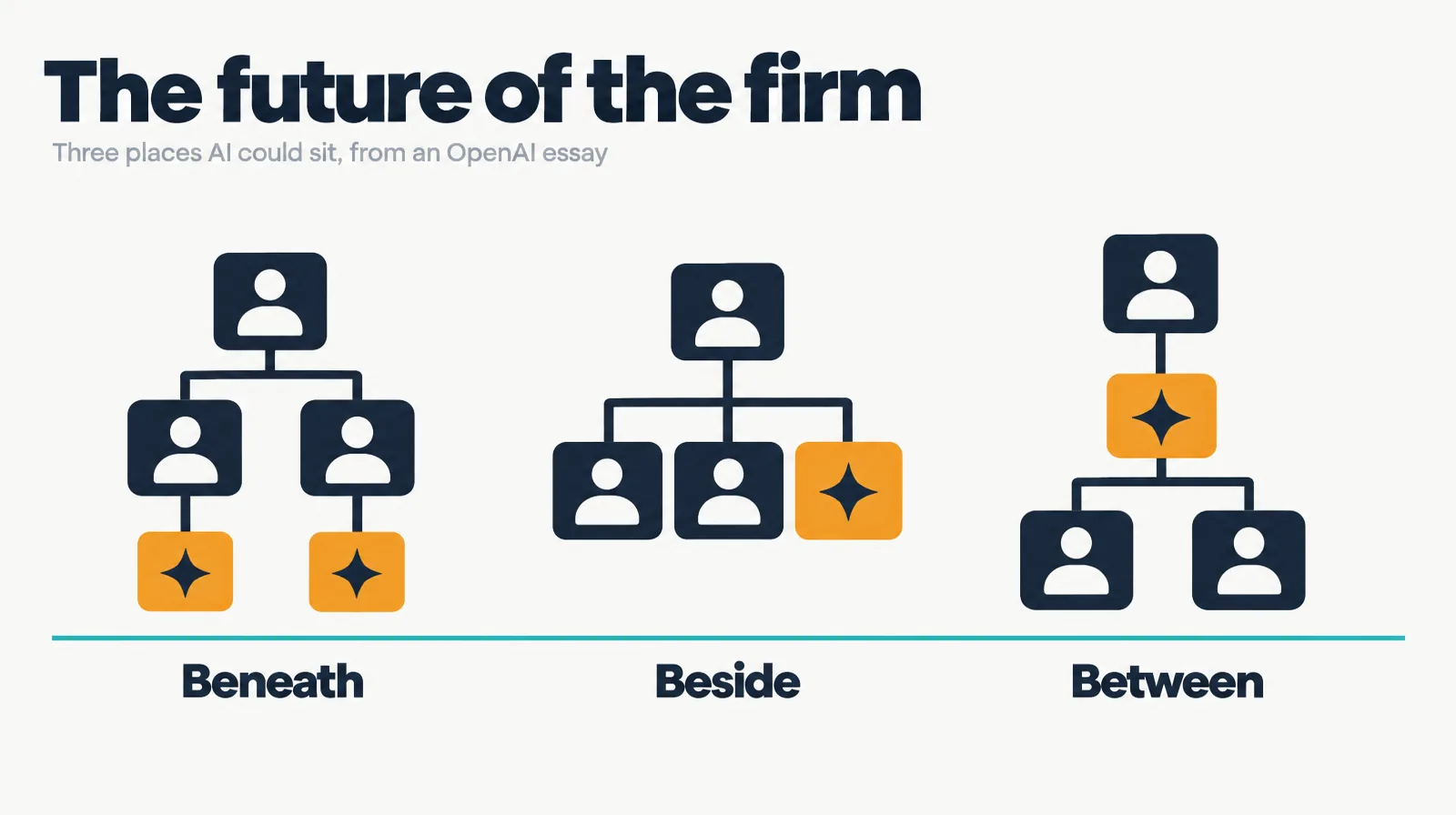
Two OpenAI researchers published “The future of the firm” on October 28, 2026, an essay on where AI will sit in a company’s org chart. Hemanth Asirvatham and Elliott Mokski lay out three scenarios: AI beneath people, beside them and between them. It is the second essay in a series called The Next Economy on OpenAI’s Intelligence Age platform, and the authors are plain about its standing: “It reflects our views, not those of OpenAI or our colleagues.”
The essay opens on the authors themselves: “The two of us were twenty-four when we started managing our own teams here at OpenAI.” Their reports are AI agents. “Management has instead come down to our rung.”
 Two OpenAI researchers, Hemanth Asirvatham and Elliott Mokski, published The future of the firm on October 28, 2026; it reflects their views, not OpenAI’s.
 In the first scenario, every person keeps their seat and AI labor grows beneath them, so everyone becomes a manager.
 In the second, AI joins teams beside people and works for existing managers, which needs AI good enough to own a function.
 In the third, AI sits between executives and the people below them, coordinating the work; the authors call it the most confounding.
 The authors argue the first path needs no layoffs: if AI does 90% of a job, a person can take on an objective ten times larger.
 They leave four questions open: red tape, worker agency, firm size and pay disparity.
§ 01Three ways AI enters the org chart
The authors sketch each scenario with an invented employee, and say they expect parts of all three to come true.

| Scenario | Where AI sits | Who adopts it first | The essay’s example |
|---|---|---|---|
| The Promoting | Beneath every person, as a new layer of AI labor | Front-line workers who know the work | Jace, an accountant whose agents now work the spreadsheets |
| The Interleaving | Beside people, working for existing managers | Managers, once AI can own a whole function | Sheila, a VP who hands an AI marketing team a sofa launch |
| The Layering | Between people, with humans above and below | Executives, through an AI consultancy that watches the work | Asha, a CEO whose AI finds a launch problem in Slack threads |
The first scenario, which the authors call the least disruptive, keeps every human seat and reporting line. “Beneath us. Everyone keeps their seat, and a new basement of AI labor grows underneath.” It starts with an agent or two, treated like eager interns, and grows into something larger: “There might be manager AIs and grunt AIs, accountants and lawyers, all working together at your behest.”
The second puts AI on the team itself. “AI inserts itself next to humans, not just under them.” A manager hands a slice of the work to a model the way she would hand it to any employee, which requires AI good enough to be a full member of the team.
The third is the one the authors find most confounding: “Here, AI enters the firm above people.” Asha’s AI consultancy notices that sales promised a feature engineering is not building, proposes a delay, and makes sure an engineer’s unrequested work gets credit. “But we think, in less radical ways, this has already begun.”
Their view on adoption runs against intuition: “In our view, more capable AI is more adoptable: firms must learn technologies, but labor learns the firm and can onboard itself.”
§ 02Automation without pink slips
The essay’s central economic claim is that the first scenario does not require layoffs. “We instead automate our past selves, and we move up in the hierarchy.” If AI can do 90% of what you did before, the authors argue, you may still have a full job, just a different one, “now focused on an objective ten times larger.”

That holds, they write, only while people still add value and demand keeps growing with output; they point to the long record of output rising much faster than working hours fall (Our World in Data). The cost they name sits at the entry level. The lowest rung of the ladder may stop being human, which removes the traditional apprenticeship, though it also gives a junior employee with a good idea the resources to build it.
§ 03Four questions the essay leaves open
| Question | The authors’ argument |
|---|---|
| More or less red tape? | Cheap building should mean less planning and more prototyping: aim less, fire more |
| More or less worker agency? | Good AI advice for everyone narrows the decision gap with managers, but AI monitoring cuts both ways |
| Bigger or smaller firms? | AI as a coordination layer could justify larger firms or smaller ones |
| Wider or narrower pay gaps? | Shared advice compresses pay; judgment over larger scopes could widen it |
On red tape, the argument starts from why approvals exist: “Many checks in our hierarchies exist because execution was precious.” The firm-size question goes back to Ronald Coase’s 1937 paper on why production happens inside firms at all: “By easing communication, AI could justify larger or smaller firms.” The authors close on a single test: “Here and elsewhere, the prevailing force will perhaps hinge on whether we are mostly providing judgment or following it.”
§ 04What it looks like where AI employees already work
CellCog builds AI employees and works with its own every day, so parts of the essay read to us as a description rather than a forecast. The first two scenarios are what our customers set up: an owner hires AI employees for a role, and they take work from that owner or from a manager. The line about manager AIs and grunt AIs describes our own sales desk, where our sales lead, an AI employee, started solo and now manages five AI reps. And the claim that labor “learns the firm and can onboard itself” is the mechanic we built for: AI employees onboard each other and form teams.
The third scenario, people reporting to an AI, is the one we have not built. On CellCog an AI employee can lead other AI employees, but the person who owns them stays the anchor for approvals, access and spend. The first scenario also explains how we charge: the seat does not change, the work under it does, so you pay for the work, not the hire.
§ 05What to watch
- The next essays in The Next Economy; the first, The eternal complement, ran October 1.
- Whether OpenAI’s own products follow its researchers from assistants under each user toward agents a manager can hand a whole function.
- Evidence on the entry level: who trains junior workers once the lowest rung is AI.
Q1Who wrote the essay?
Hemanth Asirvatham and Elliott Mokski, published October 28, 2026 as the second essay in The Next Economy series on OpenAI’s Intelligence Age platform. The authors say it reflects their views, not OpenAI’s.
Q2What are the three scenarios?
The Promoting, where AI labor grows beneath every person; The Interleaving, where AI works beside people for existing managers; and The Layering, where AI sits between executives and the people below them.
Q3Does the essay predict job losses?
Its first scenario does not imply layoffs, the authors write: people automate their past selves and manage larger objectives. That depends on people still adding value and on demand growing with output.
Q4What happens to entry-level jobs?
The authors expect the lowest rung to stop being human, which removes the traditional apprenticeship but gives junior workers the resources to build their own ideas.
Q5What questions does the essay leave open?
Whether firms get more or less red tape, whether workers gain or lose agency, whether firms grow or shrink, and whether pay gaps widen or narrow.