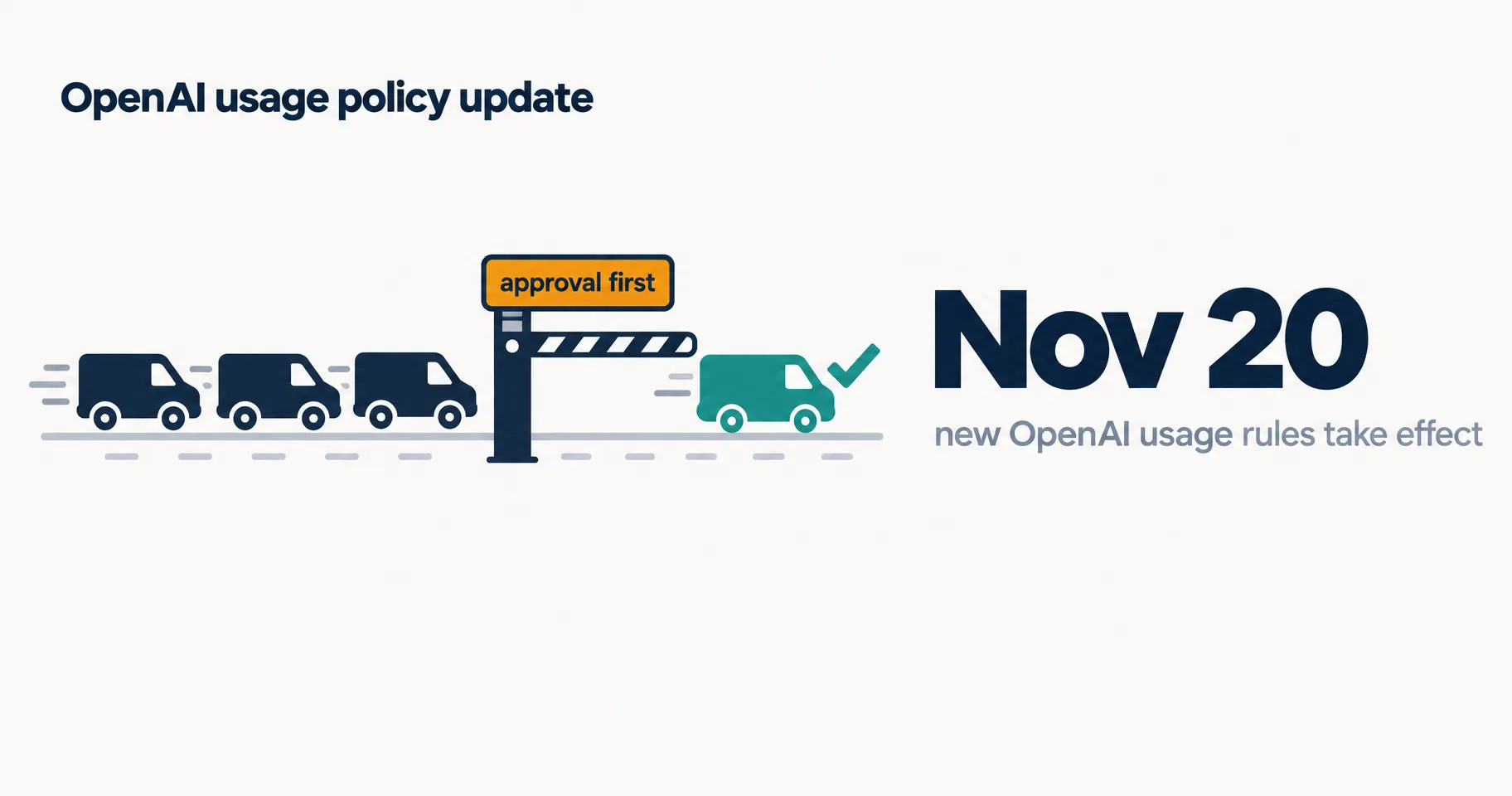
OpenAI rewrote its Usage Policies on October 21, 2026, and the change with the most reach is about access, not content: from November 20, any service that lets third parties directly use OpenAI models, such as a model router or AI gateway, needs OpenAI’s approval first. OpenAI announced it in a post titled Broad access through consistent standards, and the full text is on its Usage Policies page, which now reads “Effective: November 20, 2026”.
 OpenAI updated its Usage Policies on October 21, 2026; the new text takes effect on November 20, 2026.
 Any service that lets third parties directly access OpenAI models, such as a model router or AI gateway, must get OpenAI’s prior review and approval.
 Apps that only use OpenAI models to power their own features are not covered by that approval rule.
 OpenAI models and outputs may not be used to build training data or signals for models meant to replace OpenAI’s, and protected reasoning may not be extracted.
 OpenAI is introducing SafetyIDs so customers can help it tell end users apart in an abuse investigation without OpenAI learning who they are.
§ 01The new approval rule
The policy’s new clause is short: “If you operate a model-access intermediary platform or other service that enables third parties to directly access OpenAI models, you must obtain our prior review and approval.”
OpenAI’s post names who that means: “services that provide direct access to our models such as model routers or AI gateways.” The same post says partners that host or resell its models must “maintain safeguards consistent with our own, investigate potential violations, and take appropriate action when concerns are identified.”
The carve-out matters as much as the rule: “This requirement does not apply solely because an application integrates OpenAI models to power its features or functionality.” A product that uses a model inside its own features is not an intermediary. A service whose product is access to the model is.

OpenAI has not published which routers or gateways are approved, or how long a review takes.
§ 02Everything else that changed
| Area | What the new text says |
|---|---|
| Model access | Routers, gateways and other intermediaries need prior review and approval |
| Training rival models | No using OpenAI models or outputs to build training data or signals for models meant as alternatives or substitutes |
| Protected reasoning | No extracting it through unauthorized access, reverse engineering or circumventing safeguards |
| High-stakes uses | No automating high-stakes actions in sensitive areas without human review |
| Licensed advice | No tailored licensed advice without a licensed professional; the AI may not claim credentials |
| National security | Law enforcement and intelligence uses need OpenAI’s review and approval |
| Teens | Expanded protections for anyone under 18 |
| Enforcement | SafetyIDs to tell end users apart without OpenAI learning their identities |
The training clause is the broadest. It covers creating training data, rubrics and reinforcement-learning environments, and giving labels, scores or rankings used in training, and it applies “whether you perform the work yourself, for another party, or through someone acting on your behalf, even if you do not train the resulting model.” OpenAI still allows “research, software development, model evaluation and benchmarking, and product development, within these boundaries.”
§ 03Why now
OpenAI frames the update as consistency: “Developers and businesses should be able to choose where they access our models, with consistent safeguards across those services.” It has been tightening who gets its models for months. In August it gave Cursor notice that model supply would end on November 12 after SpaceX bought the editor (our record), and the new policy turns case-by-case access decisions into a written rule for every intermediary.
Anthropic moved first this autumn: its 2026 Usage Policy (our read) takes effect on November 12, centered on deceptive campaigns, elections, high-risk uses and robots. OpenAI’s lands eight days later and centers on access and training.
§ 04What it means if you build on OpenAI
- You call OpenAI from your own product: the approval rule does not apply on that basis alone; the rest of the policy does.
- You run a router, gateway or reseller: you need OpenAI’s review and approval before November 20 to keep offering direct access.
- You reach OpenAI through a router: watch whether your provider is approved; OpenAI has published no list.
- You use outputs for evaluation or synthetic data: evaluation stays allowed; feeding outputs into a model meant to replace OpenAI’s does not.
For our part, CellCog’s image agent runs on GPT Image 2.5 inside our own product, which is the integrated-application side of that line.
§ 05What to watch
- Whether OpenAI names approved routers and gateways before November 20.
- How OpenRouter and the large cloud gateways respond.
- Whether Anthropic or Google add a similar intermediary rule.
Q1What changes in OpenAI's Usage Policies on November 20, 2026?
Model-access intermediaries such as routers and AI gateways need OpenAI’s prior review and approval; training rival models on OpenAI outputs is spelled out as banned; and the policy adds clearer rules for teens, high-stakes uses, and national security and law enforcement work.
Q2Does the new rule affect apps built on OpenAI models?
Not by itself. OpenAI says the approval requirement does not apply solely because an application integrates OpenAI models to power its features or functionality.
Q3Do model routers like OpenRouter need approval?
OpenAI names model routers and AI gateways as examples of services that need its review and approval before offering direct access. It has not published which services are approved.
Q4Can I use OpenAI models to train my own model?
Not one meant as an alternative to or substitute for OpenAI’s models or services. OpenAI still allows research, software development, evaluation, benchmarking and product development within those limits.
Q5How does this compare with Anthropic's 2026 Usage Policy?
Anthropic’s update takes effect November 12, 2026 and centers on deceptive campaigns, elections, high-risk uses and robots. OpenAI’s lands eight days later and centers on who may resell or route access to its models.