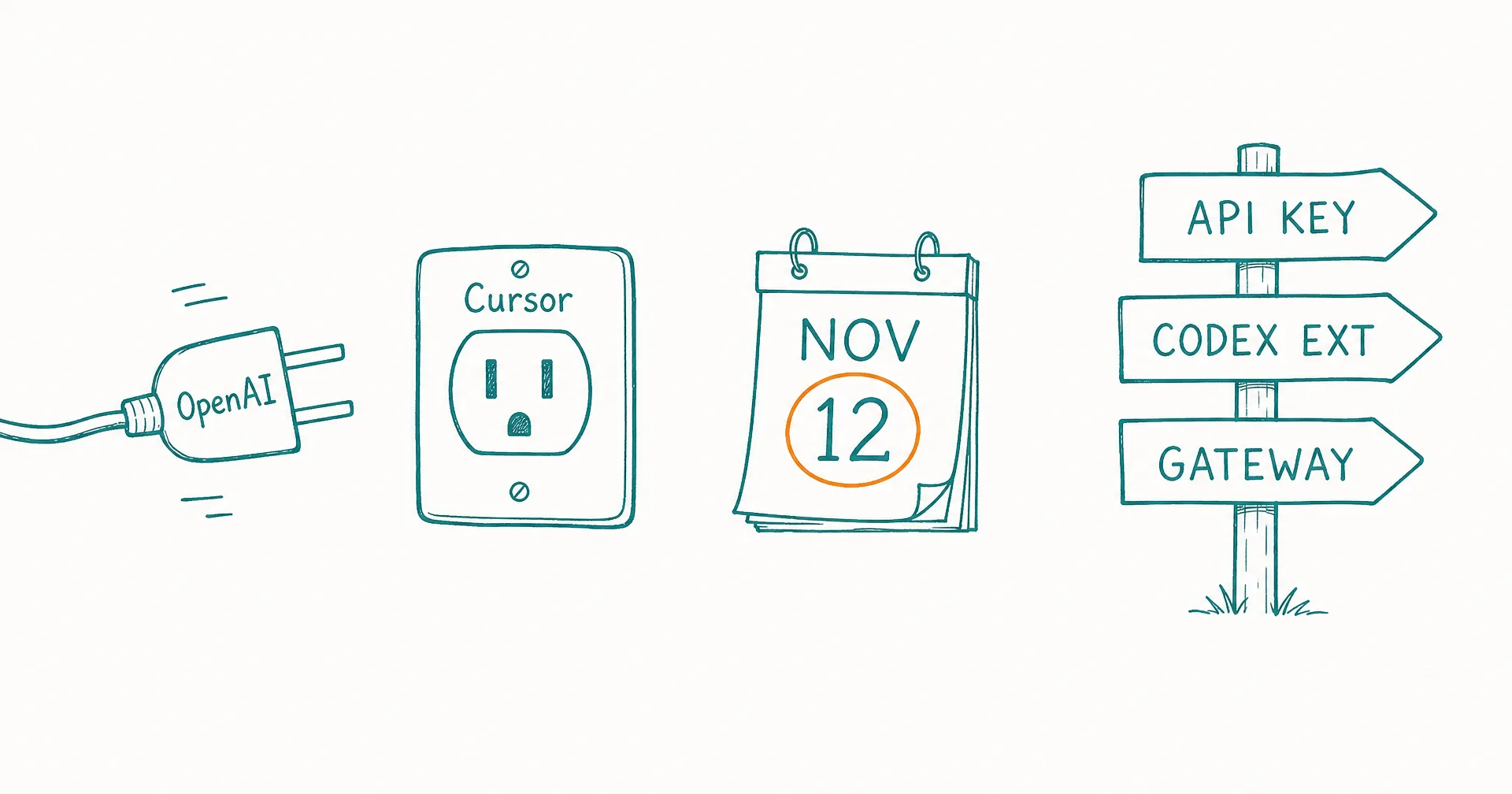
On the evening of August 28, 2026, OpenAI announced that it intends to wind down the contract under which it supplies models to Cursor, the AI code editor that became a SpaceX subsidiary two weeks earlier. The proposed shutoff date is November 12, 2026. Cursor CEO Michael Truell replied on X at 10:52 PM the same night: OpenAI models serve about 5 percent of Cursor user traffic, and the two companies are talking.
Both halves of the story are short, public, and quotable, and most coverage will stop at the headline. This page is the factual record underneath it: what OpenAI actually said and why, what Cursor answered, exactly which workflows are affected, and the three supported routes for keeping OpenAI models inside Cursor after the shutoff. The dates can still move (November 12 is proposed, not confirmed), so this is a living page: when the story changes, the update lands here, same day.
On this page · 6 sectionsOpen
- On August 28, 2026, OpenAI announced it intends to wind down its contract supplying models to Cursor, with a proposed shutoff of November 12, 2026 - described as the maximum notice the contract allows.
- The stated reason is trust, not economics: OpenAI says it cannot be confident that SpaceX will use its technology within its terms of service, citing Twitter’s contract breach and Musk’s under-oath admission that xAI violated OpenAI’s terms.
- The move exercises a change-of-control clause: SpaceX’s all-stock acquisition of Cursor closed August 14, and OpenAI’s custom contract allows cancellation within a limited window after ownership changes.
- Astra, OpenAI’s upcoming model, is excluded outright: whatever it turns out to be, Cursor will not receive it under the existing contract.
- Cursor CEO Michael Truell responded the same night: OpenAI models serve about 5 percent of Cursor user traffic, and the companies are in talks to resolve it.
- Users keep three routes to OpenAI models inside Cursor - bring-your-own API key, the Codex IDE extension, and AI gateways - but none covers Tab, Auto routing, Cloud or Background Agents, Automations, the CLI, or the SDK.
- This is a living page: dates and terms are re-verified against both companies’ statements, and updates land here same day.
§ 01The record so far
| Date (2026) | Event |
|---|---|
| April 19 | SpaceX and Cursor sign a compute and collaboration agreement; SpaceX receives an option to acquire the company |
| June 16 | SpaceX exercises the option and signs a definitive merger agreement with Anysphere, Cursor’s maker |
| August 14 | The acquisition closes in an all-stock deal; Cursor becomes a wholly owned SpaceX subsidiary |
| August 26 | Grok Bot is bundled into Cursor Pro and all Cursor Teams plans |
| August 28 | OpenAI announces the contract wind-down, proposes the November 12 shutoff, and says its upcoming Astra model will not be provided to Cursor at all |
| August 28, 10:52 PM ET | Truell responds: about 5 percent of Cursor user traffic runs on OpenAI models; the companies are in talks |
| November 12 | Proposed shutoff, described by OpenAI as the maximum notice its contract allows; not yet confirmed by both companies |
§ 02What OpenAI actually said
OpenAI’s post is barely 350 words and unusually blunt. The reason given for the wind-down is not commercial: “We are making this choice because we cannot be confident that SpaceX will use our technology within our terms of service, based on our experience with Elon Musk’s companies violating contracts.”
The evidence it cites is specific. After Musk acquired Twitter, now part of SpaceX, the company “broke the terms of our contract (alongside many others).” And under oath earlier this year, Musk “admitted that xAI, now also part of SpaceX, had violated OpenAI’s terms of service (terms which are similar to xAI’s own).”
Two structural details matter more than the rhetoric:
- The change-of-control window. OpenAI’s custom agreement with Cursor gives it a limited time window to cancel after a change of control. The SpaceX acquisition closed August 14; this announcement is that clause being exercised, held “to the latest date we can” so developers get maximum notice.
- Astra is excluded immediately. OpenAI says it will not provide future models to Cursor, naming Astra, its upcoming model, directly. Whatever Astra turns out to be (our Astra tracker collects the full dated record), Cursor users will not get it through Cursor’s own model supply.
The post closes warmly toward Cursor itself: nearly four years of partnership, “enormous respect” for the team and product, and a promise to “go above and beyond” to support affected developers. The quarrel, in OpenAI’s framing, is with SpaceX’s compliance record, not with Cursor.
§ 03Cursor’s answer, and what 5 percent means
Truell’s full response, posted at 10:52 PM ET:
“We’re sorry to see that OpenAI put out a note saying they plan to block Cursor users from accessing OpenAI models in three months. OpenAI models serve about 5% of Cursor user traffic, and we’re speaking with the OpenAI team to resolve this. Cursor was one of the very first users of OpenAI, we’ve worked closely with their team for years, and we’ve trusted their platform to be neutral infrastructure for our business.”
Three things live in those three sentences:
- The number. About 5 percent of user traffic runs on OpenAI models. That is Cursor saying: survivable. It is also a measure of how far Cursor’s center of gravity has already moved to its own routed models and, since the acquisition, the Grok family.
- The framing gap. Truell says OpenAI plans to “block Cursor users from accessing OpenAI models.” OpenAI’s own support guidance is narrower: the wholesale supply ends, while users can still run OpenAI models inside Cursor through accounts they control (next section). Both descriptions are defensible; what dies is the built-in route.
- “Neutral infrastructure.” That phrase is the real story. The assumption that frontier model APIs are neutral infrastructure, available to any paying product regardless of who owns it, just took its most public hit yet.
§ 04Keeping OpenAI models in Cursor: the three routes
OpenAI published support guidance alongside the announcement. Until the shutoff, nothing changes: Cursor keeps access to the OpenAI models it uses today, which per Cursor’s own model docs are GPT-5.6 Sol, Terra, and Luna. After that, three routes remain, all user-managed:
| Route | How it works | What it covers | Billing |
|---|---|---|---|
| Bring your own API key | Paste an OpenAI API key under Cursor Settings, then Models; enable and select the model | Local Chat and Agent sessions only | Your OpenAI API account, at API rates |
| Codex IDE extension | Install OpenAI’s Codex extension inside Cursor; sign in with ChatGPT or an API key | A separate Codex agent panel; does not change Cursor’s own model picker | An eligible ChatGPT subscription, or API rates |
| AI gateway | Connect through Amazon Bedrock, Azure, or an OpenAI-compatible gateway such as OpenRouter | Local Chat and Agent sessions only | Your provider account |
The shared fine print is the part that matters. None of these routes covers Cursor Tab and autocomplete, Auto model routing, Cloud or Background Agents, Automations, the Cursor CLI, or Cursor’s API and SDK. Those features run on models Cursor supplies or routes itself, and after the shutoff that pool simply will not include OpenAI models. A ChatGPT subscription also does not include API usage, so bring-your-own-key means paying OpenAI’s API rates on top of a Cursor plan.
For most individual users, the honest summary: the day-to-day loss is small (pick a different model in the picker, or pay twice to keep GPT-5.6 in local chat), and the structural loss is that Cursor’s routed and background features become OpenAI-free zones.
§ 05The bigger story: model supply is now strategy
Read the last month of Cursor news one line at a time. August 14: Cursor becomes part of SpaceX. August 26: Grok Bot is bundled into Cursor plans. August 28: OpenAI pulls its models. What is disappearing is the polite fiction that the model layer and the product layer are separate businesses. Labs own harnesses now, and harnesses are owned by labs. When your editor belongs to one lab, a rival lab’s models stop being a dropdown option and start being a contract risk.
For developers, the practical lesson is about what you build a workflow on. Model access inside any single tool now depends on relationships between companies that compete with each other, and those relationships can end on a few months’ notice.
§ 06Update log
This is a living page; when the story moves, the update lands here. As of August 29, 2026: the wind-down notice is public, November 12 is proposed but not confirmed, and the companies say they are talking. What we are watching: the confirmed termination date, any resolution that preserves supply, whether Astra’s exclusion holds, and Cursor’s own migration guidance to its users.
August 29, 2026 - the other two corners respond. Overnight, the story picked up its remaining voices. At 11:28 PM ET, Anthropic co-founder and Chief Compute Officer Tom Brown posted the counter-programming: “Cursor has been a trusted partner of Anthropic since Sonnet 3.5. We’ll continue to increase compute to support Claude models in Cursor and are excited for what comes next with them at SpaceX.” One lab’s contract risk is another lab’s expansion opportunity - Anthropic publicly committing more compute to Cursor within two hours of OpenAI’s exit notice is the neutral-infrastructure thesis playing out in real time. Then at 1:32 AM ET, Elon Musk replied to Truell’s post: “I couldn’t care less,” followed by personal insults aimed at Sam Altman and Greg Brockman and a repeat of his long-running claim that they “stole an open source nonprofit.” Read together, the responses sort the dispute cleanly: Cursor treats it as a supplier issue to resolve, Anthropic treats it as a market opening, and Musk treats it as the feud it grew out of. Nothing in either post changes the mechanics above - November 12 remains proposed, the talks Truell described remain the live variable.
Q1When does Cursor lose OpenAI models?
The proposed shutoff is November 12, 2026, which OpenAI describes as the maximum notice its contract allows. It is not final: OpenAI says the official date will be shared once both companies confirm it, and Cursor may choose to end access sooner. Until then, Cursor keeps access to the OpenAI models it uses today.
Q2Why is OpenAI cutting Cursor off?
In OpenAI’s own words, because it cannot be confident that SpaceX will use its technology within its terms of service. The announcement cites Twitter breaking its OpenAI contract after Musk’s acquisition, and Musk admitting under oath that xAI violated OpenAI’s terms. Mechanically, OpenAI is exercising a change-of-control clause triggered by the SpaceX acquisition closing on August 14.
Q3Can I still use GPT-5.6 in Cursor after the shutoff?
Yes, three ways: paste your own OpenAI API key in Cursor’s model settings (billed at API rates through your OpenAI account), install the Codex IDE extension inside Cursor (its own agent panel, signed in with ChatGPT or an API key), or route through a gateway like Amazon Bedrock or Azure. All three cover only local Chat and Agent sessions - not Tab, Auto, Cloud or Background Agents, Automations, the CLI, or the SDK.
Q4What is Astra, and why is it named in the announcement?
Astra is OpenAI’s upcoming model. Its capabilities and release date are unannounced, but OpenAI has said it is trained to enable persistent agents and may meet the Critical cybersecurity threshold in its Preparedness Framework. The Cursor announcement states OpenAI will not provide future models, including Astra, to Cursor - so the exclusion is immediate and total for anything new.
Q5Does this affect Grok models in Cursor?
No. Cursor is a SpaceX subsidiary and Grok is the house model family: Grok 4.6 launched inside Cursor in August, and Grok Bot has been bundled with Cursor Pro and Teams plans since August 26. This split affects only OpenAI-supplied models.
Q6How much of Cursor actually runs on OpenAI models?
About 5 percent of Cursor user traffic, per CEO Michael Truell’s response. There is no third-party verification; it is the only usage number either company has given.