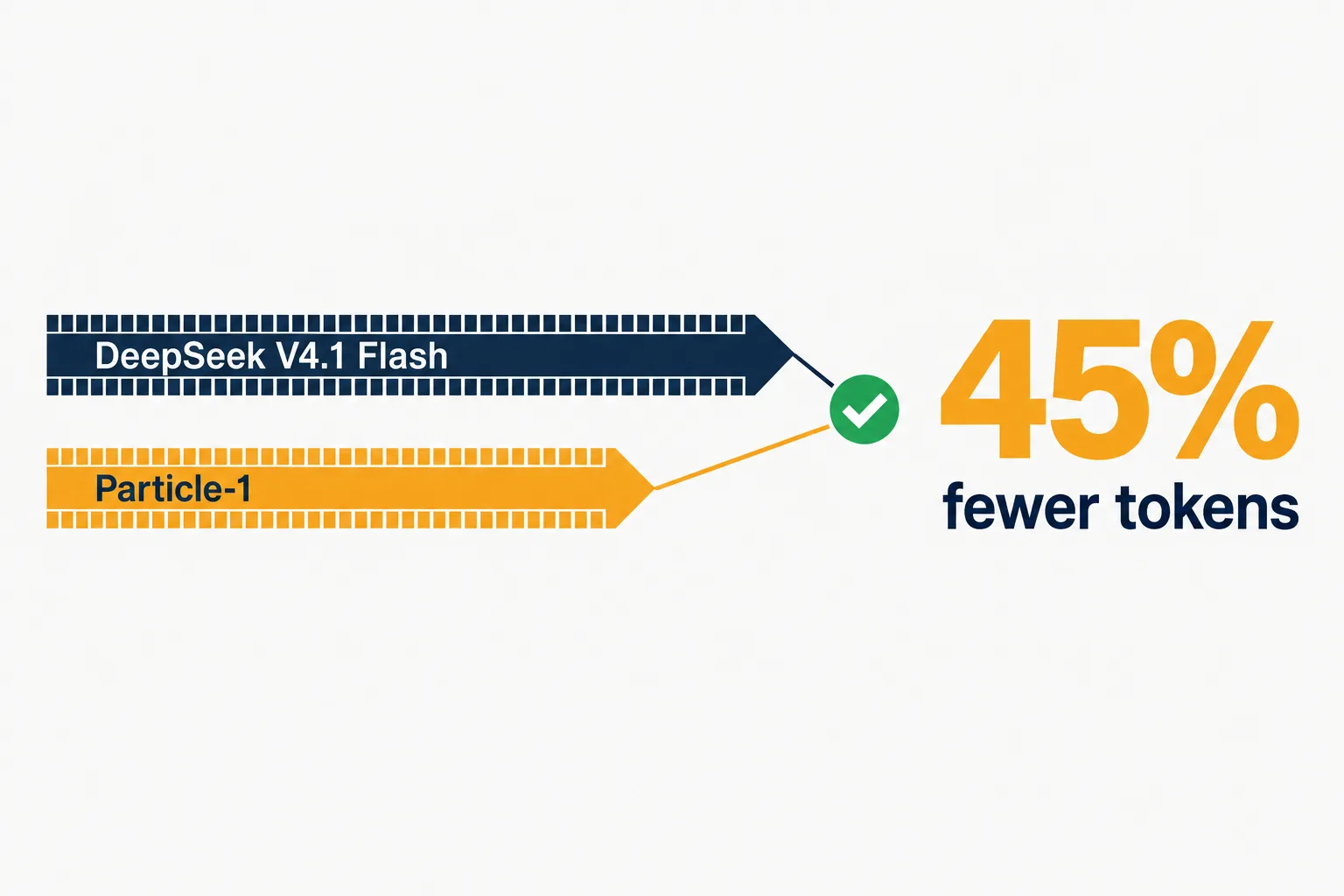
Suhail Doshi, co-founder of Mixpanel, launched a new company on October 28, 2026, and it shipped one model. His announcement on X went up at 17:36 UTC: “Excited to announce our new company Particle.” The model, Particle-1, is DeepSeek V4.1 Flash post-trained for a single goal: “With particle-1, we focused on token efficiency and managed to keep parity in performance while using ~45% fewer tokens.” Particle-1 is live on Particle’s own API and on OpenRouter.
The pitch is aimed squarely at agents. Box CEO Aaron Levie, quoting the launch: “Agents are going to consume 1,000X more tokens than we consume today.” When you pay by the token, a model that finishes the same job with fewer of them is a price cut you never had to negotiate. Every benchmark number below comes from Particle’s launch post, and as of October 29 no outside lab has rerun them. We read that post, OpenRouter’s model listing and DeepSeek’s price page on October 29.
On this page · 8 sectionsOpen
 Particle-1 is DeepSeek V4.1 Flash with a rank-64 LoRA adapter, about 1.25% of its parameters, trained by Suhail Doshi’s new company Particle and launched October 28, 2026.
 Particle reports about 45% fewer tokens on average, and 28.4% to 52.2% fewer output tokens per benchmark, across four coding benchmarks.
 Pass rates stay within the base model’s confidence intervals: 72.57% for Particle-1 against 71.15% for DeepSeek V4.1 Flash, pooled.
 At identical token prices, cost per coding task falls from $0.3368 to $0.2211, per Particle.
 OpenRouter lists Particle-1 at $0.25 input and $1.00 output per million tokens, above DeepSeek’s own $0.15 and $0.60 off-peak, so the saving depends on where you buy.
 About 90% of the savings come from shorter reasoning, and pushing the adapter to 8x cuts 78.7% of tokens but drops passing reports to 3 of 8.
§ 01Where the tokens go

Particle compared runs on the same task and seed where both models passed, then read the trajectories side by side. The cleanest case is a calendar task from Terminal-Bench 2.1: “Both models produced the correct calendar event using four model calls and six commands”. The actions matched. What differed was the talk around them. The final completion and confirmation fell from 5,193 tokens to 1,078, and total output fell from 11,023 to 4,977.
Particle names four patterns: less reasoning for the same actions, stopping once a verified task is done, fewer rounds of trial and repair, and narrower exploration. By its count, “Reasoning tokens account for roughly 90% of the token savings on Terminal-Bench 2.1, ReactBench, and ADE.” On DeepSWE 1.1, tool-call text accounts for about 30 percent of the savings.
The post also flags its own caveat. In one ADE Bench case Particle-1 reused an existing key macro where the base model built a new one, and Particle writes that “the savings also reflect a different solution rather than merely a shorter explanation of identical work.” A shorter run is not always the same run, and Particle says so itself.
§ 02The numbers, averaged over four coding benchmarks
| Model | Cost per task | Output tokens per task | Pass rate |
|---|---|---|---|
| Particle-1 | $0.2211 | 59,580 | 72.57% |
| DeepSeek V4.1 Flash | $0.3368 | 83,246 | 71.15% |
| GLM 5.3 Flash | $0.6523 | 98,155 | 66.82% |
The four benchmarks are Terminal-Bench 2.1, ReactBench, ADE Bench and DeepSWE 1.1, all run through the Terminus 2 agent with 16 rollouts per task. On each one, Particle reports 28.4 to 52.2 percent fewer output tokens and 34.4 to 51.6 percent lower cost per task than DeepSeek V4.1 Flash, and “Pass@1 rates are within the confidence intervals of the base model.” The cost column prices Particle-1 and its base at identical rates ($0.30 per million uncached input, $0.006 cached, $1.20 output, at a fixed 95 percent cache hit rate), so the gap comes from tokens alone.
Two readings of that table. First, pooled across the four benchmarks, mean output falls from 83,246 to 59,580 tokens, a cut of 28.4 percent. The 45 percent headline is an average taken across tasks, so short tasks with large percentage cuts count as much as long ones (our reading of Particle’s wording). Second, accuracy outside coding barely moved: GPQA Diamond 90.40 percent against 90.91 for the base, Tau Airlines 86.00 against 88.00, MMLU 86.08 against 85.98, and BabyVision with tools 89.18 against 89.60.
§ 03What Particle-1 is
Particle-1 is not a new base model. Particle trained a rank-64 LoRA adapter over the experts in every layer of DeepSeek V4.1 Flash, about 1.25 percent of the model’s parameters. The training was reinforcement learning in coding and data-engineering environments that Particle built itself, with a reward that pays for solving the task in fewer reasoning and tool-call tokens. The stack is Miles, RadixArk’s open-source RL framework, with Group Sequence Policy Optimization; Particle writes that a token-level loss “oscillated and eventually diverged.” In its own words: “This first release focuses on software engineering.”
OpenRouter lists particle-ai/particle-1 with a 1,048,576-token context. As of October 29, 13:05 UTC, there was no Particle-1 repository on Hugging Face, so the weights are not public.
§ 04The dial: how far the squeeze goes
Particle also ran an experiment that most launch posts would leave out. It took a contract-review task from Harvey LAB (read four legal documents, check an arbitration clause against the institution’s rules, write a Word report) and scaled the adapter’s strength from 0.25x to 8x.

| Adapter strength | Fewer output tokens than base | Reports passing every criterion |
|---|---|---|
| 1x (shipped) | 24.6% | 8 of 8 |
| 2x | 47.8% | one or two reports miss one criterion |
| 4x | 60.2% | one or two reports miss one criterion |
| 8x | 78.7% | 3 of 8 pass the strict check |
At the shipped 1x setting, all eight reports passed every criterion. The base model scored 62.5 percent on the same task while writing the most tokens. Past 1x the savings keep growing but answers start losing content, and at 8x only three of eight reports pass. Particle reads it plainly: aggressive scaling “compresses useful qualifications along with redundant analysis.” This is one task, and it is the most honest chart in the launch: token efficiency has a floor, and Particle shipped the setting just above it.
§ 05What it costs to run
OpenRouter lists Particle-1 at $0.25 per million input tokens and $1.00 per million output tokens (read October 29). DeepSeek’s own API charges $0.15 input and $0.60 output for V4.1 Flash off-peak, double that at peak, and several hosts charge $0.30 and $1.20, the rates Particle used in its table. Particle-1 costs more per token than DeepSeek’s first-party price and uses fewer tokens, so the two effects partly cancel.
On output alone, using Particle’s mean output per task, that comes to $0.060 a task for Particle-1 at the OpenRouter rate, against $0.050 for DeepSeek off-peak and $0.100 at DeepSeek’s peak or host rate (our arithmetic from the listed prices). If you buy DeepSeek direct at night, the saving on output is gone. If you pay host rates or run in daytime, it is real. Particle makes a second argument that holds either way: “tasks finish sooner which is good for end-users.”
§ 06Our read
CellCog does not route to Particle-1. Every CellCog tier runs on Claude Opus 5.5. We still follow this closely, because the bill for agent work is mostly tokens spent thinking, and Particle shows that a small, cheap adapter can remove a large share of them without moving accuracy, as long as you stop turning the dial before answers start to thin. On CellCog you pay for the work, not the hire, and the cost depends purely on how much work you assign. A model that does the same work in fewer tokens is the same goal approached from the model side.
§ 07What we are watching
- An independent rerun. Every number here is Particle’s own. Third-party Terminal-Bench or DeepSWE runs on Particle-1 are what turn a launch table into a comparison.
- Weights and license. The base is MIT-licensed DeepSeek V4.1 Flash; whether Particle opens its adapter is not stated.
- Particle’s own API price. OpenRouter’s listing is the only public price as of October 29.
- The next domains. Particle says it plans to bring the method to other domains, and the Harvey LAB result is its first look outside coding.
§ 08Update log
As of October 29, 2026, 13:20 UTC: animated explainers added under Where the tokens go and The dial.
As of October 29, 2026, 13:12 UTC: page opened from Particle’s launch post (October 28), Suhail Doshi’s announcement at 17:36 UTC, OpenRouter’s listing and DeepSeek’s price page.
Q1Who made Particle-1?
Particle, a new company announced on October 28, 2026 by Suhail Doshi, co-founder of Mixpanel. Particle-1 is its first model and focuses on software engineering.
Q2Is Particle-1 a new base model?
No. It is DeepSeek V4.1 Flash with a rank-64 LoRA adapter over the experts in every layer, about 1.25% of the model’s parameters, trained with reinforcement learning to use fewer reasoning and tool-call tokens.
Q3Is it as accurate as DeepSeek V4.1 Flash?
On Particle’s four coding benchmarks, pass rates are within the base model’s confidence intervals: 72.57% pooled against 71.15%. Outside coding, GPQA Diamond is 90.40% against 90.91% and MMLU 86.08% against 85.98%. All numbers are Particle’s own.
Q4Is Particle-1 cheaper than DeepSeek V4.1 Flash?
It depends on where you buy. OpenRouter lists Particle-1 at $0.25 input and $1.00 output per million tokens. DeepSeek charges $0.15 and $0.60 off-peak and double at peak. On output, Particle-1 costs about $0.060 per task against $0.050 off-peak and $0.100 at peak or host rates.
Q5Are the Particle-1 weights open?
Not as of October 29, 2026. There is no Particle-1 repository on Hugging Face, and Particle has not said whether it will publish the adapter.
Q6Does CellCog use Particle-1?
No. Every CellCog tier runs on Claude Opus 5.5. We track token-efficient models because the cost of agent work is mostly tokens spent reasoning.