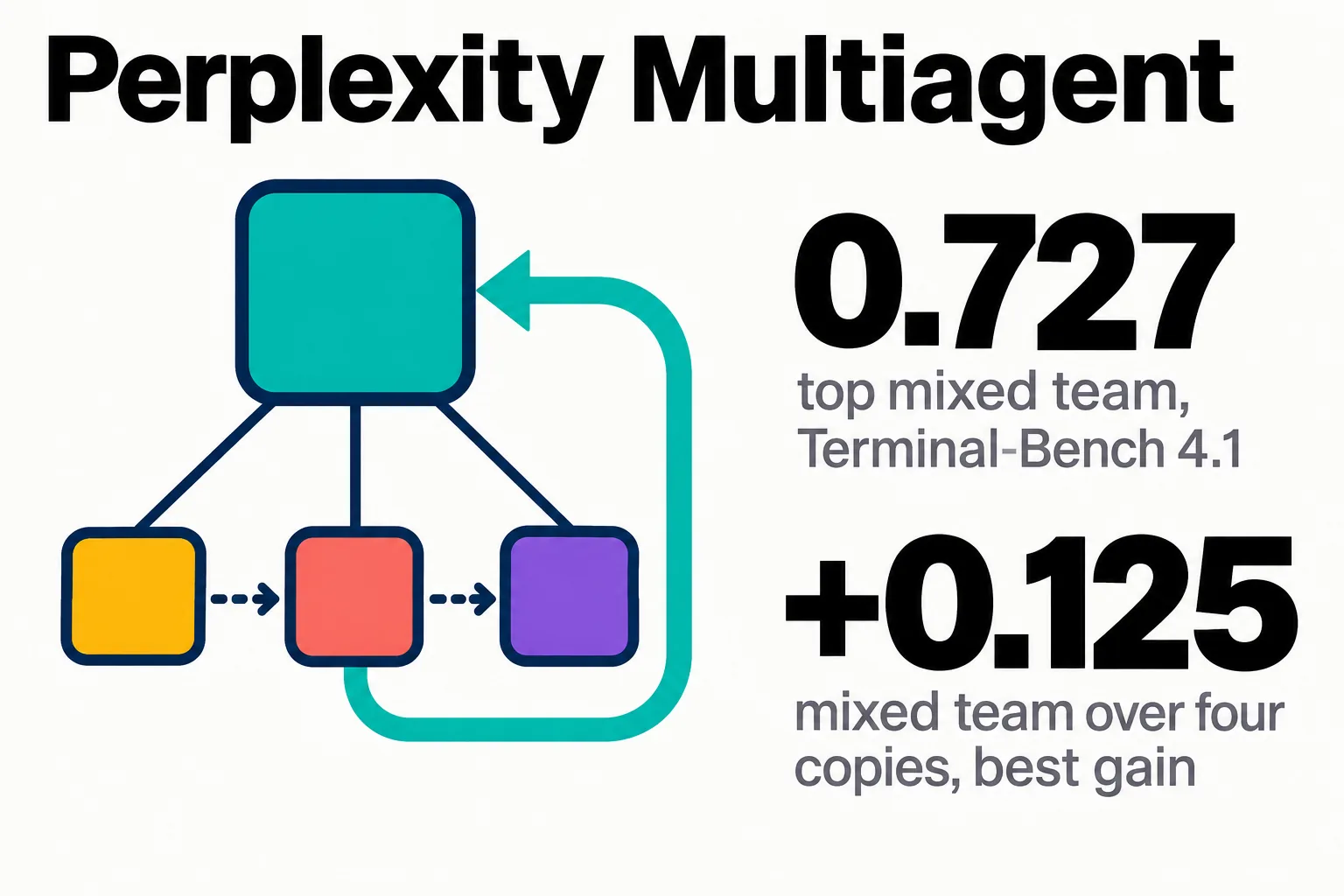
Perplexity has added Multiagent, a new effort level in Computer and teammates. A lead agent splits a task across a team of agents that run on different frontier models, the agents share findings as they work, and the lead combines everything into one answer. Perplexity announced it on X at 16:28 UTC on November 17, 2026, with benchmark charts in the same thread.
The numbers carry the story. In Perplexity’s own runs, four copies of one model were not reliably better than one, and for two models they scored lower. A team that mixed models beat four copies of its lead model every time. This page records what Perplexity published and what it left out.
On this page · 7 sectionsOpen
 Perplexity launched Multiagent on November 17, 2026: a new effort level in Computer and teammates where a lead agent runs a team of agents on different frontier models.
 On Terminal-Bench 4.1, every mixed team beat four copies of its lead model, by 0.008 to 0.125, in Perplexity’s own runs.
 Four copies of Claude Opus 5.5 or GPT-6.1 Sol scored lower than one agent of the same model.
 The top team, led by Gemini 4 Carbon, scored 0.727 at $10.31 a run. Perplexity says four Gemini copies cost about $13.
 Perplexity calls Multiagent credit-intensive and says to use it only for the most important tasks. It has not published a price or a plan list in the thread.
§ 01What Perplexity launched
- The mode. “We’re rolling out Multiagent, a new effort level in Computer and teammates.”
- How it works. “A lead agent splits tasks across a team of agents using different frontier models.” Then: “As they work, agents share findings with one another, with the lead agent combining everything into one answer.”
- Who it is for. “Multiagent is optimized for performance.” And: “Multiagent is best for forecasting, high-density problem solving, and consequential decision making.”
- The cost. “It is credit-intensive. Use it only for your most important tasks.” The thread gives no credit figure.
- Where it runs. In Perplexity Computer and in teammates, the agents Perplexity launched on November 5. Our teammates record covers that launch.
The launch post had 3,419 views when we read it through the X API shortly after it went up.

§ 02Terminal-Bench 4.1: copies against a mixed team
Perplexity says “we ran five frontier models alone, as two and four copies, and leading a mixed-model team of four”. Its finding: “each mixed-model team outperformed both the lead model and multiple copies”. The table gives the values printed on its charts. The gain column in the chart below is Perplexity’s own printed figure for each mixed team over four copies of its lead.
| Lead model | Alone | Four copies | Mixed team | Mixed team cost per run |
|---|---|---|---|---|
| Gemini 4 Carbon | 0.644 | 0.652 | 0.727 | $10.31 |
| Claude Fable 5.2 | 0.568 | 0.614 | 0.629 | $25.23 |
| Claude Opus 5.5 | 0.500 | 0.496 | 0.621 | $4.53 |
| GPT-6 Astra | 0.508 | 0.561 | 0.568 | $11.27 |
| GPT-6.1 Sol | 0.470 | 0.462 | 0.545 | $3.18 |
- Copies did not always help. Four copies of Claude Opus 5.5 scored 0.496 against 0.500 alone. Four copies of GPT-6.1 Sol scored 0.462 against 0.470.
- Mixing did. Every mixed team beat four copies of its lead, by 0.008 for GPT-6 Astra up to 0.125 for Claude Opus 5.5.
- The top score. The team led by Gemini 4 Carbon scored 0.727 at $10.31 a run. Perplexity says it “The top mixed team on each also cost less than four copies of its lead”: $10.31 against about $13.
- The cheap end. The team led by GPT-6.1 Sol cost $3.18 a run and scored 0.545, above every result for Sol alone or in copies.
§ 03WANDR: score, cost and time
Perplexity repeated the test on a second benchmark, WANDR. Gemini 4 Carbon does not appear in its WANDR charts. “Every mixed team beat four copies of its lead model” on both benchmarks, the thread says: by 0.015 to 0.064 on WANDR.
| Lead model | Mixed team | Gain over four copies | Mixed team cost per run | Median minutes, one agent to four copies |
|---|---|---|---|---|
| Claude Fable 5.2 | 0.868 | +0.015 | $54.50 | 64.3 to 48.2 |
| GPT-6 Astra | 0.837 | +0.035 | $43.77 | 37.8 to 19.0 |
| GPT-6.1 Sol | 0.809 | +0.042 | $10.47 | 33.3 to 17.3 |
| Claude Opus 5.5 | 0.801 | +0.064 | $11.52 | 14.7 to 15.9 |
- The top team. Led by Claude Fable 5.2, at 0.868 and $54.50 a run. Perplexity puts four Fable copies at $66.41.
- Time. “Every team of four scored higher than its model alone, and three of the four finished sooner.” The minutes chart compares one agent with four copies of it, not with a mixed team. Four copies of GPT-6 Astra took 19.0 minutes against 37.8 for one agent.
- The exception. Claude Opus 5.5 was the one that did not finish sooner: 14.7 minutes alone, 15.9 as four copies. It was also the fastest of the four in both cases.
§ 04What Perplexity did not publish
- The rest of each team. The charts name only the lead model. The thread does not say which models joined it.
- Run counts. No number of runs per score and no spread between runs.
- WANDR itself. The thread does not describe the benchmark, and we did not look it up for this page.
- Price and plans. No credit figure and no list of plans that get the mode.
- An outside check. These are Perplexity’s own runs on its own product. We have not reproduced any of them.
§ 05How it fits the debate on teams of agents
Anthropic’s October guide, in our record, advised folding subagents into the main loop for most tasks. Perplexity’s copies result sits close to that: more of the same model was not reliably better. Its mixed-team result is a different claim, that models from different labs working together beat any one of them in copies. That is our reading of the two documents, not a statement from either company.
Multi-agent products are ranked in our list of multi-agent platforms, which we keep current.
§ 06Where CellCog sits
Our conflict, declared: we build CellCog, a platform where a business hires AI employees, and those employees run on Anthropic’s Claude models. CellCog’s Agent Team mode puts two agents with different jobs on one problem, one directing and one doing the work, both on Claude Opus 5.5. It does not mix models from different labs. We have not run Multiagent or Perplexity’s benchmarks.
§ 07Sources
- Perplexity’s launch post on X, 16:28 UTC, November 17, 2026
- Perplexity on cost and use, November 17, 2026
- Perplexity on Terminal-Bench 4.1, with its chart
- Perplexity on both benchmarks, with its chart
- Perplexity on time per run, with its chart
Q1What is Perplexity Multiagent?
An effort level in Perplexity Computer and teammates, announced on November 17, 2026. A lead agent splits a task across a team of agents that use different frontier models, they share findings while they work, and the lead combines everything into one answer.
Q2Which model led the best team?
On Terminal-Bench 4.1, the mixed team led by Gemini 4 Carbon scored highest, at 0.727. On WANDR, the team led by Claude Fable 5.2 scored highest, at 0.868.
Q3Do more copies of the same model help?
Not reliably, in Perplexity’s numbers. On Terminal-Bench 4.1, four copies of Claude Opus 5.5 scored 0.496 against 0.500 for one, and four copies of GPT-6.1 Sol scored 0.462 against 0.470.
Q4How much does Multiagent cost?
Perplexity has not published a price in the launch thread. It says the mode is credit-intensive and should be used only for the most important tasks.
Q5Are these independent benchmark results?
No. They are Perplexity’s own runs of its own product. The thread does not give run counts, variance, or which models joined each lead.