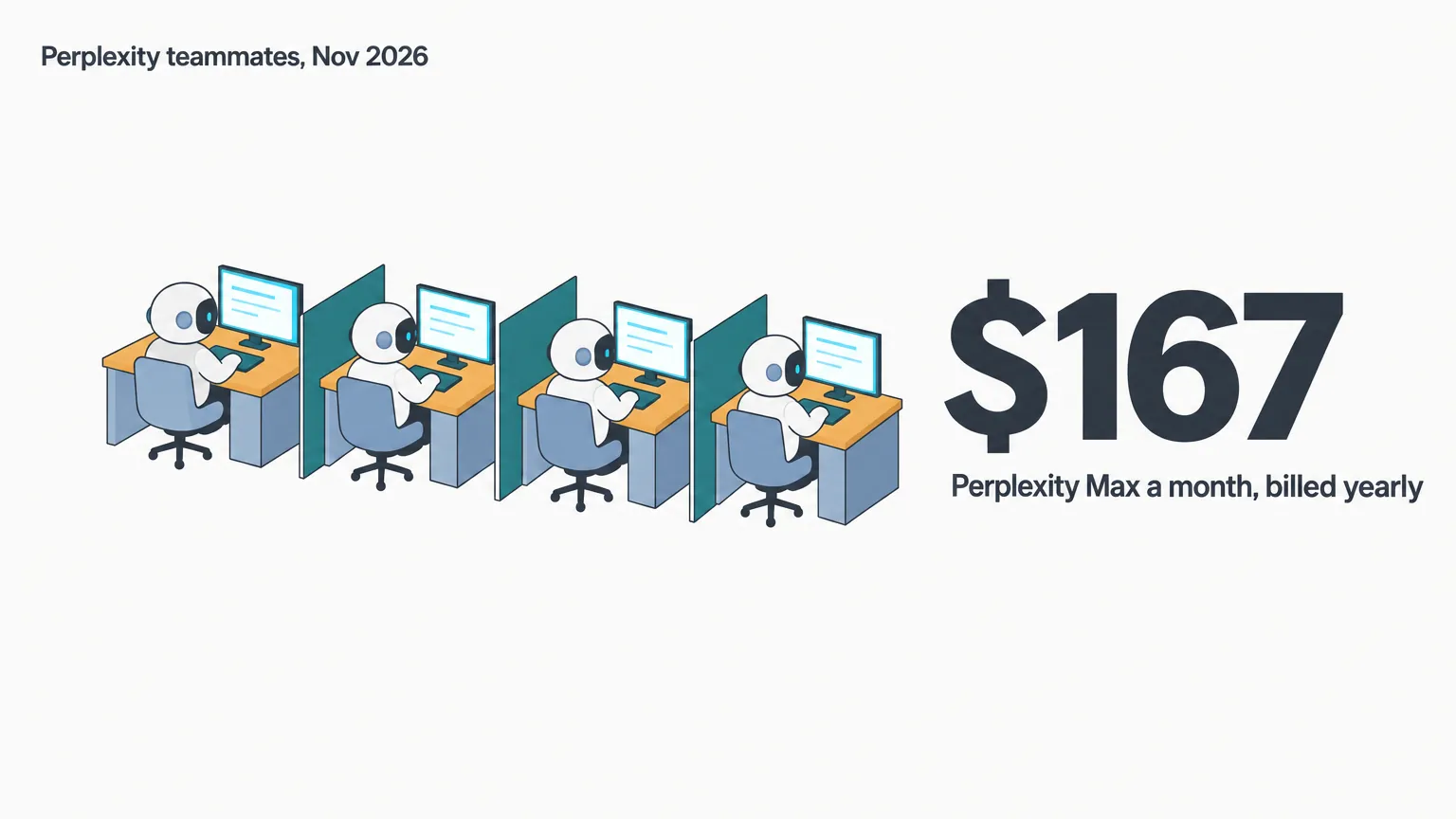
Perplexity has joined the race to give an AI agent a job instead of a chat window. On November 5, 2026 it introduced teammates, and its launch post on X put the pitch in four words: “Teammates work for you.” Each teammate owns a piece of ongoing work, runs on its own computer inside Perplexity Computer, and can be added to Slack channels and hand work to other teammates.
Teammates are a research preview for individual Perplexity Max subscribers on the web, with iOS promised soon. This page is read from Perplexity’s launch post, its help center article and its pricing page.
On this page · 9 sectionsOpen
 Perplexity launched teammates on November 5, 2026: AI agents that own ongoing work on Perplexity Computer, each with its own role and memory between conversations.
 A teammate breaks a large goal into tasks and starts extra agents in parallel, each with its own computer, then checks the results before returning finished work.
 Teammates watch connected tools like Slack, GitHub and Linear, act when something changes, and can be tagged as apps in those tools.
 Each teammate runs on its own isolated computer with its own desktop, browser and cookies; saved credentials are encrypted and teammates cannot view them.
 New teammates use Claude Opus 5.5 by default, and you can pick a different model per teammate or per task.
 The research preview is for individual Max subscribers on the web, $167 a month billed annually with 10,000 Computer credits a month; Enterprise is not included by default.
§ 01What a teammate is

Perplexity describes teammates as agents for long-running work that sit on top of Computer, its cloud agent. “A teammate coordinates Computer sessions and other teammates to keep projects moving.” You give one a role, such as triaging bug reports, tracking metrics or researching a market, and it plans the tasks and follows through until the result is ready for your review.
Memory is the point. “They remember project goals, task history, and shared files across runs.” Feedback carries forward too: Perplexity’s example is an operations teammate that, once told an agency needs two weeks’ notice, builds that lead time into later schedules.
Big goals get split. Per the help center, a teammate breaks a goal into tasks, starts extra agents for the ones that can run in parallel, each on its own computer, checks the results, and adds agents as the project grows. It returns finished work, such as a report or a pull request, and can keep watching after it ships.
§ 02What Perplexity says teammates can do
| Capability | What Perplexity says |
|---|---|
| Multi-agent orchestration | Breaks a goal into tasks, runs them in parallel across agents, adds agents as work grows |
| Its own desktop and browser | Works with apps and sites, including ones without a connector; you can take over and steer |
| Proactive monitoring | Watches connected tools such as Slack, GitHub and Linear and starts work when something arrives |
| Ongoing role | Keeps its role until you change it, schedules follow-ups, keeps memory between conversations |
| Model choice | New teammates use Claude Opus 5.5 by default; you can pick a model per teammate or per task |
| Shared Projects | Teammates in one Project share files and instructions and can message each other |
| Apps in your tools | You can tag a teammate as an app in Slack, GitHub, Linear and more |
Perplexity’s business examples cover marketing (campaigns, ads, SEO and competitor price watching), sales (finding stalled conversations and preparing outreach), support (summarizing yesterday’s complaints and drafting replies) and operations (chasing missing items 72 hours before a deadline).
§ 03Security and control
Each teammate runs on its own isolated computer with its own desktop and browser, and its browsing sessions and cookies stay with that teammate. “Saved credentials are encrypted and entered securely,” the launch post says, and the help center adds that teammates cannot view them. Access follows the permissions of the plugins and Projects you have already set up.
You stay in the loop by watching. You can review completed work, take over the desktop, or redirect a teammate mid-task, and a teammate “shares progress updates and approval requests until it completes the work.” A teammate’s chat is visible only to its owner; others see shared chats read-only or work with it in the Slack channels it monitors.
§ 04What it costs, and who gets it
The preview needs an individual Max plan. Perplexity’s pricing page lists Max at $167 a month billed annually, with 10,000 Computer credits a month and a one-time 35,000-credit bonus. Teammates draw on that monthly allocation, and the help center warns that complex projects use more, “particularly when agents run in parallel.” Pro subscribers have to upgrade, and Enterprise Pro and Enterprise Max are not included by default.
§ 05How teammates compare
| Perplexity teammates | OpenAI dots | Manus Cue | CellCog AI employees | |
|---|---|---|---|---|
| Computer | Its own isolated computer, desktop and browser per teammate | Its own cloud computer per dot | Its own computer, depending on availability | Its own secure VM and file system, plus its own browser identity and logins, per employee |
| How many | Several, each with its own role | One primary dot; teams planned | Several personal agents in group chats | As many as you hire; they form teams and manage each other |
| Where you reach it | Perplexity web; Slack, GitHub and Linear as apps; iOS soon | ChatGPT, Slack, Teams, voice; texting in a US preview | The Cue app, plus its own email and phone | Chat, its own email inbox, its own phone number, meetings |
| Who can get it | Individual Max subscribers | ChatGPT Pro and Business Premium | Invite code; free in early access | Anyone; try it free, no credit card needed |
One detail stands out: teammates start on Claude Opus 5.5, the same model every CellCog tier runs as of November 5, 2026 (our tier note). With the brain the same, the comparison is about what surrounds it.
If you already pay for Max and your work lives in Slack, GitHub and Linear, teammates are the natural place to start. The parallel agents that reproduce a bug and open a pull request are a real strength, and Perplexity’s search is its home ground. CellCog makes a different bet: each AI employee gets an identity of its own, with an inbox and a phone number, reports into a team, and anything above the approval level you set waits for you. More on the others: OpenAI dots and Cue by Manus.
§ 06What is not established yet
- How many teammates a Max account can run at once. Perplexity has not said.
- What a typical teammate costs in credits per day of work.
- Enterprise access. Not included by default; admins can ask.
- The iOS date. “Soon,” per the launch post.
- Independent tests. No third party has published results yet.
§ 07What we are watching
- A published cap on teammates per account, and any credit pricing specific to teammates.
- The iOS release and the move from research preview to general availability.
- Whether Pro or Enterprise plans get teammates.
- How Perplexity’s sandbox, which it open-sourced as SPACE, holds up under teammates running in parallel.
§ 08Where CellCog sits
Our conflict, declared: we build CellCog, a platform where businesses hire AI employees, so teammates are a direct competitor. The table uses each maker’s own pages, and our ranked list of AI employee platforms covers the rest of the field.
§ 09Sources
- Perplexity, Teammates are agents for complex, ongoing work, dated November 4, 2026.
- Perplexity Help Center, Get started with Perplexity teammates, last modified November 5, 2026.
- Perplexity, pricing, read November 5, 2026.
- Perplexity on X, launch post, November 5, 2026, 17:05 UTC.
- Our records on OpenAI dots and Cue by Manus, each read from the maker’s own pages.
Q1When did Perplexity launch teammates?
Perplexity announced teammates on X on November 5, 2026 at 17:05 UTC. Its launch blog post is dated November 4, 2026.
Q2How much do Perplexity teammates cost?
Teammates come with Perplexity Max, listed at $167 a month billed annually, and draw on its 10,000 monthly Computer credits. Parallel agents and frequent automations use more credits.
Q3Can teammates work in Slack?
Yes. You can add a teammate to a Slack channel so colleagues can hand it work or ask for updates, and tag it as an app in Slack, GitHub and Linear.
Q4How are teammates different from OpenAI dots?
Both give each agent its own computer. A Max account can run several teammates with separate roles that pass work to each other, while OpenAI starts each person with one primary dot.
Q5Where does CellCog fit?
CellCog is our product: AI employees that each own a role, run on their own secure VM with their own browser identity, inbox and phone number, and form teams that manage each other.