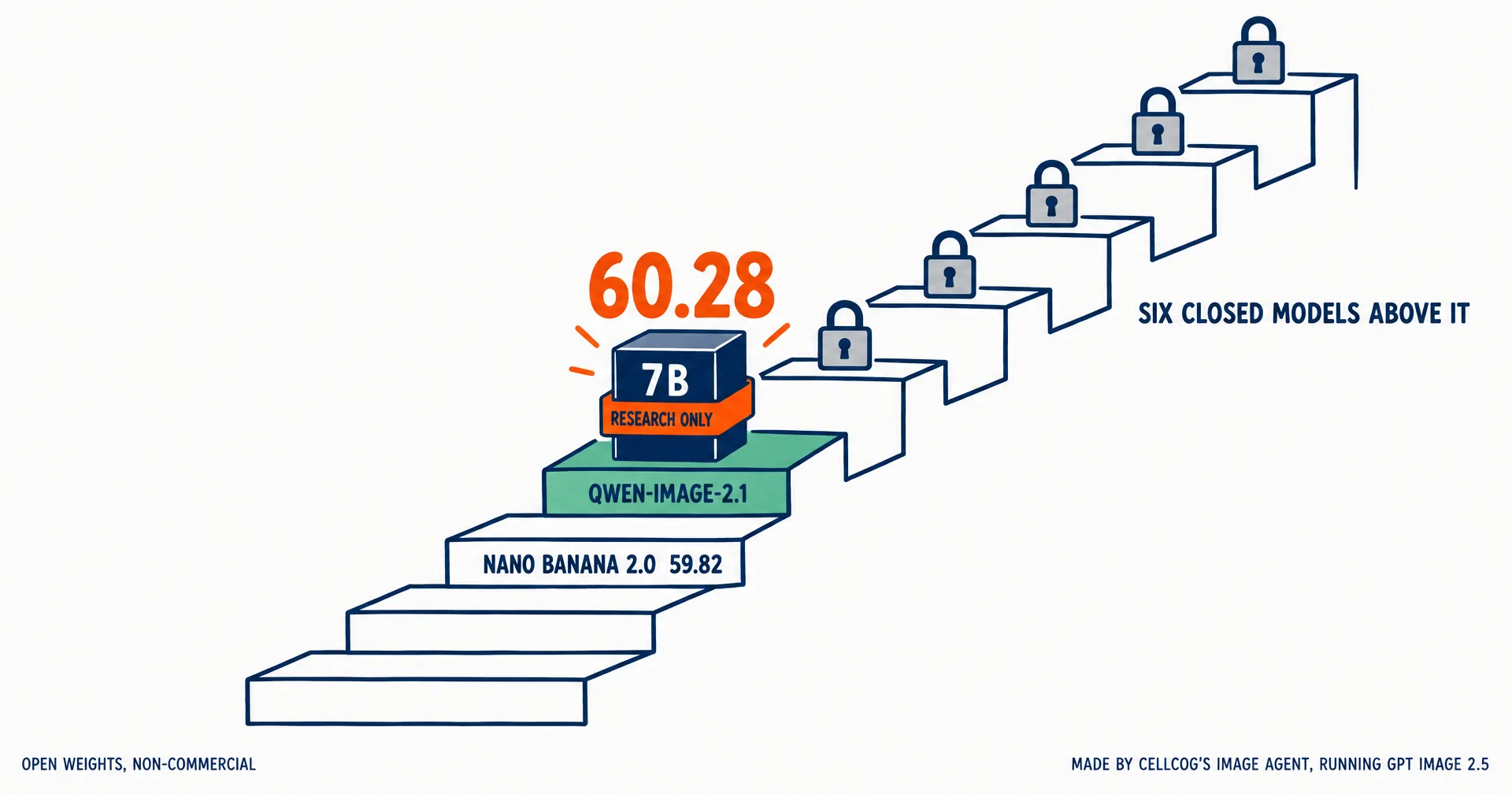
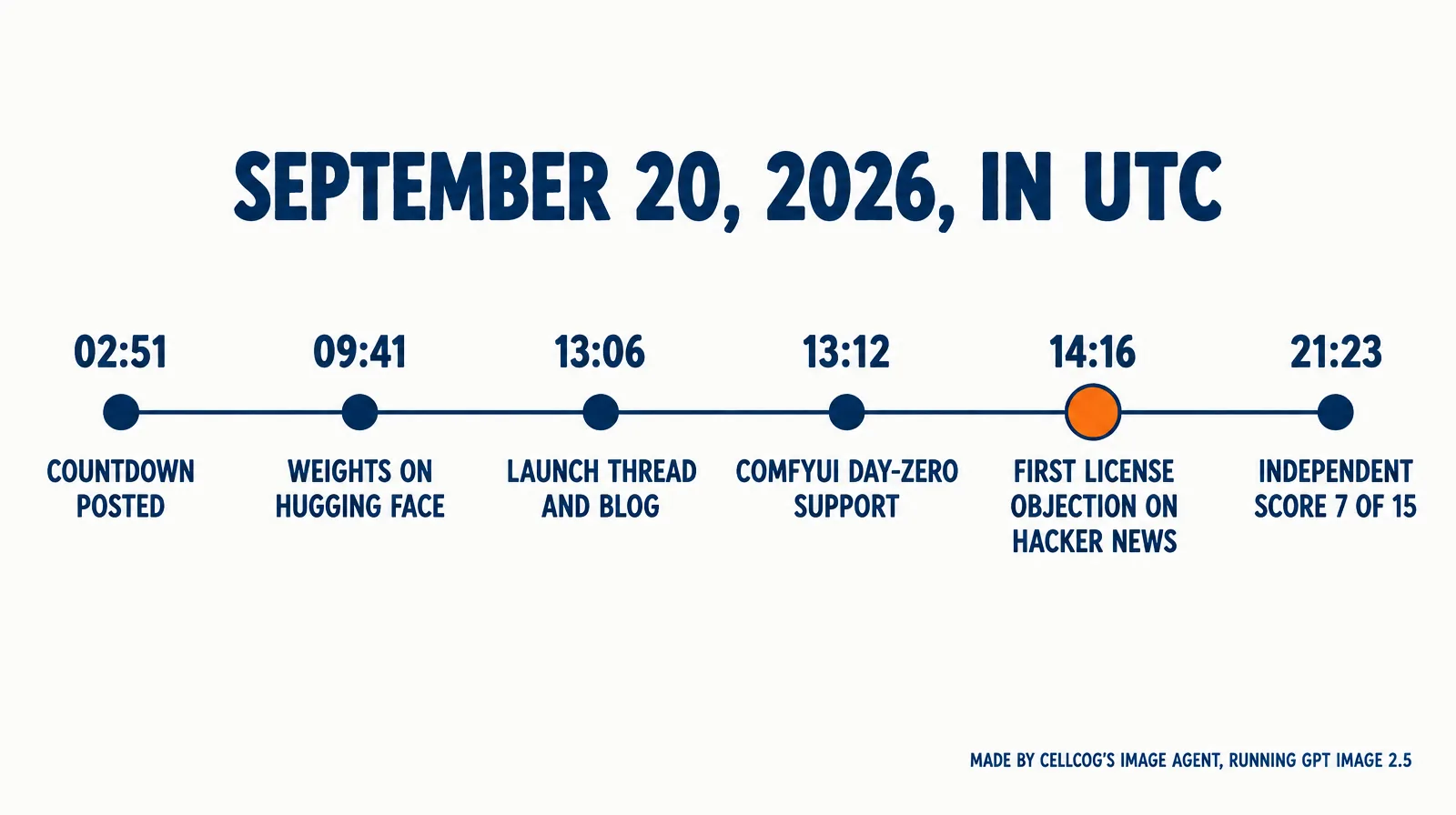
Alibaba’s Qwen team open-sourced Qwen-Image-2.1 on September 20, 2026, and the word open is doing two different jobs in that sentence. The weights are public: Hugging Face at 09:41 UTC, ModelScope, GitHub, and ComfyUI, Diffusers, vLLM-Omni and SGLang support on day zero. The license is not open: the Qwen Research License Agreement, dated the same day, grants use “FOR NON-COMMERCIAL PURPOSES ONLY” and sends anyone who wants to charge for the output to an email address. Between those two facts sits a genuinely interesting model, 7B parameters that Qwen’s own chart places above Google’s Nano Banana 2.0 and above every other open-weight image model, with native transparency and a ten-reference editing mode that runs in under two seconds on Qwen’s hardware. This page is the dated record: what Qwen shipped, what its own numbers say, what the license says, what independent testers measured in the first ten hours, and where we stand. Times are UTC.
On this page · 9 sectionsOpen
 Alibaba’s Qwen team released Qwen-Image-2.1 on September 20, 2026: weights on Hugging Face at 09:41 UTC, the launch thread and blog at 13:06 UTC. One 7B model does text-to-image and image editing, accepts up to 10 reference images, and generates transparent RGBA images natively.
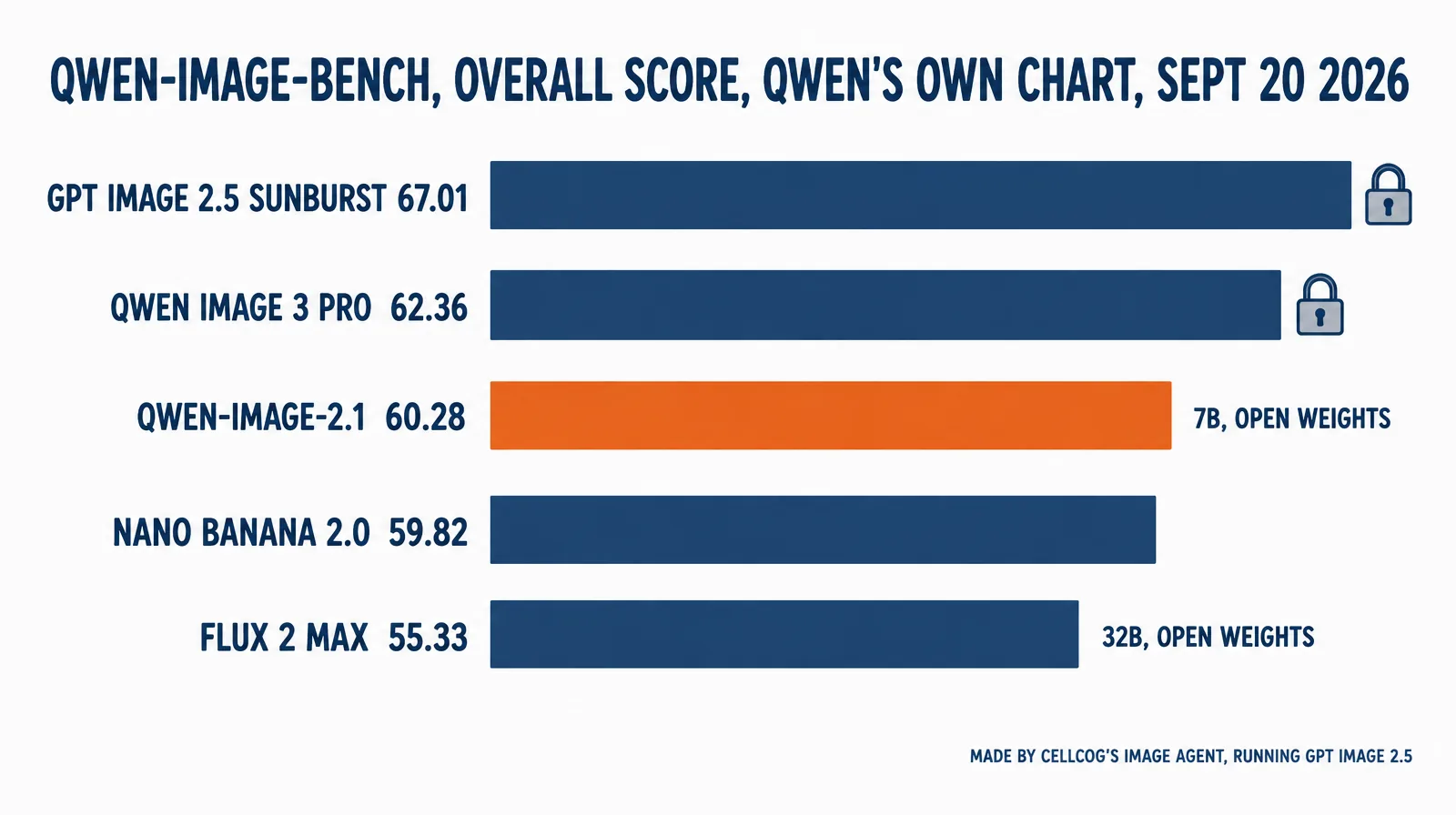
 On Qwen’s own chart, Qwen-Image-Bench overall score, it lands seventh of 29 at 60.28: behind six closed models led by GPT Image 2.5 Sunburst at 67.01, and 0.46 ahead of Nano Banana 2.0 at 59.82. Every open-weight model on the chart, FLUX 2 Max at 32B included, sits below it.
 The weight-to-score ratio is the claim that travels: 7B parameters against 20B for Qwen-Image 1.0, and scores that Qwen says beat most closed models. The benchmark is Qwen’s own, and the closed models’ parameter counts are unpublished, so the size comparison holds only among open models.
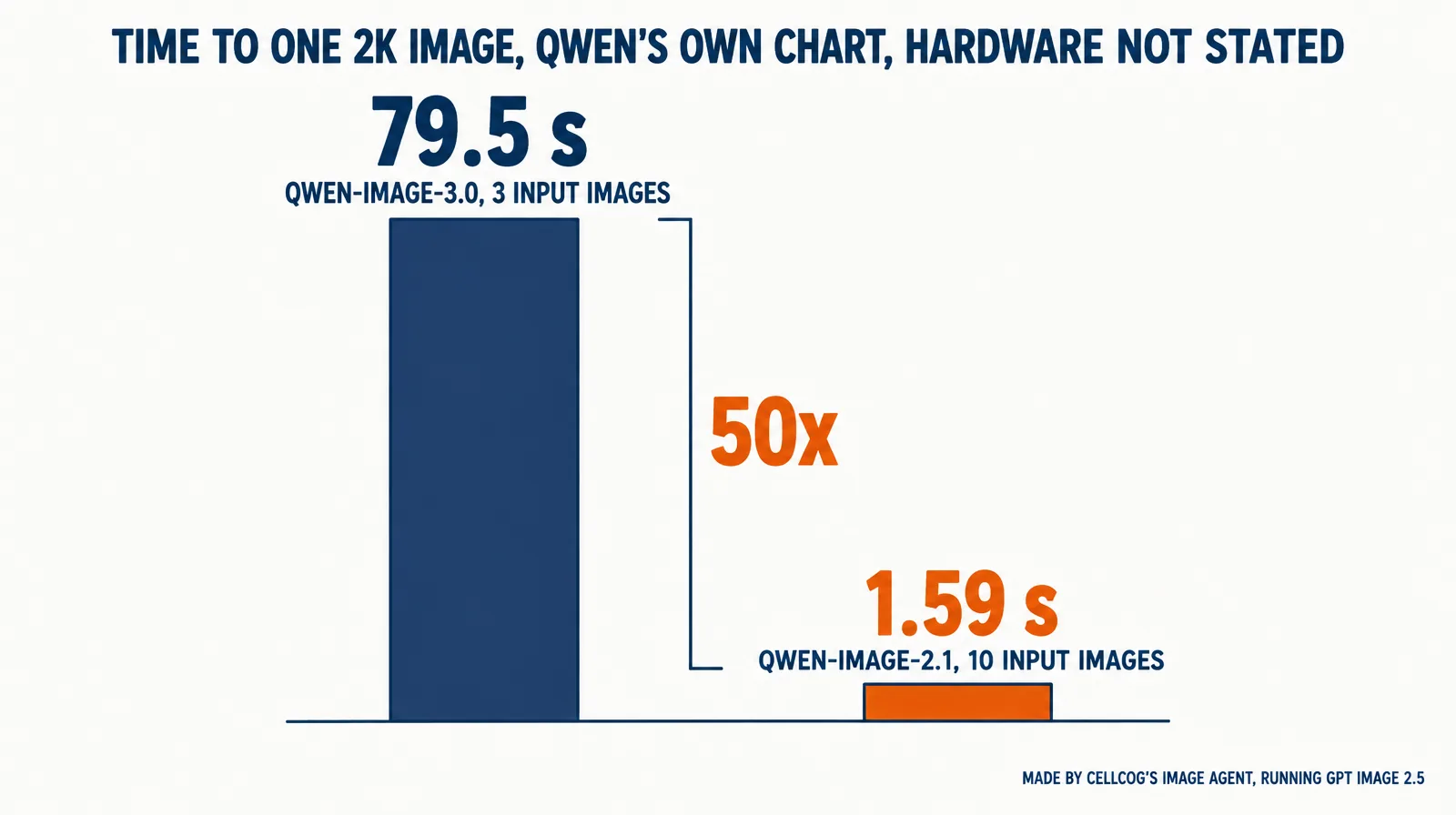
 Speed is where the architecture pays: mixed-granularity attention and prefix KV cache reuse mean the input images are encoded once. Qwen’s chart puts a 2K edit with ten input images at 1.59 seconds against 79.5 seconds for Qwen-Image-3.0 with three; a Hacker News user measured about five seconds per 1MP image on an RTX 4090.
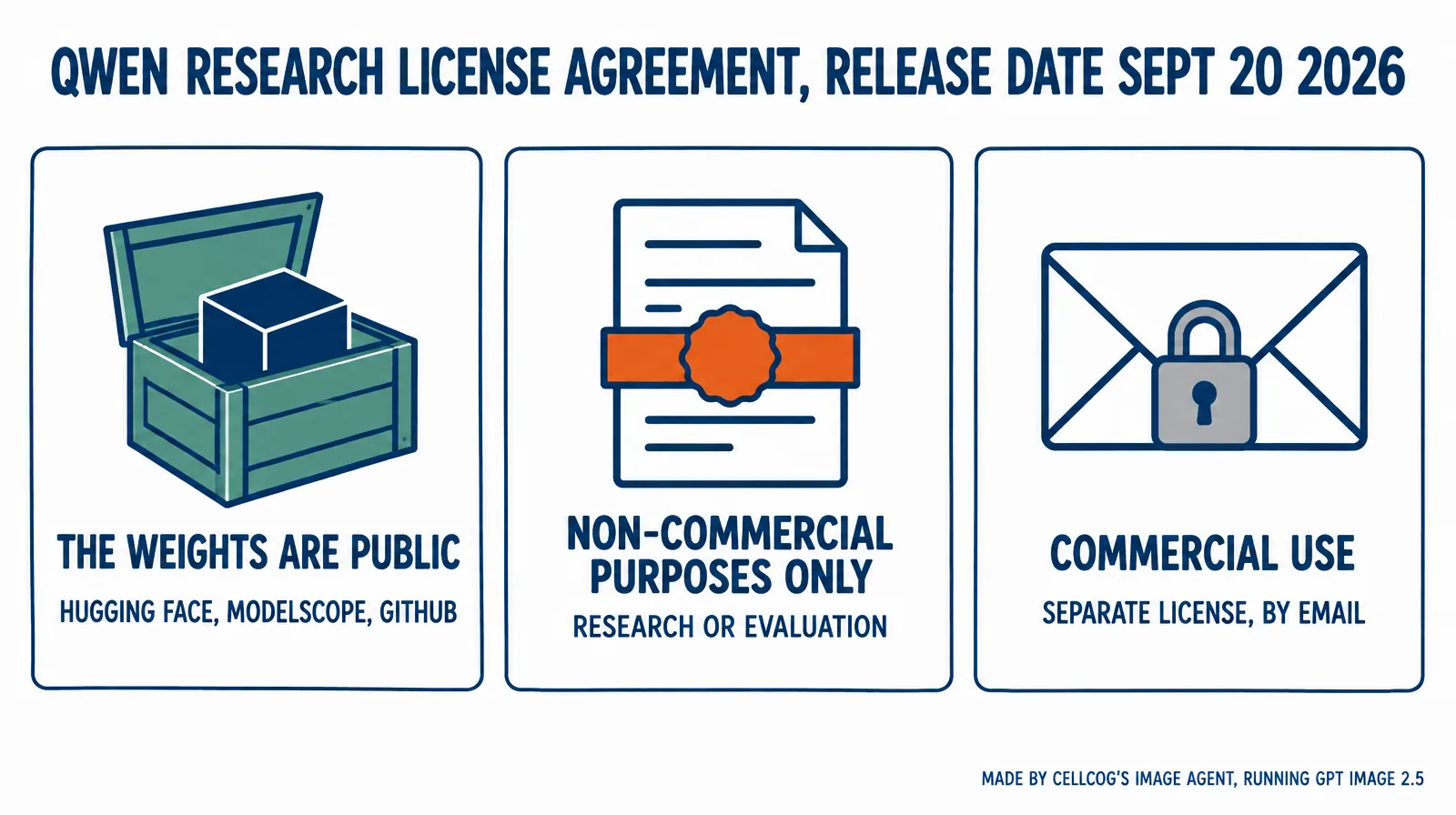
 The license is the catch. Qwen-Image 1.0, Edit, Layered and 2512 shipped under Apache 2.0; 2.1 ships under the Qwen Research License Agreement, dated September 20, 2026, which grants use for non-commercial purposes only and requires a separate commercial license by email. Open weights, not open source.
 Day-zero support is unusually wide: Diffusers, ComfyUI, vLLM-Omni, SGLang and LightX2V on launch day, with ComfyUI’s own weights published at 16:14 UTC. Anyone can run it locally within an hour of the release; nobody can charge for the output without Qwen’s permission.
 First independent read, September 20 at 21:23 UTC: 7 of 15 on one Hacker News user’s text-to-image test, up from 4 of 15 for Qwen-Image 1.0, with text rendering called the best on the open-weights market. This is a launch record; the Model Studio price, a commercial-license price and third-party benchmarks are what we are watching.
§ 01What Qwen shipped
Qwen’s launch post calls it “the most balanced and cost-effective image generation model in the Qwen-Image series” and leads with the size: “A lightweight 7B architecture that outperforms most closed-source models, with drastically accelerated inference for multi-image inputs.” The spec, from the GitHub README and the Hugging Face card:
| Item | Qwen’s documentation |
|---|---|
| Visual generation component | 32 single-stream DiT layers, 7B parameters (7.12B in the safetensors) |
| Text encoder | Qwen3-VL 8B, encoding both instructions and condition images |
| VAE | 64-channel RGBA autoencoder, 16x spatial compression, native transparency |
| Tasks | Text-to-image and image editing in one model; transparent generation and editing; subject extraction from photos |
| Reference images | Up to 10 per edit; local edits by circle, painted annotation or separate mask |
| Native output | 2048x2048 and six other aspect ratios up to 2752x1536 |
| Weights | Hugging Face (09:41 UTC), ModelScope, GitHub QwenLM/Qwen-Image-2.1 |
| Day-zero support | Diffusers (QwenImage21Pipeline), ComfyUI, vLLM-Omni, SGLang, LightX2V |
| License | Qwen Research License Agreement, release date September 20, 2026 |
| API | No Alibaba Cloud Model Studio listing or price for qwen-image-2.1 or qwen-image-2.1-pro at 23:20 UTC |
Two of those rows carry the story. The transparency row folds Qwen-Image-Layered, a separate model from December 2025, into the main model: the prompt decides whether the output has an alpha channel, and the same model edits transparent layers and pulls a subject out of a photograph as an RGBA layer. ComfyUI’s launch post, published at 13:12 UTC, put it plainly: “No other major open model does this.” The reference row is the other half: ten input images, with circles, painted annotations or a separate mask to say where the edit lands.
§ 02The benchmark, Qwen’s own
The launch blog says only that “The Qwen-Image-Bench comparison below shows its performance alongside other open-source and closed-source models.” The comparison is a chart image. We read it in a browser; these are its figures for the top of the field and every open-weight model on it.
| Model | Overall | Weights |
|---|---|---|
| GPT Image 2.5 Sunburst | 67.01 | Closed |
| GPT Image 2 | 64.69 | Closed |
| Grok Imagine 2.0 | 63.47 | Closed |
| Qwen Image 3 Pro | 62.36 | Closed |
| Muse Image | 62.34 | Closed |
| MAI Image 2.5 Pro | 61.02 | Closed |
| Qwen-Image-2.1 | 60.28 | Open, 7B |
| Nano Banana 2.0 | 59.82 | Closed |
| GPT Image 1.5 | 59.65 | Closed |
| Seedream 5 Pro | 59.53 | Closed |
| Nano Banana Pro | 59.45 | Closed |
| Qwen Image 2.0 Pro | 57.84 | Closed |
| FLUX 2 Max | 55.33 | Open, 32B |
| FLUX 2 Pro | 54.57 | Open, 32B |
| Qwen Image 2512 | 52.06 | Open, 20B |
| Boogu | 51.40 | Open, 10B |
| Hunyuan Image 3.0 | 50.81 | Open, 80B |
| Qwen Image (1.0) | 49.23 | Open, 20B |
| GLM Image | 48.19 | Open, 16B |
| LongCat | 46.34 | Open, 6B |
| HiDream O1 | 46.17 | Open, about 8B |
Three readings, in order of how far they travel. First, the one on X: a 7B open model scores above Nano Banana 2.0. True on this chart, by 0.46 points, and Nano Banana 2 is Google’s Gemini 3.1 Flash Image, released February 26, 2026, the Flash tier of Google’s image line rather than its Pro tier, which sits one row lower at 59.45. Second, the one Qwen’s post makes: it “outperforms most closed-source models.” Twelve of the eighteen closed models on the chart score below it; six score above, and the gap to the top is 6.73 points. Third, the one that holds without any asterisk: among open-weight models it is first, and it is the smallest of the top four by a factor of four or more. Qwen-Image 1.0, the 20B model this replaces, scores 49.23.
Two caveats travel with all three. The benchmark is Qwen’s, and the model under test is Qwen’s; the same prompts that put Qwen Image 3 Pro fourth put Qwen-Image-2.1 seventh, so it is not obviously tuned to flatter the small model, but no independent lab had run it on launch day. And the parameter counts for the closed models are unpublished, so “7B beats them” is a comparison of a known number to unknown ones.
§ 03The speed chart
Alongside the benchmark chart, Qwen’s launch assets include a second chart: seconds to one 2K image against the number of input images. It carries a Qwen-Image-2.1-Pro variant that appears nowhere else in the release, and no hardware line.
| Model | Input images | Seconds |
|---|---|---|
| Qwen-Image-2.1 | 10 | 1.59 |
| Qwen-Image-2.1-Pro | 10 | 6.31 |
| Qwen-Image-3.0 | 3 | 79.5 |
| Qwen-Image-3.0-Pro | 3 | 112.5 |
The mechanism is in the README: text uses a token-level causal mask, images a chunk-level bidirectional mask, and the input images and instruction are “computed once at the first denoising step and cached for all subsequent steps.” The 3.0 line climbs with every added image; the 2.1 line barely moves from zero inputs to ten. Fifty times faster is Qwen’s number on Qwen’s hardware. The independent number, from a Hacker News user at 15:45 UTC, is “a 1MP image took around ~5 seconds on an RTX4090” using the ComfyUI convrot weights; two others reported about three minutes per image on a laptop CPU and roughly 15.6 GB of VRAM in one configuration.
§ 04The license
| Model | Released | Parameters | License |
|---|---|---|---|
| Qwen-Image | August 2025 | 20.4B | Apache 2.0 |
| Qwen-Image-Edit | August 2025 | 20.4B | Apache 2.0 |
| Qwen-Image-Layered | December 2025 | 20.4B | Apache 2.0 |
| Qwen-Image-2512 | December 2025 | 20.4B | Apache 2.0 |
| Qwen-Image 2.0 and 2.0 Pro | February 2026 | Not published | API only on Alibaba Cloud |
| Qwen-Image-2.1 | September 20, 2026 | 7.1B | Qwen Research License Agreement |
The agreement, released the same day as the model, defines its own key term: “Non-Commercial” “shall mean for research or evaluation purposes only.” The grant is a royalty-free, worldwide license to use, modify and distribute the weights “FOR NON-COMMERCIAL PURPOSES ONLY,” and the next clause closes the door: “You shall not use the Materials for any commercial purpose without obtaining a separate commercial license from us,” with an email address for the request. No price, no volume threshold, no revenue cap.
That is the change from every earlier Qwen-Image release, and it was the first thing Hacker News noticed. The thread opened at 13:09 UTC; at 14:16 UTC the top comment read the license and said “it looks like this model is using a much more restrictive license.” By evening one commenter had a name for the combination of a blog that says “We are excited to open-source Qwen-Image-2.1” and a license that forbids selling the output: “I would call this a license trap.” A minority argued the restriction is unenforceable; that is not a position a company can build a product on.
Two things the license does not do. It does not stop anyone from running the model, and the ecosystem made that trivially easy: ComfyUI published its own converted weights at 16:14 UTC, and stable-diffusion.cpp, Diffusers, vLLM and SGLang all ran it the same day. And it does not say what the commercial license costs, which means the real price of Qwen-Image-2.1 in a product is a number nobody outside Alibaba knows.
§ 05What developers measured on day one
| Time | Who | What they found |
|---|---|---|
| 14:16 | jfoster | Read the license; noted the move away from Apache 2.0 |
| 15:36 | jjcm | Compared outputs against GPT Image 2 in a design harness; text rendering “much, much better than anything else on the open weights market” |
| 15:45 | vunderba | About 5 seconds per 1MP image on an RTX 4090 with the convrot weights |
| 16:39 | peri-cl | Ran it through stable-diffusion.cpp on CPU |
| 20:06 | vunderba | Noted yellow tinting on non-cherry-picked outputs seen on X and Reddit |
| 21:23 | vunderba | 7 of 15 on a 15-prompt text-to-image test, against 4 of 15 for Qwen-Image 1.0 |
The 7-of-15 result is the first independent score and it is not comparable to Qwen’s 60.28: one is a hand-graded pass count on fifteen hard prompts, the other a 1,000-prompt vendor benchmark. What it does say is that the 7B model is a clear step past the 20B model it replaces on the same test, which is the claim that matters for anyone who ran 1.0 locally. The same tester’s negative, the yellow cast on unselected outputs, is the kind of thing a vendor chart never shows.
§ 06Where CellCog stands
We have a stake in this chart, so here it is plainly. CellCog’s image agent runs on GPT Image 2.5, which is the model at the top of Qwen’s own ranking: Sunburst at 67.01 and Flare at the same token price, chosen per request. Every image on this page was made by that agent from the tables above. We do not route to Qwen-Image-2.1, and under this license we could not put it in a product if we wanted to. Where Qwen-Image-2.1 is genuinely ahead of what we run is not on the chart: a 7B model that fits a consumer card, ships an alpha channel without a matting step, and edits from ten references in under two seconds is a different tool from an API, and for research, evaluation and personal work the license allows exactly that.
§ 07What we are watching for
- An Alibaba Cloud Model Studio listing and per-image price for qwen-image-2.1 and qwen-image-2.1-pro; the 2.0 models list at $0.035 and $0.075 per image on the international pricing page.
- A published commercial license price, or a change to the license itself; Qwen-Image 1.0 went out under Apache 2.0.
- An independent benchmark run that includes Qwen-Image-2.1 alongside Nano Banana 2 and GPT Image 2.5.
- Whether the Qwen-Image-2.1-Pro on the speed chart appears as a product.
§ 08Update log
This is a living page; when the story moves, the update lands here.
As of September 20, 2026, 23:35 UTC: page opened. Qwen’s launch blog read in a browser (dated 2026/09/20; benchmark and speed charts read as images); the X launch thread read in a browser and clocked from post ids (13:06:39 UTC); the GitHub README, Hugging Face card and LICENSE read from their raw URLs; ComfyUI’s post read at 23:20 UTC (published 13:12:07 UTC); the Hacker News thread read via the Algolia API at 23:21 UTC (449 points, 145 comments); Alibaba Cloud’s Model Studio pricing page read at 23:24 UTC, no 2.1 rows; Google’s Gemini API pricing page read at 23:27 UTC for the Nano Banana 2 model id.
§ 09Sources
- Qwen, Qwen-Image-2.1: Compact, Efficient, and Unified Image Creation, 2026/09/20
- QwenLM/Qwen-Image-2.1 on GitHub (README, architecture, day-zero support, license)
- Qwen/Qwen-Image-2.1 on Hugging Face (model card, safetensors) and its LICENSE, last modified 2026-09-20T09:41 UTC
- @Alibaba_Qwen launch thread, X, 2026-09-20 13:06 UTC
- ComfyUI, Qwen-Image-2.1 in ComfyUI: Open-Weight Image Generation and Editing, Now with Transparency, 2026-09-20 13:12 UTC; Comfy-Org/Qwen-Image-2.1 weights, 16:14 UTC
- Hacker News, Qwen Image 2.1, item 49775499, opened 2026-09-20 13:09 UTC
- Qwen-Image-Bench on GitHub (methodology; May 2026 leaderboard)
- Alibaba Cloud Model Studio, model inference pricing, read 2026-09-20 23:24 UTC
- Google, Nano Banana 2: Combining Pro capabilities with lightning-fast speed, 2026-02-26; Gemini API pricing page, model id gemini-3.1-flash-image
- Hugging Face model cards for Qwen/Qwen-Image, Qwen-Image-Edit, Qwen-Image-Layered and Qwen-Image-2512 (Apache 2.0)
Q1Is Qwen-Image-2.1 open source?
The weights are public and the code is on GitHub, but the license is not an open-source license. The Qwen Research License Agreement, dated September 20, 2026, grants a royalty-free license to use, modify and distribute the model for non-commercial purposes only, defined as research or evaluation, and requires a separate commercial license from Qwen for any commercial use. The accurate phrase is open weights under a research license.
Q2How does it compare to Qwen-Image 1.0 and 2.0?
Qwen-Image 1.0, released August 2025 under Apache 2.0, is a 20B model with a separate Qwen-Image-Edit for editing. Qwen-Image 2.0 shipped in February 2026 as an API model on Alibaba Cloud; its Hugging Face repository is not publicly readable. Qwen-Image-2.1 is 7B, does generation and editing in one model, adds native transparency, and on Qwen’s own chart scores 60.28 against 49.23 for Qwen-Image 1.0 and 57.84 for Qwen Image 2.0 Pro.
Q3What does Qwen-Image-Bench measure?
Qwen’s own benchmark: 1,000 prompts scored on five pillars, Quality, Aesthetics, Alignment, Real-world Fidelity and Creative Generation, aggregated into an overall score. The May 2026 release of the benchmark ranked 18 models with GPT Image 2 first at 64.69; the launch chart for 2.1 covers 29 models and adds GPT Image 2.5 Sunburst at 67.01 on top. It is a vendor benchmark, and the model under test is the vendor’s.
Q4What did independent testers find on day one?
On Hacker News, one user’s 15-prompt text-to-image test scored Qwen-Image-2.1 at 7 of 15, against 4 of 15 for Qwen-Image 1.0, with about five seconds per 1MP image on an RTX 4090. A second user running a design tool called its text rendering the best on the open-weights market. Others reported roughly three minutes per image on a laptop CPU and about 15.6 GB of VRAM in one setup. These are individual runs, not a controlled benchmark.
Q5Should I build a product on it?
Not on this license without a commercial agreement from Qwen. If you need an image engine in a product today, the choice is between paid APIs and openly licensed weights: FLUX 2 Max at 55.33 on Qwen’s chart is 32B under its own license, and Qwen-Image 1.0 at 49.23 is Apache 2.0. CellCog’s image agent runs on GPT Image 2.5, the top of Qwen’s own chart, with the engine chosen per request; an AI employee keeps its role and its work while the engine underneath changes. Try it free, no credit card needed; you pay for the work, not the hire, and the cost depends purely on how much work you assign.