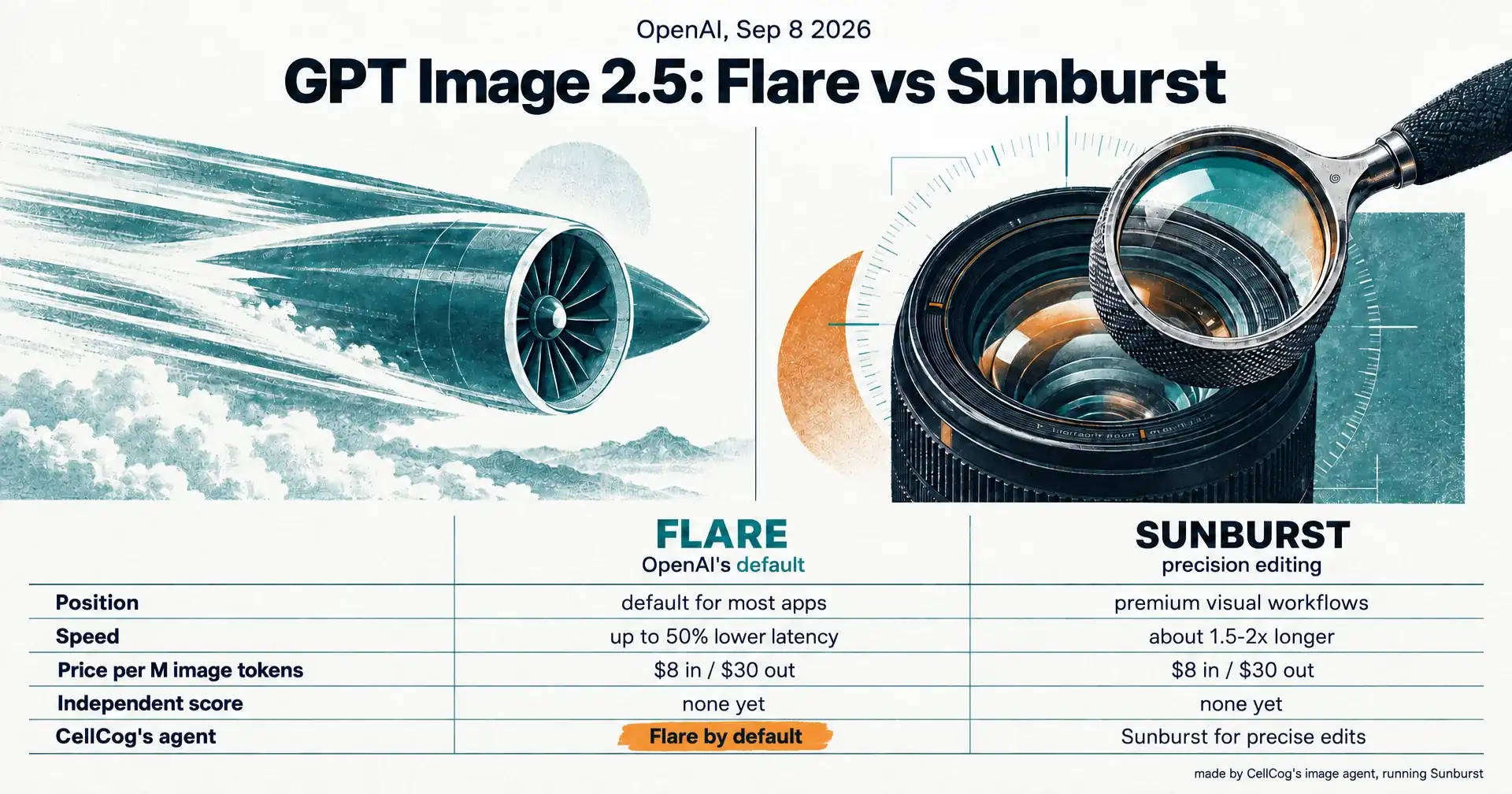
GPT Image 2.5 exists. OpenAI launched it on September 8, 2026, five days after the hidden announcement modal that made this page necessary, and it shipped under exactly the name the community had guessed. In ChatGPT it is ChatGPT Images 2.5, rolling out to every ChatGPT, ChatGPT Work and Codex tier. In the API it is two models, gpt-image-2.5-flare and gpt-image-2.5-sunburst, both live in the changelog and on the pricing page the same day.
On this page · 6 sectionsOpen
- GPT Image 2.5 launched September 8, 2026. In ChatGPT it ships as ChatGPT Images 2.5, rolling out to all ChatGPT, ChatGPT Work and Codex tiers on desktop, mobile and web. In the API it ships as two models: gpt-image-2.5-flare and gpt-image-2.5-sunburst, both with a 2026-09-08 snapshot.
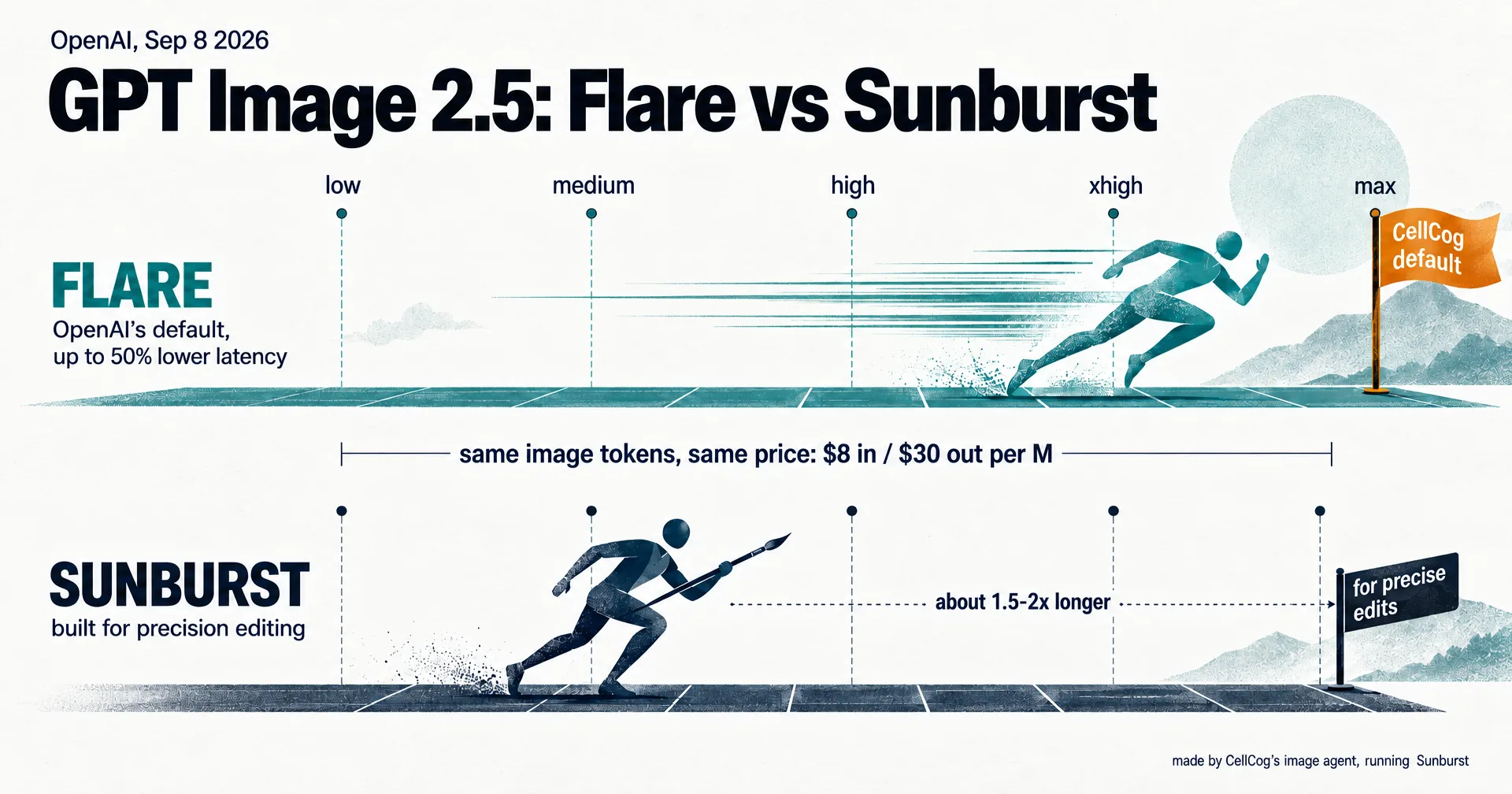
- Flare is the default: the same quality, editing and speed improvements, up to 50 percent lower latency than GPT Image 2 per OpenAI. Sunburst is for editing precision on premium creative work, with longer generation times.
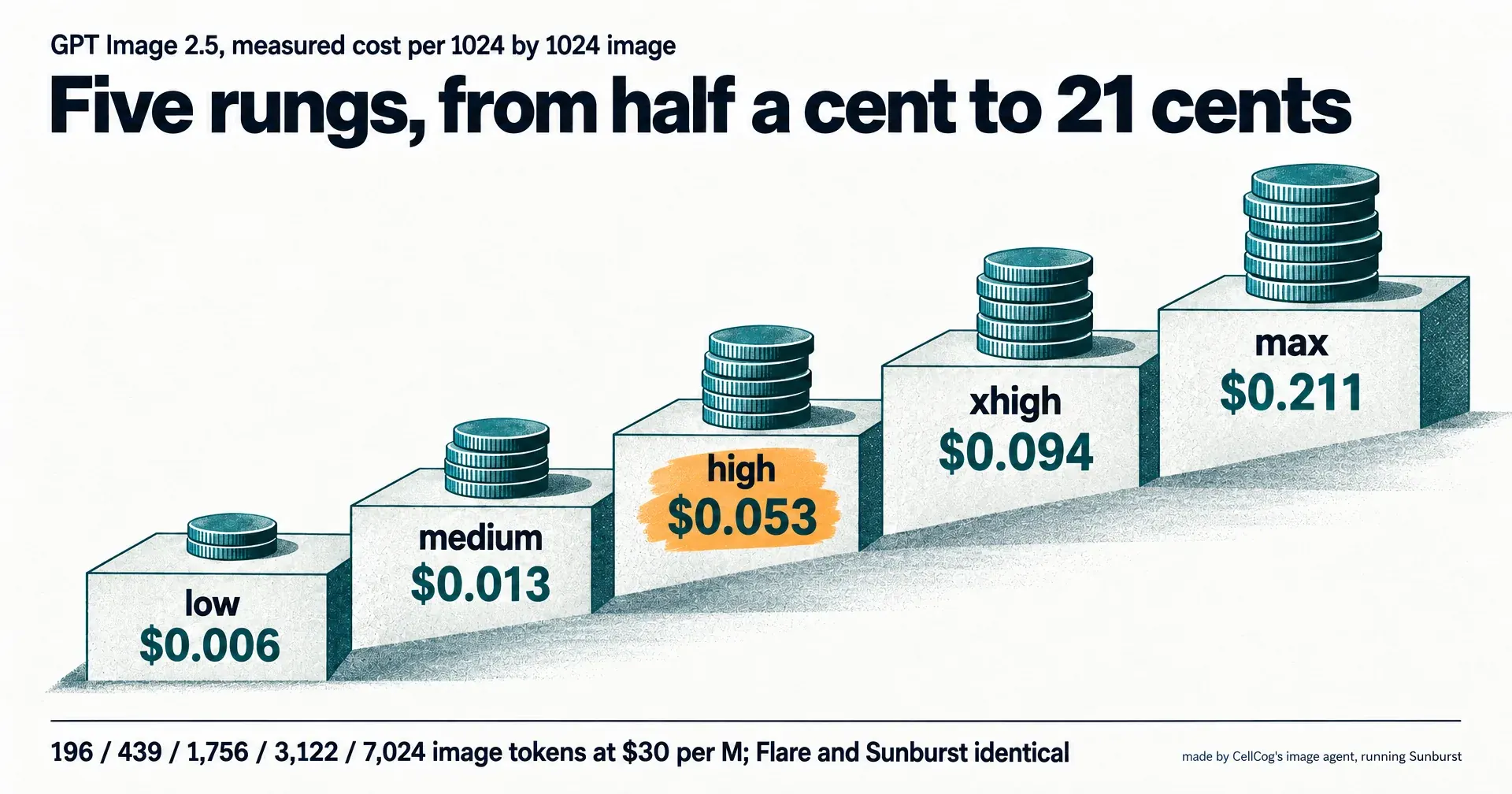
- Token prices did not move: $8 per million image input tokens, $2 cached, $30 per million image output tokens, $5 per million text input, identical to gpt-image-2. Two new quality settings, xhigh and max, sit above high; measured per 1024 by 1024 image, the ladder runs $0.006 at low to $0.211 at max.
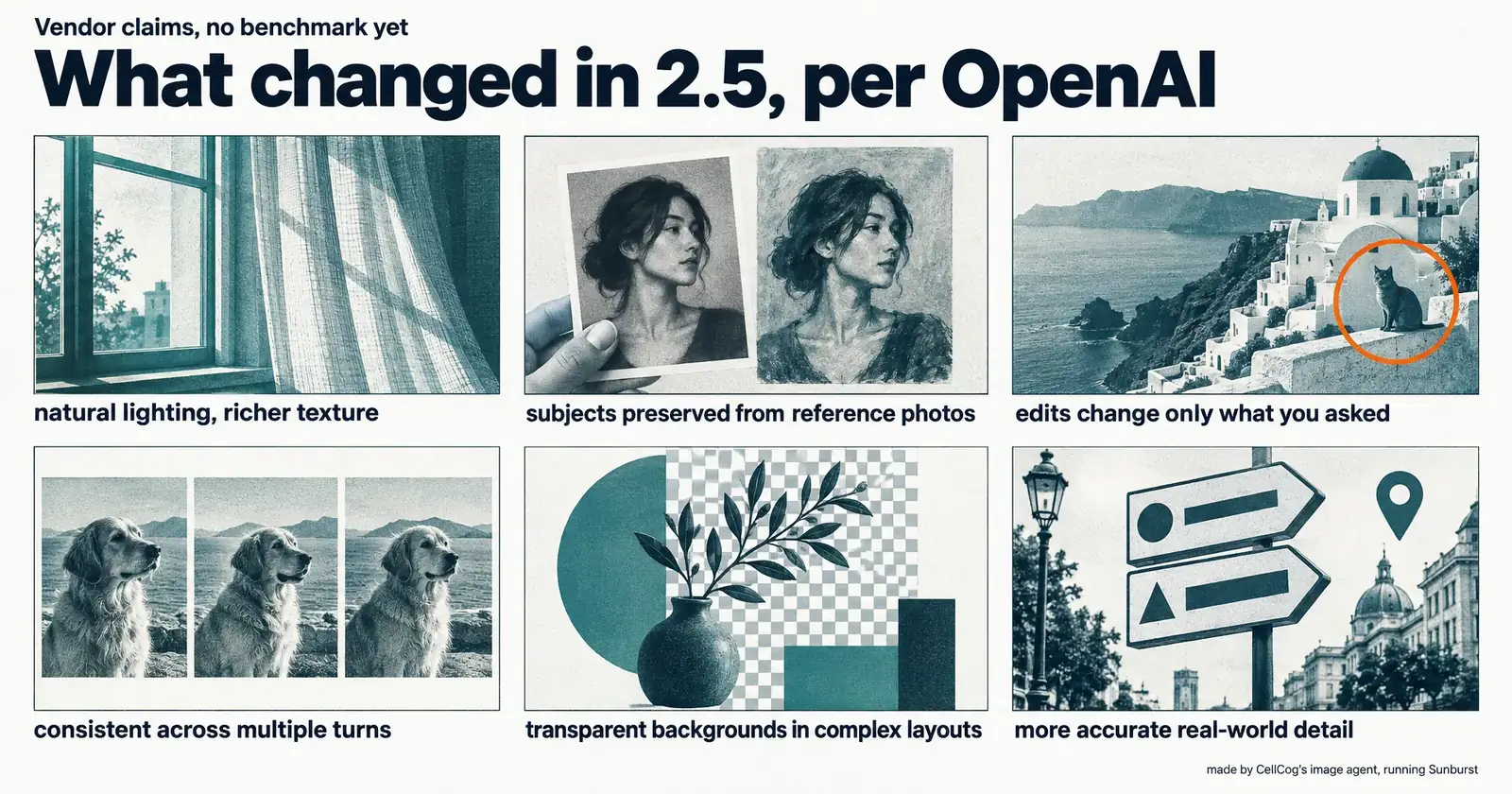
- What OpenAI says changed: more natural lighting and richer textures, better preservation of subjects from reference photos, edits that change only what you asked across multiple turns, transparent backgrounds in complex layouts, and more accurate real-world information in images.
- New in ChatGPT: Sketch (draw a reference directly in ChatGPT, type @Sketch), templates for formats like posters and merch, comments placed on images, and prompt sharing.
- Scorecard: the hidden September 3 modal was real and shipped five days later; the name the community guessed was right; the two anonymous Arena checkpoints map to two shipped models; nothing about the price or the date was ever leaked correctly, because nothing about them was leaked at all.
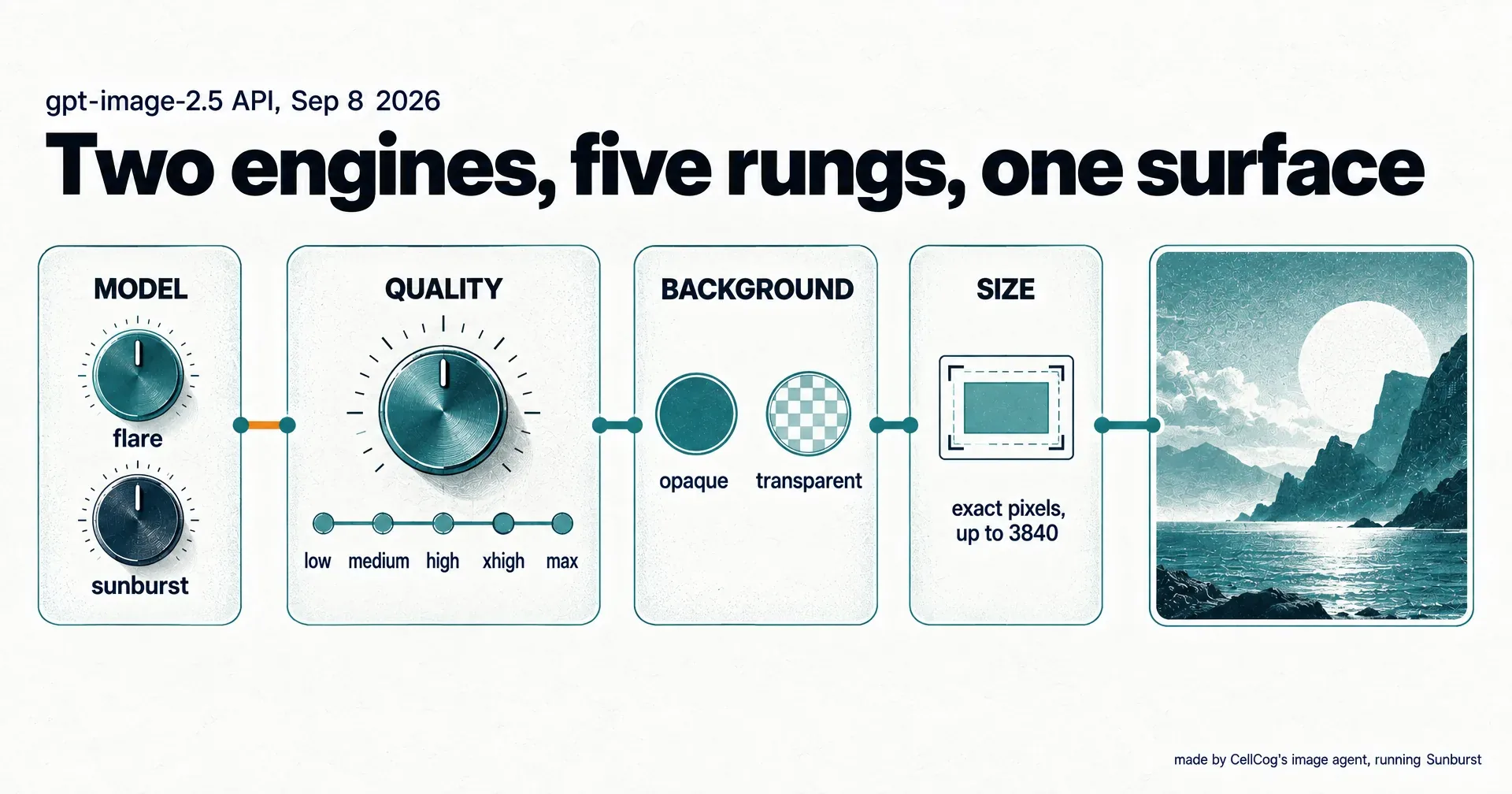
- Our read: CellCog’s image agent gets the whole GPT Image 2.5 surface: Flare or Sunburst chosen per request, five quality settings, transparent or opaque backgrounds, and size. Flare at high quality is the default, Sunburst when edit precision matters; our own test found identical image tokens and price and Sunburst about 1.5 to 2x slower. The separate transparent-background tool retires. It ships as a product update.
§ 01What shipped
| Item | Fact |
|---|---|
| ChatGPT product | ChatGPT Images 2.5, rolling out to all ChatGPT, ChatGPT Work and Codex tiers on desktop, mobile and web |
| API models | gpt-image-2.5-flare (fast, high-quality everyday generation, the default) and gpt-image-2.5-sunburst (editing precision, longer generation) |
| Default snapshots | gpt-image-2.5-flare-2026-09-08 and gpt-image-2.5-sunburst-2026-09-08 |
| Speed | Up to 50 percent lower latency than Images 2.0 / GPT Image 2, per OpenAI |
| Quality settings | low, medium, high, xhigh (new), max (new), auto |
| Inputs and outputs | Text and image in, image out; inpainting supported on both |
| Where in the API | Image API (generations and edits) and the Responses API image generation tool |
| Token prices | Unchanged from gpt-image-2: $8 per million image input, $2 cached, $30 per million image output; $5 per million text input |
| New ChatGPT features | Sketch (@Sketch), templates, comments on images, prompt sharing |
| Safety | C2PA metadata and invisible watermarking continue; a system card is published |
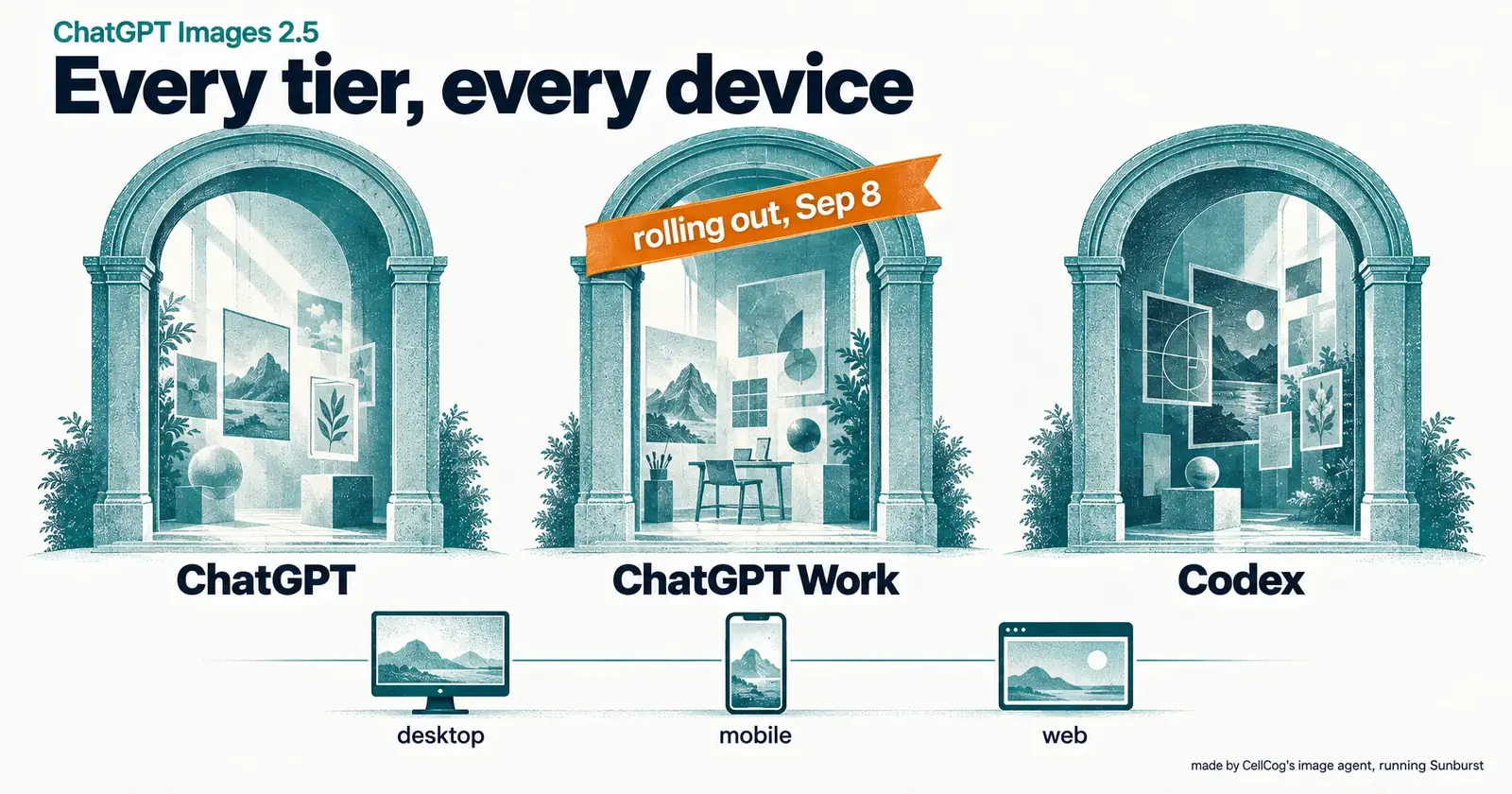
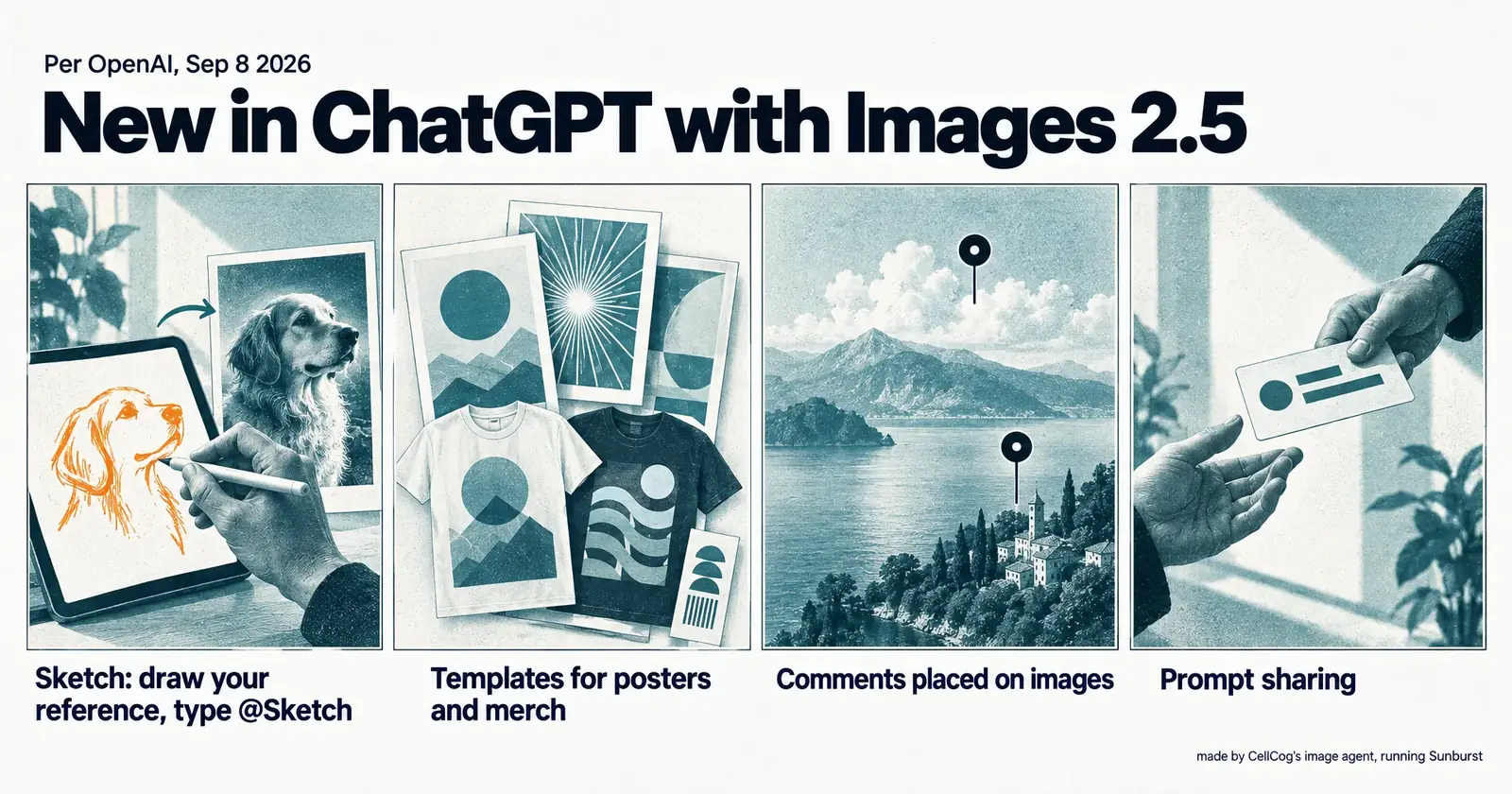
Two models, one direction. OpenAI’s split is by workflow, not by size. Flare “brings the same improvements in quality, editing, and speed to the API and is the default choice for most applications, delivering higher-quality images than GPT-Image-2 at 50% lower latency.” Sunburst “is built for premium visual workflows that benefit from tighter control across edits.” The launch post names Higgsfield AI, Adobe and Manus as early customers, with Higgsfield’s head of product praising Flare for “how well it understands what not to change.”
What OpenAI says improved. Sharper details, more natural lighting and richer textures; better preservation of the subjects in reference photos; edits that change only what you asked while keeping everything else, “even with more complex subjects and backgrounds,” and that stay consistent across multiple turns without degrading; more accurate real-world information in images; more complex layouts, including transparent backgrounds; closer adherence to a requested visual style. None of that is a benchmark. Arena had no 2.5 entry at launch, and OpenAI published no comparative scores.
§ 02The rumor scorecard
As on our Astra tracker and Fable 5.1 tracker, we wrote the claims table below on September 4 and left it in place so it can be graded honestly.
| Claim as we recorded it | What shipped | Grade |
|---|---|---|
| “GPT Image 2.5” is a community label, never sighted in an OpenAI document | Shipped as GPT Image 2.5, under that exact name | Right to doubt, wrong to bet against; the community called it |
| Hidden “Image creation got a major upgrade” modal, gate off, hero uploaded Sep 1 | The launch asset; the product shipped Sep 8 | Hit. The strongest signal was the right one |
| Two anonymous Arena checkpoints read as one release in two sizes | Two shipped models, Flare (fast) and Sunburst (precision) | Consistent; OpenAI has not confirmed the mapping |
| “Imminent” per an independent observer on Sep 3 | Five days | Hit |
| Better realism, skin, fabric, lighting; less grain | OpenAI’s own list: natural lighting, richer textures, sharper detail | Directionally right; still no benchmark |
| No price, date or model card anywhere | Price unchanged, date Sep 8, system card published, all by OpenAI on launch day | Nothing was leaked; nothing needed to be |
| Text rendering and edit fidelity, our two axes | Edit fidelity is the headline claim; text rendering is not called out | Half answered; see our read |
| Date | Event | Source type |
|---|---|---|
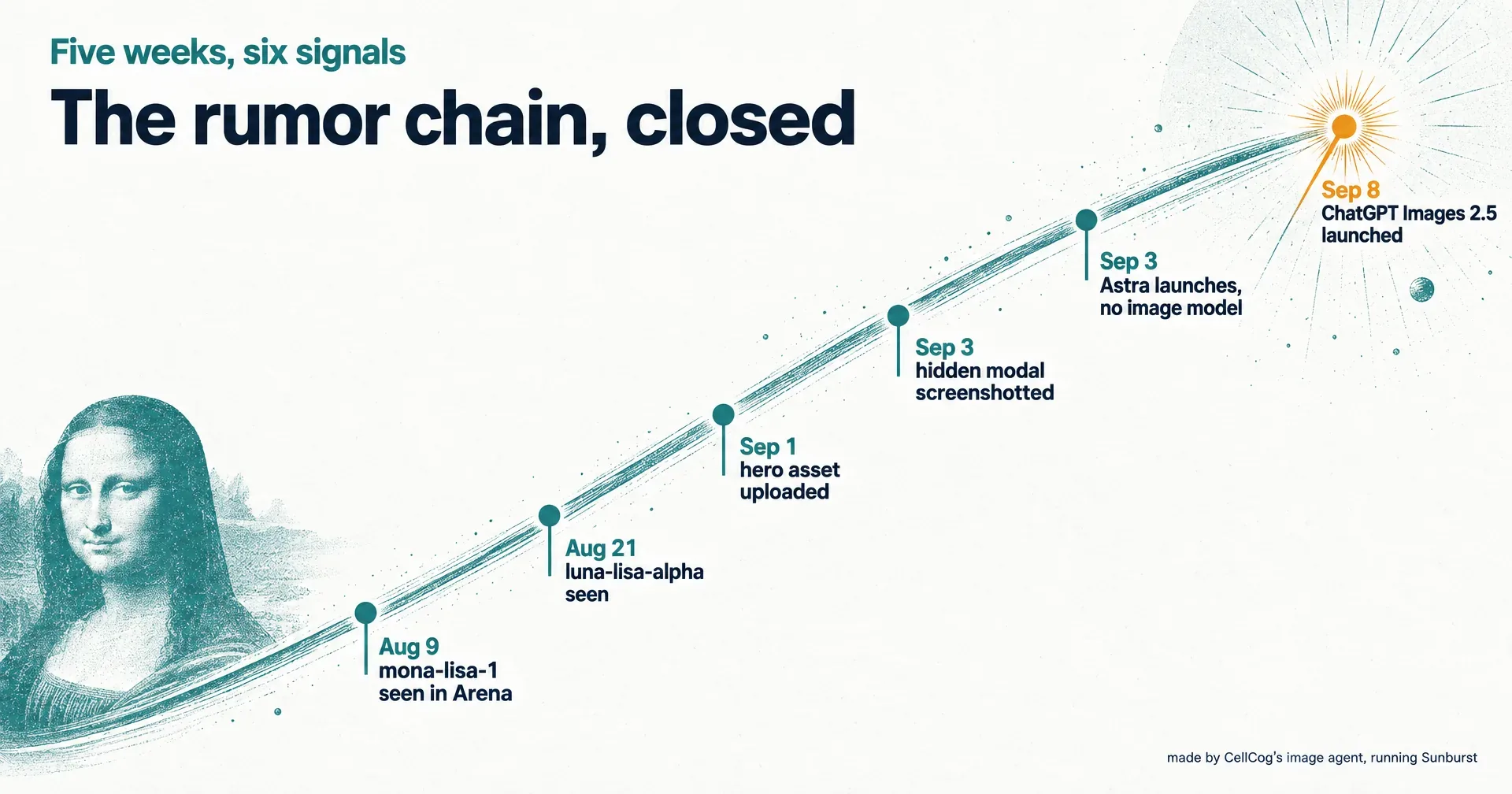
| Aug 9 | Anonymous checkpoint mona-lisa-1 seen in image Arena battles | Community sighting |
| Aug 21 | Second checkpoint luna-lisa-alpha seen | Community sighting |
| Sep 1 | Hero image for an upgrade announcement uploaded to ChatGPT’s asset host | Build artifact, reported Sep 3 |
| Sep 3 | Hidden modal screenshotted: “Image creation got a major upgrade” | Build artifact, screenshots |
| Sep 3 | GPT-6 Astra launches; no image model mentioned | OpenAI, official |
| Sep 8 | ChatGPT Images 2.5 launched; Flare and Sunburst in the API | OpenAI, official |
The lesson matches Astra and Fable 5.1: the shipped build artifact was worth more than every anonymous benchmark sighting combined, and the price was never going to leak because it did not change.
§ 03What it costs
The token rates are identical to GPT Image 2, so what an image costs depends only on the tokens each quality setting spends. We measured those tokens on both models at 1024 by 1024, five settings each; the numbers below are ours, not a vendor estimate.
| Model | Image input | Cached image input | Image output | Text input |
|---|---|---|---|---|
| gpt-image-2.5-sunburst | $8.00 | $2.00 | $30.00 | $5.00 |
| gpt-image-2.5-flare | $8.00 | $2.00 | $30.00 | $5.00 |
| gpt-image-2 | $8.00 | $2.00 | $30.00 | $5.00 |
| gpt-image-1.5 | $8.00 | $2.00 | $32.00 | $5.00 |
| Quality | Image output tokens | Cost at $30 per million |
|---|---|---|
| low | 196 | $0.006 |
| medium | 439 | $0.013 |
| high | 1,756 | $0.053 |
| xhigh | 3,122 | $0.094 |
| max | 7,024 | $0.211 |
The chart is in cents. Against GPT Image 2’s published tiers the ladder shifted a rung: 2.5 at high spends what GPT Image 2 spent at medium, and 2.5 at max spends what GPT Image 2 spent at high, so the two new settings are the top of the ladder, not a surcharge on the old rungs. Tokens do not scale with area either: a 3840 by 2160 image at low spends 371 tokens, under twice a 1024 square. The image generation guide carries OpenAI’s calculator; Batch API pricing for the two new models was not on the pricing page we pulled at launch, while the gpt-image-2 Batch rows still are.
§ 04Our read
We route real image work every day: infographics, posters and product visuals produced inside larger jobs by CellCog’s image agent. Our watchlist from September 4 had two axes, text rendering and edit fidelity. Launch day answered the second loudly: precision editing is the headline of the whole release, and Sunburst exists for it.
We did not wait for a benchmark. On September 8 we ran Flare and Sunburst against each other: the same prompt (a product photo with one handwritten label), 1024 by 1024, all five quality settings each, through the Image API with usage reporting on.
| Measure | Result |
|---|---|
| Image tokens per image | Identical for Flare and Sunburst at every quality setting |
| Price per image | Identical, since both bill at the same token rates |
| Generation time | Sunburst about 1.5 to 2x longer than Flare |
| Quality | No measured difference; OpenAI positions Sunburst for edit precision |
The result: CellCog’s image agent gets the whole GPT Image 2.5 surface, with Flare at high quality as its default. Per request the agent picks Flare or Sunburst, one of five quality settings, a transparent or opaque background, and the size; the separate transparent-background tool that ran GPT Image 1.5 retires. Flare is the default because the two cost the same and Flare is faster; the agent reaches for Sunburst when a job is about edit precision, which is what OpenAI built it for. All of it lands under existing work with no change on the user’s side, and it ships as a product update. Every image on this page, the hero included, was made by that agent running Sunburst, from the same facts as the tables.
§ 05What we are still watching
- Arena placement. gpt-image-2 at medium holds number one on text-to-image and both edit boards at launch; a 2.5 entry, and where Flare and Sunburst land relative to each other, is the first independent read.
- OpenAI’s own per-image table. The pricing page has token rates only; our measured ladder above stands until OpenAI publishes one.
- Batch API rows for the two new models.
- Text rendering. Our test prompt carried one handwritten label. A dense infographic pass against GPT Image 2 is next; results here.
§ 06Update log
This is a living page; when the story moves, the update lands here.
September 9, 2026 - measured costs, more pictures. The inherited GPT Image 2 per-image table is gone; in its place our own measurement on both models at 1024 by 1024, 196 to 7,024 image output tokens, $0.006 to $0.211 per image, with 2.5 high costing what GPT Image 2 medium did. A three-picture strip on what shipped replaces a paragraph of tracker history.
September 8, 2026, evening - CellCog’s agent gets the whole 2.5 surface, Flare at high by default. Ran Flare and Sunburst at all five quality settings on one prompt: identical image tokens, Sunburst about 1.5 to 2x slower, no measured quality difference. CellCog’s image agent now chooses per request across both models, five quality settings, transparent or opaque backgrounds and size, with Flare at high as the default and Sunburst for edit precision; the separate GPT Image 1.5 transparent tool retires. New hero and a four-image slideshow, the first on this blog, all made by that agent running Sunburst.
September 8, 2026 - launched. OpenAI published “Introducing ChatGPT Images 2.5,” added gpt-image-2.5-flare and gpt-image-2.5-sunburst to the API changelog, model pages and pricing page, and started the ChatGPT rollout to all tiers. Page rewritten from rumor tracker to launch record; the September 4 claims table survives as the scorecard above. Verified against OpenAI’s launch post, both model pages, the changelog and the pricing page on September 8.
As of September 4, 2026: page opened. No official movement to log.
Q1When did GPT Image 2.5 launch?
September 8, 2026. OpenAI published ‘Introducing ChatGPT Images 2.5’ and added gpt-image-2.5-sunburst and gpt-image-2.5-flare to its API changelog, model pages and pricing page the same day. Both models carry a 2026-09-08 default snapshot.
Q2Which model should I use in the API?
OpenAI’s own guidance: Flare for fast, high-quality everyday generation and for high-volume work, creator and social content, product experiences and prototyping; Sunburst where editing precision matters most, such as production campaign creative and polished product imagery. Both are selectable in the Image API and as the model of the Responses API image generation tool.
Q3Did the price change?
No. The pricing page lists gpt-image-2.5-sunburst and gpt-image-2.5-flare at exactly the gpt-image-2 rates: $8 input, $2 cached input and $30 output per million image tokens, $5 per million text input tokens. The new xhigh and max quality settings cost more per image only because they spend more output tokens.
Q4What are xhigh and max?
Two quality settings above high, new with 2.5, available on both Flare and Sunburst alongside low, medium, high and auto. OpenAI lists no per-image price for them; we measured 3,122 and 7,024 image output tokens at 1024 by 1024 on both models, about $0.094 and $0.211 per image.
Q5What happened to the GPT Image 2.5 rumors?
Mostly confirmed in shape. The hidden ‘Image creation got a major upgrade’ modal screenshotted September 3 was the launch asset and shipped September 8. The community name was right. Two anonymous Arena checkpoints in August, read as a larger and a smaller model, line up with two shipped models. No price, date or model card was ever leaked; those arrived only from OpenAI.
Q6Does CellCog use GPT Image 2.5?
Yes, both models. CellCog’s image agent chooses per request across the whole GPT Image 2.5 surface: gpt-image-2.5-flare or gpt-image-2.5-sunburst, five quality settings (low to max), transparent or opaque background, and size; the separate transparent-background tool that ran GPT Image 1.5 retires. Flare at high quality is the default and Sunburst is the pick when edit precision matters: we ran both at all five quality settings on the same prompt, image tokens and price were identical, and Sunburst took about 1.5 to 2x longer, so the fast one is the everyday choice. You pay for the work, not the hire; the cost depends purely on how much work you assign.