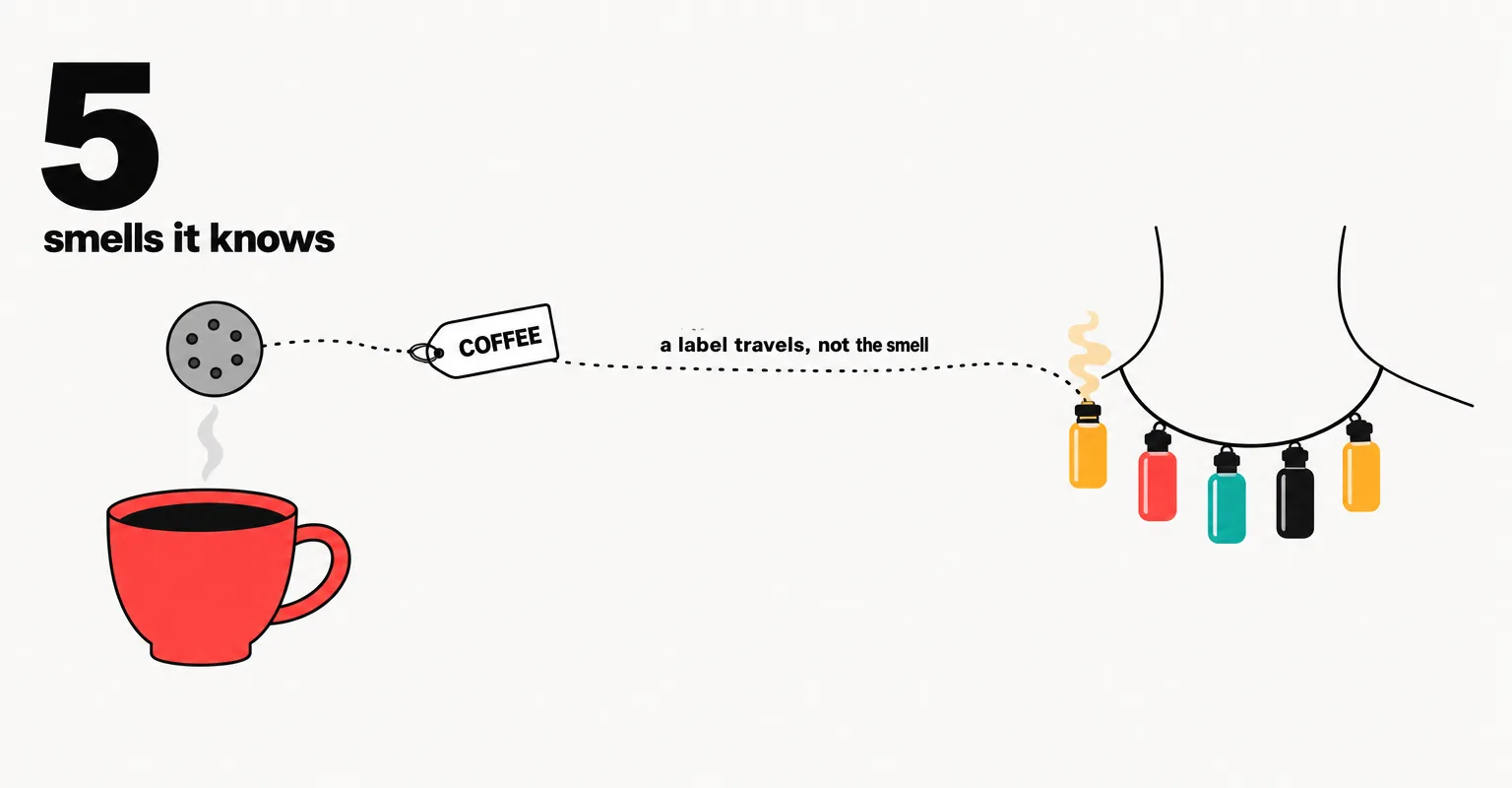
On October 21, a team at The Ohio State University published Scentronic in Science Advances: an electronic nose that recognizes a smell, sends what it recognized over the internet, and a wearable at the other end that recreates it from scented liquids it already carries. On October 23 a Polymarket post framed it as scent coming to phone calls and video chats, and had passed 1.2 million views about four hours later.
The smell itself never travels. What crosses the network is a label, and the prototype knows five of them: beer, cake, coffee, orange and red wine. Here is how it works, how often people could tell the scents apart, and what its lead author says it cannot do yet.
On this page · 7 sectionsOpen
 Scentronic, published in Science Advances on October 21, 2026 by an Ohio State team, pairs an electronic nose with wearable scent emitters linked over the internet.
 The smell itself never travels. The e-nose classifies what it smells, a cloud server relays that label in about 65 ms, and the receiver mists a scented liquid it already holds.
 Receivers come as a two-scent wristband, a five-scent handheld and a five-scent necklace, plus a cup that adds five tastes to five smells.
 It knows five smells: beer, cake, coffee, orange and red wine. Its best model labeled all 50 held-out samples correctly.
 Fourteen volunteers named the right scent 72.86% of the time against 20% by chance. The lead author calls it a research prototype, not a phone feature.
§ 01How Scentronic works

Two devices sit on either side of a cloud server. The sender is an e-nose of six metal-oxide gas sensors, read once a second. A machine-learning model turns the sensor voltages into one of five labels. The receiver is a wearable with small piezoelectric atomizers, each holding one scented liquid, which mist on command.
| Part | What the paper reports |
|---|---|
| Sensing | Six metal-oxide gas sensors, sampled once a second for 200 seconds per sample |
| Recognition | k-NN on end-point voltages: 100% on 50 held-out samples |
| Relay | Wi-Fi to a program on a Google Cloud server: 57 to 76 ms, about 65 ms average |
| Release | Piezoelectric atomizers fired in 10 ms bursts at 110 kHz |
| Receivers | Wristband (2 scents), handheld (5), necklace (5), cup (5 scents plus 5 tastes) |
| Library | Beer, cake, coffee, orange, red wine |
The necklace strings its five channels “like pearls on a string”, with a flexible circuit board along the back of the neck. In a live demo with alcohol vapor, the whole loop from sensor to mist responded in 0.6 seconds, and the atomizer’s output rose and fell as a cup moved toward and away from the sensor.
§ 02How well the machine recognized smells
The training set is small and clean. The team recorded 250 samples, 50 per food, each for 200 seconds under a cap that kept room air out. The foods were single products: the cake was King’s Hawaiian Sweet Rolls, the coffee a STōK cold brew, the oranges mandarins. They held back 20% of the samples for testing.
- A k-NN classifier on the final voltage readings labeled all 50 held-out samples correctly.
- Across repeated data splits, the same setup averaged 98.5%.
- The weakest model they tried, a random forest on the full time series, still reached 96%.
Those numbers say the e-nose can tell five very different foods apart in a closed box. They say nothing yet about a kitchen, where smells mix and drift.
§ 03How well people smelled it
The human tests ran on the receiving side with consenting volunteers, who sniffed a released scent and picked an answer on a screen.
| Test | Volunteers | Correct | Chance |
|---|---|---|---|
| Name one of 5 scents | 14 | 72.86% | 20% |
| Name one of 5 two-scent mixtures | 14 | 71.43% | 20% |
| Rank 5 intensity levels | 14 | 58.57% | 20% |
| First noticed of 10 orange strengths | 16 | Level 5 most often (6 people) | Not a choice task |
People did far better than guessing, though roughly one answer in four was wrong for single scents.
§ 04What it cannot do yet
Lead author Chunyu Yang, an Ohio State doctoral student in materials science and engineering, was direct with Reuters: “At present, this is a research prototype.” The limits are concrete.
- Five smells only. “We have not yet expanded beyond those categories,” Yang said. Each new smell needs training data for the e-nose and a matching liquid in the receiver.
- Recognizing is not reproducing. “Recognizing an odor and accurately reproducing it are separate challenges,” he said. The receiver can only mist what it carries.
- The nose is not wearable. Reuters reports the e-nose is about 15 cm (6 inches) across: portable, but not designed to be worn.
- Short runtime. At a 10% duty rate the emitter ran more than 35 minutes; at full output, under 5 minutes.
- No company, no price. Reuters reports no company was involved, and Yang lists cost, refilling, durability and the safety of repeated mist exposure as open problems.
§ 05Will phones get smell?
Not soon. Yang told Reuters: “In principle, a smartphone could connect to a scent-generating accessory.” Building it into the phone itself is harder, he said, because reservoirs, electronics and atomizers take space and add weight. And on the tailgate-party example Reuters put to him: “Our current system has not demonstrated the transmission of a grilling-hot-dog scent or the exact mixture of smells at a tailgate party.”
The paper’s own pitch is narrower and nearer: remote smell tests that track loss or distortion of smell without a clinic visit. The AAAS release adds food for astronauts and field rations, where smell can make bland food more appealing.
§ 06Update log
- October 23, 2026: page opened from the Science Advances paper (October 21), the AAAS release and Reuters’ interview with the lead author. Same day: added an explainer scene of how the label travels.
§ 07Sources
- Chunyu Yang et al., Scentronic: An artificial intelligence-assisted olfactory interface for remote odor sharing and transmission, Science Advances 12(43), October 21, 2026.
- AAAS, Smell you later: New device detects and relays scents across distance, October 21, 2026.
- Reuters, New ‘Scentronic’ technology can detect and transmit aromas remotely, October 23, 2026.
- Polymarket on X, October 23, 2026.
Q1Can you send a smell over the internet now?
Only in a lab prototype. Scentronic sends a label for one of five smells it was trained on, and the receiving wearable releases a matching scented liquid it already carries.
Q2Does Scentronic transmit scent molecules?
No. Molecules stay where they are. The e-nose turns sensor voltages into a label, a cloud server relays it, and atomizers on the other end mist stored fragrance.
Q3Who built Scentronic?
Researchers at The Ohio State University led by doctoral student Chunyu Yang, with Jinghua Li as the expert contact. Reuters reports no company was involved.
Q4How accurate is Scentronic?
Its k-NN classifier labeled 100% of 50 held-out samples. In human tests, 14 volunteers identified single scents 72.86% of the time and mixtures 71.43%, against 20% by chance.