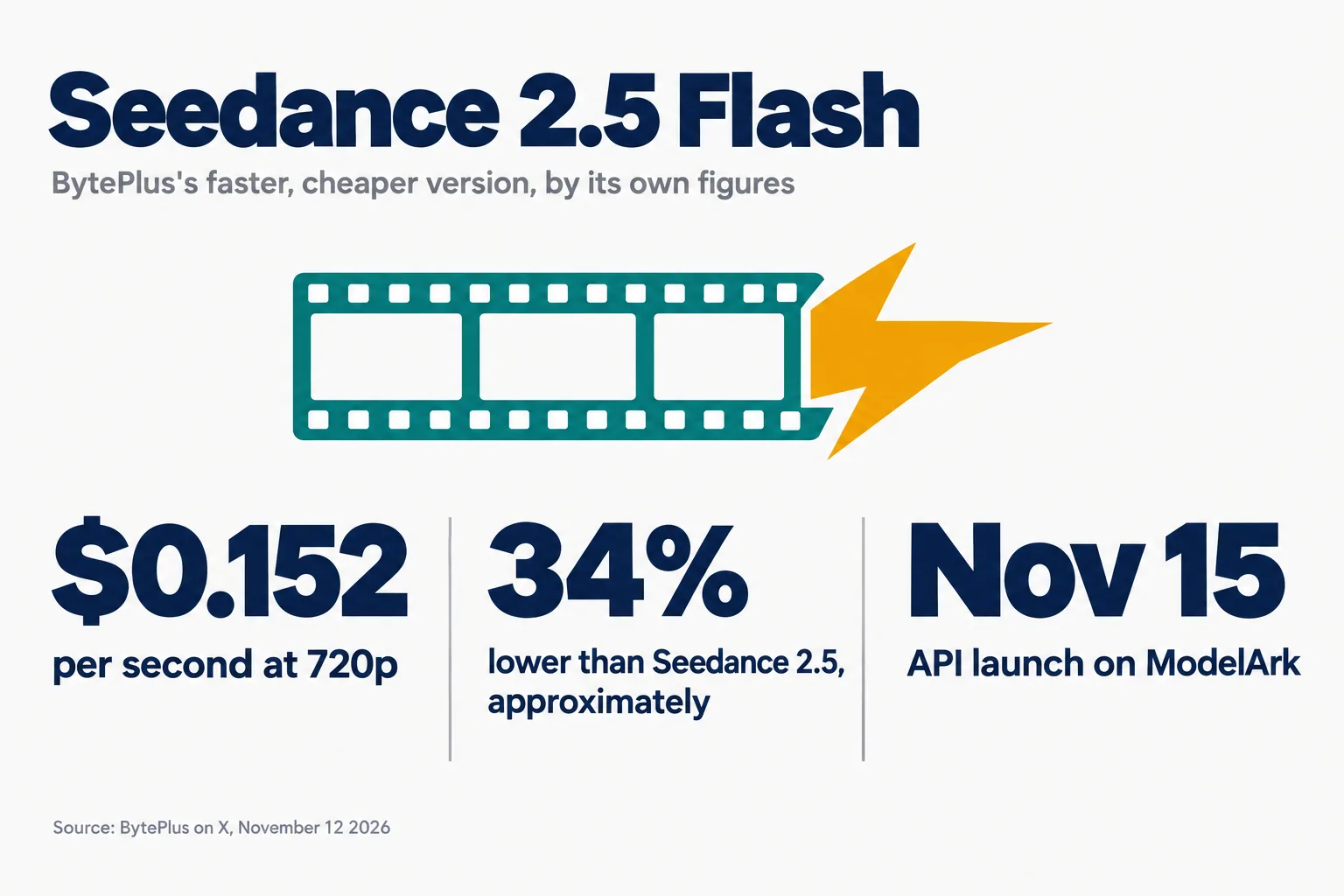
BytePlus announced Dreamina Seedance 2.5 Flash on November 12, 2026, a faster and cheaper version of ByteDance’s video model. It gave one price, one speed claim and one date: the API opens on its ModelArk platform on Sunday, November 15.
This post is read from BytePlus’s announcement on X and from its ModelArk price page, model list, Seedance 2.5 guide, video generation tutorial and region availability page, all read on November 12, 2026. We did not use the 46-second video attached to the announcement. By BytePlus’s account the API opens on November 15, so this post has no test in it.
On this page · 8 sectionsOpen
 BytePlus announced Dreamina Seedance 2.5 Flash on November 12, 2026 and said its API opens on ModelArk on Sunday, November 15.
 BytePlus says Flash gives results close to the flagship’s at nearly twice the generation speed. The documentation pages we read give no timing.
 BytePlus’s price page lists Flash at $7.0 per million tokens for 480p and 720p, against $10.70 for Seedance 2.5.
 The price page marks 1080p, 4K and offline inference as not supported for Flash.
 Flash’s listed rate equals Seedance 2.0’s, and both are listed at $0.76 for a 5-second 720p clip.
§ 01What BytePlus announced
- The claim. BytePlus’s post promises “results close to flagship Seedance 2.5, with nearly twice the generation speed”.
- The price. For 720p text-to-video and image-to-video, it says “pricing is USD 0.152 per second, approximately 34% lower than Seedance 2.5”.
- The date. The post says “The API will launch on BytePlus’s ModelArk platform on Sunday, November 15”. The model id on the price page is dreamina-seedance-2-5-flash-261115.
- Where it was said. The announcement is a post by @BytePlusGlobal at 06:09 UTC on November 12. It had about 3,200 views when we read it at 07:35 UTC. The raw HTML of BytePlus’s blog index did not contain the word Flash when we fetched it at 07:35 UTC.
§ 02What the price page lists
BytePlus’s price page says “Token prices are USD per million tokens”. Its update stamp reads November 12, 2026 06:06:31 and names no time zone.
| Model | 480p and 720p, no video input | 1080p, no video input | 480p and 720p, with video input |
|---|---|---|---|
| Seedance 2.5 Flash | $7.0 | Not supported | $4.3 |
| Seedance 2.5 | $10.70 | $11.7 | $6.40 |
| Seedance 2.0 | $7.0 | $7.7 | $4.3 |
- Resolution. Flash is listed for 480p and 720p only. Its 1080p, 4K and offline inference cells all read Not supported.
- Against the flagship. $7.0 against $10.70 is 34.6% lower by our arithmetic, in line with the announcement’s figure.
- Against Seedance 2.0. Flash’s rate equals Seedance 2.0’s in both columns where the two are listed. The announcement does not mention Seedance 2.0.
- With video input. The rate per token is lower when a reference video is supplied, yet the page says “A video generated with video input costs more than one generated without video input”. The formula explains it: tokens are counted on the input video’s seconds plus the output’s.
§ 03What a clip costs
The page gives worked examples for a 5-second clip at 16:9.
| Model | 480p clip | 720p clip | 720p per second | 1080p clip |
|---|---|---|---|---|
| Seedance 2.5 | $0.514 | $1.156 | $0.231 | $2.843 |
| Seedance 2.5 Flash | $0.34 | $0.76 | $0.15 | Not supported |
| Seedance 2.0 | $0.35 | $0.76 | $0.15 | $1.87 |
- The two figures. The announcement says $0.152 a second and the page’s example says $0.15. The page’s formula gives $0.1512 for a frame of 1280 by 720 at 24 frames a second. Those frame figures are our assumption. They reproduce the flagship’s listed 720p examples.
- With a reference video. For a 5-second output with a 2 to 30 second input video, the page lists Flash at $0.37 to $1.45 at 480p and $0.84 to $3.25 at 720p. It lists the flagship at $0.553 to $2.152 and $1.244 to $4.838.
- Failed generations. The page says “You are only charged for successfully generated videos”.
- Estimates. It also says “Token consumption values are estimates”. The bill follows the token count the API returns.

§ 04The speed claim
- One phrase. In the text of the announcement, the speed claim is one phrase: nearly twice the generation speed.
- No figure. None of the documentation pages we read gives a generation time for Flash, in seconds or as a ratio. The model list and the Seedance 2.5 guide do not mention Seedance 2.5 Flash.
- How to check it. Once the API opens, the claim can be timed: the same prompt, resolution and length on both models, from request to finished file.
§ 05What we do not know
- Limits. The guide says the flagship generates up to 30 seconds and takes up to 30 reference images. We found no page that says whether Flash keeps those limits.
- Quality. The pages we read carry no benchmark and no side-by-side comparison for the claim of results close to the flagship’s.
- Regions. BytePlus’s region availability page does not mention Seedance 2.5 Flash. We do not know where it will be sold.
- The tutorial. BytePlus’s video generation tutorial does not mention Seedance 2.5 Flash.
- Other hosts. We did not check whether the hosts that resell Seedance 2.5 will carry Flash. Our Seedance 2.5 pricing record lists those hosts and their flagship prices.
§ 06Where CellCog sits
Our conflict, declared: CellCog’s video agent runs on Seedance 2.5, the flagship this post compares Flash against. As of November 12, 2026, we do not route to Seedance 2.5 Flash and we have not tested it. Nothing in our routing changes today. We compared the flagship with Kling 4.0 and with Gemini Omni 1.2 Flash in tests of our own.
Choosing a tool for a business’s video, and not a model? Our ranked list of eight AI content creator tools compares them on video, graphics and posts. We wrote that list, and we rank CellCog first on it.
§ 07What we are watching
- November 15. Whether the API opens on the date given, and under which model id.
- The first timings. Whether outside tests find the speed close to twice.
- The other hosts. Whether other hosts list Flash, and at what price.
- 1080p. Whether Flash gets a 1080p tier. The flagship launched without one and gained it in October, per our pricing record.
§ 08Sources
- BytePlus’s announcement on X, November 12, 2026
- BytePlus ModelArk pricing, read November 12, 2026
- BytePlus ModelArk model list, read November 12, 2026
- BytePlus’s Dreamina Seedance 2.5 guide, read November 12, 2026
- BytePlus’s video generation tutorial, read November 12, 2026
- BytePlus’s region availability page, read November 12, 2026
Q1What is Seedance 2.5 Flash?
A faster, cheaper version of ByteDance’s Seedance 2.5 video model, announced by BytePlus on November 12, 2026. BytePlus says its results are close to the flagship’s at nearly twice the generation speed.
Q2How much does Seedance 2.5 Flash cost?
BytePlus’s price page lists it at $7.0 per million tokens for 480p and 720p without video input. Its example for a 5-second 720p clip is $0.76, or $0.15 a second. The announcement says $0.152 a second.
Q3When can I use the Seedance 2.5 Flash API?
BytePlus says the API opens on its ModelArk platform on Sunday, November 15, 2026.
Q4Does Seedance 2.5 Flash support 1080p?
Not on the price page we read on November 12, 2026. It lists Flash for 480p and 720p, and marks 1080p, 4K and offline inference as not supported.
Q5Is Seedance 2.5 Flash really twice as fast?
BytePlus says nearly twice. The pages we read give no timing, and BytePlus says the API opens on November 15, so we have not timed it.
Q6Does CellCog use Seedance 2.5 Flash?
Not as of November 12, 2026. CellCog’s video agent runs on Seedance 2.5. BytePlus says Flash’s API opens on November 15, and we have not tested it.