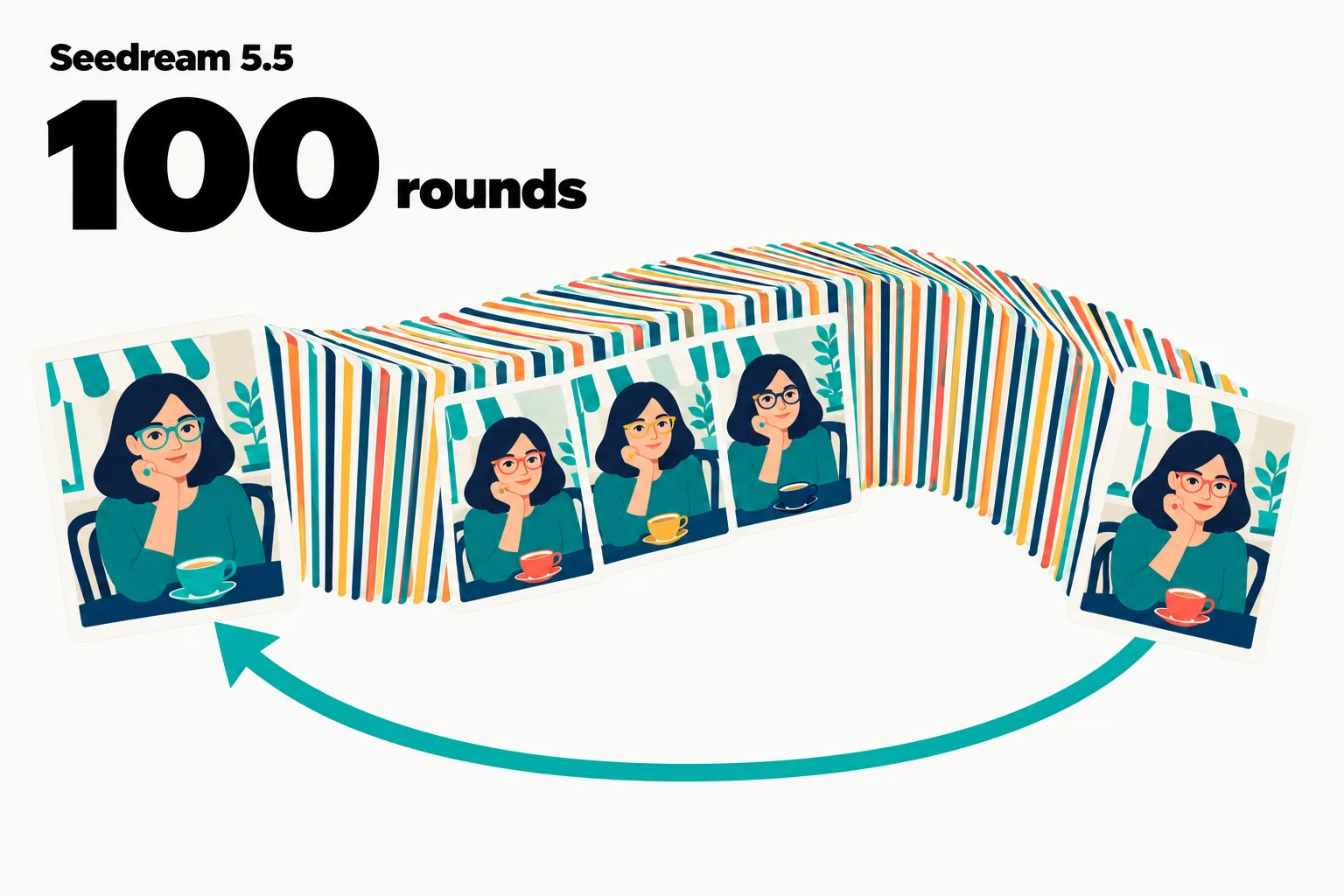
ByteDance’s Seed team released Seedream 5.5 on November 9, 2026, its next image creation model, and the headline claim is about editing rather than first drafts. The company says you can edit the same image across 100 rounds, feeding each output back in as the next input, while everything outside the edited area stays the same down to the pixel. It also adds native transparent output and reports better realism and small-text rendering.
BytePlus, ByteDance’s international cloud, announced it on X at 10:37 UTC the same day. Below: what was announced, what the evaluations actually measure, what it costs, and what is still unknown. We run our own image work on GPT Image 2.5 and recently measured GPT Image 2.6 against 2.5 over 80 generations, so we read the claims with that test in hand.
On this page · 8 sectionsOpen
 ByteDance’s Seed team released Seedream 5.5 on November 9, 2026; BytePlus announced it on X at 10:37 UTC.
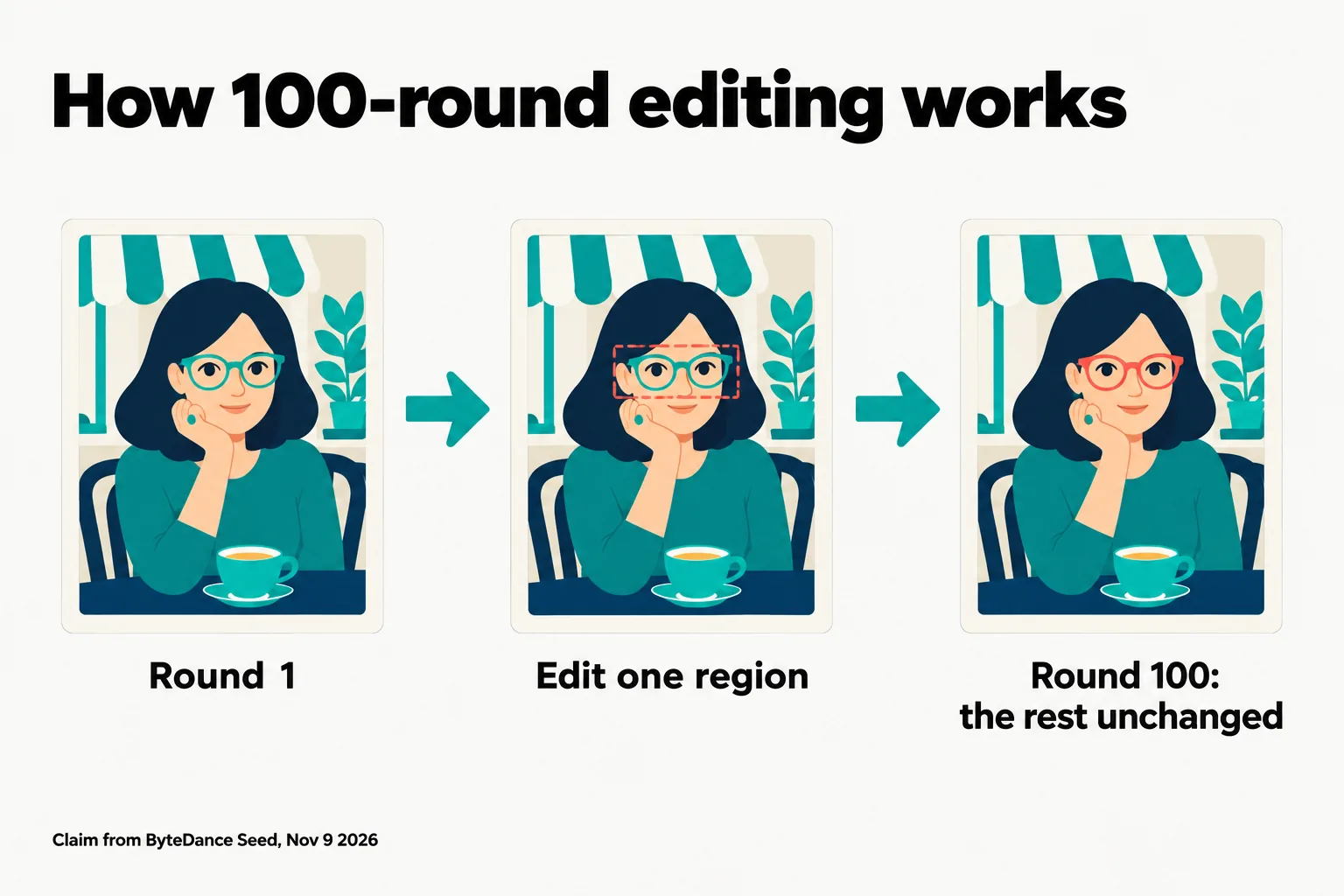
 The headline claim: edit one image across 100 rounds while unedited regions stay the same at the pixel level.
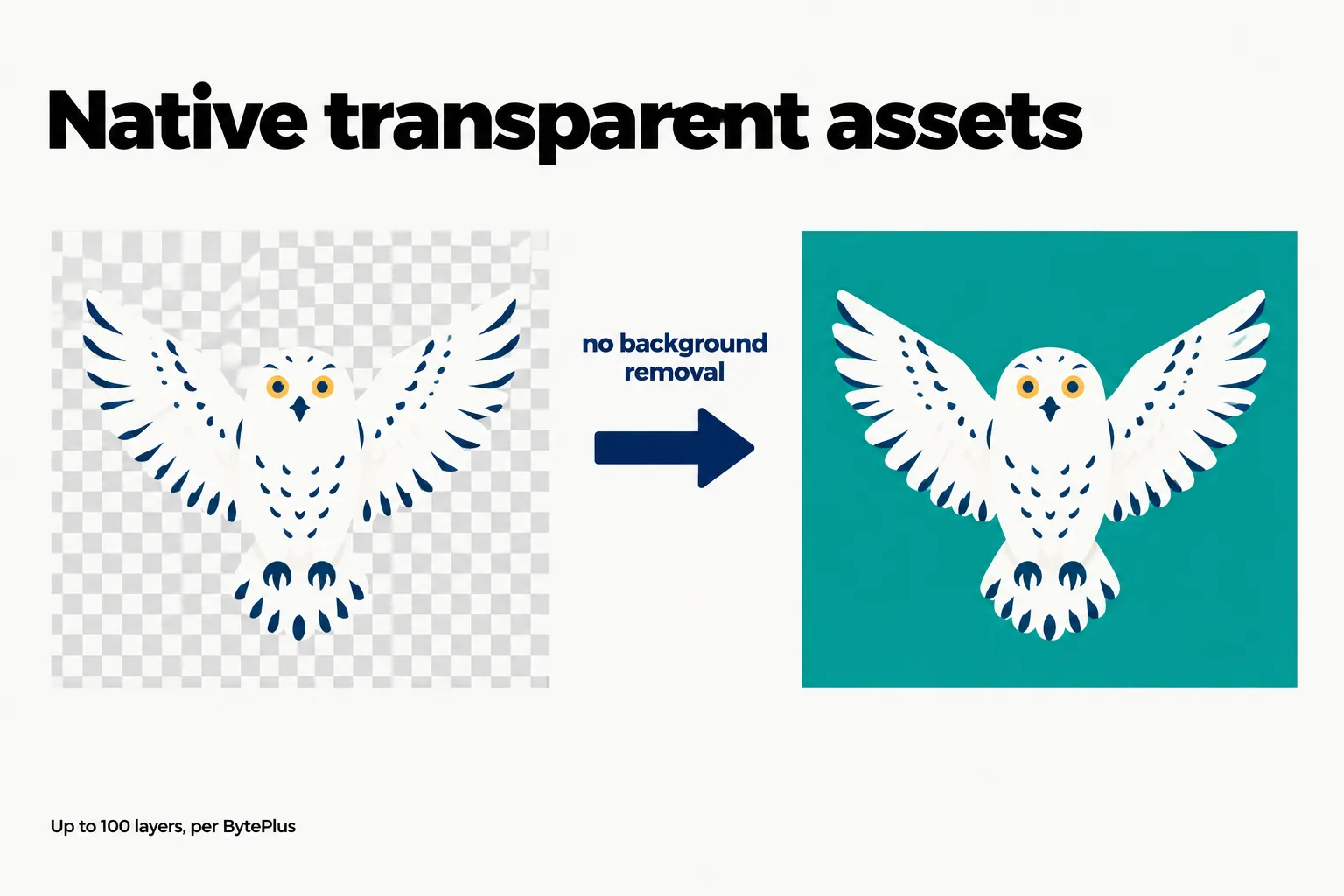
 It outputs native transparent images with an alpha channel, and BytePlus says it supports up to 100 layers.
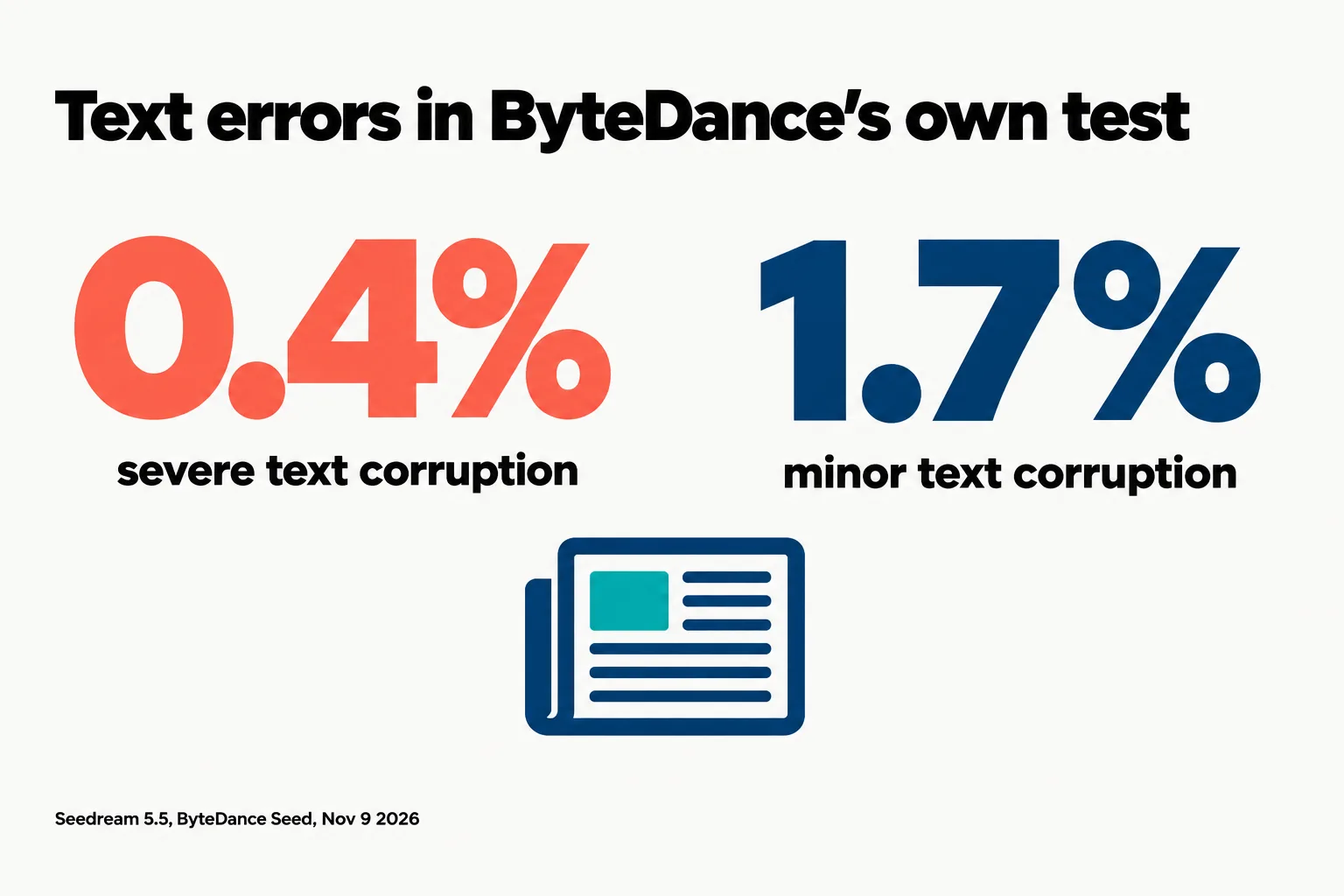
 ByteDance reports 0.4% severe and 1.7% minor text corruption, and says it leads GPT Image 2.5 Sunburst and Nano Banana 2.1 on text structure, with no rival numbers published.
 BytePlus lists it from $0.02 per image; the API model ID, max resolution and independent results are not out yet.
§ 01What ByteDance announced
The Seed blog post lists three upgrades. All three come from ByteDance’s own post and demos; none has been measured independently yet.
| Upgrade | What ByteDance says it does | Why a team would care |
|---|---|---|
| Multi-round editing | Unedited regions kept at the pixel level, up to 100 rounds | Iterate on one image without it slowly degrading |
| Native RGBA output | Images with an alpha channel, full and partial transparency | Stickers, cutouts and layers without background removal |
| Realism and text | More natural light, materials and skin; denser small text | Product shots and infographics that need less fixing |
ByteDance says a Pro version is coming: “A Pro version of the Seedream 5.5 series will follow.” It gave no date.
§ 02100 rounds of editing without drift
Anyone who has edited an AI image several times knows the problem. Each round re-renders the whole picture, so faces soften, colors wander and details you never asked to change quietly disappear. After ten rounds the image can look like a copy of a copy.
ByteDance’s claim is that Seedream 5.5 was trained to leave everything outside the requested change alone. Its stated goal is to “Preserve unedited regions at the pixel level” and to reduce “detail loss and image degradation across successive edits.” In the main demo, the team ran 100 successive edits on one portrait, each round built on the previous output, changing clothes, accessories and objects on the table, and says the model could still make precise changes to small items such as rings and eyeglass frames at the end.

BytePlus put it more plainly in its launch thread: “Change what you want. Keep the rest intact, down to the pixel.” The demos show interiors where furniture moves and the model fills in what was hidden behind it, and floral pieces where single stems change material. These are the company’s chosen examples, which is the usual caveat for any launch demo.
§ 03Native transparent assets
Seedream 5.5 can output images with an alpha channel directly, from a text prompt or a reference image. ByteDance’s examples include a snowy owl cut out with its feathers and claws intact, sticker sets with transparent surroundings and a set of characters generated as separate pieces to recombine. The BytePlus thread adds “support for up to 100 layers.”
For design and e-commerce teams this removes a step: today most generated product shots or stickers still go through a separate background removal tool, which is where edges usually break. GPT Image models already offer a transparent background setting, so this is ByteDance catching up on one feature and claiming better edges, not a new category.
§ 04What the evaluations show, and what they do not
ByteDance tested six production use cases (e-commerce, marketing, film and television, gaming, office productivity and fashion design) on its own MagicArena platform, scored by expert evaluators. Against Seedream 5.0 Pro, it reports higher quality scores and usability rates in all six, with usability more than twice as high in film and television and in office productivity.
| Measure | Compared with | Reported result |
|---|---|---|
| Usability, film and TV and office | Seedream 5.0 Pro | More than 2x |
| Realism, image-to-image (GSB) | Seedream 5.0 Pro | +55.62% |
| Text structure and realism, 4 comparisons | Seedream 5.0 Pro | Positive in all four |
| Text structure, both tasks | GPT Image 2.5 Sunburst, Nano Banana 2.1 | Leads (no number published) |
| Severe text corruption rate | Own test set | 0.4% |
| Minor text corruption rate | Own test set | 1.7% |
The comparison against rivals is the part to read carefully. ByteDance says Seedream 5.5 “leads in text structure across both tasks and shows a substantial advantage in text-to-image realism” against GPT Image 2.5 Sunburst and Nano Banana 2.1. The post gives no head-to-head numbers, no prompt set and no method beyond expert preference scoring (GSB, Good / Same / Bad). The +55.62% figure is against ByteDance’s own previous model, not against either rival. It is also notable what is not claimed: no lead over rivals on image-to-image realism or on editing.
§ 05Price and availability
ByteDance says Seedream 5.5 is rolling out across its own apps and its Volcano Engine Ark platform in China. IT Home reports the API keeps the two-part input image plus output image billing, charges nothing for text tokens, and puts a 2K square edit at about 0.28 yuan, less than half the cost of Seedream 5.0 Pro. That figure comes from the report, not a published rate card.
On BytePlus, the international product page lists Seedream 5.5 “starting at $0.02/image,” with first-purchase bundles of 700, 1,800 and 3,500 images.
| Model | Price | Source and conditions |
|---|---|---|
| Seedream 5.5 | From $0.02 per image | BytePlus product page, starting price |
| Seedream 5.5 | About 0.28 yuan per 2K square edit | IT Home report, China API |
| GPT Image 2.5 Flare, low | $0.0061 per 1024 image | Our measured run, November 5 |
| GPT Image 2.5 Flare, high | $0.0529 per 1024 image | Our measured run, November 5 |
| GPT Image 2.6 Flare, low | $0.0250 per 1024 image | Our measured run, November 5 |
These are not like-for-like: sizes, quality levels and pricing models differ, and a starting price is not a price for your workload. What the table does show is that Seedream 5.5 is pitched in the same cents-per-image band where GPT Image 2.6 removed the cheap tier that 2.5 still has.
§ 06What is not known yet
- The API model ID. BytePlus’s public ModelArk model list showed Seedream 5.0 variants but not 5.5 when we checked.
- Maximum resolution. The 2K square figure is a pricing example, not a stated limit.
- Third-party hosts. We found no Seedream 5.5 listing on fal or Replicate yet.
- Independent results. No arena or outside benchmark has scored it so far; the rival comparison has no published numbers.
- The Pro model. Announced as coming, with no date or spec.
§ 07What this means if you make images for a living
The 100-round claim targets the most expensive habit in AI image work: regenerating and fixing. If an edit really leaves the rest of the picture alone, a team can treat one approved image as a master and make variants from it, a new outfit, a new product color, a new price tag, without re-approving the whole frame each time. That is the workflow ByteDance is pitching to e-commerce and film teams.
The way to know is the same test we ran on GPT Image 2.6: take your own image, run 20 or 30 edits in a row and compare the untouched regions with the original pixel by pixel. A launch demo picks its best case. Your catalog will not. Until Seedream 5.5 shows up on the hosts and leaderboards developers use, the rival comparison is a claim, and the price is the most concrete thing in the announcement.
§ 08Sources
- ByteDance Seed, Introducing Seedream 5.5
- ByteDance Seed, Seedream 5.5 model page
- BytePlus, Seedream 5.5 product page
- BytePlus on X, launch thread
- IT Home, Seedream 5.5 report
- CellCog, GPT Image 2.6 vs 2.5, our 80-generation test
Q1What does 100 rounds of editing mean?
Feeding each edited output back in as the next input, 100 times, while the parts you did not ask to change stay the same.
Q2Can Seedream 5.5 make transparent images?
Yes. ByteDance says it outputs images with an alpha channel directly, with full and partial transparency, from a prompt or a reference image.
Q3Is there a Seedream 5.5 Pro?
ByteDance says a Pro version will follow. It gave no date.
Q4Where can I use it?
In ByteDance’s own apps and Volcano Engine Ark in China, and through BytePlus internationally. We found no listing on fal or Replicate yet.
Q5Does CellCog use Seedream 5.5?
No. CellCog’s image agent runs GPT Image 2.5 today.