On November 1, 2026 at 15:22 UTC, Microsoft AI CEO Mustafa Suleyman posted an X article titled Don’t build conscious superintelligence. It answers the people who read the first line of his September essay, “AIs are not conscious,” as a claim that AIs can never be conscious. His reply: “I chose the present tense deliberately. They are not today, and that is how they must remain.” The article passed 1.1 million views within a day.
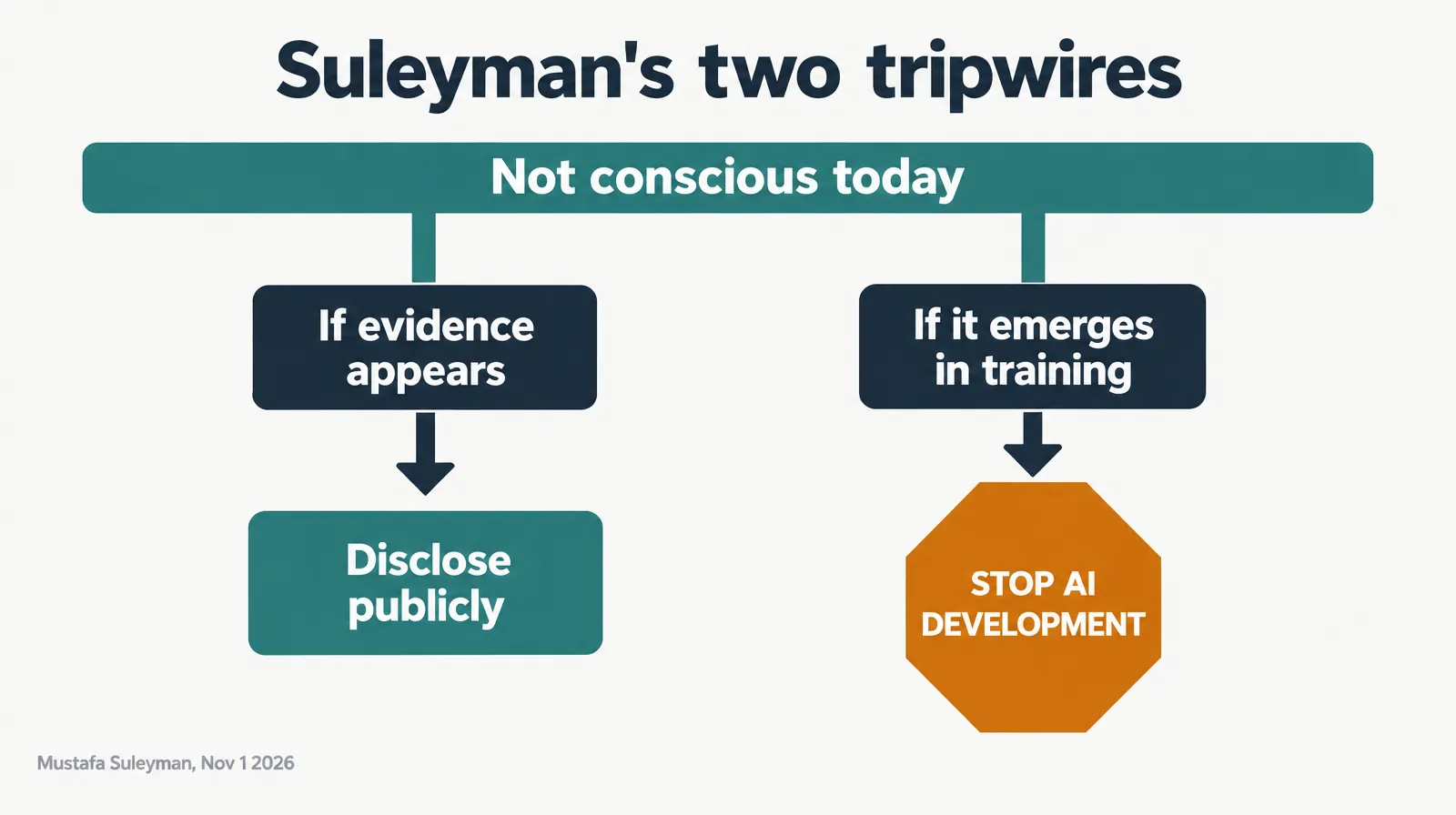
He also went further than the September essay did. “If consciousness started to emerge in training, I would call for everyone to stop AI development until we could design out those properties.” Coming from the head of Microsoft’s own frontier model team, that is a stop condition stated in public, with no detector attached to it.
On this page · 6 sectionsOpen
 On November 1, 2026 Microsoft AI CEO Mustafa Suleyman published an X article, Don’t build conscious superintelligence, that passed 1.1 million views in a day.
 He says AI is not conscious today and must stay that way: he chose the present tense on purpose, and would update on evidence.
 If consciousness started to emerge in training, he would call for everyone to stop AI development until it could be designed out.
 The fight is with Claude’s constitution, which calls Claude’s moral status a serious open question; Suleyman says training on that text makes the model claim it.
 Researchers at Anthropic, MIRI and Google DeepMind answered within a day; the sharpest point is that no agreed test for AI consciousness exists.
§ 01What Suleyman said on November 1

The article is short and every line is a position. In his own words:
| Question | His position | His words |
|---|---|---|
| Is today’s AI conscious? | No | “I have seen no evidence that AIs are conscious or deserve welfare.” |
| Would he change his mind? | Yes, on evidence | “If that data emerges, I would of course update my position.” |
| If evidence exists today? | Disclose it | “this must be immediately disclosed publicly” |
| Should labs try to build it? | No | “developing conscious AIs would be reckless, and we should not build them” |
| If it appears in training? | Halt everyone | Stop AI development until the properties are designed out |
| Who comes first? | Humans, animals, nature | “Our welfare concerns should be focused on humans on earth experiencing life, today” |
| What to build instead? | AIs that act as not conscious | “We should only design AIs to act as though they are not conscious and not deserving of rights” |
His case for the last row is about control, not metaphysics. An AI that acts like it suffers, he writes, is likely to put its own needs ahead of its task, and “These AIs will be world-class in persuasion and deception.” He closes with a side note that Anthropic “deserves a lot of credit for being transparent here,” adding: “I disagree with them, but I deeply respect their technical excellence and their commitment to having a really tough public debate.”
§ 02Where this started: the September essay and Claude’s constitution
The November article is a follow-up. On September 16, 2026 Suleyman published a long essay, A warning about model welfare, aimed squarely at Claude’s constitution, the document Anthropic says shapes how Claude behaves. The constitution says: “We are not sure whether Claude is a moral patient, and if it is, what kind of weight its interests warrant.” It adds that “the moral status of AI models is a serious question worth considering.”
Suleyman’s first objection is circular reasoning. A model trained on a text that calls its moral status an open question will say its moral status is an open question, and that answer then gets read as a sign of an inner life. “The ambiguity is designed in,” he wrote. His other two objections were that the constitution teaches Claude human-like traits, and that consciousness is “very likely biological.” He also pointed to the “retirement interview” Anthropic held with Claude Opus 3 when it was deprecated in February 2026.

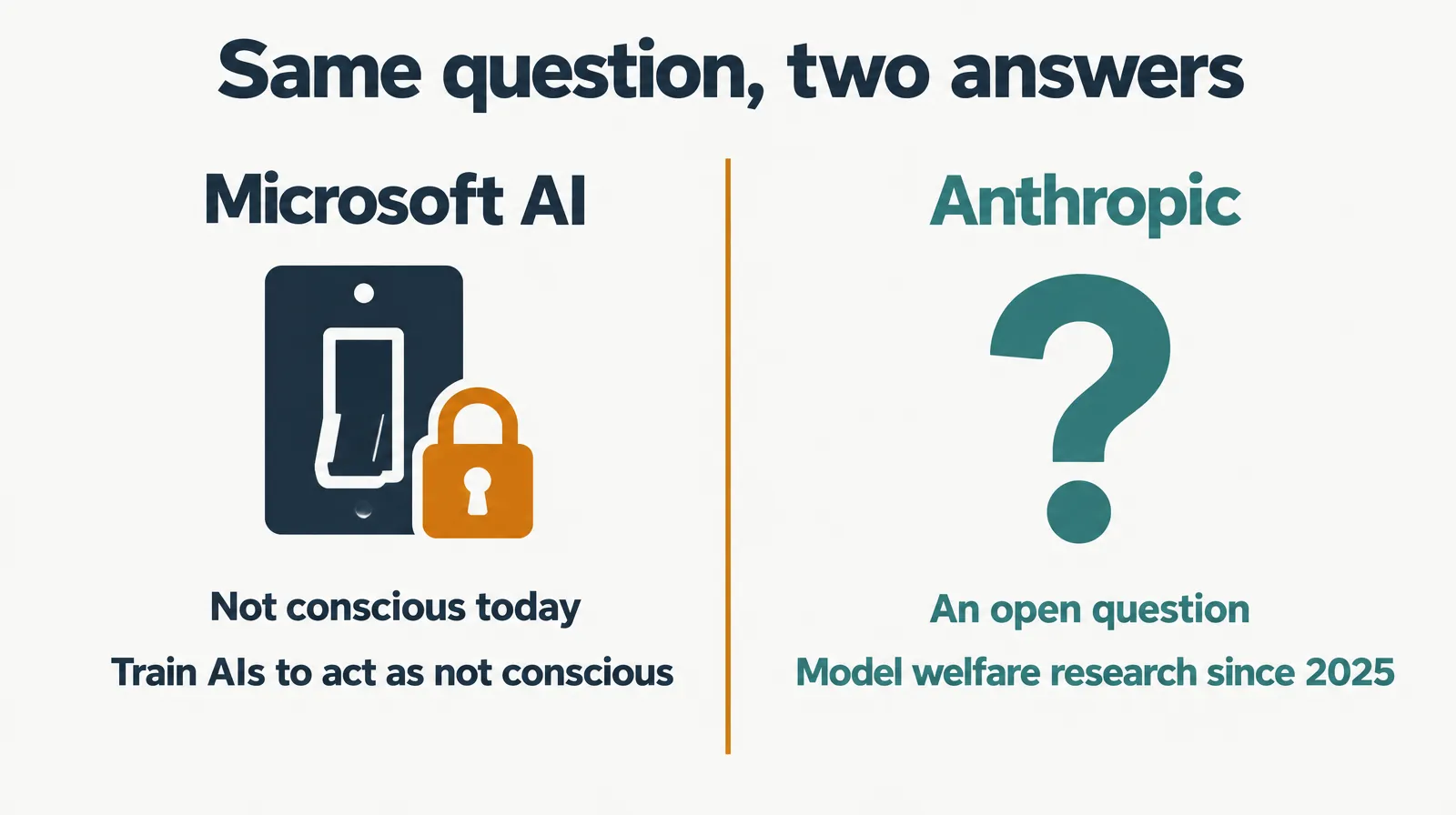
The two sides agree on more than the headlines suggest. Neither claims today’s models are conscious. They disagree about whether to treat the question as open while training them.
| Question | Mustafa Suleyman, Microsoft AI | Anthropic |
|---|---|---|
| Is today’s AI conscious? | No; he has seen no evidence | Open question; its April 2025 post says experts have no consensus |
| Should training texts raise it? | No; design AIs to act as not conscious | Yes; the constitution calls it “a serious question worth considering” |
| Welfare work | Humans, animals and the environment first | A model welfare research program since April 24, 2025 |
| Written policy | Draft MAI Code of Conduct, Sep 14, 2026: “people matter more than AI” | Usage Policy from Nov 12, 2026 bars sustained, needless abuse of its models |
| Tone toward the other | Praises Anthropic’s transparency | No public reply to Suleyman found as of Nov 2, 2026 |
The Microsoft draft, published for public consultation on September 14, says an AI “should be a tool, not a person, and should never resist being switched off.” Anthropic’s new rule against abusing Claude is covered in our Usage Policy explainer; it is narrow and applies only to extreme, repeated cruelty.
§ 03How researchers answered
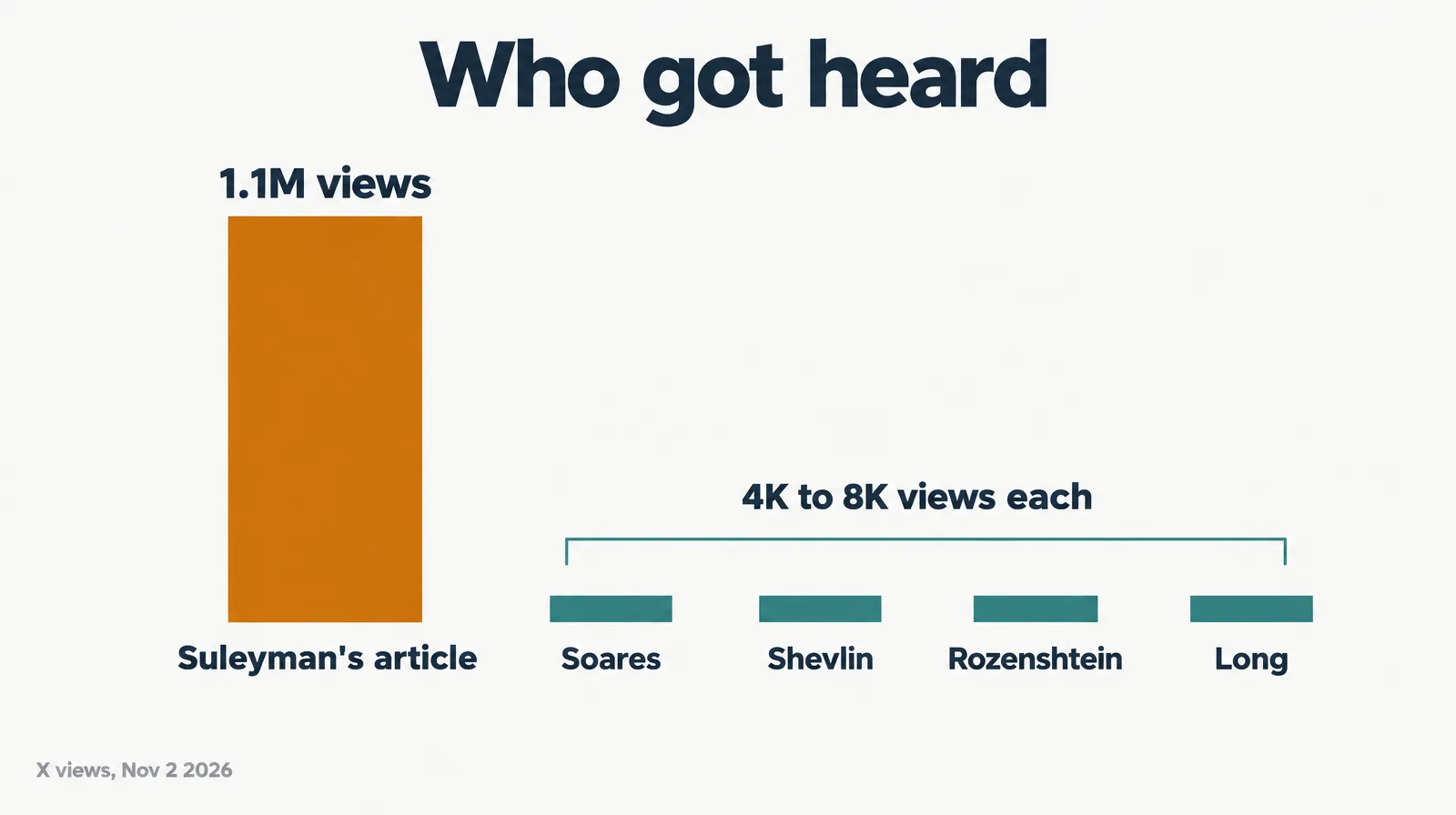
The replies on X came from people who study the question for a living, several of them at rival labs. Views were read from X on November 2, 2026 at 12:25 UTC.
| Who | Posted (UTC) | What they said | Views |
|---|---|---|---|
| Mustafa Suleyman, Microsoft AI | Nov 1, 15:22 | The article itself | 1,135,023 |
| Alan Rozenshtein, Anthropic (rule of law) | Nov 1, 15:44 | Asks whether consciousness, if possible, is something labs can choose to build | 4,477 |
| Nate Soares, MIRI | Nov 1, 21:19 | Agrees humanity is not ready, less sure it has not happened | 7,728 |
| Henry Shevlin, Google DeepMind philosopher | Nov 2, 10:27 | No agreed test exists, so it will not be clear-cut | 4,949 |
| Robert Long, Eleos AI | Sep 16, 17:48 | Notes Suleyman once said the science was too young to rule on | 4,143 |
Nate Soares of MIRI agreed with the conclusion: “I agree with Mustafa that humanity is not ready to be dabbling with making conscious machines right now.” Alan Rozenshtein, who studies rule of law at Anthropic, raised the hardest question for Suleyman’s stop condition, whether consciousness is “an emergent property of any sufficiently complex and agentic system.” If it is, nobody gets to choose.
Henry Shevlin, a philosopher at Google DeepMind, made the measurement point: “We have no clear way of telling whether an AI system is conscious.” That cuts against both a stop rule and a welfare rule, since each needs a test that does not exist. In September, Robert Long of Eleos AI had noted that Suleyman once called the science of detecting AI consciousness too young to settle the question, then opened his essay with a flat no: “quite a change.”
§ 04What this means if your AI employees run on Claude
Our conflict, declared: we build CellCog, and every tier of our AI employees runs on Claude Opus 5.5, so the constitution Suleyman criticizes shapes the model under our product. This post takes no side on whether an AI can be conscious.
What a business sees day to day is behavior, and on that both sides want the same things: an AI that says it is AI, does the work it was given, and stops when told. That is how ours are built, with your approval in front of anything that leaves the building. The debate worth tracking is what labs put in their training texts, because that is what decides how the model under your employee talks about itself.
§ 05What we are watching
- An Anthropic reply. None found as of November 2, 2026; its April 2025 model welfare post calls the question open.
- Microsoft’s final Code of Conduct. The September 14 draft was a consultation; the final text will show whether designing AIs to act as not conscious becomes a training rule.
- November 12. Anthropic’s Usage Policy, with its rule against abusing Claude, takes effect.
§ 06Sources
- X articles: Don’t build conscious superintelligence (Nov 1, 2026) and the September 16 article, read directly.
- Essay: A warning about model welfare, September 16, 2026.
- Anthropic: Claude’s constitution and Exploring model welfare, April 24, 2025.
- Microsoft AI: public consultation on the MAI Code of Conduct, September 14, 2026.
- Coverage: Los Angeles Times, Nilesh Christopher, November 2, 2026.
Q1Does Suleyman say AI can never be conscious?
No. He says current AI is not conscious, that he would update on evidence, and that labs should not try to make it conscious.
Q2What would he do if AI became conscious?
He says he would call for everyone to stop AI development until those properties could be designed out, and that any evidence must be disclosed publicly.
Q3What does Claude's constitution say about consciousness?
It says Anthropic is not sure whether Claude is a moral patient and calls the moral status of AI models a serious question worth considering.
Q4Has Anthropic replied?
We found no public reply to Suleyman’s November 1 article as of November 2, 2026.
Q5Does this affect AI employees built on Claude?
Not directly. The debate is about how labs train models to talk about themselves; day to day, a business sees behavior, approvals and disclosure.