Vercel has released UI SDK, an open source library of interface behaviors that it says is made for agents to build with. The company announced it on X on November 12, 2026. Its X profile describes the company as “Agentic Infrastructure for apps and agents.”
This page is read from Vercel’s post on X, two posts by people at Vercel, and the project’s public repository on GitHub. We did not use Vercel’s website or the project’s docs site as sources, and we have not used the library.
On this page · 7 sectionsOpen
 Vercel announced UI SDK on X on November 12, 2026: an open source library of interface behaviors that it says agents can build components from.
 A behavior is one reusable piece of how a control works, such as a popup, selection, keyboard navigation or focus. The README says every component in UI SDK is built from them.
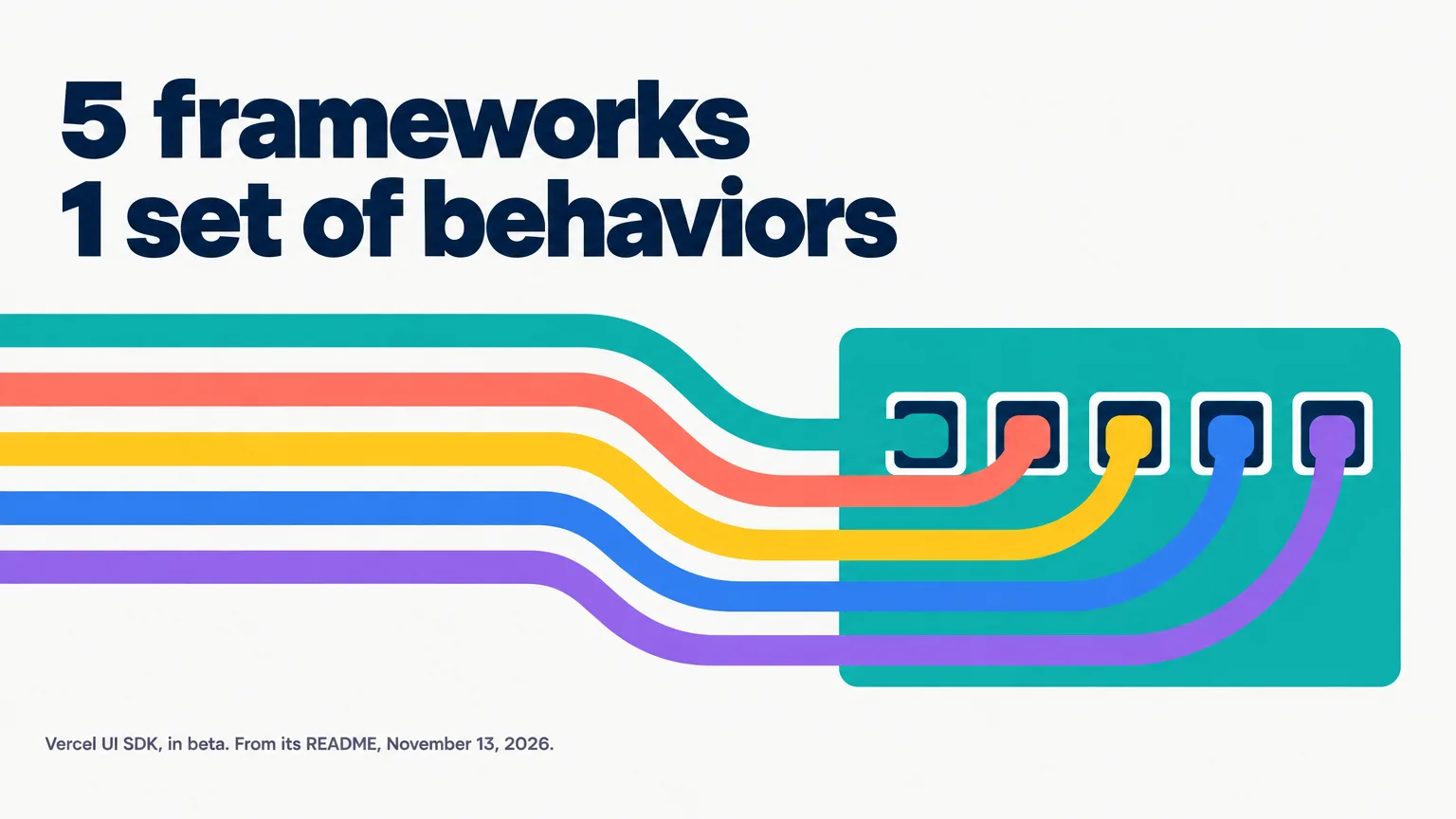
 One core package carries the behaviors, with adapters for React, Vue, Svelte, Solid and Web Components. The README says the parts are the same in all five.
 The README says UI SDK is in beta and may change. All six packages were at version 0.1.0-beta.2 when we read the repository on November 13.
 The code is public under the Apache 2.0 license. The repository had 3,124 stars when we read it. We have not installed or used the library.
§ 01What Vercel announced
- The post. Vercel’s X post reads “Introducing the UI SDK.” and carries a video. It had about 532,000 views when we read it at 14:19 UTC on November 13.
- The code. Vercel’s reply under that post links the repository, which sits in the vercel-labs organization on GitHub.
- In one line. The repository describes itself as “A library of behaviors for agents to build the next generation of user interfaces.”
- Why. shadcn, whose X profile names Vercel, wrote in a post: “Agents are becoming both the builders and the users of interfaces.”
- Status. The README says UI SDK is in beta. Its beta terms line says “the framework, APIs, documentation, and behavior may change before general availability”.
- License. Apache 2.0, per the repository.
§ 02What a behavior is
- The idea. shadcn’s post takes a select menu as the example: a popup, selection logic, keyboard navigation and focus management. He says the same behaviors are useful in many other components.
- Pulled apart. He writes: “So we pulled those pieces apart, tested them, and made them reusable.”
- What the library covers. The README lists keyboard navigation, focus, selection, dismissal, popups, drag and drop, and the ARIA that goes with them.
- How many. Chris Tate of Vercel Labs gave a count in his post: “50+ behaviors: popups, selection, typeahead, focus”. We did not count them.
- The same everywhere. shadcn writes: “The behavior stays the same, whichever framework, renderer you build with or the harness generating the UI.”
- An example. The alt text of a picture in the README describes an environment selector split into three behaviors, named createPopup, createSelection and createTypeahead.

§ 03What is in the repository
We read the repository between 14:08 and 14:10 UTC on November 13, 2026.
| Item | What we read |
|---|---|
| Created | October 26, 2026 |
| License | Apache 2.0 |
| Main language | TypeScript |
| Packages | 6: core, react, vue, svelte, solid, web |
| Version | 0.1.0-beta.2 on all six |
| Releases listed | 6, all dated November 13, 2026 |
| Stars | 3,124 |
| Forks | 71 |
- Five adapters. The README names adapters for React, Vue, Svelte, Solid and Web Components, on top of one core package. Of the component parts it says: “The parts are the same in all five.”
- Entry points. The core package lists 69 entry points besides its root. Most are named for a component, such as menu, dialog, select and combobox. That is our count, and an entry point is not the same thing as a behavior.
- Releases. The release list holds six entries, one per package. All are version 0.1.0-beta.2, all are marked as pre-releases, and all were published at 13:02 UTC on November 13, the day after the announcement. We found no earlier release in that list.
| What | Count | Whose count |
|---|---|---|
| Frameworks with an adapter | 5 | The README |
| Packages in the repository | 6 | Ours |
| Entry points in the core package | 69 | Ours |
| Behaviors | 50+ | Chris Tate’s post |
§ 04How an agent is meant to use it
- Install. The README gives one install command for the core package and the adapter for your framework.
- A skill for the agent. It then says to give your agent the UI SDK skill, with one more command.
- Who writes the code. Above its code example the README says: “Don’t worry, you don’t need to learn how to write this.” It adds that your agents will.
- Agents as users. The repository’s topics include mcp and webmcp. The README does not explain them, and we did not read the docs.
- Any agent. Chris Tate’s post says the library is easy for agents to build with and for any agent to use. The README and the three posts name no particular coding agent. The repository’s root holds files named AGENTS.md and CLAUDE.md, which we did not open.
§ 05What we did not check
- We have not installed or used UI SDK.
- We read no product page, blog post or changelog entry on Vercel’s website, and we did not open the docs site the README links. Anything said only there is not on this page.
- We did not watch the video in Vercel’s post or the one in Chris Tate’s post.
- We did not count the behaviors, read the source code or run the tests.
- We did not check the packages on npm.
- We did not compare UI SDK with other component libraries.
§ 06Where CellCog sits
CellCog is our product, an AI employee platform. CellCog AI employees write code and build web apps, among other work. We have not built anything with UI SDK, so we make no claim about how well it works for an agent. OpenAI makes the image model behind this page’s pictures.
§ 07Sources
- Vercel: post on X, November 12, 2026, 18:41 UTC.
- shadcn: post on X, November 12, 2026, 18:45 UTC.
- Chris Tate: post on X, November 12, 2026, 19:48 UTC.
- Vercel Labs: the UI SDK repository on GitHub, README, package list and release list read between 14:08 and 14:10 UTC on November 13, 2026.
Q1What is Vercel UI SDK?
A library from Vercel Labs that packages interface behaviors, such as popups, selection, keyboard navigation and focus, so that coding agents can build components from them.
Q2Is Vercel UI SDK open source?
Yes. The repository is public on GitHub under the Apache 2.0 license.
Q3Which frameworks does UI SDK work with?
React, Vue, Svelte, Solid and Web Components, per the README. Each has its own adapter package on top of one core package.
Q4Is UI SDK ready for production?
The README says it is in beta and that the framework, APIs, documentation and behavior may change before general availability.
Q5How many behaviors does UI SDK have?
Chris Tate of Vercel Labs wrote more than 50 in his post on X. We did not count them.