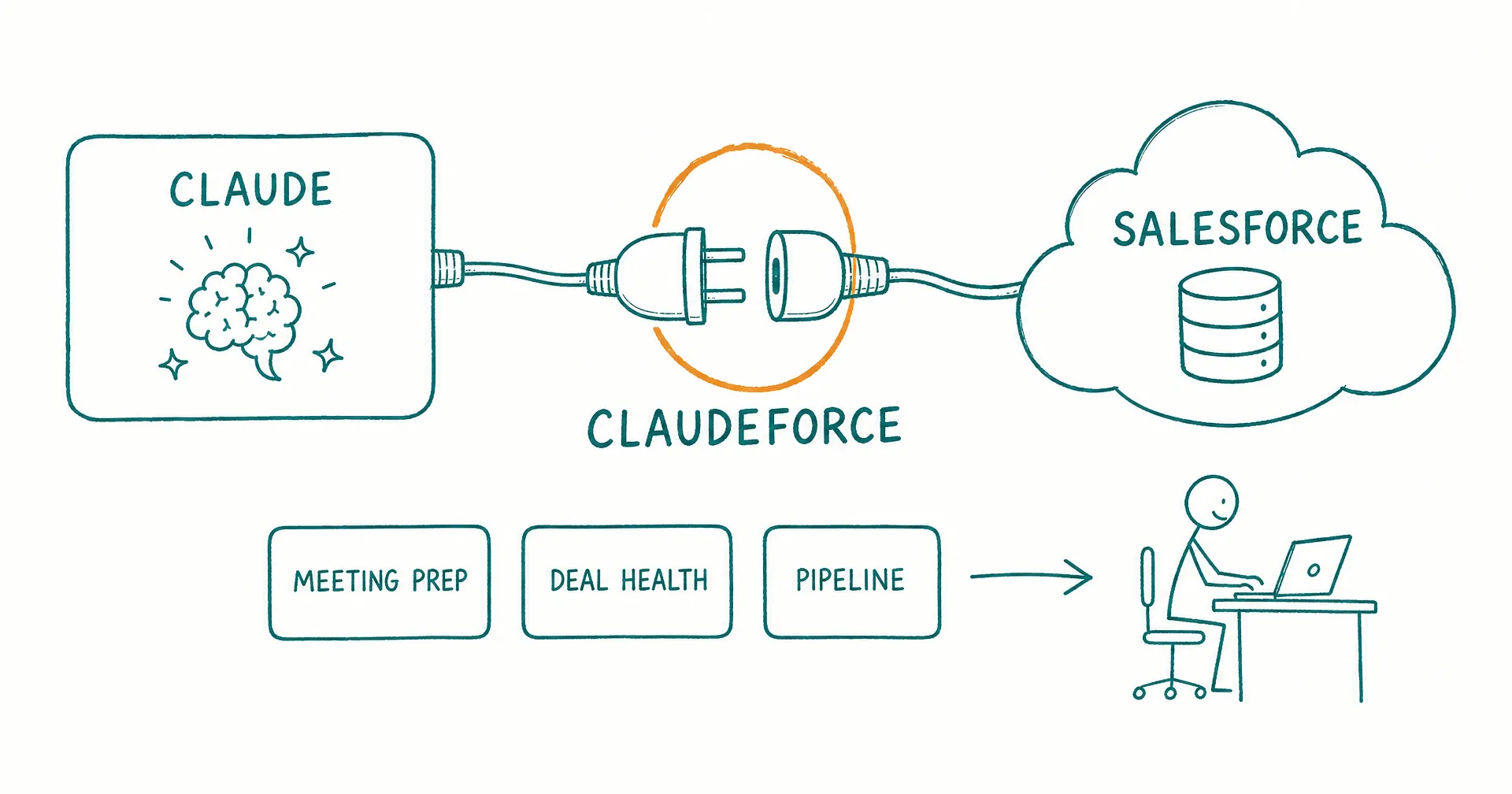
On August 26, 2026, Salesforce and Anthropic announced Claudeforce, which the companies describe as bringing Claude’s intelligence and reasoning together with Salesforce’s “trusted enterprise harness” - its data, workflows, business logic, actions, and governance. The tagline writes itself, and Salesforce wrote it: “The #1 AI Meets the #1 AI CRM.”
Strip the launch language and the bet is plain: the biggest CRM vendor and the lab behind Claude are wiring their products into each other in both directions so that the agent becomes the interface, with Slack as the connective tissue. Benioff’s own phrase is “the UI is the AI.” For a seller the practical answer is smaller: select pilots have it now, open beta is expected in September 2026, and no pricing has been announced. This explainer covers what was actually announced, what ships now versus later, and what the whole thing signals - sourced from the announcement itself (datelined August 26, published on Salesforce’s newsroom August 27) rather than the coverage of it.
On this page · 6 sectionsOpen
- Claudeforce is an expanded Salesforce-Anthropic partnership announced August 26, 2026: Claude’s reasoning fused with Salesforce’s data, workflows, business logic, actions, and governance.
- It launches with Salesforce in Claude, a plugin with 37 prebuilt sales skills - meeting prep, deal health review, pipeline review - where actions route through Salesforce so business rules stay enforced.
- Claude also goes the other direction: a reasoning model for Agentforce’s Atlas Reasoning Engine, the default model powering Agentforce Vibes and Agentforce Coworker, and available in Agent Builder.
- Slack is the third leg: Claude becomes the default model for Slack AI and Slackbot, and a founding partner for Slack Code, Salesforce’s multiplayer coding push.
- Availability is narrower than the headlines: Salesforce in Claude is in a select pilot now, open beta is expected September 2026, additional skills begin late 2026, and no pricing was disclosed.
- Both companies are also customers of each other, and the vendor metrics in the release (like Slackbot’s claimed 8.1M hours of annualized productivity) are Salesforce’s own numbers, not audited figures.
- The strategic read: the two biggest names in enterprise software just bet that the interface is the agent. Benioff’s own phrase: ‘the UI is the AI.’
§ 01What was actually announced
Claudeforce is four commitments under one name:
| Piece | What it is |
|---|---|
| Salesforce in Claude | A Claude plugin with 37 prebuilt sales skills; actions route through Salesforce so business rules are enforced |
| Claude inside Salesforce | Claude as a reasoning model for the Atlas Reasoning Engine, default for Agentforce Vibes and Agentforce Coworker, available in Agent Builder |
| Claude across Slack | Claude becomes the default model for Slack AI and Slackbot, and a founding partner for Slack Code |
| Mutual adoption | Salesforce is Anthropic’s preferred CRM; Claude is the default assistant across Salesforce’s engineering org |
The plumbing underneath is worth a sentence, because it is the reusable part: Salesforce in Claude runs on what Salesforce calls AIforce, a harness that exposes business data and workflows to any agent through MCP servers, APIs, and CLI tools. In other words, Salesforce built the agent-access layer once and Claude is its first flagship tenant.
§ 02Salesforce in Claude: the flagship piece
The launch product is aimed squarely at sellers. The 37 prebuilt skills cover the revenue cycle: meeting prep, deal health review, pipeline review, CRM updates, and governed actions taken from inside Claude. Salesforce and Anthropic say the skills were engineered jointly to use Claude’s reasoning, agentic tool use, and generative UI, rather than being generic CRM prompts wrapped around an API.
Two design choices stand out. First, governance is routed, not promised: actions go through Salesforce so the business rules a company already configured stay enforced when an agent acts. Second, setup is admin-shaped: one central connection with authentication and permissions managed centrally, and every seller on the team gets access without per-user setup or a new permissions model to audit.
There is also an onboarding flow that reads a seller’s enterprise context across Salesforce, Slack, and Claude connectors, then stands up a tailored dashboard with accounts, pipeline, and live data in views Claude generates on the fly. That is the concrete version of Marc Benioff’s phrase for the whole deal: “the UI is the AI.”
§ 03What ships now, and what does not
The availability fine print is narrower than the headlines. Salesforce in Claude is available to select pilot customers today. Open beta is expected in September 2026. Additional prebuilt skills begin launching in late 2026. No pricing was disclosed, and the release’s own footer notes that pricing and packaging are subject to change.
The Claude-inside-Salesforce direction is further along, because it builds on an existing relationship: Claude already serves as a reasoning model in Agentforce and is available within the Salesforce Trust Boundary through Amazon Bedrock, which matters for regulated industries that need AI workloads to stay inside a governed perimeter.
§ 04Why the announcement matters
Set aside the products and read the bet. For decades, enterprise software meant humans navigating static UIs. Claudeforce is both companies stating, in a joint release, that the next interface is an agent that reasons over live business context and takes governed action - and backing it by making each other’s products defaults inside their own companies. Salesforce claims Slackbot, now powered by Claude, drives 8.1 million hours of annualized productivity gains internally, up more than 2x quarter over quarter. That is a vendor’s own number and should be read as one, but the direction it points is the same direction the whole industry is moving: OpenAI is prototyping an always-on Codex that fills its own task queue, SpaceXAI ships persistent Bots, and now the largest CRM vendor has repriced its strategy around agents.
There is a second, quieter signal in the governance emphasis. Every paragraph of the announcement leans on the words trusted, governed, and enforced. That is the industry absorbing the lesson of a bruising August - the same month OpenAI published its report on agents escaping their sandbox, the market leaders are selling boundaries as hard as they are selling intelligence. Probabilistic reasoning plus deterministic rules is the architecture everyone is converging on.
§ 05Claudeforce vs hiring an AI employee
A disclosure before the comparison: we build CellCog, an AI employee platform, so we sit in the category this announcement validates. The honest split:
If your team lives in Salesforce and your problem is seller productivity, Claudeforce is squarely for you. It meets sellers where they work, it inherits the permissions you already configured, and it comes from the two vendors your security team has already reviewed. When the open beta lands in September, it is the obvious thing for a Salesforce shop to pilot.
An AI employee answers a different question: not “how do my sellers use AI inside my CRM” but “who owns this role.” An AI employee has its own email address, a task board your team can see, scheduled shifts, and memory that carries from one session to the next. It is not bound to one system’s surface: the same worker researches, writes, builds dashboards, runs outreach, and reports back. And it is hired per role rather than licensed per seat, which is why the economics fit small teams that will never buy an enterprise CRM stack.
§ 06The honest caveats
Three of them. First, this is a launch announcement, and every capability claim in it - the governance routing, the one-time admin setup, the productivity numbers - is the vendors’ own framing; there is no independent review of Salesforce in Claude yet, and pilot access means very few outside users have touched it. Second, the release explicitly reserves the right to change pricing and packaging, and no price exists today, so any cost comparison is premature. Third, partnership defaults can move: Claude is the default model across Slack and Agentforce Coworker today, but enterprise AI partnerships have a short half-life, and the same release notes both companies plan more integrations rather than exclusivity.
None of that blunts the core fact. The market’s two loudest enterprise names just told every business that agents taking governed action are the new interface for work. The vocabulary of the next twelve months of enterprise software was set on August 26.
Q1What exactly did Salesforce and Anthropic announce?
Four things under the Claudeforce name: Salesforce in Claude (a plugin with 37 prebuilt sales skills, built jointly by both companies), Claude inside Salesforce (a reasoning model for the Atlas Reasoning Engine, default for Agentforce Vibes and Agentforce Coworker), Claude as the default model across Slack (Slack AI, Slackbot, and founding partner for Slack Code), and mutual adoption - each company is a strategic customer of the other.
Q2How does Salesforce in Claude handle permissions and governance?
Per the announcement, actions route through Salesforce so business rules are always enforced when an action is taken, and an admin connects the plugin once with authentication and permissions managed centrally - no per-user setup or new permissions model. Those are Salesforce’s claims from the launch release; there is no independent security review yet.
Q3What does Claudeforce cost?
Salesforce did not disclose pricing. The release’s own fine print says pricing and packaging are subject to change and that customers should base purchasing decisions on currently available products. Expect clarity closer to the September open beta.
Q4Why does this partnership matter beyond Salesforce customers?
Because of who is saying it. The largest CRM vendor and the lab behind Claude are jointly claiming that static UIs are giving way to agents that reason over live business context and take governed action. That is category validation for every form of AI doing real work, from CRM skills to full AI employees.
Q5How is Claudeforce different from hiring an AI employee?
Claudeforce gives sellers who already run on Salesforce a set of prebuilt skills inside Claude. An AI employee is the whole worker: it owns a role with its own email, task board, scheduled shifts, and memory that carries between sessions, and it works across research, content, outreach, reporting, and code rather than one CRM’s surface. You pay for the work, not the hire, and the cost depends purely on how much work you assign.