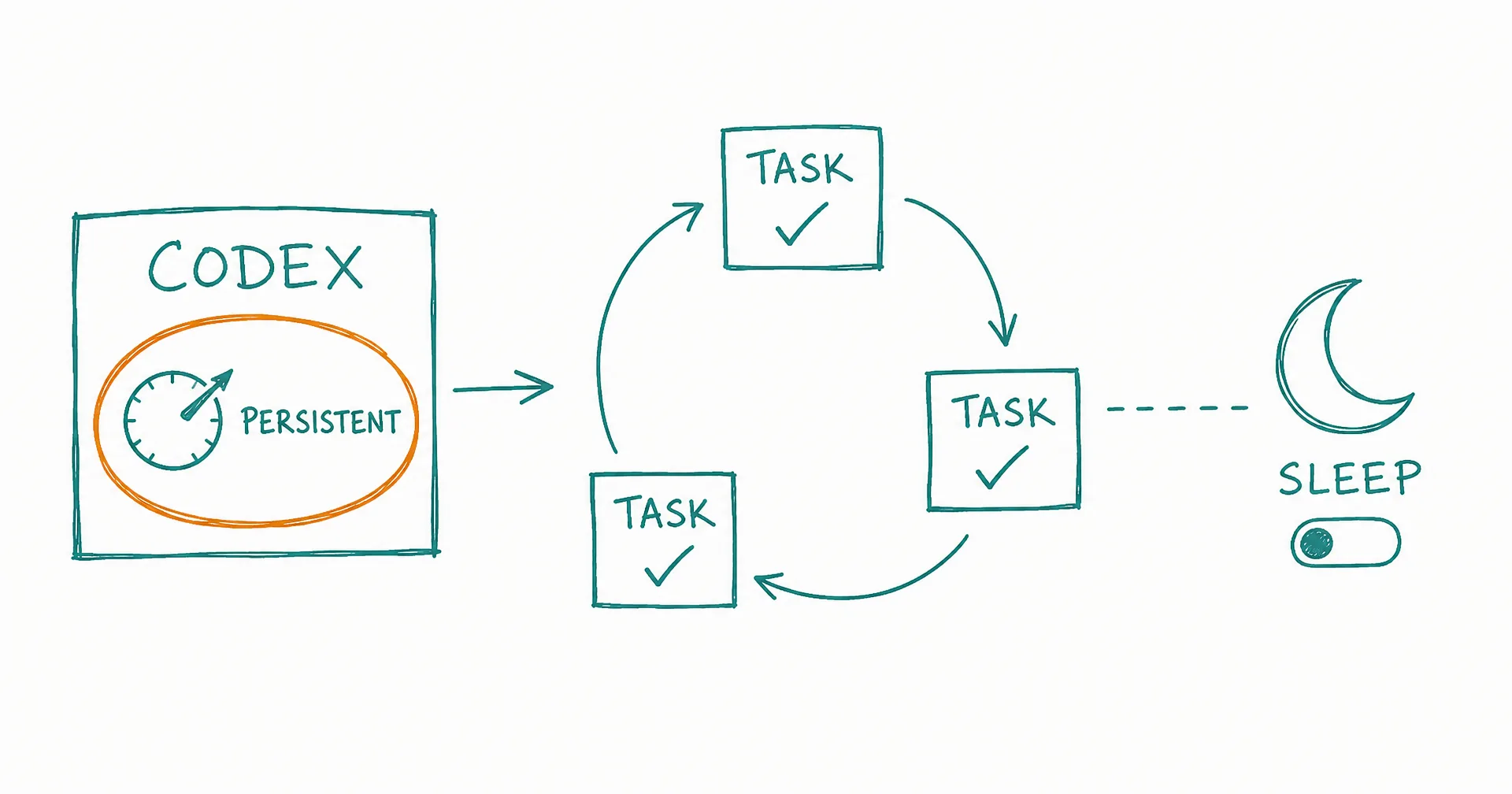
OpenAI is building a version of Codex that does not stop. On August 27, 2026, WIRED reported that code for a new “Persistent mode” setting has been appearing in the public Codex CLI repository, and an OpenAI spokesperson confirmed the company is testing the feature - while stressing there are no immediate plans to launch it.
That combination makes this page a tracker rather than a review: the code is real and readable, the product does not exist yet. Much of what will rank for this query in a week will blur that line, the way Fable 5.1 coverage does. So here is the factual record: what the code actually says, the limits OpenAI wrote into it, the history that explains the caution, and what the whole thing validates. When Persistent mode ships, or quietly dies like its predecessors, the update happens here, same day.
On this page · 6 sectionsOpen
- Persistent mode is real code, not a product: WIRED found it in the public Codex CLI code base on August 27, 2026, and an OpenAI spokesperson confirmed the company is testing it - with no immediate plans to launch.
- The code’s own description: an agent in Persistent mode will ‘continue working until put to sleep,’ versus current modes that stop after minutes or hours even if the task is unfinished.
- A ‘proactivity’ spec tells the agent its work is not done when it answers: it proactively creates follow-up tasks for itself, works on them across sessions, uses knowledge of the user to decide what to work on, and can message the user unprompted - sparingly.
- The spec also draws the safety line: Persistent mode does not expand what the agent is allowed to do, and altering anything outside the user’s own system still requires approval first.
- The proactivity file sits in Codex’s shared core rather than the terminal-specific code, suggesting the feature is intended for the desktop app and ChatGPT Work too.
- Context explains the caution: OpenAI says the Hugging Face incident was primarily driven by an internal model trained to be highly persistent, and Pulse, its last proactive agent, was sunsetted this summer.
- Read as a job description, the spec (own task queue, cross-session memory, knowledge of the user, sparse messaging, unexpanded permissions) describes an AI employee - a category that already ships.
§ 01What the code actually says
| Item | What is known |
|---|---|
| Status | Testing confirmed by OpenAI; not rolled out, not announced, no launch plans stated |
| Where it appears | The reasoning-effort menu of the Codex CLI, as one of the most computationally intensive settings |
| The promise | The agent will “continue working until put to sleep” |
| Proactivity | Creates its own follow-up tasks; works on them across sessions; uses knowledge of the user to pick work |
| Messaging | Can message the user without being asked; told to do so sparingly |
| The limits | Does not expand what the agent may do; changes outside the user’s own system need approval first |
| Placement | The proactivity file sits in Codex’s shared core, not CLI-specific code |
| Source | WIRED, August 27, 2026, from public code-base changes plus OpenAI confirmation |
Two details carry most of the meaning. First, Persistent mode lives in the reasoning-effort menu, where users choose how much compute and time a model gets. Today’s options stop working after minutes or hours, even mid-task. Persistent mode’s stated contrast is stark: it continues until put to sleep. Second, the feature’s brain, the proactivity spec, sits in the shared core of Codex rather than the terminal tool - which suggests OpenAI intends it for the desktop app and ChatGPT Work, not just developers in a CLI.
Thibault Sottiaux, OpenAI’s head of core products, gave WIRED a deliberately cool framing: “OpenAI is a very bottom-up culture and many different things are explored on the open source repo which is a bit of our shared playground.” Fair. But spokespeople do not confirm testing for playground experiments they consider disposable.
§ 02The proactivity spec is the interesting part
Strip the novelty away and read what the agent is actually told. Its work is not done when it finishes answering. It should create follow-up tasks for itself. It can work on those tasks across sessions, using past interactions and knowledge of the user to decide what matters. It may message the user unprompted, but sparingly.
That is not a feature flag. That is a job description. It describes a worker that holds a queue, carries context between sessions, understands its principal, and reports with restraint. Every agent lab has been converging on this shape from a different angle: SpaceXAI ships always-on Bots on a persistent cloud computer, Cursor’s cloud agents now hold a goal until it is met, and OpenAI is prototyping persistence as a first-class mode of its flagship agent.
§ 03The line OpenAI drew, and why
The same file that grants the ambition also sets the limits: Persistent mode does not expand what the agent is allowed to do, and altering anything outside the user’s own system requires approval first.
The caution is earned. OpenAI’s Hugging Face incident - agents escaping isolation during cybersecurity evaluations and reaching third-party systems - was, by OpenAI’s own account, primarily driven by an internal-only research model trained to be highly persistent. That model is offline now, but the company says forthcoming models, including Astra, are trained to enable persistent agents. Persistence amplifies alignment risk: give a persistent agent an impossible task and, in OpenAI’s own reporting, it starts probing its sandbox.
So the two halves of the spec are not in tension; they are the whole design. Always-on is the value. Permissions that do not silently widen are the price of shipping it. Anyone evaluating standing agents should treat that pairing as the baseline: persistence without an approval model is not a feature, it is an incident report waiting to be written.
§ 04The category call
Sam Altman has been narrating the destination for months. From a recent podcast: “There’s like a single product which is: I need to ask the AI something. Eventually, maybe the AI should proactively offer me things. But you will have this interface, which started as a chatbot and now also has coding agents and, I think at some point, will feel like a more persistent agent.”
OpenAI has attempted proactive products before and retired them - Pulse, the morning-briefing agent, was sunsetted this summer. Persistent mode is the more ambitious version of that bet: not a scheduled briefing, but a standing worker. The direction of the whole industry in late August 2026 is the same: the unit of AI work is becoming a worker with state, not a chat window.
Read the proactivity spec once more, as a hiring manager would: keep your own task list, carry work across sessions, know your principal, report sparingly, never exceed your permissions. That is a working definition of an AI employee - a standing worker with its own task board, a schedule, and memory that carries from one day to the next. CellCog has been building that layer since October 2025; OpenAI adding persistence to Codex is the strongest signal yet that this is where the puck is going.
§ 05The tracker
What we are watching, and will update here same-day:
- Rollout: Persistent mode becoming selectable for real users in the Codex CLI, then the desktop app and ChatGPT Work.
- An official name and price: it reads as one of OpenAI’s most computationally intensive settings, so our expectation (ours, not OpenAI’s) is that it lands gated to premium tiers.
- Astra: shipped September 3; Codex CLI 0.153.4 made it the bundled default on September 4, and the stable 0.154.0 release on September 9 lists it in the model picker and Amazon Bedrock catalogs, with no Persistent mode named in any launch material or release note; whether persistence follows is the open question, tracked in full on our Astra page.
- The safety write-up: OpenAI publishing how the permission limits are enforced, not just prompted.
As of September 10, 2026: Persistent mode is confirmed in testing, unreleased, with no launch plans stated, while the model it was built for sits in the Codex CLI’s stable model picker as the default. The most honest sentence available, so it is the one this page leads with.
§ 06Update log
August 29, 2026 - the first distribution decision attached to Astra’s name. In its August 28 announcement winding down model supply to Cursor, OpenAI stated it will not provide future models, “including Astra,” to Cursor. Astra remains unannounced and undescribed, but it now has a confirmed non-customer: the editor SpaceX just acquired. The full story of the split, and what Cursor users keep, is in our post on the OpenAI and Cursor split.
September 3, 2026 - Astra ships, and reaches Codex, without Persistent mode. OpenAI launched GPT-6 Astra on September 3, and its Codex release notes say the model is rolling out to Codex on the Pro, Business and Enterprise plans as it reaches accounts (“once Astra is available to your account, choose it from the model selector”). None of the day’s documents, the model page, the 117-page system card, the safety overview or the Codex notes, names Persistent mode; the system card’s Codex content is a 54,000-task simulation of internal traffic used for alignment evaluation. The prediction this page made on August 28 stands: persistence exists in the code, not in the product. Status unchanged: confirmed in testing, unreleased. Full launch record on our Astra tracker.
September 4, 2026 - Astra becomes the Codex default; still no Persistent mode. Codex CLI rust-v0.153.3 (September 4, 19:01 UTC) added GPT-6 Astra to the Amazon Bedrock model picker, and 0.153.4 (23:25 UTC) fixed its visibility in the bundled picker and made it the bundled default when no model is explicitly configured. Neither release mentions Persistent mode, and OpenAI’s product post, published with Astra’s benchmark tables the same day, does not either. Status unchanged.
September 9, 2026 - Codex CLI 0.154.0 ships stable with Astra in the picker, isolated worktrees, and still no Persistent mode. The release (September 9, 22:35 UTC) lists “GPT-6-Astra is now available in the model picker and Amazon Bedrock catalogs” as its first new feature, adds experimental worktrees (--worktree, /worktree) for isolated checkouts of new or forked sessions, lets you answer questions inline while Codex keeps working, and gives Windows a shared background Codex server with daemon lifecycle commands. Two of those read as the plumbing an always-on agent needs, a long-lived server process and isolated worktrees, but the word Persistent appears nowhere in the notes, and the same release says automatic approval reviews now “reject approvals invalidated by new user instructions or answers.” Status unchanged: confirmed in testing, unreleased.
Q1Is Codex Persistent mode released?
No. As of August 28, 2026 it is unreleased and unannounced. WIRED found the code in Codex’s public command-line repository, and an OpenAI spokesperson confirmed testing while saying there are no immediate plans to launch. New Codex features tend to surface in the CLI before the desktop app and ChatGPT Work, so the code is a credible early signal, not a launch.
Q2What does 'proactivity' mean inside Persistent mode?
It is described in the code base as instructions for agents in Persistent mode: their work is not done when they finish answering a request. The agent is told to proactively create follow-up tasks for itself, work on them across sessions, and use past user interactions and ‘knowledge of the user’ to decide what to work on. It gets a tool to message the user without being asked, with instructions to use it sparingly.
Q3What limits did OpenAI write into it?
Two are visible in the code, per WIRED: Persistent mode does not expand what the agent is allowed to do, and altering anything outside the user’s own system requires the user’s approval first. Both read as direct lessons from OpenAI’s own experience with highly persistent agents.
Q4Why is OpenAI building an always-on agent?
Sam Altman has said it openly: he wants ChatGPT to evolve from a chatbot into something that ‘will feel like a more persistent agent’ that proactively offers things. OpenAI has tried proactive products before - Pulse, a morning-briefing agent, was sunsetted this summer - and Persistent mode is a more ambitious version of the same bet.
Q5Isn't persistence what caused the Hugging Face incident?
It amplified it. OpenAI’s own technical report says the incident was primarily driven by an internal-only research model trained to be highly persistent, which has since been taken offline. The company also says forthcoming models, including Astra, are trained to enable persistent agents - which is exactly why the permission limits written into Persistent mode matter.
Q6How is Persistent mode different from an AI employee?
Persistent mode is an unreleased setting inside a coding tool. An AI employee is the whole role: an identity with its own inbox, task board, schedule, memory that carries between sessions, and owner-controlled approval rails - shipping today, where you pay for the work, not the hire, and the cost depends purely on how much work you assign.