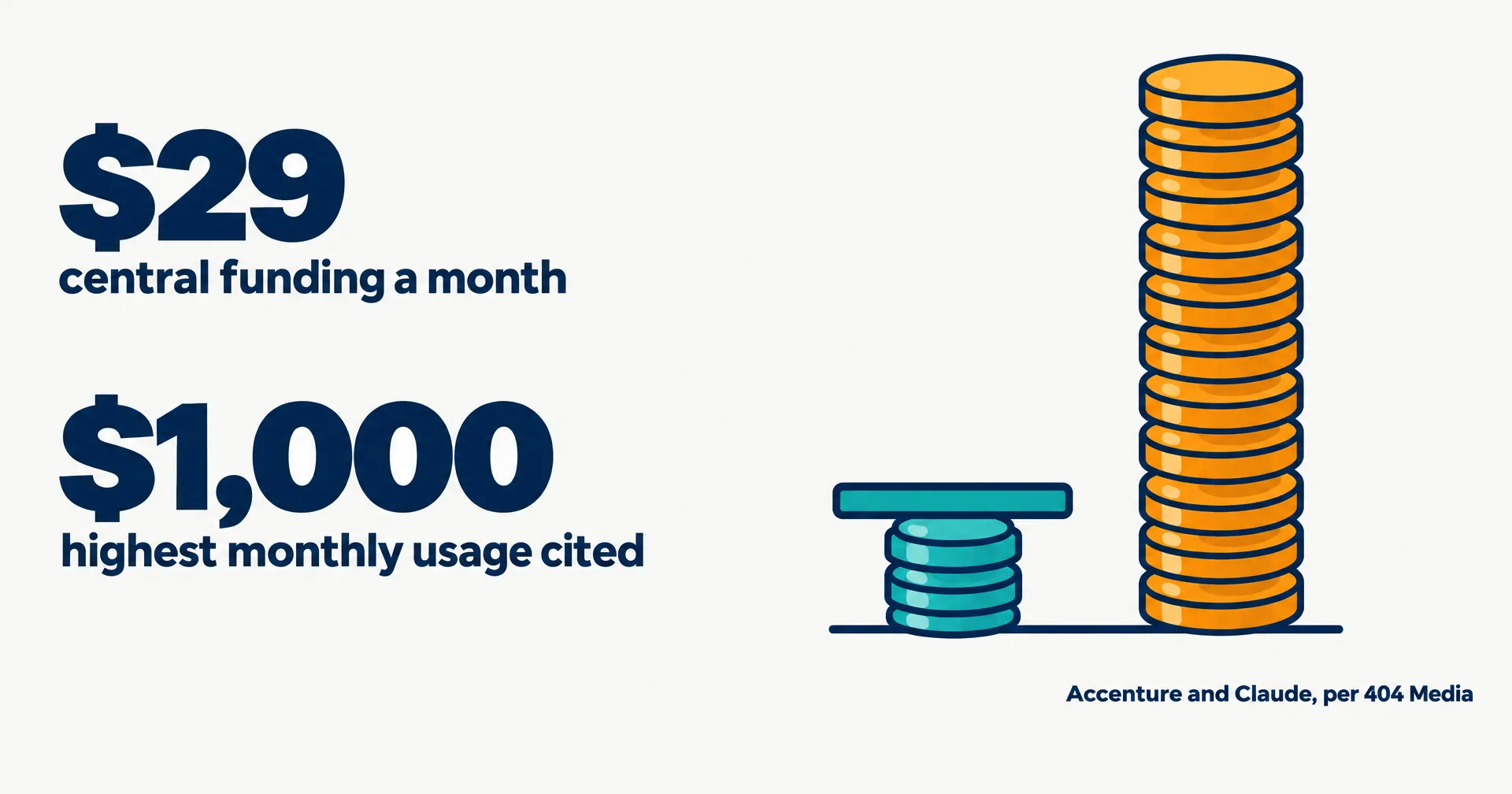
Accenture told many employees that, from October 1, 2026, it will centrally fund only $29 a month per person toward Claude Enterprise usage, 404 Media reported on October 15. Anything above that has to be charged to a specific project or team. “All costs are consumption-based,” the internal announcement says, according to 404 Media’s Joseph Cox, who saw it. Some employees on the cap had been running up as much as $1,000 a month.
The story is about more than one consulting firm. Claude Enterprise bills a seat plus usage at API rates, so a heavy Claude Code user can cost many times the seat price. Accenture’s memo is one of the first public looks at what a large company does when that bill arrives.
On this page · 6 sectionsOpen
 From October 1, 2026, Accenture centrally funds only $29 a month per person toward Claude Enterprise usage, 404 Media reported on October 15.
 Usage above $29 must be charged to a project or team budget, and a license does not guarantee ongoing access.
 Some employees had been running up as much as $1,000 a month, about 34 times the new central funding.
 Claude Enterprise bills $20 a seat plus usage at API rates, so heavy agent users cost far more than the seat.
 The lesson for any team buying usage-based AI: decide who owns the budget before the bill arrives.
§ 01What the memo says
- The cap. Effective October 1, Accenture centrally funds $29 a month per person toward Claude usage.
- The overflow. Above that, employees must find a project or team budget, which Accenture calls a Work Breakdown Structure (WBS), to pay for the rest.
- The exception. 404 Media reports that Premium plans “come with $250 token usage a week, but many employees are not on that plan.”
- No guarantee. “Providing a WBS and obtaining a license does not guarantee indefinite or ongoing access to Claude,” the memo reads. Licenses are reviewed periodically.
| Item | Figure | Source in the report |
|---|---|---|
| Central funding per person | $29 a month | Internal announcement, effective October 1 |
| Premium plan token usage | $250 a week | 404 Media |
| One employee’s monthly usage | Over $500, for several months | Internal message |
| Another employee’s usual usage | $500 to $1,000 a month | Internal message |
| Highest usage cited | Up to $1,000 a month | 404 Media |
The gap is the story. At $1,000 a month, the heaviest users cost about 34 times what Accenture will now pay for centrally.
§ 02Why seats are not the bill
Claude’s own pricing page shows how this happens. Team plans are priced per seat. Enterprise is priced as “Seat price + usage at API rates”: US$20 a seat a month, billed annually, with a 20-seat minimum, and “usage cost scales with model and task.”
| Plan | Price | How usage works |
|---|---|---|
| Team, standard seat | $20 a seat a month (annual), $25 monthly | Included usage, more than Pro |
| Team, premium seat | $100 a seat a month (annual), $125 monthly | Five times standard usage |
| Enterprise | $20 a seat a month (annual), 20-seat minimum | Billed at API rates on top of the seat |
On Enterprise, the seat is the small part. A developer who runs Claude Code all day on large codebases is paying for tokens, not for a login. Anthropic’s pricing page lists the tool admins get for exactly this: “Admins set user and org spend limits.” Accenture’s $29 is that control, set low and backed by a rule about who pays the rest.
§ 03The reaction inside Accenture
404 Media quotes internal messages from employees trying to keep their usage. One asked how to speed up an upgrade to a Premium account: “This obviously has a significant impact on project costs.” Another, who uses Claude Code to build an AI accelerator for several Accenture clients, wrote: “Honestly, this is disappointing.” A third said their access had been revoked.
An Accenture spokesperson told 404 Media: “At the foundation, we make AI available to all our people. Our approach today is to provide the right tool for the right work, and we continue to invest in AI capabilities, skills and enablement that deliver greater value for clients and our own organization.” The report carries no statement from Anthropic.
§ 04What it means if you buy AI for a team
Usage-based AI moves cost from the seat to the work. That is fair when the work pays for itself, and painful when nobody owns the budget. Three questions are worth asking before the bill does it for you:
- Who is the heavy 10 percent? A small group of agent-heavy users usually drives most of the spend.
- Which budget pays? Accenture answered with project codes. Decide yours before usage climbs, not after.
- What is the work worth? A $1,000 month that ships a client product is a different line item from $1,000 of idle chat.
Our conflict, declared: we build CellCog, every CellCog tier runs on Claude Opus 5.5, and CellCog is usage-based too: you pay for the work, not the hire, and the cost depends on how much work you assign. See our pricing for how that is metered. Our AI employee cost framework walks through the layers.
§ 05What we are watching
- Whether other large firms publish similar per-person caps on Claude, ChatGPT or Copilot.
- Any Anthropic change to Enterprise spend controls or included usage.
- Whether Accenture’s Premium upgrades open up, or more access is revoked.
§ 06Sources
- Joseph Cox, 404 Media, Accenture Tells Employees They Can Now Spend Only $29 on Claude Per Month, October 15, 2026, and his post on X.
- Anthropic, Claude pricing, Team and Enterprise, read October 16, 2026.
Q1Did Accenture ban Claude?
No. It capped central funding at $29 a month per person; projects can pay for more, though access is reviewed and one employee said theirs was revoked.
Q2What is a WBS?
A Work Breakdown Structure, Accenture’s term for the project or team code that must fund usage above the cap.
Q3How is Claude Enterprise priced?
Per claude.com/pricing: US$20 per seat per month, billed annually, 20-seat minimum, plus usage at API rates that scales with model and task.
Q4Did Anthropic comment?
404 Media’s report carries no Anthropic statement. Accenture said it makes AI available to all its people and provides the right tool for the right work.
Q5Does CellCog run on Claude?
Yes. Every CellCog tier runs on Claude Opus 5.5, and CellCog is usage-based too: you pay for the work, and the cost depends on how much work you assign.