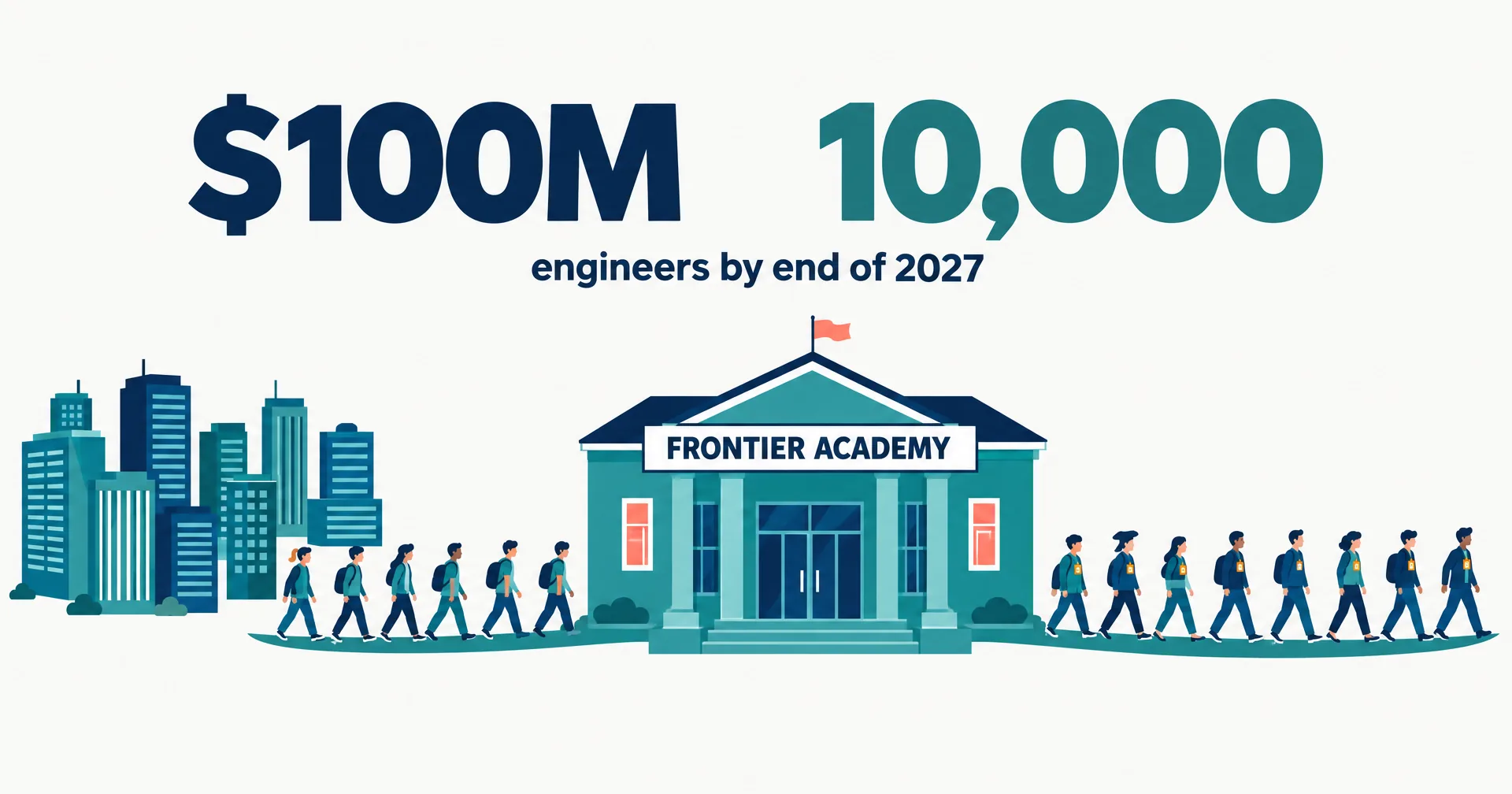
Anthropic announced on Friday that it will spend $100 million to train 10,000 engineers inside other companies by the end of 2027. The program is called Claude Frontier Academy, the graduates will be called Frontier Deployed Engineers, and the first cohorts come from Accenture, Bain, Capgemini, Commonwealth Bank of Australia, Deloitte, McKinsey, Morgan Stanley and Novo Nordisk. The bet underneath it is plain: Anthropic thinks the model is no longer the bottleneck for enterprise AI. The people who can deploy it are. This page reads the announcement, lays out the residency step by step, and sets it against what OpenAI and Google have put behind the same problem.
On this page · 8 sectionsOpen
- Anthropic launched Claude Frontier Academy on October 2, 2026, backed by a $100 million commitment, with a goal of training 10,000 Frontier Deployed Engineers (FDEs) by the end of 2027.
- The first cohorts come from eight organizations: Accenture, Bain, Capgemini, Commonwealth Bank of Australia, Deloitte, McKinsey, Morgan Stanley and Novo Nordisk. Five of the eight sell consulting or IT services.
- The first program, the FDE Residency, follows a medical model: a multi-day in-person course ending in a graded practical, then a 12-week residency leading a real Claude project at the engineer’s own company, then a second assessment.
- It is invitation only. Organizations nominate their strongest engineers through their Anthropic account team or Partner Account Manager, and each nominee arrives with a named Claude project to lead.
- The two badges are Claude Resident Engineer after the course and Claude Frontier Deployed Engineer after the residency; the first FDE badges are expected in early 2027.
- Rivals bet on different shapes: OpenAI put $150 million behind 300,000 certified consultants and more than $4 billion into a deployment company starting with about 150 FDEs; Google set aside a $750 million partner fund with its own FDEs and no headcount target.
§ 01What Anthropic announced
| Question | Answer |
|---|---|
| Money | A $100 million commitment |
| Goal | 10,000 Frontier Deployed Engineers (FDEs) by the end of 2027 |
| First program | The Frontier Deployed Engineer Residency |
| First cohorts | Accenture, Bain, Capgemini, Commonwealth Bank of Australia, Deloitte, McKinsey, Morgan Stanley, Novo Nordisk |
| Where | San Francisco, New York and London, running now |
| Who gets in | Engineers their organization nominates, each with a named Claude project |
| Credentials | Claude Resident Engineer, then Claude Frontier Deployed Engineer |
| First FDE badges | Expected in early 2027 |
| Builds on | The Claude Partner Network: 46,000 firms, more than 175,000 Claude certifications |
Steve Corfield, Anthropic’s Global Head of Business Development and Partnerships, framed the thesis in the announcement: “A small team of high-agency people with the right skills, access to Claude, and a deep understanding of how their business runs can transform an entire company.” Anthropic calls the Academy “the first of its kind from an AI company”, a claim about its own category that we have not tested.
§ 02How the residency works
Anthropic modeled the Residency on how doctors train: learn from practitioners, practice on realistic cases, get assessed before working alone. The program is for hands-on software engineers with strong fundamentals, a record of building with large language models and experience helping others adopt AI. Prior experience building agents is not required.
| Stage | What happens | The gate | What you earn |
|---|---|---|---|
| Nomination | The organization nominates its strongest engineers, each arriving with a named Claude project to lead | Eligibility, checked through the Anthropic account team or Partner Account Manager | Nothing yet |
| In-person course | Multi-day program with Anthropic engineers and licensed instructors; a simulated enterprise deployment from choosing the use case through security review to handover | A graded practical on a new scenario | Claude Resident Engineer badge |
| 12-week residency | The engineer leads a real Claude use case at their own organization, supported by Anthropic engineers and learning from the cohort | A second assessment at the end | Claude Frontier Deployed Engineer badge |
Two design choices stand out. The final exam is real work at the engineer’s own company, not a test center, so the badge certifies a shipped system rather than a passed quiz. And every nominee arrives with a project already named, which means the program doubles as a pipeline of live enterprise Claude deployments that Anthropic engineers help along.
Accenture’s Ram Ramalingam picked out the same point in his quote: the residency tests “judgment tested against a simulated enterprise deployment, not technical skills in isolation.”
§ 03Who is in the first cohorts
Seven of the eight organizations are quoted in the announcement. Morgan Stanley is named in the first cohorts but carries no quote.
| Organization | Type | Quoted | What they said, in short |
|---|---|---|---|
| Accenture | Consulting and IT services | Ram Ramalingam, FDE and Software & Platform Engineering lead | The residency tests judgment in a simulated deployment, which matches how Accenture already uses FDEs with clients |
| Bain | Consulting | Michael Blake, Partner, Global Head of Engineering | Engineers sharpen hands-on skills working directly with Anthropic, then bring it to clients |
| Capgemini | Consulting and IT services | Geoffroy Pajot, Global Head of AI Partnerships Ecosystem | Clients care about solving real problems, not the number of certificates |
| Commonwealth Bank of Australia | Bank | Rodrigo Castillo, Group Chief Technology Officer | Its teams produced up to 3x more code changes in the past year with AI tools |
| Deloitte | Consulting | Faruk Muratovic, Principal, Deloitte Consulting LLP | Scales a deployment discipline Deloitte has already tested in the field |
| McKinsey | Consulting | Dan Tinkoff, Senior Partner, Global Co-leader of QuantumBlack | Sets the bar for how its technologists apply Claude for clients |
| Morgan Stanley | Bank | Not quoted | Named in the first cohorts only |
| Novo Nordisk | Pharmaceuticals | Loic Giraud, VP Data & AI | Already uses Claude Science in R&D; wants engineers trained the way Anthropic deploys |
Five of the eight sell consulting or IT services, so most of the first 10,000 engineers will likely deploy Claude for other people’s companies rather than their own. That matches Anthropic’s channel: the Academy sits on top of the Claude Partner Network, which Anthropic says now spans 46,000 firms and more than 175,000 Claude certifications, with nearly 4,000 people through its Basecamp program. Capgemini’s quote reads almost like a comment on that scale: what clients want “isn’t about certification counts or training volume”, in Pajot’s words.
Commonwealth Bank gave the only hard number in the cohort quotes: its teams “have produced up to 3x more code changes in the past year”. Anthropic’s own earlier numbers show how the certification side has grown. On July 23, 2026 it reported more than 36,000 consultants certified across more than 1,300 organizations since March, with Accenture committed to 50,000 certified professionals and Capgemini to 20,000. Those count people; the October figure of 175,000 counts certifications, so the two are not a growth rate.
Anthropic has been building this channel for about ten months. The Academy is the top rung of a ladder that started with certification.
| Date | Move | Number Anthropic gave |
|---|---|---|
| December 9, 2025 | Accenture Anthropic Business Group | About 30,000 Accenture professionals to be trained on Claude |
| March 12, 2026 | Claude Partner Network and the first technical certification | An initial $100 million for training, support and joint market development |
| July 23, 2026 | Four role-based certifications | 36,000+ consultants certified across 1,300+ organizations since March; 400,000+ people trained in 2026 |
| October 2, 2026 | Claude Frontier Academy and the FDE Residency | $100 million, 10,000 Frontier Deployed Engineers by end of 2027 |
The pace the goal implies is steep for a program this selective. From October 2026 to the end of 2027 is 15 months, so 10,000 engineers means about 670 a month entering the pipeline, each through an in-person course and a 12-week residency, with the first graduates not due until early 2027. Anthropic has not said how many are in the first cohorts.
§ 04How it compares with OpenAI and Google
Every frontier lab has now put money behind the same diagnosis, that companies cannot hire enough people who know how to deploy AI. They answered it with different shapes.
| Program | Announced | Money | People target | Who the people are |
|---|---|---|---|---|
| Claude Frontier Academy (Anthropic) | October 2, 2026 | $100 million | 10,000 by end of 2027 | Nominated engineers who pass two graded assessments |
| Claude Partner Network (Anthropic) | March 12, 2026 | An initial $100 million | None at launch; 175,000+ certifications by October 2 | Certified partner professionals |
| OpenAI Partner Network | June 14, 2026 | $150 million | 300,000 by end of 2026 | Certified consultants, plus a pilot Forward Deployed Experts program |
| OpenAI Deployment Company | May 11, 2026 | More than $4 billion initial investment | About 150 from day one, via the Tomoro acquisition | Forward Deployed Engineers and Deployment Specialists it employs |
| Google Cloud partner fund | April 22, 2026 | $750 million | None stated | Google FDEs working with systems integrators |
The dollar figures fund different things, so the bars measure ambition, not efficiency. The people targets say more. Divide each program’s money by its own target and Anthropic plans about $10,000 per engineer, against about $500 per certified consultant at OpenAI’s Partner Network. That ratio is ours, not a cost either company published, and both budgets cover more than training. It still shows the choice: OpenAI is certifying a large consulting workforce fast and hiring its own deployment engineers separately; Anthropic is putting twenty times the budget per head into fewer engineers who already work inside its customers. Accenture shows the overlap between the two shapes: it already trains about 30,000 people on Claude, including the forward deployed engineers it calls reinvention deployed engineers.
§ 05What Anthropic did not say
- Whether the $100 million is new. Anthropic committed an initial $100 million to the Claude Partner Network in March for training, technical support and joint market development. The Academy announcement does not say whether its $100 million is a fresh pool or part of that one.
- What it costs a participating company. No fee, price or cost split appears in the announcement.
- Who outside the first eight can join. Eligibility runs through the account team or Partner Account Manager; there is no public application or published criteria beyond the engineer profile.
- Pass rates. Two graded gates imply some engineers will not earn the badge, but Anthropic gives no expected rate.
- The curriculum. The announcement describes the format, not the syllabus, and it is not published.
§ 06What it means if you are not a nominee
The Academy is built for companies big enough to have an Anthropic account team and an engineer to spare for twelve weeks. Anthropic’s own diagnosis, that a small group of skilled people drives most of what AI delivers inside a company, applies just as much to a 20-person business. The difference is that a small business will not get a nominated engineer, so the deployment work the Residency teaches, picking the use case, getting through security review and handing over a working system, has to happen another way.
That is the gap AI employees fill for a small team. Instead of an engineer wiring Claude into each workflow, you onboard an AI employee the way you would a new hire, in plain language, with access to the tools you choose. It keeps what it learned from one session to the next, and the approvals you set decide what it can do on its own. Our guide to onboarding an AI employee walks through it step by step.
§ 07What we are watching for
- A public eligibility path or application outside the first eight organizations.
- Whether Anthropic says the $100 million is new money or part of the Partner Network commitment.
- The first Claude Frontier Deployed Engineer badges, expected in early 2027, and how many engineers pass.
- New cohort cities beyond San Francisco, New York and London.
- OpenAI’s answer: whether its Forward Deployed Experts pilot grows into a credential with its own targets.
- A first count toward 10,000, which would show the pace against the end-of-2027 goal.
§ 08The record
As of October 2, 2026, 17:30 UTC: page opened. Anthropic’s sitemap lists the announcement with a last-modified time of 17:01:58 UTC on October 2, and the page is dated Oct 2, 2026; we read it in full at 17:12 UTC. The comparison rows were read on each company’s own page the same afternoon: Anthropic’s Claude Partner Network post (March 12, 2026), its certifications post (July 23, 2026), its Accenture partnership post (December 9, 2025), OpenAI’s Partner Network (June 14, 2026) and Deployment Company (May 11, 2026) announcements, and Google Cloud’s partner fund post (April 22, 2026). The per-head ratios and the monthly pace are our arithmetic on the announced figures.
Q1What is a Frontier Deployed Engineer?
Anthropic’s name for an engineer with the highest level of AI fluency who can take Claude from an idea to a system in production inside a business. The title is a credential: it is the badge an engineer earns after passing the Residency’s final assessment.
Q2Is the Academy's $100 million new money?
Anthropic does not say. In March 2026 it committed an initial $100 million to the Claude Partner Network for training, technical support and joint market development. The Academy announcement says it is backed by a $100 million commitment and does not say whether that is a new pool or part of the earlier one.
Q3Does the Residency cost anything for the company?
The announcement does not say. It describes nomination, eligibility through the account team and the program format, and gives no price or fee for participating organizations.
Q4Do engineers need prior experience building AI agents?
No. Anthropic asks for hands-on software engineers with strong fundamentals, a record of building with large language models, experience helping others adopt AI, and a habit of tackling their business’s most important problems. Building agents before is not required.
Q5Why did Anthropic launch it?
Anthropic says talent, not the model, is now the hardest part of putting AI to work: people with the skills to make it work inside a real business have become the hardest hires to find, and a small group of skilled people drives an outsized share of what AI delivers.