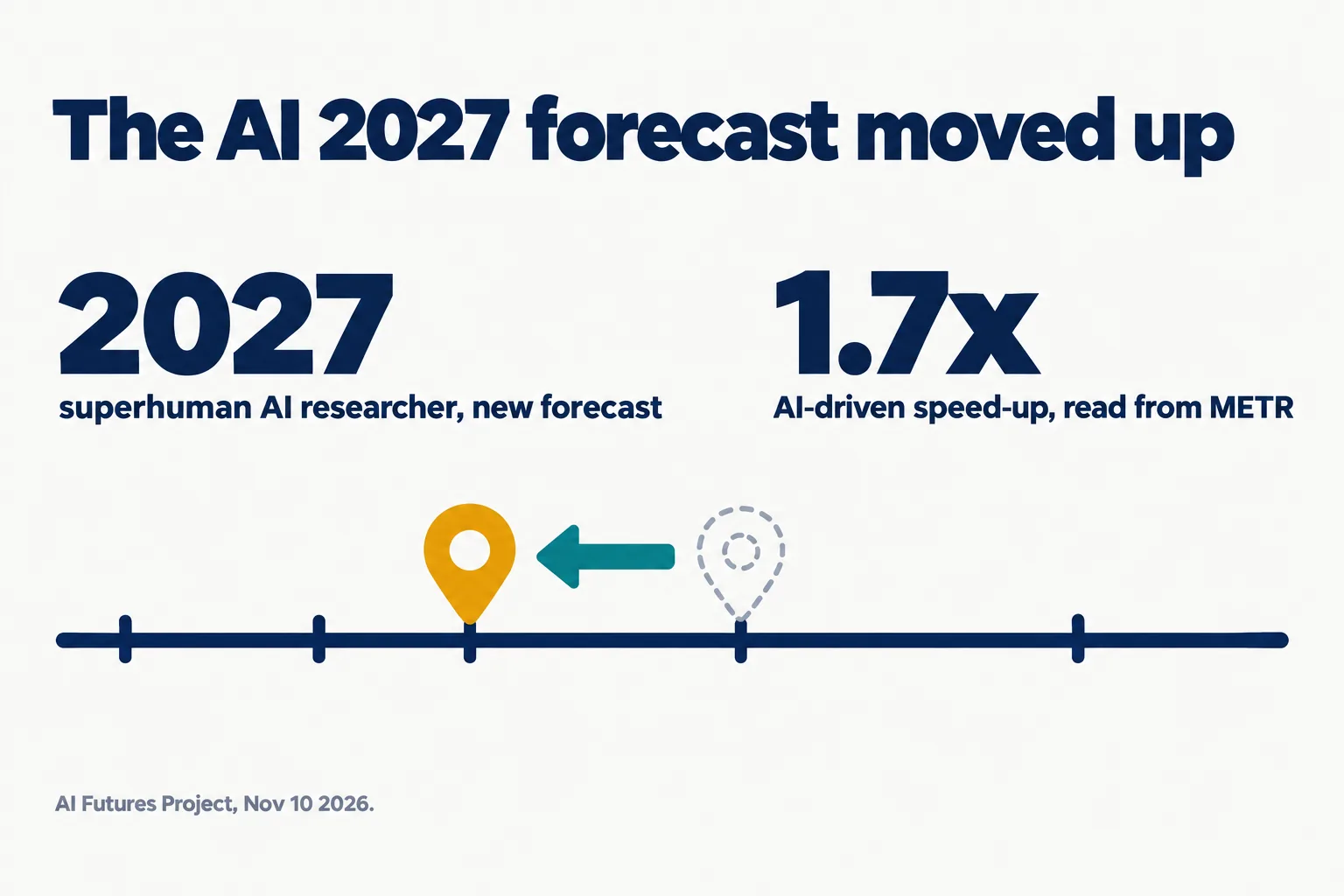
The six authors at the AI Futures Project, the group behind the AI 2027 scenario, now all expect a superhuman AI researcher to arrive in 2027. They published the update on November 10, 2026. They also give a 35 to 65 percent chance that AI able to do all white-collar work arrives before 2028. Their previous forecasts for that second milestone, made less than three months ago, had medians from late 2028 to early 2035.
The reason is mostly one document: METR’s November 5 report on how much AI has sped up research at Anthropic. This page sets out what the authors changed, what they base it on, and how much of that evidence the public can see. By their own account, the answer to the last question is not much.
On this page · 7 sectionsOpen
 The six authors at the AI Futures Project, the group behind the AI 2027 scenario, now all expect a superhuman AI researcher in 2027. They published the update on November 10, 2026.
 The main reason is METR’s November 5 report on Anthropic. The authors read it as a 1.7x AI-driven speed-up in the pace of AI progress.
 They give a 35 to 65 percent chance that AI able to do all white-collar work arrives before 2028. Their previous medians ran from late 2028 to early 2035.
 The evidence is thin by their own account. METR says Anthropic redacted most of what it found most informative, and the authors say the 1.7x figure has no comparable public support.
 They call for an industry-wide pause on frontier AI development. Their dates assume no deliberate slowdown.
§ 01What changed

The post went up at 16:15 UTC under six names: Daniel Kokotajlo, Eli Lifland, Thomas Larsen, Romeo Dean, Brendan Halstead and Lukas Finnveden. Its headline sentence: “Now, all of us forecast that Superhuman AI Researcher (SAR) will likely arrive at some point in 2027 (assuming no substantial deliberate slowdown).”
It uses two milestones.
- Superhuman AI Researcher, or SAR. Roughly the point where a company would rather rely only on automated AI researchers than keep a team of the best human researchers with no AI.
- Top-Expert-Dominating AI, or TED-AI. The post describes these as “AIs that can automate all white-collar work”.
| Question | Before | On November 10, 2026 |
|---|---|---|
| Superhuman AI researcher | Kokotajlo, the most bullish author, gave it a 50% chance before 2029 | All six say it will likely arrive in 2027 |
| Eli Lifland’s median for it | About 2030 | 2027 |
| AI that can do all white-collar work | Five medians, from late 2028 to early 2035 | Five medians, from September 2027 to September 2028 |
| Chance of that before 2028 | Not stated in this post | 35% to 65% |
Larsen put the first row more exactly on X: “all of our medians for superhuman AI researcher (SAR) are now between May and Nov 2027”. Lifland gave his own change in a post: “My previous median for Superhuman AI Researcher was ~2030, now it’s 2027.”
The post’s chart gives the white-collar medians for five of the six authors.
| Author | Previous median | Median on November 10, 2026 |
|---|---|---|
| Daniel Kokotajlo | Late 2028 | September 2027 |
| Brendan Halstead | Early 2031 | April 2028 |
| Thomas Larsen | Early 2032 | April 2028 |
| Eli Lifland | Mid-2032 | September 2028 |
| Romeo Dean | Early 2035 | September 2028 |
All of these dates carry a condition. The authors say the forecasts hold only if AI companies do not slow down.
§ 02Why they moved
The post says of its inputs: “the single biggest source was the METR report”. That is METR’s assessment of AI research at Anthropic, published November 5. Our post on the METR report covers what it found.
- Two estimates from METR. METR estimated that Anthropic is making AI progress about twice as fast as its historical rate. It said it would not be surprised by anything from 1.3x to 3x. It also guessed that perhaps 80% of the current acceleration is due to AI.
- One number from the authors. They combine the two into a 1.7x speed-up that they attribute to AI.
- Their model did not expect it. Their most aggressive forecast gave less than a 4% chance to a speed-up that large by November 2026. In their words: “This level of acceleration due to AI is very unexpected.”
- Ahead of their own scenario. In their reconstruction of AI 2027, a 1.7x pace arrives in about April 2027. So they put the world about five months ahead of that scenario.
They also argue that the number is larger than it sounds: “1.7x AI-attributable acceleration is a bigger deal than it may seem”. Their point is that it measures the pace of progress as a whole, which is harder to move than the productivity of individual staff.
§ 03How much of the evidence is public
The authors are direct about the limits.
- Most of the evidence is redacted. They quote METR: “Anthropic redacted a majority of the evidence we found most informative for these conclusions”.
- The key number has no public backing. METR could share a chart for the 2x figure. For the rest, the authors write: “The 80%/1.7x estimates have no comparable public support.”
- The post was written fast. Its first lines say: “It’s possible that there are some errors in the modeling, but we think it’s very unlikely that they undermine the high level conclusions.”
- It rests on trust in METR. Lifland wrote in a reply on X: “We are putting substantial trust in the authors of the METR report to have made a reasonable assessment.”
- Larsen’s summary. After noting that most of METR’s evidence was redacted, he wrote: “So we’re reading the tea leaves.”
Their own chart also shows that these forecasts have moved in both directions. The medians drifted later through 2025, moved earlier during 2026, and dropped in this update.
§ 04What they want done
The post is also an argument for policy. It says that if a superhuman AI researcher is coming in 2027, the ideal response is “an industry-wide pause followed by an international agreement”. On safety it says: “Companies are not on track to align a SAR”.
Kokotajlo shared the post on X with the line: “Unfortunately, it seems like the intelligence explosion will be happening in 2027 after all.” He ended it: “I am scared, sad, and angry.” That post had more than 220,000 views when we read it at 21:04 UTC.
§ 05The same day, in Anthropic’s IPO filing
Anthropic filed Amendment No. 2 to its S-1 on November 10. It adds a passage that is not in Amendment No. 1. Anthropic’s Responsible Scaling Policy has a capability threshold for AI research and development. The filing says of it: “we made a determination that we have met this threshold based on what we expect from future models and our overall rate of progress, rather than on what we have observed from current models”.
The next sentence is short: “We continue to assess the underlying data.” The filing adds that Anthropic is evaluating what meeting the threshold implies and will release further reports. Lifland pointed to the passage on X that evening. Our post on the AI acceleration language in the S-1 covers the earlier wording.
§ 06Our read
This part is ours, not the authors’.
- A forecast is not a measurement. The chain runs from one report to two estimates, then to one derived number, then through a model to a set of dates. Each step adds uncertainty, and the 80% share is a figure METR itself called a guess.
- The authors have a position. They want a pause. That does not make them wrong. It is a reason to read the caveats they wrote as carefully as the headline.
- What can be measured today is smaller. On the Remote Labor Index, which tests AI on real freelance projects, the best model reached 41.3% on November 10. Our post on that index has the record.
- Plan from what works now. A business deciding what to hand to AI can test that directly, on its own work, this week. A forecast about 2027 does not change what a tool can do today.
Our conflict, declared: CellCog’s AI employees run on Claude Opus 5.5, which is Anthropic’s model, and we sell AI that does white-collar work. We take no position on the forecast. This page records what was published and what it rests on.
§ 07Sources
- AI Futures Project, Q3.5 Timelines Update: Looks Like the Intelligence Explosion Will Happen in 2027 After All, November 10, 2026
- METR, Independent Assessment of AI R&D Acceleration at Anthropic in October 2026, November 5, 2026
- Anthropic, Amendment No. 2 to Form S-1, SEC, November 10, 2026
- Daniel Kokotajlo, Thomas Larsen and Eli Lifland on X, November 10, 2026
Q1What is a superhuman AI researcher?
In the AI Futures Project model it is roughly the point where a company would rather rely only on automated AI researchers than keep a team of the best human researchers with no AI.
Q2When do the AI 2027 authors now expect it?
In 2027. Thomas Larsen, one of the authors, wrote on November 10, 2026 that all of their medians are now between May and November 2027.
Q3Do they say AI will replace all white-collar work by 2028?
They give it a 35 to 65 percent chance before 2028, on the condition that AI companies do not slow down. It is a forecast, not a measurement.
Q4What is the 1.7x figure?
It is the authors’ calculation from two METR estimates: Anthropic’s AI progress running about twice its historical rate, and perhaps 80 percent of the current acceleration being due to AI.
Q5What did Anthropic say the same day?
Its amended IPO filing of November 10, 2026 says it determined that it has met the AI research and development capability threshold in its Responsible Scaling Policy, based on what it expects from future models.