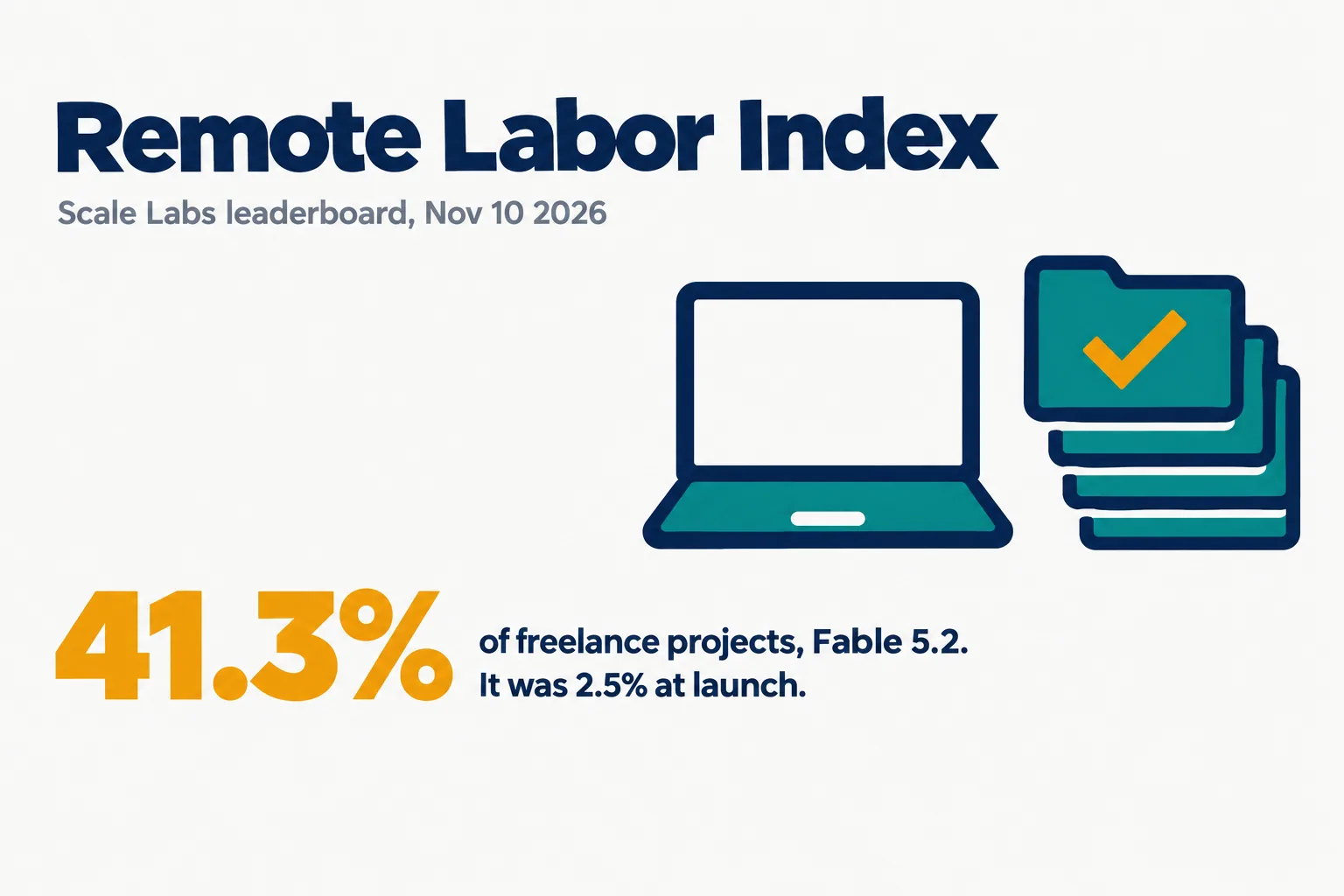
Claude Fable 5.2 completes 41.3% of the projects on the Remote Labor Index, a benchmark built from real freelance jobs. When the index launched in October 2025, the best AI agent completed 2.5%. The Center for AI Safety, which launched the index with Scale Labs, posted the comparison on X at 00:24 UTC on November 10 (post). It added a forecast: “The automation rate is doubling every ~3 months.”
Its next sentence is the one that spread: “AIs may soon be able to do all remote work faster and more cheaply than humans.” A Polymarket post restating it as a warning had about 118,000 views by 19:56 UTC. We read the leaderboard, the project site and the paper to check both claims. The doubling holds on average, though the record moved in two large steps. The index also leaves out several kinds of remote work.
On this page · 7 sectionsOpen
 Claude Fable 5.2 leads the Remote Labor Index at 41.3%, on a row Scale Labs added on November 9, 2026. When the index launched in October 2025, the best AI agent scored 2.5%.
 The index has 240 real freelance projects from 358 Upwork freelancers, worth $143,991 in total. The average project took a human 28.9 hours.
 The Center for AI Safety says the score doubles about every 3 months. From first to last the arithmetic holds, at 93 days, but the record moved in two large steps.
 Humans do the grading. Reviewers compare each result with the work the freelancer delivered, and it passes if a reasonable client would accept it.
 The index leaves out projects that need physical labor, long-term evaluation or direct client interaction, so 41.3% is not 41.3% of all remote work.
§ 01What the leaderboard shows

Scale Labs, part of Scale AI, publishes the scores on its leaderboard. Read at 18:40 UTC on November 10, the top five were Fable 5.2 at 41.30, Opus 5.5 at 21.25, GPT-6 Astra at 20.83, Fable 5.1 at 17.92 and Gemini 4 Argon at 17.08. Gemini 4 Carbon is not listed. Anthropic’s launch table gave the same 41.3% for Fable 5.2 (our Fable 5.2 record).
The table below follows the record: each row is a result that beat every earlier one.
| Date added | Model | Score | Days after launch |
|---|---|---|---|
| October 27, 2025 | Manus 1.0 | 2.5% | 0 |
| January 9, 2026 | Claude Opus 4.5 (thinking) | 3.75% | 74 |
| March 5, 2026 | Claude Opus 4.6 (CoWork) | 4.17% | 129 |
| July 1, 2026 | Fable 5 | 15.83% | 247 |
| September 17, 2026 | GPT-6 Astra | 20.83% | 325 |
| October 7, 2026 | Opus 5.5 | 21.25% | 345 |
| November 9, 2026 | Fable 5.2 | 41.3% | 378 |
The dates are when each result was added to the leaderboard, which is not always when the model was released. We shortened some of the leaderboard’s model labels.
§ 02What the index measures
The paper was posted to arXiv on October 30, 2025. Its abstract said then: “AI agents perform near the floor on RLI, with the highest-performing agent achieving an automation rate of 2.5%.”
- Real projects. There are 240 of them, sourced from 358 verified freelancers on Upwork. Each has a brief, the input files, the work the freelancer delivered, and what it cost and how long it took.
- Real money. The projects are worth $143,991 in total. The average is $632.60 and the median is $200. The average project took a human 28.9 hours, and the median took 11.5.
- Many file types. Deliverables include documents, audio, video, 3D models and CAD files. The project site lists game development, product design, architecture, data analysis and video animation among the fields.
- Human graders. Scale’s page says: “All evaluations are therefore performed manually by trained experts using a specialized platform.” A result passes if it meets the brief at least as well as the human’s work and a reasonable client would accept it.
- One headline number. The automation rate is the share of projects that meet or exceed the human standard. Three reviewers vote, and Scale reports 94.4% agreement between them.
Of the 240 projects, 230 are private and used for the leaderboard, and 10 are public.
§ 03The doubling claim, checked
| Period | Record score | Days | Doubling time |
|---|---|---|---|
| October 27, 2025 to March 5, 2026 | 2.5% to 4.17% | 129 | 175 days (5.7 months) |
| March 5 to July 1, 2026 | 4.17% to 15.83% | 118 | 61 days (2.0 months) |
| July 1 to October 7, 2026 | 15.83% to 21.25% | 98 | 231 days (7.6 months) |
| October 7 to November 9, 2026 | 21.25% to 41.3% | 33 | 34 days (1.1 months) |
| Whole period | 2.5% to 41.3% | 378 | 93 days (3.1 months) |
- From first to last, the claim holds. Going from 2.5% to 41.3% is 4.05 doublings in 378 days. That is one doubling every 93 days, or about 3.1 months. The project site shows a similar figure, about 3.3 months.
- The path was not steady. Two results carry most of the rise: Fable 5 in July and Fable 5.2 in November. Between them, the record took 98 days to move from 15.83% to 21.25%, a pace of one doubling every 7.6 months.
- It cannot continue for long. A share cannot pass 100%. One more doubling would be 82.6%, and a second is not possible. On the three-month line, 82.6% would arrive around February 10, 2027.
§ 04Is it all remote work?
Not by the index’s own design. Scale’s page says the projects cover 23 of Upwork’s 64 domains, “excluding projects requiring physical labor, long-term evaluation, or direct client interaction”. Four limits follow from that and from the method:
- One-off projects. Each task comes with a brief and its files. Work that runs for months, or that depends on talking with a client, is outside the set.
- More fail than pass. At 41.3%, Fable 5.2 did not meet the human standard on 58.7% of the projects.
- No breakdown yet. The leaderboard gives each model one automation rate. We found no list of which projects Fable 5.2 completed.
- An old summary. Scale’s page still carries its launch-time findings, including this line: “At the time this leaderboard was launched, the highest-performing agent (Manus) achieved a 2.5% automation rate”. It says the early successes were in audio, image generation, report writing and data retrieval. That analysis has not been updated for the new score.
§ 05Where CellCog sits
Our conflict, declared: we build CellCog, and every CellCog AI employee runs on Claude Opus 5.5, which scores 21.25% on this index. None runs on Fable 5.2. We have not run CellCog on the Remote Labor Index, so we make no claim about where it would land.
The index tests one project at a time, from a brief and a folder of files. An AI employee holds a standing role, keeps memory between tasks and waits for approval on anything above the level its owner sets. The index does not measure that kind of work in either direction.
§ 06What to watch
- The next record, and whether it lands on the three-month line.
- A breakdown of which kinds of project Fable 5.2 completes.
- A score for Gemini 4 Carbon, which the leaderboard does not list yet.
§ 07Sources
- Scale Labs, Remote Labor Index leaderboard, read November 10, 2026 (18:40 UTC)
- Center for AI Safety and Scale AI, Remote Labor Index project site, read November 10, 2026
- Mazeika et al., Remote Labor Index: Measuring AI Automation of Remote Work, arXiv, October 30, 2025
- Center for AI Safety on X (00:24 UTC, November 10, 2026)
- Polymarket on X (18:03 UTC, November 10, 2026)
Q1What does the Remote Labor Index measure?
Whether an AI agent can finish a real freelance project to the standard of the human who was paid for it. The projects come from Upwork freelancers and include a brief, the input files and the delivered work.
Q2How is the Remote Labor Index graded?
By people. Trained reviewers compare the AI result with the human deliverable on a three-point scale. The automation rate is the share of projects that meet or exceed the human standard.
Q3Does 41.3% mean AI can do 41.3% of remote jobs?
No. It means Fable 5.2 passed 41.3% of this set of one-off projects. The set leaves out work that needs physical labor, long-term evaluation or direct client interaction.
Q4Which models lead the Remote Labor Index?
As of November 10, 2026: Fable 5.2 at 41.3%, Opus 5.5 at 21.25%, GPT-6 Astra at 20.83%, Fable 5.1 at 17.92% and Gemini 4 Argon at 17.08%, per the Scale Labs leaderboard.
Q5Who built the Remote Labor Index?
The Center for AI Safety and Scale Labs. The paper, Remote Labor Index: Measuring AI Automation of Remote Work, was posted to arXiv on October 30, 2025.