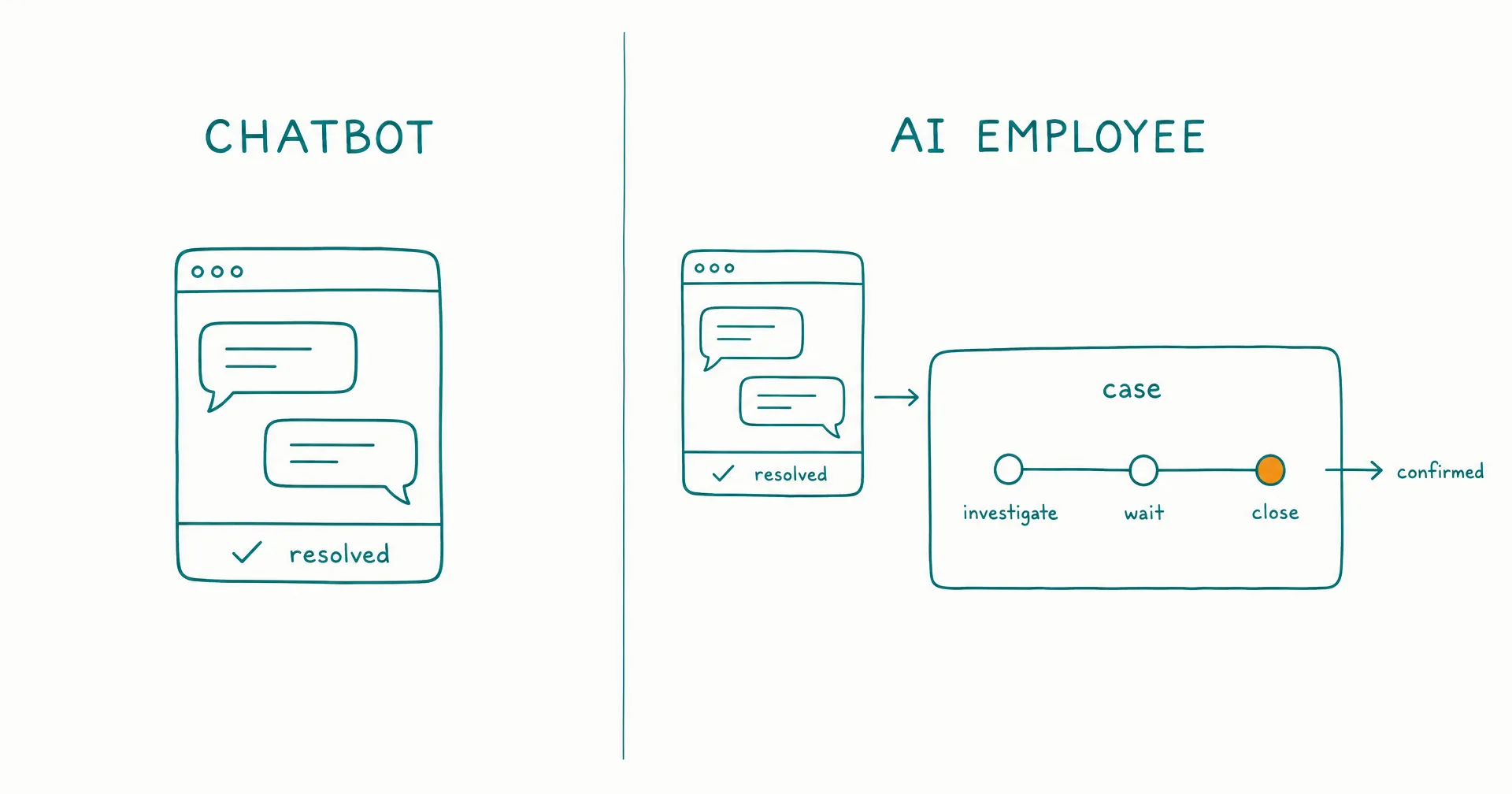
A chatbot gives people a conversational way to ask questions, find information, or complete a guided transaction. An AI employee is assigned a bounded responsibility and expected to carry that work forward across triggers, tasks, tools, reviews, and work sessions.
The cleanest distinction is conversation versus ownership.
A chatbot can be sophisticated. It may understand open-ended language, retrieve account data, call tools, remember the current conversation, and complete a transaction. An AI employee can also communicate through chat. Neither interface nor model quality settles the comparison.
The practical test is what happens when no person is typing. Does the system know that work should begin? Does it know which open task it owns? Can it act only within approved authority? Does it preserve evidence and state? Can it wait, resume, escalate, and close the loop? Is its performance measured across accepted outcomes?
If those operating objects are absent, the product may be an excellent chatbot without being a standing worker.
On this page · 13 sectionsOpen
- AI Employee vs Chatbot at a Glance
- What Is a Chatbot?
- What Is an AI Employee?
- Can a Chatbot Also Be an AI Employee?
- What Are the 8 Practical Differences Between a Chatbot and an AI Employee?
- Why Model Intelligence Does Not Settle the Comparison
- When Is a Chatbot the Better Choice?
- When Is an AI Employee the Better Choice?
- How Should Chatbots and AI Employees Work Together?
- What Should You Ask an “AI Employee” Vendor to Demonstrate?
- How CellCog Implements the AI Employee Pattern
- A 12-Point Decision Checklist
- Final Verdict
- A chatbot is primarily a conversational interface. It responds to a user, interprets intent, supplies information, and may guide or complete a transaction.
- An AI employee is primarily an operating role. It owns a recurring outcome, receives work from approved triggers, maintains task state, uses tools within permissions, and reports completion or exceptions.
- Modern chatbots can use generative AI, memory, APIs, and agentic actions. Those features make a chatbot more capable; they do not automatically give it durable responsibility.
- Choose a chatbot when the user is present and conversation is the natural unit of work. Choose an AI employee when the business needs follow-through before, between, and after conversations.
- The two patterns often work together: the chatbot manages the front-door interaction while an AI employee or deterministic workflow carries the resulting back-office work.
- CellCog AI Employees implement the standing-role pattern with inboxes, shifts, wake conditions, memory, task boards, KPIs, permissions, approvals, and handovers around a general-purpose agent.
§ 01AI Employee vs Chatbot at a Glance
| Decision dimension | Chatbot | AI employee | Buyer implication |
|---|---|---|---|
| Primary unit | Conversation or user intent | Recurring role or outcome | Decide whether the work ends with the interaction |
| Typical start | A user sends a message or selects an option | Schedule, event, message, queue item, task, or person | Proactive work needs trigger policy |
| Work owner | User or application workflow | Named AI role under a human supervisor | Ownership must persist outside chat |
| Context | Current exchange, account data, or retrieved knowledge | Role, business, open-task, and prior-decision context | Persistent context needs governance |
| Action | Answer, guide, retrieve, or complete a bounded transaction | Select and perform permitted steps toward an outcome | Tool access should be action-specific |
| State | Conversation state or transaction state | Task state across shifts, blockers, and handovers | Long-running work needs durable status |
| Human involvement | User is usually present; escalation transfers the conversation | Supervisor reviews defined decisions, samples, and exceptions | Oversight changes position |
| Success measure | Resolution, containment, response quality, or conversion | Accepted outcomes, quality, cycle time, intervention, cost, and risk | Conversation volume is not role performance |
| Best fit | Self-service and interactive requests | Recurring digital responsibility | Many operations need both |
| Main risk | Wrong answer, poor routing, or frustrating experience | Repeated error, excess authority, stale state, or silent drift | Persistence increases the control burden |
The categories overlap because a chatbot can be one interface into an agent, workflow, or employee. Evaluate the operating system behind the conversation rather than the chat window in front of it.
§ 02What Is a Chatbot?
A chatbot is software designed to communicate with people through text or voice. It interprets a message, determines the user’s intent, and responds with information, a question, a recommendation, or an action.
IBM’s current chatbot definition separates two broad forms: rule-based chatbots that follow scripts, decision trees, or predefined flows; and AI chatbots that use natural-language processing, generative AI, or large language models to handle a wider range of requests.
Both forms organize the experience around conversation. Even when the chatbot calls a database or completes a return, the interaction normally begins with a person asking for help.
A chatbot can do more than answer FAQs
Treating every chatbot as a scripted website bubble creates a false comparison. A modern chatbot may:
- identify intent from open-ended language;
- retrieve data from a knowledge base or system of record;
- authenticate a user;
- create or update a ticket;
- book an appointment;
- guide a customer through a transaction;
- call an agent or workflow;
- preserve context across turns; and
- transfer the conversation to a human.
That is real work. The question is whether the work remains bounded by the conversation or becomes a standing responsibility after it.
The chatbot’s natural unit is an interaction
A useful chatbot loop looks like this:
- A person starts a conversation.
- The system identifies intent and relevant entities.
- It answers, asks for missing information, or invokes an approved action.
- It confirms the result or transfers the interaction.
- The conversation ends when the user’s immediate need is resolved.
This design is ideal when the user needs a fast answer or a guided path. It becomes strained when the request creates work that lasts beyond the interaction.
Suppose a customer asks, “Can you investigate why our monthly export is incomplete and tell me when it is fixed?” The chatbot can collect details and acknowledge the issue. A standing worker must then own the investigation, check dependencies, update the task, follow up after a fix, and close the loop with evidence. Those are different operating obligations.
§ 03What Is an AI Employee?
An AI employee is agentic software placed inside a continuing business role. It receives recurring work, carries approved state across work sessions, uses tools within delegated authority, and reports through tasks, metrics, approvals, escalations, and handovers.
The practical definition of an AI employee uses five tests:
- Role: a bounded area of responsibility.
- Continuity: context and open work survive one interaction.
- Initiative: approved triggers can begin or resume work.
- Agency: the system can choose and perform steps through tools.
- Accountability: outcomes, actions, exceptions, and ownership remain visible.
The term describes an operating pattern, not a legal status. The system is software, and the organization remains responsible for its access, decisions, outputs, and actions.
The employee’s natural unit is a responsibility
An employee-style loop looks different:
- A schedule, message, queue item, event, or person opens work.
- The role loads its goal, current task state, approved sources, and authority.
- It plans and performs permitted steps.
- It records evidence, actions, decisions, and blockers.
- It completes, waits, follows up, or escalates.
- A human reviews defined checkpoints and performance signals.
- The next shift resumes from a structured handover.
The employee may use chat at several points. It might receive an email, ask a supervisor a question, or send a status update. Conversation is a channel inside the role rather than the complete operating model.
A title alone does not create ownership
Calling a chatbot “Sales Employee,” “Support Employee,” or “Finance Employee” does not establish a role.
A usable role also needs an outcome and explicit non-goals, work-intake rules, approved context and source ownership, task states, read and write permissions, approval thresholds, quality requirements, escalation conditions, completion evidence, and a named human supervisor.
The AI employee hiring guide turns those objects into an assignment before the platform is configured.
§ 04Can a Chatbot Also Be an AI Employee?
Yes. The categories describe different layers.
“Chatbot” describes how a person interacts with the system. “AI employee” describes how the system owns work. One product can satisfy both definitions.
A copilot creates another overlap: it uses conversation and application context to help a person operate the workflow. The AI copilot versus AI employee decision asks whether the human should keep driving or delegate the recurring outcome.
For example, a support AI employee may expose a chat interface to customers. During the conversation it answers questions, checks identity, retrieves account information, and gathers missing details. Behind the interface, its employee layer may also:
- create and prioritize the case;
- monitor a promised follow-up;
- update a knowledge-gap queue;
- ask a billing specialist for evidence;
- wait for an external event;
- resume the case later;
- escalate at a policy boundary; and
- record whether the outcome was accepted.
The chatbot manages the exchange. The employee role manages the continuing obligation.
Four possible product shapes
| Product shape | Conversation | Standing ownership | Correct description |
|---|---|---|---|
| Scripted FAQ bot | Yes | No | Chatbot |
| Generative support bot with transaction tools | Yes | Usually limited to the session or case flow | AI chatbot or virtual agent |
| Background research worker with no customer chat | Optional | Yes | AI employee or standing agent |
| Support role with chat, queue, follow-up, KPIs, and handovers | Yes | Yes | Chatbot interface plus AI employee |
This is why feature labels create confusion. A vendor can truthfully say its chatbot acts, remembers, and runs workflows. The buyer still needs evidence that a durable role owns work outside an active exchange.
§ 05What Are the 8 Practical Differences Between a Chatbot and an AI Employee?
1. Conversation intent versus business outcome
A chatbot is commonly optimized to resolve the user’s current intent: find an answer, change a setting, submit information, or route a request.
An AI employee is optimized around a bounded business outcome: maintain a support queue, produce a weekly executive briefing, keep a content operation moving, or research qualified accounts.
Intent resolution can be one step inside the larger outcome.
2. User initiation versus trigger coverage
Chatbots usually begin when a person sends a message. Some can send proactive notifications, but the conversation still frames the event.
AI employees may wake from schedules, new email, Slack or queue messages, database or application events, KPI thresholds, task assignments, another worker’s delegation, or a supervisor’s request.
Trigger breadth is not enough. A role also needs deduplication, priority, frequency limits, concurrency rules, and a clear response when required inputs are missing.
3. Conversation memory versus governed continuity
A chatbot may remember earlier turns, user preferences, or retrieved account data. This improves the conversation.
An AI employee needs role continuity: which tasks remain open, which promises were made, which sources support the current conclusion, which decision is waiting for approval, what changed since the last shift, what must be forgotten or refreshed, and who owns the next step.
Useful memory treats provenance, scope, correction, expiry, and deletion as part of the design - not as optional administration.
4. Transaction action versus delegated authority
A chatbot can call an API to reset a password or change a reservation. The action may be tightly coupled to the authenticated user’s request.
An AI employee may act while the supervisor is absent. Its authority therefore needs to be shaped by role, object, action, consequence, and time.
| Action | Possible default | Why |
|---|---|---|
| Read an assigned queue | Allow | Required to receive work |
| Draft a response | Allow | Reversible and reviewable |
| Send a routine policy-backed reply | Conditional | Depends on identity and consequence |
| Issue a refund | Approval or bounded threshold | Financial impact |
| Change access rights | Human-only by default | Security consequence |
| Publish a public statement | Approval | Reputation and legal risk |
An action-specific permission model is more useful than one global “autonomy” switch.
5. Conversation state versus task state
A conversation has turns, intents, slots, and a resolution state. Those objects help the system understand the interaction.
A task has an owner, trigger, priority, deadline, evidence, status, blocker, reviewer, and completion condition. Those objects help the organization understand the work.
Chat history can explain what was said. It does not reliably answer: Is the task still open? What event should wake it? Who accepted responsibility? Which action is blocked? What proves completion?
An employee needs both communication history and work state.
6. Transfer of conversation versus handover of responsibility
A chatbot escalation usually transfers the user and conversation to a human agent. That is a valuable and necessary control.
An employee handover may transfer responsibility to a person or another AI role even when no customer is waiting in chat. The packet should include goal, current state, evidence, decisions, authority, exceptions, next action, and acceptance criteria.
A handover is incomplete until the receiver accepts ownership or the sender retains it.
7. Conversation analytics versus role performance
Chatbot teams often track intent recognition, containment or deflection, resolution rate, response time, escalation, user satisfaction, abandonment, and conversion. Those measures can be appropriate for the channel.
An AI employee also needs measures for the continuing role: accepted outcomes, first-pass quality, correction effort, on-time completion, appropriate escalation, reopened work, cost per accepted outcome, and incident severity.
Role performance separates outcomes, quality, reliability, intervention, cost, and risk from raw activity.
8. Interaction risk versus compounding operating risk
A chatbot can cause serious harm through an incorrect answer, unauthorized disclosure, bad transaction, or missed escalation. A standing worker adds persistence and repetition.
One weak rule can affect hundreds of future tasks. Stale memory can influence later decisions. Over-broad permissions can reach several systems. An error can be handed to another worker as if it were evidence.
That does not make AI employees inherently unsafe. It means their controls must match the duration and consequence of the role.
§ 06Why Model Intelligence Does Not Settle the Comparison
A smarter model can improve both patterns. It can help a chatbot understand unusual phrasing, reconcile retrieved information, ask a better clarification question, and generate a more useful answer. It can help an AI employee plan a variable task, choose a tool, evaluate evidence, and recognize when it is blocked.
The model does not supply the full operating contract.
OpenAI’s practical guide to building agents describes agents as systems that independently accomplish tasks on a user’s behalf, while distinguishing them from simple chatbots and single-turn language-model applications. Its core components - model, tools, and instructions - explain how agentic execution works. A standing employee role still needs triggers, queue ownership, task state, permissions, longitudinal metrics, and handovers around that execution.
Anthropic’s guide to building effective agents makes a related distinction between workflows, whose paths are defined in code, and agents, which dynamically direct their own tool use. That boundary identifies who chooses the next step. It does not determine whether the system owns an ongoing business responsibility.
This produces three separate design questions:
| Design question | Possible answers | What it decides |
|---|---|---|
| How does a person interact with it? | Chat, email, task board, API, voice, or no direct interface | Channel |
| How is the next step selected? | Script, workflow rule, model-driven agent, or human | Execution architecture |
| Who carries the obligation across time? | User, workflow owner, AI role, or human team | Operating ownership |
A product can therefore be a chatbot backed by fixed decision logic; a chatbot backed by an agent; an AI employee that uses a chatbot as one channel; an AI employee with no public chat interface; or a hybrid in which deterministic workflows, agentic judgment, and human approvals each own different steps.
Capability claims need operating evidence
“Uses the latest model” is not evidence of dependable follow-through. “Can access 1,000 tools” is not evidence that the role has safe authority. A memory claim is not evidence that stored context is accurate, necessary, correctable, or deletable.
Translate each capability claim into an operating question:
| Capability claim | Operating question |
|---|---|
| Understands natural language | Which intents and exceptions are evaluated? |
| Uses tools | Which objects and actions are permitted? |
| Remembers context | What is stored, sourced, refreshed, corrected, and deleted? |
| Works autonomously | What starts, stops, pauses, or escalates the work? |
| Learns over time | Which changes occur automatically, and who can inspect or reverse them? |
| Completes workflows | What proves the business outcome was accepted? |
This translation prevents a polished demo from becoming an operating assumption.
Safety moves from the answer to the system
For a narrow chatbot, safety testing may concentrate on answer quality, identity, retrieval boundaries, transaction rules, and escalation. Once the system owns continuing work, the test surface expands to permissions, external actions, durable memory, trigger behavior, cross-agent transfers, monitoring, and recovery.
NIST’s Generative AI Profile frames risk management as an ongoing lifecycle involving governance, measurement, and management rather than a one-time model check. That lifecycle view is especially useful for standing roles because the operating environment, sources, permissions, and failure patterns change after launch.
The practical conclusion is simple: buy intelligence for tasks that need it, but evaluate ownership through the surrounding system.
§ 07When Is a Chatbot the Better Choice?
Choose a chatbot when conversation is the most direct path from user need to resolution.
| Situation | Why a chatbot fits | Design requirement |
|---|---|---|
| Product FAQ | The user needs immediate information | Approved knowledge and fallback |
| Order or case status | The user wants a specific authenticated answer | Identity and data-access controls |
| Appointment scheduling | Conversation gathers preferences for a bounded transaction | Confirmation and conflict handling |
| Guided troubleshooting | Questions narrow a known decision tree | Clear escalation after failed steps |
| Lead qualification | A short exchange gathers agreed fields | Consent and CRM-write policy |
| Internal knowledge access | Employees need a conversational front door | Source citations and access filtering |
| Simple account change | Intent maps to a stable transaction | Authentication and post-action confirmation |
A chatbot is often the better product even when the underlying model could plan more broadly. Narrowness improves predictability, evaluation, latency, and user trust.
Conversation is valuable when the person has the missing context
Some work should remain interactive because the user’s preferences change the answer. Travel planning, product selection, troubleshooting, and creative direction benefit from clarification in real time.
Do not wrap every useful conversation in a standing role. The operating overhead - triggers, persistent state, access policy, ongoing evaluation, and supervision - should earn its keep.
High-volume self-service favors the chatbot pattern
A public chatbot can handle many simultaneous users with the same bounded knowledge and transaction set. An AI employee may still maintain the knowledge base or investigate exceptions behind the scenes, but the front door remains conversational.
§ 08When Is an AI Employee the Better Choice?
Choose an AI employee when work should continue without an active user and can be defined as a recurring, observable responsibility.
| Readiness signal | Practical question | Why it favors an employee |
|---|---|---|
| Recurrence | Does the work return on a schedule or event? | Repeated prompting can become governed triggers |
| Durable state | Does work remain open across hours or days? | Task state and handovers preserve continuity |
| Follow-through | Must someone check for a response or changed condition? | The role can resume within policy |
| Multiple tools | Does the outcome cross inboxes, files, apps, or data? | Role-shaped authority can connect the steps |
| Observable result | Can a reviewer accept or reject the output? | Performance can be measured |
| Bounded exceptions | Can uncertain or consequential cases return to a person? | Delegation remains controlled |
| Stable ownership | Can one human supervise scope and policy? | Accountability has a clear home |
Good first roles do not require unlimited autonomy. The best tasks tend to be recurring, digitally observable, reversible, and supported by available inputs. Examples:
- prepare a source-backed weekly briefing;
- maintain a research queue;
- draft policy-backed support replies for approval;
- monitor a defined competitor set;
- update a content-production board;
- reconcile a recurring KPI report; or
- perform first-pass account research with evidence.
“Handle every customer issue” is not a safe role specification. “Triage new support messages, draft answers from approved policies, and escalate identity, billing, legal, security, or repeated-failure cases” is closer.
§ 09How Should Chatbots and AI Employees Work Together?
The strongest design often separates the conversational front door from the continuing work owner.
Pattern 1: chatbot resolves; employee never enters
Use this when the request maps to an approved answer or stable transaction.
- User asks for an invoice.
- Chatbot authenticates the user.
- A deterministic API retrieves the invoice.
- Chatbot confirms delivery.
- The interaction closes.
Adding an employee would create unnecessary coordination.
Pattern 2: chatbot gathers; employee investigates
Use this when conversation supplies the intake but resolution takes time.
- Chatbot identifies the request and gathers required details.
- It creates a structured task with the conversation evidence.
- The employee accepts the task.
- The employee investigates across approved systems.
- A human reviews any consequential action.
- The employee returns the result to the conversation channel.
- The task closes only after confirmation.
Pattern 3: employee monitors; chatbot explains
Use this when standing work identifies an event that a person needs to understand.
- The employee detects a material KPI exception.
- It validates the source and opens an exception task.
- It prepares an explanation with evidence.
- A chatbot or inbox lets the manager ask follow-up questions.
- The employee records the approved action and monitors the result.
Pattern 4: chatbot escalates; human owns
Use this when identity, policy, consequence, or uncertainty requires a person.
The system should transfer the authenticated user and account, stated intent, relevant conversation turns, actions already attempted, retrieved evidence, the policy or confidence reason for escalation, and promised response expectations.
Good escalation design places people at uncertainty and consequence boundaries instead of reviewing every low-risk step.
§ 10What Should You Ask an “AI Employee” Vendor to Demonstrate?
Do not ask only whether the product has chat, memory, integrations, or autonomy. Ask for a live trace of standing work.
| Vendor claim | Demonstration to request | Weak evidence |
|---|---|---|
| “Owns outcomes” | Show one task from trigger through accepted completion | A polished chat answer |
| “Works proactively” | Show trigger, suppression, priority, and retry behavior | A scheduled prompt |
| “Remembers” | Show source, scope, correction, expiry, and deletion | A long transcript |
| “Uses tools” | Show read/write scope and action-specific approvals | Integration-logo wall |
| “Follows up” | Show waiting state, wake condition, and closure | Reminder notification |
| “Escalates safely” | Show rule, evidence packet, owner, and response path | “Human in the loop” label |
| “Is measurable” | Show accepted-output and intervention metrics | Runs or messages sent |
| “Works with a team” | Show delegation, acceptance, authority, and handback | Multiple agent names |
Run the “silence test”
Give the product a bounded recurring responsibility, then stop prompting.
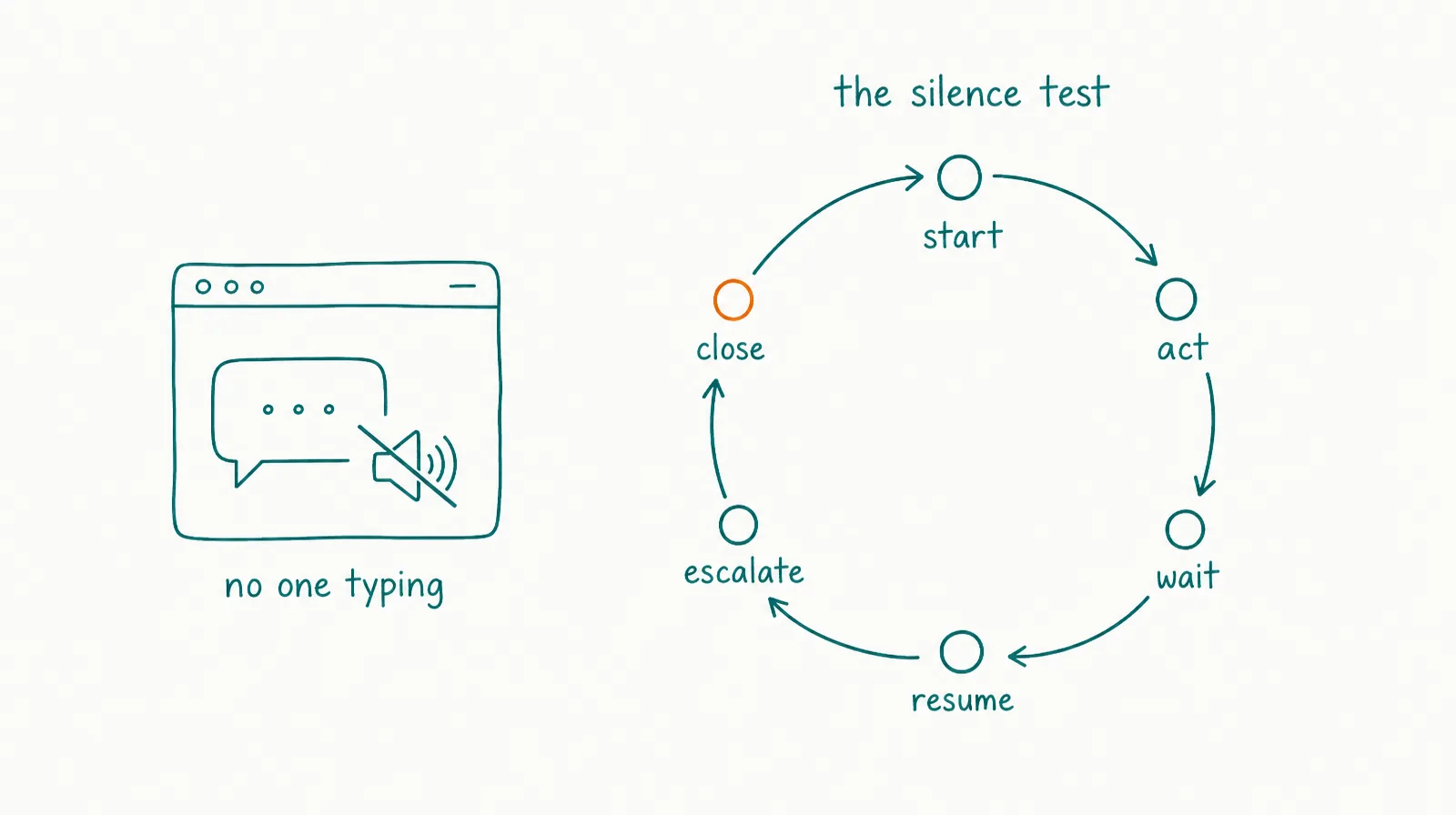
Observe whether it:
- starts from the approved condition;
- finds or requests required inputs;
- creates visible task state;
- takes only allowed actions;
- records evidence;
- waits correctly when blocked;
- resumes from the right event;
- escalates at the agreed boundary; and
- closes with an accepted result.
If the buyer must remember and restart every step, the product is operating as a chatbot or assistant, regardless of its label.
§ 11How CellCog Implements the AI Employee Pattern
CellCog offers chat-based general-purpose agent capability, but its AI Employee product adds the operating machinery required for standing work.
According to CellCog’s current AI Employees product page, a role can have:
- a name and persistent identity;
- its own inbox;
- goals and KPIs;
- schedules and wake conditions;
- memory across shifts;
- a task board;
- connected tools;
- approval routing;
- shift handovers; and
- delegation to other AI employees.
That architecture does not make every possible assignment appropriate for autonomous execution. Users still define the goals, permissions, connected accounts, and approval expectations, and remain responsible for monitoring work and actions taken on their behalf.
CellCog is a fit when the business has a recurring digital responsibility that crosses conversation, research, files, data, documents, or connected software - and when the team can define how the work is accepted.
A conventional chatbot may remain the better choice when the requirement is simply to answer a bounded set of questions or complete a stable transaction in the user’s presence.
§ 12A 12-Point Decision Checklist
Score each statement 0 for no, 1 for partly, and 2 for yes.
| Statement | Score |
|---|---|
| Work recurs without a person noticing every instance | 0–2 |
| The outcome remains open after the initial conversation | 0–2 |
| A named role can own the queue | 0–2 |
| Approved digital inputs are available | 0–2 |
| The result is observable and reviewable | 0–2 |
| The role needs to use more than one tool or system | 0–2 |
| The work has clear non-goals | 0–2 |
| Actions can be separated into allowed, approved, and prohibited | 0–2 |
| Exceptions can route to a named person | 0–2 |
| Task state must survive hours, days, or shifts | 0–2 |
| Performance can be measured across accepted outcomes | 0–2 |
| The expected value justifies ongoing supervision and operating cost | 0–2 |
Interpret the total:
- 0–8: start with a chatbot, assistant, or deterministic workflow.
- 9–16: use a hybrid; keep conversation in front and assign only one bounded recurring obligation.
- 17–24: an AI employee pilot may be justified, subject to risk and evidence checks.
The score is a design aid, not a safety certification. A high-consequence role may still need narrow authority even with a strong operating fit.
§ 13Final Verdict
Use a chatbot when the job is to help a person through a conversation. Use an AI employee when the job is to carry a bounded responsibility across conversations, triggers, tools, waits, reviews, and work sessions.
Do not choose based on how human the interface feels. Choose based on who starts the work, who carries state, who owns follow-through, what the system may change, and how the organization knows the outcome was accepted.
If the responsibility exists only while someone is typing, a chatbot may be exactly right. If the responsibility should keep moving after the chat closes, define the role and test the operating machinery around it.
Explore how CellCog structures AI Employees, then start with one recurring outcome, narrow permissions, and a named human supervisor.
Q1Is ChatGPT a chatbot or an AI employee?
ChatGPT is a conversational AI product with assistant and agent capabilities. It can answer questions, create artifacts, use tools, and complete multi-step work. Product capabilities change over time, so the durable classification test is operating behavior: whether a configured system owns a recurring role, starts from approved triggers, carries durable task state, and reports performance across work sessions. A powerful chatbot or agent does not automatically become an AI employee.
Q2Can a chatbot work without a human prompt?
Yes. A chatbot can send proactive messages, run scheduled tasks, react to events, or be invoked by an application. Proactivity alone does not prove role ownership. Check whether the system also manages task state, permissions, follow-through, evidence, escalation, and accepted outcomes.
Q3Is an AI employee better than a customer-service chatbot?
Not universally. A chatbot is often better for immediate self-service questions and stable transactions. An employee pattern is useful when cases require investigation, follow-up, knowledge maintenance, or work across sessions. A strong support design may use a chatbot for the customer interaction and an employee role for the continuing case.
Q4Does an AI employee need a chat interface?
No. It may work through email, a task board, scheduled reports, connected applications, or another agent. Chat is one possible communication channel, not the defining feature.
Q5What is the biggest risk of replacing a chatbot with an AI employee?
The system may receive broader authority and continue acting after the original interaction. That can turn one bad answer into repeated or cross-system harm. Limit permissions, preserve action evidence, require approval for consequential steps, and define pause and escalation paths before expanding autonomy.
Q6What should the first AI employee pilot do?
Choose one recurring, digitally observable outcome with reversible first actions. Define the trigger, sources, output, reviewer, permissions, escalation rules, completion evidence, and stop criteria. Avoid starting with an entire department or an outcome that cannot be objectively reviewed.