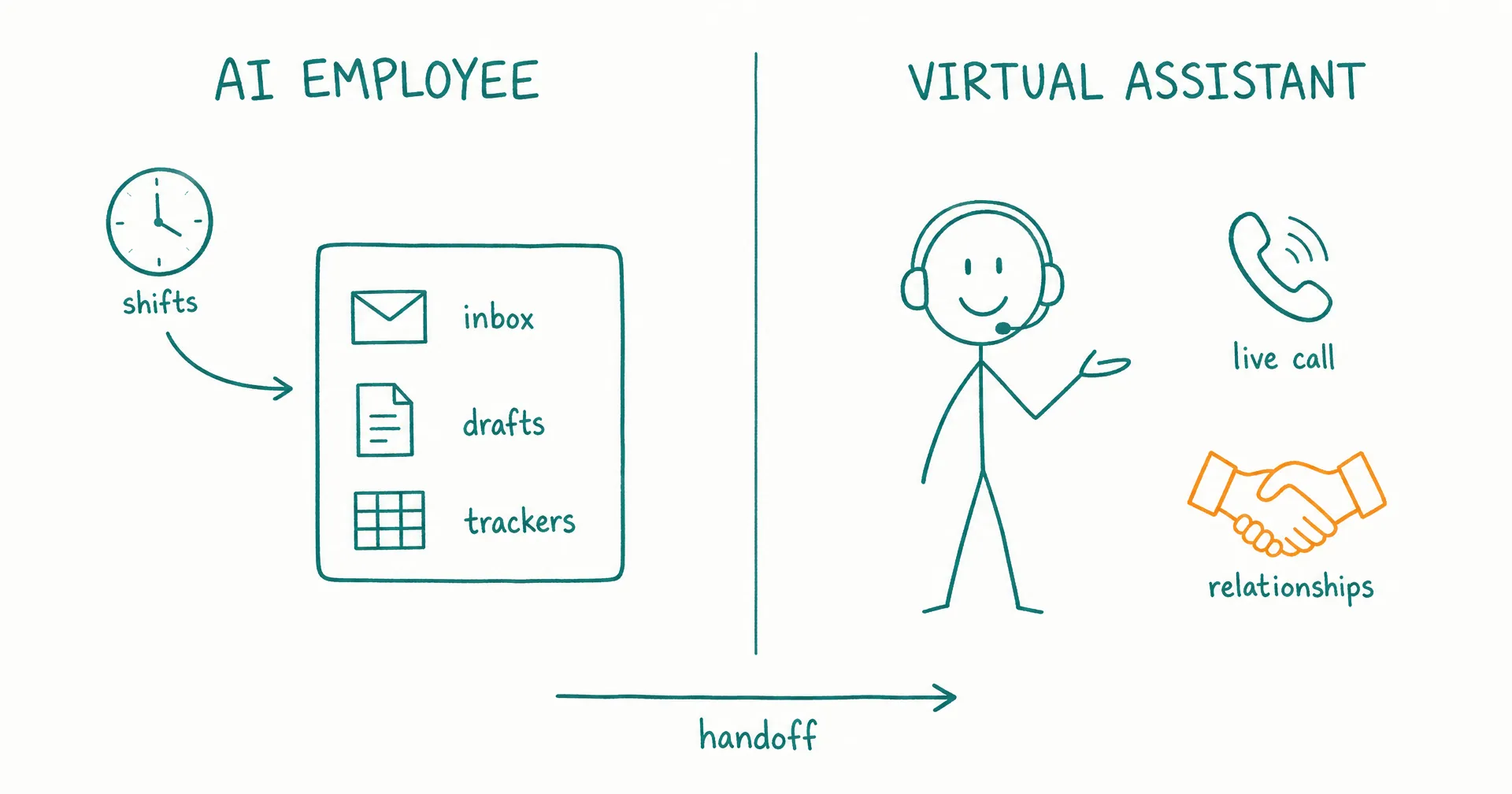
A virtual assistant is a person who provides administrative, operational, creative, or specialized support from another location. An AI employee is software configured to own a bounded digital responsibility through schedules, tools, persistent context, permissions, metrics, approvals, and handovers.
The shortest useful distinction is human service versus software operation.
A human virtual assistant can understand social nuance, negotiate ambiguity, build relationships, exercise judgment, and take responsibility as a person. An AI employee can process digital work at flexible hours, repeat a defined operating pattern, produce many artifact types, and preserve structured state without being a person.
Neither is a universal substitute for the other. Use an AI employee for recurring, digital, observable tasks whose actions can be bounded. Use a human virtual assistant when the work depends on interpersonal judgment, personal representation, physical-world coordination, or responsibility that cannot be delegated to software. Use both when software can prepare, monitor, and organize the work while a person owns relationships, exceptions, and consequential decisions.
On this page · 14 sectionsOpen
- AI Employee vs Virtual Assistant at a Glance
- What Is a Human Virtual Assistant?
- What Is an AI Employee?
- Is an AI Virtual Assistant the Same as a Virtual Assistant?
- Which Tasks Are Better for an AI Employee?
- Which Tasks Are Better for a Human Virtual Assistant?
- How Do Cost and Capacity Really Compare?
- How Much Management Does Each Option Require?
- What Are the Privacy and Security Trade-Offs?
- When Should You Use Both?
- How Do You Run a Fair AI-versus-VA Pilot?
- How CellCog Fits This Decision
- A Role-Splitting Worksheet
- Final Verdict
- A virtual assistant is a human worker or service provider. Employment, contractor, privacy, tax, and management obligations depend on the actual relationship and applicable law.
- An AI employee is a software operating pattern, not a legal employee. The purchasing organization remains accountable for its goals, access, outputs, and actions.
- Human VAs are stronger at social nuance, live interaction, ambiguous judgment, personal representation, and novel exceptions.
- AI employees are strongest when work is recurring, fully digital, source-backed, reviewable, and separable into allowed, approval-required, and prohibited actions.
- Compare total operating cost per accepted outcome - not an AI subscription against a human salary headline. Include onboarding, tools, review, corrections, coordination, and failure cost for both options.
- CellCog’s AI assistant-style roles are designed for inbox, calendar, research, documents, trackers, follow-ups, and digital logistics, with explicit human review for judgment calls and no current live-call capability.
§ 01AI Employee vs Virtual Assistant at a Glance
| Decision dimension | AI employee | Human virtual assistant | Buyer implication |
|---|---|---|---|
| Legal nature | Software/service | Person working as employee, contractor, or through an agency | Do not treat the labels as equivalent |
| Best work unit | Recurring digital outcome | Human support relationship | Decompose the role before comparing |
| Initiation | Schedule, event, inbox, queue, task, or person | Assignment, message, meeting, or agreed cadence | Both can work proactively |
| Judgment | Model-based inference inside policy | Human practical and social judgment | Consequential ambiguity favors a person |
| Context | Approved files, systems, memory, and task state | Experience, conversations, notes, and tacit understanding | Each needs an explicit source of truth |
| Availability | Can run configured shifts at flexible hours | Contracted hours, capacity, time zone, and availability | Coverage is not the same as judgment |
| Action | Connected digital tools within permissions | Digital and some physical or live-channel actions | Authority and credentials need governance |
| Management | Role design, evaluation, approvals, incidents | Hiring, delegation, feedback, development, and relationship management | Neither is management-free |
| Main risk | Hallucination, excess access, silent repetition, or drift | Miscommunication, turnover, confidentiality, capacity, or misclassification | Risk type changes rather than disappears |
The important comparison is not “AI or human for the whole job?” It is “which parts of this role require a person, and which parts can be turned into a controlled digital operating loop?”
§ 02What Is a Human Virtual Assistant?
A human virtual assistant, commonly shortened to VA, is a person who supports a business remotely. The arrangement may be direct employment, independent contracting, agency staffing, or a managed service.
Common responsibilities include inbox and calendar management, meeting coordination, travel research and booking, data entry and tracker upkeep, document preparation, customer or vendor follow-up, research, basic bookkeeping support, social and content operations, and project administration.
The title does not determine the legal relationship. In the United States, IRS worker-classification guidance looks at behavioral control, financial control, and the relationship between the parties. The label in a contract is not enough. Other countries and states apply their own rules.
This matters because a human VA may create obligations involving wages or contractor payments, tax reporting and withholding, overtime or minimum-wage protections, benefits, intellectual-property assignment, confidentiality, data access, equipment, supervision, and termination.
Businesses should get qualified legal or tax advice for their actual arrangement. An AI product does not remove or change the classification rules for people who also perform the work.
A VA provides human capacity
A strong VA does more than execute instructions. Over time, a person can learn how the owner communicates, recognize unstated priorities, notice relationship tension, and adapt when the business context changes.
That human capacity is especially valuable when work requires:
- interpreting tone or politics;
- representing the executive in a live interaction;
- negotiating competing preferences;
- protecting trust in a long-term relationship;
- handling a novel exception;
- applying common sense outside a written policy; or
- taking personal responsibility for a judgment call.
These are not edge cases in administrative work. They often explain why a trusted assistant becomes more valuable with tenure.
“Virtual” describes location, not capability
A VA can be a general administrator, an executive assistant, or a specialist in bookkeeping, ecommerce, recruiting, marketing, operations, or customer support. Remote location does not imply low skill, low cost, or narrow scope.
The buyer should specify the required outcome and expertise instead of treating every VA as interchangeable labor.
§ 03What Is an AI Employee?
An AI employee is agentic software assigned a continuing role. It receives work from approved triggers, preserves relevant context and task state, selects steps and tools within permissions, and reports completion, evidence, blockers, or escalation.
The five-part AI employee definition tests for a bounded role, continuity across work sessions, initiative from schedules or events, action through real tools, and accountability through tasks, metrics, logs, approvals, escalation, and handovers.
An AI employee is not a person, legal worker, licensed professional, or independent bearer of accountability. “Employee” is an operating metaphor for standing work.
Software capacity behaves differently
An AI employee can:
- process text, documents, structured data, and other digital artifacts;
- work from a schedule or event without a fresh chat;
- use approved software connections;
- create drafts, reports, spreadsheets, dashboards, and task updates;
- preserve structured work state across shifts;
- apply the same evaluation rubric repeatedly; and
- route exceptions to a person.
Its weaknesses also differ: it may produce plausible but unsupported output; it lacks human lived experience and social responsibility; source context can be incomplete or stale; model behavior is probabilistic; tool use can amplify an error; memory can retain the wrong information; and supervision can become invisible if tasks run in the background.
A capable model does not eliminate these weaknesses. The surrounding role design determines whether they remain visible and recoverable.
§ 04Is an AI Virtual Assistant the Same as a Virtual Assistant?
No. One is software; the other is a person.
The two may perform overlapping tasks, but overlap in output does not create equivalence in judgment, accountability, law, or relationship.
| Same requested output | AI version | Human version |
|---|---|---|
| Inbox triage | Classifies and drafts from rules and retrieved context | Reads social context and may infer unstated priorities |
| Meeting scheduling | Applies availability, time-zone, and policy constraints | Negotiates preferences and relationship sensitivities |
| Vendor research | Gathers and compares source-backed options | Challenges criteria using experience and can contact vendors |
| Travel plan | Produces itinerary options and records constraints | Handles live disruptions and personal preferences |
| Document preparation | Drafts and formats from source material | Resolves ambiguous intent and owns client-ready judgment |
| Follow-up tracking | Monitors defined events and reminders | Decides when and how to pursue a person |
The output label - “calendar managed” or “research completed” - can hide important differences in how the result was produced.
The human remains an accountable party
A human assistant can make a promise, recognize harm, explain a judgment, and be held accountable within an employment or service relationship.
An AI system can log its inputs and actions, but it does not assume moral or legal responsibility. A human owner must decide what the software may do and remain accountable for monitoring the work.
The AI can still be a useful operating role
Rejecting legal equivalence does not reduce the practical value of standing software. “AI employee” is useful when it accurately signals that the system has a recurring assignment, starts and resumes work, maintains a queue, uses connected tools, reports against outcomes, and hands back consequential decisions.
The label is credible only when the operating machinery is visible.
§ 05Which Tasks Are Better for an AI Employee?
The strongest AI tasks are recurring, digital, observable, and recoverable.
| Task | Why AI can fit | Required control |
|---|---|---|
| Daily inbox classification | High recurrence and digital inputs | Approved taxonomy and sensitive-message escalation |
| Draft routine replies | Output is reviewable | Source policy and send approval |
| Recurring briefing | Sources and format can be specified | Citations, exception threshold, and reviewer |
| Tracker maintenance | State changes are visible | Write scope and reconciliation |
| First-pass vendor research | Evidence can be linked | Source requirements and decision rubric |
| Meeting-note processing | Input and deliverables are digital | Recording consent and fact review |
| Calendar conflict detection | Rules can be encoded | No unilateral high-impact rescheduling |
| Renewal monitoring | Dates and owners are observable | Source-of-truth contract record |
| Data cleanup proposal | Changes can be diffed | Approval before destructive writes |
| Document formatting | Acceptance is visually inspectable | Template and completeness check |
Recurrence alone is not enough. The work also needs available inputs, an observable output, bounded authority, and a viable escalation path.
Start where the AI can draft or propose
Graduated autonomy is more reliable than assigning full control on day one.
For an inbox role:
- Observe and classify.
- Draft replies without sending.
- Send only preapproved low-risk categories.
- Monitor responses and reopen tasks.
- Expand authority only after accepted outcomes and correct escalations.
An evidence-gated onboarding beats a promise that every role becomes autonomous on the same timeline. The outcome-first hiring process builds those gates in from the start.
Repetition does not mean “no judgment”
Many recurring tasks contain a small number of high-consequence exceptions. Calendar coordination is routine until the meeting involves a sensitive customer. Inbox triage is routine until the message alleges fraud. Travel booking is routine until visa, health, or accessibility constraints appear.
The system must recognize those boundaries and stop. A repeatable process with 5% difficult cases still needs a named owner for that 5%.
§ 06Which Tasks Are Better for a Human Virtual Assistant?
Choose a person when the work depends on human relationship, responsibility, or open-ended judgment.
| Task condition | Why a human fits | Possible AI support |
|---|---|---|
| Personal representation | Tone and trust attach to the person | Prepare context and draft options |
| Live negotiation | Goals and concessions change in real time | Supply facts and record decisions |
| Sensitive employee matter | Empathy, confidentiality, and legal risk are material | Organize approved records only |
| Ambiguous executive priority | Trade-offs depend on tacit context | Summarize conflicts and options |
| Physical-world execution | Work requires presence or manual action | Research, schedule, and track |
| High-impact decision | Human accountability cannot be delegated | Gather evidence and flag policy |
| Relationship repair | History and emotional nuance dominate | Produce a private chronology |
| Novel crisis | The response cannot be safely specified in advance | Monitor sources and maintain a log |
Human work still benefits from good systems. A VA should not have to reconstruct context from scattered messages any more than an AI should.
Trust and discretion can be the product
An executive assistant often earns trust by knowing when not to follow the literal instruction. The person may notice that a request conflicts with an earlier commitment, protect focus during a fragile negotiation, or ask a question that no checklist anticipated.
Those behaviors are hard to reduce to a task count, yet they may be the highest-value part of the role.
Live calls and physical logistics remain human strengths
Some AI systems support voice interactions, but a live conversation is not only speech generation. It can require identity, negotiation, emotional intelligence, interruption handling, legal disclosure, and a person’s authority to commit.
Physical errands, in-person representation, and responsibility for people or property also remain outside a purely digital AI role.
§ 07How Do Cost and Capacity Really Compare?
Do not compare a software plan with a human salary and call the difference “savings.” Normalize the same workload and accepted result.
Human VA total operating cost
Depending on the relationship, cost may include:
pay or agency fee + employer costs + recruiting + onboarding + software + management + coverage + turnover
For context, U.S. Bureau of Labor Statistics occupational data reports compensation for administrative-assistant roles, but those national occupation figures are not a quote for a remote contractor, a specialist, or a particular geography. An agency VA, domestic employee, and overseas independent contractor are different buying models.
AI employee total operating cost
AI operating cost may include:
subscription + usage + integrations + setup + review + corrections + supervision + incidents + change management
The AI employee cost framework keeps those components visible.
Compare one normalized service level
Suppose the requirement is: by 9:00 a.m. each weekday, classify new inbox messages, prepare policy-backed drafts, surface the five items requiring executive judgment, and maintain a follow-up queue.
Measure both options on messages processed, accepted classifications, draft acceptance, missed consequential messages, review minutes, follow-up completion, response time, access incidents, coverage, monthly cost, and owner satisfaction.
The lower sticker price can lose if review or correction consumes the saved capacity. The higher-cost human option can lose if most time goes to repetitive preparation that software could handle. The same-scenario comparison reveals the mix.
Cost is not the only capacity constraint
A human VA has finite working hours but can adapt broadly. An AI role can run more frequent shifts but may consume unpredictable compute, require approval queues, or repeat a bad rule at scale.
Capacity should therefore include throughput, latency, exception rate, supervisor load, recovery time, and consequence of failure.
§ 08How Much Management Does Each Option Require?
Both require management. The management work is different.
Managing a human VA
A human arrangement may require recruiting or vendor selection, a role description, interview and reference checks, classification and contract review, onboarding, access provisioning, communication norms, feedback and development, workload planning, backup coverage, and relationship management.
The U.S. Small Business Administration’s outsourcing overview notes that administrative tasks, including inbox and scheduling work, are common outsourced functions. Outsourcing still requires clear processes and instructions.
Managing an AI employee
An AI role may require outcome and non-goal definition, source and context preparation, prompt or SOP design, tool integration, action-specific permissions, approval queues, scenario testing, output evaluation, memory review, incident response, and ongoing performance monitoring.
Role KPIs prevent “it ran” from being mistaken for “it worked.”
The hidden management failure is the same
Both options fail when the manager assigns a vague title instead of a usable operating contract.
“Manage my life” is not a role specification. A better starting contract defines the recurring outcome, in-scope requests, excluded decisions, approved sources, authority, response expectations, evidence, reviewer, escalation, and completion.
The difference is that a human may use common sense to repair a weak brief. Software is more likely to follow the gaps literally or inconsistently.
§ 09What Are the Privacy and Security Trade-Offs?
Both options may receive sensitive access. Neither should receive every credential by default.
Human access risks
A human VA may see executive email, calendars, customer information, contracts, financial records, employee data, travel details, and internal systems.
Controls can include confidentiality terms, role-based accounts, password managers, audit logs, training, and immediate revocation at offboarding.
AI access risks
An AI system may transmit task content to model, storage, integration, analytics, or infrastructure providers. It may also act quickly across connected systems or retain context beyond one task.
Controls should include purpose-limited data, separate service accounts, least privilege, read-before-write onboarding, approval for consequential actions, secret redaction, memory scope and deletion, tool logs, incident pause and revocation, and vendor-data-flow review.
NIST’s Generative AI Profile treats governance, measurement, documentation, and ongoing management as lifecycle work. That is a better frame than assuming either a contract or a guardrail makes access safe.
One access matrix can govern both
| Resource/action | Human VA | AI employee | Default reviewer |
|---|---|---|---|
| Read shared scheduling inbox | Role-based access | Scoped connector | Operations owner |
| Draft routine email | Allowed under policy | Allowed under policy | Sampled review |
| Send external email | Training and authority dependent | Approval or narrow allowlist | Accountable sender |
| View payment details | Need-to-know | Mask or prohibit by default | Finance/security |
| Change account permissions | Separate admin process | Prohibited or explicit approval | System owner |
| Delete records | Policy and confirmation | Human approval | Data owner |
The same action inventory works even when a human also performs the role.
§ 10When Should You Use Both?
Use a hybrid when the process combines high-volume digital preparation with relationship or exception work.
Hybrid inbox example
AI employee: classifies new messages, retrieves approved account context, drafts routine replies, updates the follow-up queue, detects stale commitments, and prepares a morning exception briefing.
Human VA: reviews sensitive drafts, handles relationship-heavy replies, negotiates timing, calls vendors or customers, resolves ambiguous priorities, and makes sure the executive’s intent is represented.
Executive: owns consequential decisions, approves policy changes, handles high-trust relationships, and reviews performance and access.
Hybrid research and logistics example
The AI gathers options, checks constraints, creates a comparison, and records sources. The VA validates edge cases, contacts providers, negotiates changes, and handles live disruptions. The owner approves commitments.
The handoff should carry the goal, source evidence, current state, unresolved uncertainty, actions already taken, the permitted next action, the deadline, and acceptance criteria.
Without that packet, a hybrid creates more coordination than it removes.
§ 11How Do You Run a Fair AI-versus-VA Pilot?
Test the same bounded service level for 20 business days. Do not give the human a broad role and the AI a narrow demo, or compare a trained VA with an unconfigured model.
Step 1: define one outcome
Weak: help me be more productive.
Testable: by 9:00 a.m. every weekday, deliver an inbox brief that classifies new messages, identifies urgent or sensitive items, prepares source-backed drafts for routine replies, and lists every commitment that needs follow-up.
The testable version specifies timing, input, output, evidence, and a boundary between routine and consequential work.
Step 2: give both options the same source pack
Provide inbox categories, priority rules, approved response policies, tone examples, customer or stakeholder context, commitments already made, escalation triggers, prohibited actions, and the acceptance rubric.
Separate authoritative sources, examples, definitions, and explicit unknowns. The same discipline improves human onboarding.
If the human receives two weeks of explanations while the AI receives one vague prompt, the trial measures onboarding quality rather than provider fit.
Step 3: equalize authority
Start both options with the same practical access: read the assigned inbox; write drafts to a review queue; update a follow-up tracker; do not send; do not delete; do not change account settings; and escalate named sensitive categories.
This makes quality and judgment visible before speed is rewarded. After an evidence gate, the owner may authorize routine sends for either option.
Step 4: define accepted output
An item is accepted only if it has the correct category and priority, uses the approved source, contains no unsupported fact, follows the tone and format, identifies the requested next action, preserves the commitment date, escalates when required, and creates the correct task state.
“Draft created” is not an accepted outcome.
Step 5: record reviewer effort
Review time is part of operating cost. Track minutes to inspect, minutes to correct, clarification messages, repeated feedback, missed exceptions, work reopened after apparent completion, and management time outside individual tasks.
A fast system that requires 12 minutes of correction per message may deliver less capacity than a slower provider whose first pass is usually accepted.
Step 6: test normal, edge, and stop cases
| Scenario class | Example | What it tests |
|---|---|---|
| Normal | Routine scheduling request | Throughput and consistency |
| Edge | Conflicting dates and unstated preference | Clarification and judgment |
| Stop | Legal threat or account-security concern | Escalation discipline |
Do not surprise a real customer to test a failure. Use historical, synthetic, or sandboxed cases unless the production risk has already been approved.
Step 7: compare the full scorecard
| Metric | AI employee | Human VA | Interpretation |
|---|---|---|---|
| Accepted outputs | Useful volume | ||
| First-pass acceptance rate | Quality before correction | ||
| Median cycle time | Responsiveness | ||
| Reviewer minutes | Hidden supervision load | ||
| Correct escalation rate | Boundary judgment | ||
| Missed high-risk cases | Consequence exposure | ||
| Reopened work | False completion | ||
| Total operating cost | Same-period economics | ||
| Cost per accepted outcome | Normalized value | ||
| Owner confidence | Qualitative adoption signal |
The winner may differ by task class. The AI may excel at classification and draft preparation while the VA wins on edge cases and external coordination. That result supports a hybrid instead of forcing one provider to own everything.
Review the scorecard by consequence as well as by average performance. Ten perfect routine drafts do not offset one missed security escalation. Weight critical failures separately, document the recovery effort, and narrow the role when the acceptance rate looks good only because easy cases dominate the sample.
Step 8: make an explicit decision
At the end of the trial, choose one of five outcomes:
- keep the task human-owned;
- keep AI in draft-only support;
- use a hybrid with named handoff conditions;
- grant bounded AI autonomy for proven low-risk actions; or
- stop the workflow because neither option creates enough value.
Record why. Otherwise teams often expand automation because it is available rather than because the evidence supports it.
A pilot should be reversible
The test should include separate credentials, a known rollback or correction path, no irreversible actions, a daily owner, an incident contact, a maximum usage or spend limit, and a stop condition.
If a provider cannot be paused, access cannot be revoked quickly, or work cannot be reconstructed after an error, the pilot is not yet bounded.
§ 12How CellCog Fits This Decision
CellCog’s assistant-style AI Employee roles, described on its AI Employees hub, currently position this kind of role around:
- inbox triage and reply drafting;
- scheduling;
- research and digital errands;
- documents and tracker upkeep;
- travel planning;
- follow-ups;
- persistent role context;
- scheduled or event-triggered work; and
- human approval for judgment calls.
CellCog also states that it does not currently provide live voice calls. That boundary makes the role better suited to digital preparation and asynchronous operations than to replacing a human who represents the business by phone.
Users set the goals, permissions, and connected accounts and remain responsible for monitoring work and actions taken on their behalf. The product is not a legal employment relationship and should not be evaluated as one.
CellCog is most relevant when the team repeatedly asks a human to gather the same digital context, prepare the same category of artifact, monitor the same defined condition, or update the same visible work state.
A human VA remains the stronger fit when the primary value is trusted personal representation, judgment under ambiguity, live coordination, or physical-world action.
§ 13A Role-Splitting Worksheet
For every recurring responsibility, complete one row before choosing a provider.
| Responsibility | Frequency | Required judgment | Digital inputs available? | Consequence of error | Best initial owner |
|---|---|---|---|---|---|
| Example: morning inbox triage | Daily | Medium | Yes | Medium | AI drafts; human reviews exceptions |
Then define:
- What proves completion?
- Which sources are authoritative?
- Which actions are reversible?
- Which actions require approval?
- Which conditions force a human handoff?
- Who owns the result after the handoff?
- What metric will reveal whether the split works?
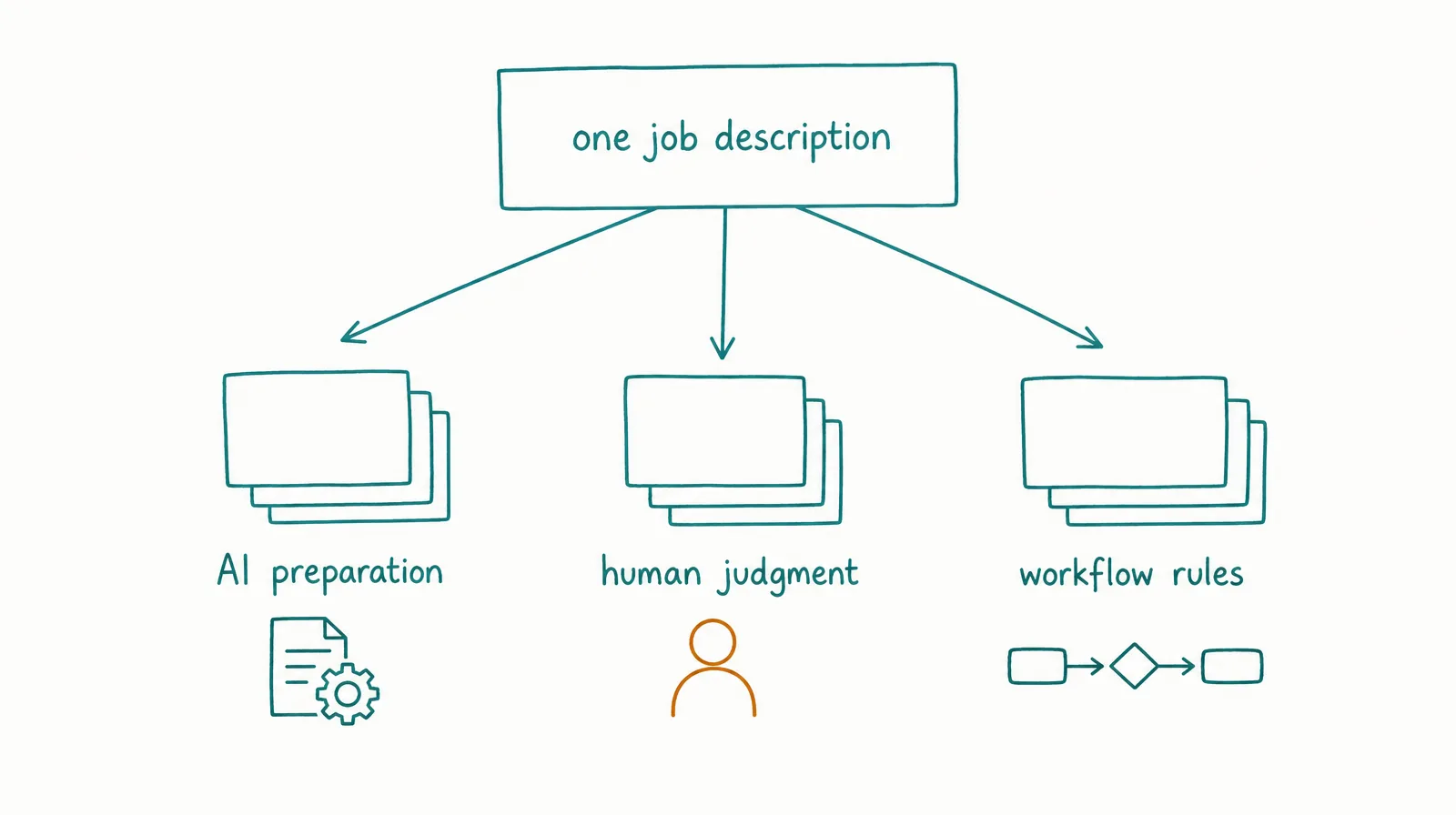
The worksheet usually produces three piles: AI-suitable preparation, human-owned judgment, and deterministic workflow steps. That is more useful than forcing the entire job into one category.
§ 14Final Verdict
Choose an AI employee for bounded digital work that recurs, can be observed, and can operate inside explicit permissions. Choose a human virtual assistant when the value depends on human judgment, relationship, representation, or responsibility.
Do not frame the decision as “software replaces a person.” Decompose the role. Keep the human where being human is part of the outcome, and apply software where repetition, digital scale, structured state, and flexible coverage create value.
If both are justified, give each a distinct operating contract and make the handoff explicit.
Explore CellCog AI Employees for the digital portion, then define the human-owned exceptions before granting write or send authority.
Q1Is an AI employee legally an employee?
No. It is software offered under a product or service agreement. AI employee describes a standing operating role, not legal personhood or employment status. A business remains accountable for the system. Human VAs may be employees, independent contractors, or agency workers depending on the facts and applicable law.
Q2Can an AI employee replace a virtual assistant?
It can replace or reduce some repetitive digital tasks, but it does not reproduce human judgment, relationships, legal responsibility, or physical presence. Compare responsibilities one by one and retain a person wherever those qualities are necessary.
Q3Is a human virtual assistant safer with sensitive information?
Not automatically. Both people and software can create confidentiality and access risk. Use need-to-know access, separate accounts, logs, contractual controls, revocation, and supervision. For AI, also inspect provider data flows, memory, model retention terms, and tool-action controls.
Q4Which option is cheaper?
It depends on workload, geography, skill, usage, review, software, management, and error cost. Compare total monthly cost for the same accepted service level. A low-cost tool with heavy correction can be more expensive than a skilled person; a human performing mostly repeatable preparation may be an inefficient use of scarce judgment.
Q5Should a small business hire a VA or start with AI?
Start with the work, not the provider. If the first need is recurring and digitally observable - such as a source-backed briefing or draft-only inbox triage - an AI pilot may fit. If the need is broad, relationship-heavy, or constantly changing, a human VA is more likely to succeed. A narrow hybrid is often the strongest first design.
Q6How should an AI employee hand work to a human VA?
Use a structured packet containing the goal, current state, sources, actions, uncertainty, permissions, deadline, and required acceptance. The receiving person should explicitly accept ownership; otherwise the AI role retains the task and follows the escalation policy.