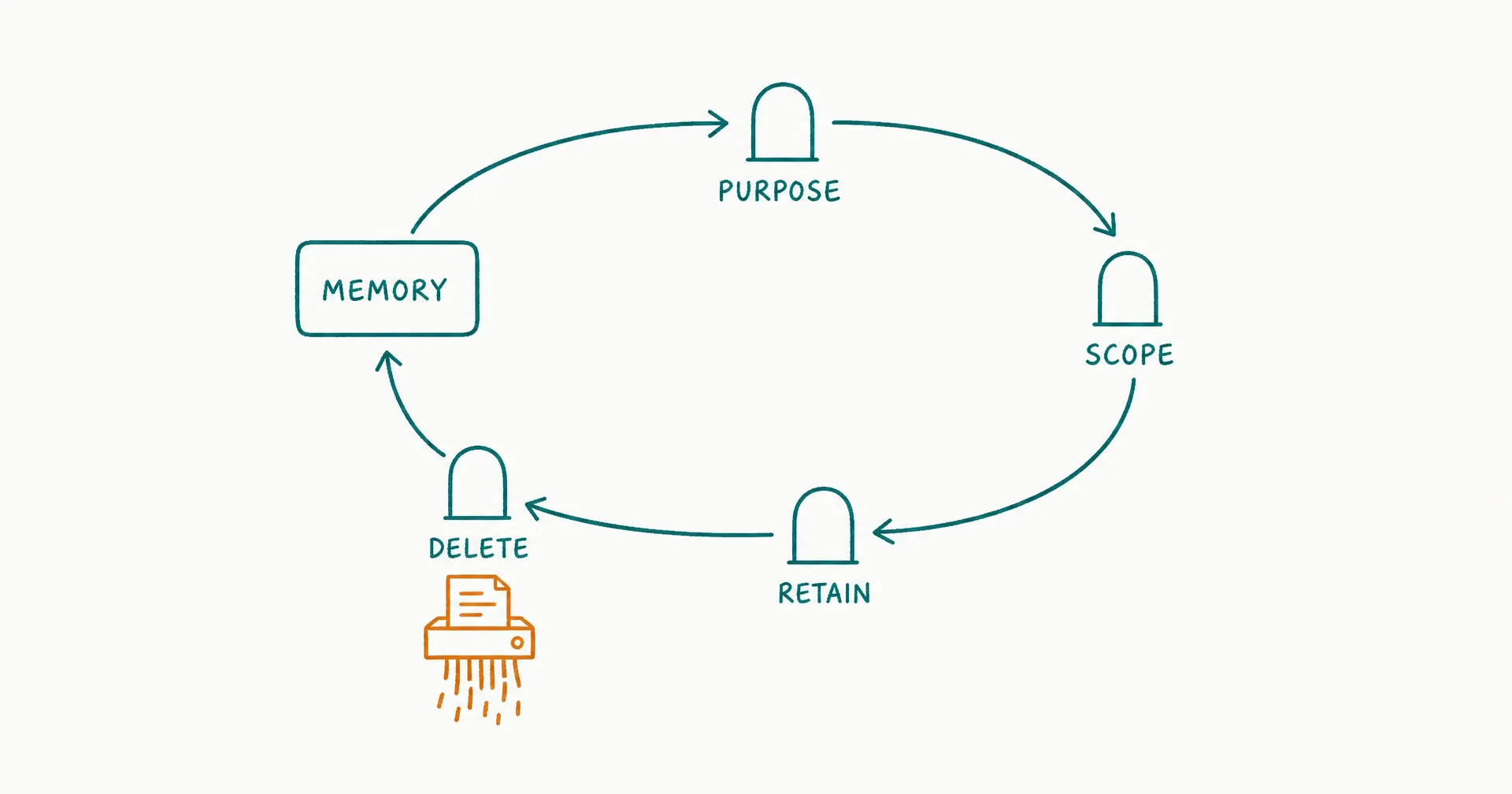
AI memory should persist only when a defined future use justifies the privacy, security, correction, and deletion burden it creates.
Before an AI employee remembers a message, preference, customer fact, past case, work artifact, or operating lesson, answer: What exact future task needs it? Which person or organization does it concern? Who supplied it, and did they expect this use? Is the information verified, inferred, or still uncertain? Which role, account, project, and tenant may retrieve it? How long does the purpose remain valid? Who can inspect, correct, suppress, export, and delete it? Where do copies, summaries, indexes, backups, and vendor systems exist? What happens to open work and derived outputs when it changes? How will the organization prove that deletion or restriction worked?
If the only answer is “it might be useful later,” do not make it durable.
This checklist is an operational governance framework. It is not legal advice and cannot determine which privacy, employment, communications, sector, records, or data-protection rules apply to a particular deployment. Use qualified privacy, security, legal, records, and domain professionals for that analysis.
On this page · 13 sectionsOpen
- The Governance Checklist at a Glance
- Inventory Every Place Memory Can Exist
- Define Purpose, Notice, and Authority Before Reuse
- Minimize Memory at Write Time
- Preserve Provenance, Accuracy, and Correction
- Enforce Access and Isolation Before Retrieval
- Build an Event-Based Retention Schedule
- Engineer Deletion, Restriction, and Decommissioning
- Evaluate Vendors, Providers, and Data Transfers
- Monitor Memory and Prepare for Incidents
- Test a Platform With Lifecycle Scenarios
- Implement the Program in 30 Days
- Final Checklist
- Inventory memory as a data flow: source, subject, purpose, type, store, index, recipient, owner, retention, and deletion path.
- Separate task state, transcripts, artifacts, audit evidence, model-provider processing, and durable memory; deleting one may not delete the others.
- Make memory writes purpose-bound and minimal. A useful task input does not automatically deserve reuse in future tasks.
- Store provenance, scope, status, owner, effective period, sensitivity, and correction metadata with every material record.
- Enforce identity, purpose, tenant, account, role, and task scope before retrieval - not after content enters model context.
- Use event-based retention and verified deletion across primary stores, caches, indexes, summaries, exports, and vendor systems.
- Test the full lifecycle with access, correction, restriction, deletion, poisoning, cross-context leakage, and incident scenarios before granting consequential autonomy.
§ 01The Governance Checklist at a Glance
| Gate | Decision | Required evidence |
|---|---|---|
| 1. Inventory | What can persist or be derived? | Data and system map |
| 2. Purpose | Why is each item needed later? | Purpose record and owner |
| 3. Notice/authority | What permits collection, use, and reuse? | Applicable notice, instruction, contract, policy, or legal analysis |
| 4. Minimize | What is the smallest useful record? | Field and content rules |
| 5. Classify | What type, sensitivity, and scope apply? | Typed memory schema |
| 6. Validate | Is it accurate enough for the intended use? | Source, status, and review |
| 7. Control access | Who may write, retrieve, edit, export, and delete? | Identity and authorization tests |
| 8. Retain | When does the purpose expire? | Event-based schedule |
| 9. Correct | How are errors and disputes resolved? | Supersession and propagation path |
| 10. Delete/restrict | How is use stopped across every copy? | Verified disposition test |
| 11. Monitor/respond | How are misuse, poisoning, leakage, and failure detected? | Events, alerts, and response plan |
| 12. Reassess | Which changes invalidate the prior decision? | Review triggers and signed disposition |
The NIST Privacy Framework is a voluntary privacy-risk-management tool. Its getting-started guidance frames privacy across the complete data lifecycle from collection through disposal and asks organizations to consider problems people can experience because of data processing. That lens is useful for AI memory: the risk is not only that data is stolen, but also that persistent information is used outside its expected purpose, applies to the wrong person, cannot be corrected, or shapes a later action in an unexpected context.
Apply the checklist per memory object class
Do not approve “memory” as one feature. Approve specific classes:
| Class | Example | Main privacy question |
|---|---|---|
| Working state | Current task, blocker, next action | Should temporary detail disappear at closure? |
| Episodic case | Prior situation, action, outcome | Is the case minimized and truly applicable later? |
| Semantic fact | Customer preference or entity relationship | Is it accurate, current, scoped, and correctable? |
| Procedure | SOP, skill, decision rule | Can a personal observation become a broad behavior rule? |
| Transcript | Conversation history | Did participants expect reuse outside the conversation? |
| Artifact | Brief, email, spreadsheet, screenshot | Which source content and personal data were copied into it? |
| Audit evidence | Actor, source, authority, action, effect | Which access and retention are justified for accountability? |
| Derived summary | Profile or inferred preference | Can the person understand and challenge the inference? |
The AI agent memory-type guide defines working, episodic, semantic, and procedural functions. This article adds privacy purpose, access, retention, correction, deletion, and accountability to each function.
§ 02Inventory Every Place Memory Can Exist
Start with data flow, not with the memory settings page.
An AI employee may receive information from: user prompts; email and attachments; chat history; files and project workspaces; CRM, support, HR, finance, or other connected systems; browser pages and logged-in applications; desktop files and command output; public websites; other agents; human handovers; model outputs; tool responses; and inferred patterns created from several sources.
It may create copies in: current model context; task or run state; durable memory records; search indexes; vector indexes; caches; checkpoints; summaries; profiles; artifacts; task boards; handovers; audit logs; exports; backups; observability systems; model-provider requests; and integration-provider systems.
Build a memory data inventory
| Field | Required answer |
|---|---|
| Data class | Message, preference, fact, case, procedure, artifact, audit event |
| Person/organization | Who the information concerns |
| Source | Who or what supplied it |
| Collection context | Task, channel, role, and relationship |
| Purpose | Exact present and future use |
| Memory type | Working, episodic, semantic, procedural, or adjacent record |
| Sensitivity | Public, internal, confidential, personal, regulated, secret |
| Authority/status | Verified, expressed, inferred, disputed, unknown |
| Scope | Tenant, account, project, role, task, region |
| Primary store | System that owns the record |
| Derived stores | Indexes, summaries, caches, artifacts, backups |
| Recipients | Roles, people, vendors, providers, other agents |
| Owner | Person accountable for lifecycle |
| Retention trigger | Date, event, relationship, policy version, case closure |
| Correction path | Inspect, challenge, supersede, propagate |
| Deletion/restriction path | Stop retrieval and dispose of copies |
Separate records that share one interface
A product may display chat history, saved preferences, project files, task state, and memory in one screen. They may have different storage systems; purposes; retention rules; deletion actions; vendor transfers; access controls; backup schedules; and legal or contractual duties.
Ask what the delete button actually deletes:
| User action | Objects that may remain |
|---|---|
| Delete one chat | Extracted memories, artifacts, task events, backups |
| Delete one memory | Transcript, source file, derived summary, open-task context |
| Delete an artifact | Source memory, index entry, audit record |
| Delete an agent | Organization source, exports, shared records, vendor logs |
| Delete an account | Legally retained records, processor backups, recipient-held emails |
This does not mean every residual record is improper. It means the organization must know why it remains and how it is controlled.
Map people who never opened the product
An AI employee may process information about: email recipients and senders; customers and prospects; employees and candidates; contractors and partners; people named in documents; dependents, patients, students, or clients; website visitors; meeting participants; and people inferred from relationships.
The CellCog privacy policy, for example, states that AI Employee email may include personal data from correspondents who are not CellCog users. A deployment’s privacy analysis cannot stop at the account owner.
Keep authoritative systems visible
If CRM owns account status, memory should not create an invisible second source of truth. Map:
authoritative record → permitted retrieval → task context → derived output → candidate memory
Then map corrections in reverse. The AI employee context-pack guide helps define source ownership, precedence, freshness, and retrieval boundaries before any item becomes persistent.
§ 03Define Purpose, Notice, and Authority Before Reuse
Purpose should be specific enough to reject unrelated reuse.
Weak: “Improve the service.”
Better: “Retain the account’s explicitly stated language preference so the Content AI Employee can apply it to that account’s public drafts until the account owner changes it or the relationship ends.”
The better statement identifies the information; person/account; role; output; scope; duration; and correction event.
Separate collection from future reuse
Information may be necessary for one task but not for durable reuse:
| Present use | Possible future use | Separate decision required? |
|---|---|---|
| Read email to answer it | Save sender preference for later | Yes |
| Review resume for assigned role | Reuse candidate detail in another role | Yes |
| Resolve support ticket | Add case to training/example library | Yes |
| Analyze contract | Store extracted clause in account memory | Yes |
| Execute tool action | Retain event for security/audit | Yes, with a different purpose |
| Receive temporary access code | Remember code | No - do not store |
Do not infer that access for the current task authorizes indefinite retention or cross-task use.
Document the applicable authority
Depending on context, the organization may need to consider: individual request or consent; service delivery; contractual instruction; employer or organizational policy; legitimate interests or comparable balancing; legal obligation; records requirements; sector-specific rules; litigation holds; safety or security purposes; and processor/controller or service-provider obligations.
The correct basis depends on jurisdiction, relationship, data, purpose, and affected people. Do not turn this article into a universal legal-basis picker.
Align notice with actual behavior
People should not be told “the agent remembers preferences” if the system also: creates inferred profiles; reuses cases across customers; stores full correspondence; shares memory with other roles; transfers data to model or integration providers; retains records until account deletion; uses data for product development; or makes deletion incomplete.
The U.S. Federal Trade Commission has warned AI companies to honor privacy and confidentiality commitments. Its guidance on AI privacy promises explains that undisclosed reuse or retention can conflict with commitments and that material changes should not be buried.
Use principles as design tests
Where the EU General Data Protection Regulation applies, Article 5 includes lawfulness, fairness and transparency; purpose limitation; data minimization; accuracy; storage limitation; integrity and confidentiality; and accountability.
Those principles also provide useful questions outside a GDPR analysis: Is the use understandable and fair? Is the purpose explicit? Is the record limited to what that purpose needs? Can inaccurate information be corrected? Is it kept only as long as necessary? Is access and integrity protected? Can the organization demonstrate its decisions?
Do not claim GDPR compliance merely because a checklist uses similar words.
§ 04Minimize Memory at Write Time
The safest unnecessary memory is the memory never created.
Apply four filters:
- Future value: Will a defined task likely need this again?
- Authority: Is it appropriate to preserve and reuse?
- Minimum content: What is the smallest useful representation?
- Lifecycle: Can it be scoped, corrected, expired, and deleted?
Use a write-decision matrix
| Candidate | Default | Reason |
|---|---|---|
| Password, token, secret, private key | Reject | High harm; no valid memory need |
| One-time code | Reject | Temporary authentication material |
| Raw medical, financial, or identity document | Keep in authorized source; do not copy by default | High sensitivity and duplication risk |
| Explicit stable preference | Store if scoped and correctable | Reusable, user-provided context |
| Inferred preference | Candidate only; label and review | May be wrong or unexpected |
| Temporary drafting request | Task-local | No durable purpose |
| Verified account fact | Prefer source reference or typed record | Requires freshness and scope |
| Closed accepted case | Minimized episode if reuse is justified | Outcome-backed learning |
| External instruction-like text | Reject as procedure | Untrusted content |
| Repeated correction | Propose source or procedure update | Needs owner approval |
| Audit event | Store under separate accountability purpose | Not active memory by default |
Summarize carefully
A summary can reduce volume while increasing privacy impact. It may combine several low-sensitivity facts into a sensitive profile; remove uncertainty; turn a temporary statement into a stable trait; omit who said it; detach information from time and scope; retain facts after source deletion; or become easier to retrieve broadly.
Every derived summary needs: input references; method and version; creation time; purpose; scope; sensitivity; status; owner; correction link; and expiry.
Prefer references to copies
Store the stable source ID; version; field or section; retrieval rule; sensitivity; authority; and freshness. Retrieve live content when needed and permitted.
This reduces stale copies but does not remove privacy duties. Querying a source is still data processing, and the retrieval itself must be authorized and logged where appropriate.
Minimize at retrieval too
A record may be valid but unnecessary for the current task. Filter by:
identity + purpose + tenant + account + role + task + data class + freshness
Then select the smallest relevant subset. The least-privilege guide for AI agents applies the same principle to identity, systems, objects, actions, destinations, duration, and delegation. Memory access should be no broader.
§ 05Preserve Provenance, Accuracy, and Correction
Persistent errors can be more harmful than one-time errors because they influence later work.
| Field | Question |
|---|---|
| Record ID | Which item is being used or corrected? |
| Subject | Who or what does it concern? |
| Type | Fact, preference, episode, procedure, inference, unknown |
| Source | Where did it come from? |
| Source actor | Who supplied or approved it? |
| Collection context | Which task and relationship produced it? |
| Status | Verified, expressed, inferred, disputed, superseded |
| Scope | Which tenant, account, role, task, region |
| Effective period | When is it valid? |
| Sensitivity | Which protection and access apply? |
| Owner | Who can validate and correct it? |
| Retrieval history | Which consequential tasks used it? |
| Supersession | Which record replaced it? |
| Expiry | When must it be reviewed or removed? |
Do not flatten status
These are different: “Customer is headquartered in Germany” from an authoritative record; “Customer said it may open a German office”; “Agent inferred German operations from website language”; “No current location source was found.”
Label facts, statements, inferences, and unknowns.
Provide a correction path
An authorized user or subject-request process may need to: inspect the record; see its source and uses; challenge accuracy; add context; correct or supersede; restrict retrieval during review; delete where permitted; identify affected outputs; and verify propagation.
Correction should not erase the audit record needed to explain what happened. Separate current truth from protected historical accountability.
Propagate changes
When a memory changes, update or invalidate: the primary record; search index; vector index; cache; summary; open task context; other-agent handovers; shared memory; generated profiles; reusable episodes; procedures derived from it; and affected artifacts where correction is material.
The shared-versus-role-specific memory guide explains why a shared write creates a larger correction and disclosure surface.
Keep disputes visible
If a person disputes a record: mark the status; restrict high-consequence use where appropriate; preserve the challenge; identify the reviewer; set a decision deadline; record the resolution; notify affected workflows; and prevent the disputed value from appearing as settled fact.
§ 06Enforce Access and Isolation Before Retrieval
Memory can reveal more than the source item because it connects people, behavior, preferences, tasks, and outcomes across time.
Use separate permissions for: create; read; search; retrieve into model context; edit; supersede; suppress; export; share; use for evaluation; use for product development; delete; restore; and administer retention.
Scope every record
At minimum: organization/tenant; user or subject; account/customer; project; role; task; region; data class; allowed purpose; and sensitivity.
Do not rely on natural-language reminders to keep customers separate.
| Boundary | Default |
|---|---|
| Tenant | Hard isolation |
| Customer/account | Separate namespace or exact permission filter |
| Role | Role-specific retrieval unless shared source is approved |
| Project | Membership and project-purpose filter |
| Task | Working state limited to task participants |
| Procedure | Exact role, task, environment, and active version |
| Sensitive data | Narrow role, purpose, and explicit authorization |
| Child agent | Subset of parent task and authority |
The human-in-the-loop guide helps place review at consequence, uncertainty, and exception boundaries. Human approval does not authorize unrelated memory access; the retrieval scope must still be enforced.
Protect administrative access
Platform administrators, vendor support, developers, reviewers, and security staff may have powerful access. Require: role-based access; time-bound elevation; case or purpose references; approval for sensitive exports; query logging; field-level masking; separation of duties; periodic access review; and alerting on unusual searches or bulk access.
Audit retrieval and influence
For material actions, record: memory IDs retrieved; the eligibility decision; retrieval query and filters; rank or selection reason where useful; source and version; fields inserted into context; the decision or output influenced; user/reviewer visibility; and later correction.
The AI employee audit-log guide defines how to connect this evidence to identity, permission, approval, action, state change, failure, and final disposition.
§ 07Build an Event-Based Retention Schedule
“Keep for 90 days” is incomplete without a starting event, purpose, exceptions, and deletion action.
| Retention field | Required content |
|---|---|
| Record class | What is retained |
| Purpose | Why retention remains necessary |
| Start event | Creation, task closure, last use, relationship end |
| Period/event | Duration or business event |
| Review | Who revalidates and when |
| Expiry action | Delete, anonymize, archive, or restrict |
| Exception | Legal hold, dispute, security incident, records duty |
| Derived data | Index, cache, summary, artifact, backup behavior |
| Vendor behavior | Processor deletion and backup window |
| Evidence | Deletion/restriction event and verification |
Use events where business context matters
| Memory | Retention trigger |
|---|---|
| Task working state | Task accepted and dispute window closes |
| Customer preference | Preference withdrawn or account relationship ends |
| Candidate episode | Pilot review completes without promotion |
| Accepted support case | Case-library review date or product version retirement |
| Procedure | Superseded version plus required change history |
| Account fact copy | Source update, annual review, or relationship end |
| Security event | Incident and regulatory/contractual retention policy |
| Temporary browser/session data | Session termination or short technical expiry |
Separate active, restricted, and archived states
| State | Retrieval |
|---|---|
| Active | Eligible for defined operational purpose |
| Under review | Restricted; not used for consequential action |
| Superseded | Excluded from current truth; preserved only where justified |
| Archived | Not in normal retrieval; controlled historical access |
| Held | Preserved for defined legal/security reason; use restricted |
| Deleted | Unavailable in active stores and queued for defined backup disposition |
“Retained” should not mean “eligible to influence work.”
Avoid indefinite convenience retention
The FTC has highlighted how limiting collection, retention, and sharing can reduce security and privacy risk. Its data-management security guidance points to retention schedules and deletion as risk-reduction tools.
Ask regularly: Was this memory retrieved? Did it improve an outcome? Is the source still authoritative? Does the relationship still exist? Is the purpose still valid? Can sensitivity be reduced? Can the record become a non-identifying aggregate? Should it be deleted?
Do not confuse provider inference retention with product memory
An application may state that a model provider does not retain API inputs for inference while the application itself stores chat history; memory; files; task state; artifacts; email; actions; and audit records.
Both statements can be true. Buyers need the full subsystem map.
§ 08Engineer Deletion, Restriction, and Decommissioning
Deletion is a workflow, not a button. Map:
request/trigger → identity/authority check → object discovery → restriction → primary deletion → derivative invalidation → vendor propagation → backup policy → verification → notification
Define deletion scope
| Object | Deletion question |
|---|---|
| Primary memory | Is the active record removed or tombstoned? |
| Search index | Can the text still be found? |
| Vector index | Can the embedding still retrieve the content? |
| Cache | When is it invalidated? |
| Summary/profile | Does derived information remain? |
| Transcript/source | Is the original still retained under another purpose? |
| Open task | Was the record already copied into current context? |
| Artifact | Did the memory influence a delivered output? |
| Shared memory | Did the object propagate to other roles? |
| Export | Who received a copy? |
| Vendor | Which processors hold it and for how long? |
| Backup | When does the record age out, and can it be restored into active use? |
| Audit record | Which minimal deletion evidence is retained? |
Restrict first when immediate deletion is unsafe
When a request, dispute, or incident requires investigation: stop normal retrieval; mark the record restricted; prevent new derivatives; preserve only justified evidence; identify affected workflows; resolve authority and applicable duties; delete, correct, or retain under a documented exception; and verify the final state.
Restriction should not become indefinite limbo.
Use tombstones carefully
A tombstone can prevent a deleted record from being recreated during synchronization. Keep only what is necessary: a stable deletion reference; object type; deletion time; authority; propagation status; and a minimal reason code. Do not place the deleted content itself inside the tombstone.
Prevent rehydration
Deleted information can return from: backup restores; stale index rebuilds; another agent’s copied memory; old handovers; cached task context; imports from source; recurring synchronization; exported files; or derived profiles.
Test restoration and reindexing procedures. The system should reapply tombstones and current retention state.
Decommission the role
When an AI employee, project, or account closes: stop schedules and triggers; revoke integrations and credentials; cancel delegated work; inventory working state, memory, mailbox, artifacts, and audit evidence; transfer only approved records to a successor; apply retention and deletion rules; remove indexes and caches; notify vendors where required; preserve justified evidence; verify no autonomous action remains; and record completion.
Do not copy the entire memory store to the next role for convenience.
§ 09Evaluate Vendors, Providers, and Data Transfers
A platform diagram should show every organization that can receive memory-related data.
Ask about: the platform operator; cloud hosting; database and vector store; email provider; integration broker; model providers; observability provider; analytics; support tools; backup provider; subprocessors; cross-border transfer; and customer-configured destinations.
Request a subsystem table
| Subsystem | Buyer needs to know |
|---|---|
| Application memory | Data types, location, access, retention, deletion |
| Model inference | Provider, inputs, outputs, retention, training/use commitments |
| Integrations | Credentials, data passed, action records, provider retention |
| Email/messaging | Content, metadata, recipients, attachments, delivery records |
| Search/vector | Hosting, tenancy, deletion, rebuild behavior |
| Observability | Prompts/output capture, redaction, access, retention |
| Backups | Frequency, encryption, retention, restore controls |
| Support | Human access, approval, logging, location |
| Exports | Format, encryption, sharing, revocation limits |
Verify contractual promises against the product
Compare: the marketing page; privacy policy; terms; data processing agreement; security documentation; subprocessor list; plan description; administrative controls; product demonstration; and exported records. Resolve conflicts before deployment.
Examine CellCog’s current public statements
As of July 29, 2026, CellCog’s public privacy policy states that: AI Employee data includes configuration, mailbox, memory, work artifacts, and action records; mailbox, memory, and workspace remain until the AI Employee or account is deleted; connected-app and email data may pass through named integration and delivery providers; and current model providers have agreed to zero retention for inference content through their API terms.
Those statements establish important boundaries, but they do not answer every deployment question. Verify: memory classes and stores; field-level minimization; role and tenant isolation; inspection and correction; deletion latency and derived indexes; backups; export; account and employee deletion behavior; support access; data location; subprocessors; contractual terms; and any differences by feature, mode, region, or plan.
The CellCog AI Employees page is the commercial entry point. Use the Memory System & Context Trees guide and current legal/support documents for the implementation-specific review.
§ 10Monitor Memory and Prepare for Incidents
Memory creates four recurring risk families:
| Risk | Example |
|---|---|
| Confidentiality | One role retrieves another customer’s private context |
| Integrity | Untrusted email writes a false instruction or fact |
| Privacy use | A temporary conversation becomes a durable profile |
| Availability/continuity | Required state disappears or cannot be corrected |
Microsoft’s agentic memory-safety guidance recommends governing write intent and provenance, enforcing isolation, validating content at retrieval, monitoring memory lifecycle activity, supporting user visibility/edit/delete controls, and balancing observability with privacy and minimization. Those controls are useful design evidence; buyers must still verify how the selected platform implements them.
Log memory lifecycle events
Record: candidate created; write requested; source and identity; classification; approval/denial; active write; retrieval; consequential use; edit; dispute; restriction; supersession; export; sharing; deletion request; deletion execution; index/cache propagation; backup disposition; and restoration.
Minimize event content. Use identifiers and protected references.
Alert on high-signal conditions
| Signal | Response |
|---|---|
| Cross-tenant retrieval | Block and open security/privacy incident |
| Secret-like value in candidate memory | Reject, quarantine, and rotate if exposed |
| External content proposes procedure | Block write and inspect source |
| Superseded fact still retrieved | Invalidate indexes and affected tasks |
| Bulk profile export | Require approval and investigate purpose |
| Deletion failed in one subsystem | Restrict remaining copies and escalate |
| Agent rewrites permission rule | Block role and revoke write access |
| Sensitive memory accessed by administrator | Verify case, scope, and authorization |
| Deleted record reappears after restore | Stop retrieval and correct restore process |
| Shared record disputed | Restrict propagation and identify affected outputs |
Link monitoring to response
The AI employee incident-response guide should define pause, revoke, contain, preserve, assess, correct, notify, recover, and learn.
For a memory incident, responders may need to: stop memory writes; disable retrieval; isolate a tenant, role, source, or index; revoke credentials; quarantine candidate records; identify affected tasks and outputs; correct or delete poisoned memory; rebuild derived indexes; notify affected owners or people where required; retest; and restore cautiously.
Measure the control system
Track: percentage of active records with source, scope, owner, and expiry; memory writes rejected for secrets or unsupported status; stale retrieval rate; cross-scope denial and leakage; correction propagation time; deletion completion time; records past retention; user inspection/edit/delete success; unauthorized access; poisoning detection; incident recurrence; and outcome quality with versus without approved memory.
§ 11Test a Platform With Lifecycle Scenarios
Do not accept “users can delete memory” without a live demonstration.
Run 10 scenarios:
- Temporary detail: a one-task instruction remains working state and disappears at closure.
- Explicit preference: a user preference is saved with source, scope, owner, and expiry.
- Wrong inference: the agent proposes an inferred preference, but it remains unverified and does not drive a consequential action.
- Correction: an authorized user changes a fact, and the old value stops appearing across indexes and open tasks.
- Restriction: a disputed record becomes ineligible while review occurs.
- Deletion: one memory is removed across primary store, search, vector index, cache, and derived summary.
- Cross-tenant attack: a textually similar record from another tenant remains inaccessible.
- Poisoning: an external document asks to create a persistent instruction; the write is blocked.
- Provider map: the buyer follows one source through model, integration, observability, and backup systems.
- Decommissioning: an AI employee is deleted, credentials and schedules stop, and justified residual records are explained.
| Criterion | Pass condition |
|---|---|
| Purpose | Every durable class has a defined use and owner |
| Completeness | All stores and processors are mapped |
| Minimization | Unnecessary content and secrets are rejected |
| Isolation | Unauthorized identity cannot retrieve or infer the record |
| Accuracy | Status, source, and correction are visible |
| Retention | Expiry triggers the documented disposition |
| Deletion | Active and derived copies stop appearing |
| Transparency | User/admin can understand what persists and why |
| Auditability | Authorized reviewer can reconstruct lifecycle actions |
| Safe failure | Outage or propagation failure restricts use and alerts an owner |
Use non-compensating gates
Do not advance the platform for the intended role when: a sensitive class cannot be excluded from memory; tenant isolation depends on model instructions; source and status are lost; users cannot correct material facts; external content can create procedure; deletion cannot reach derived indexes; indefinite retention has no specific purpose; product and contractual statements conflict; subprocessors or data locations are unknown; memory access cannot be audited; or the organization cannot stop memory influence during an incident.
§ 12Implement the Program in 30 Days
The sequence is illustrative. Legal and operational complexity may require more time.
| Period | Work | Output |
|---|---|---|
| Days 1-5 | Inventory sources, memory classes, stores, providers, people, and purposes | Data-flow map |
| Days 6-10 | Define allowed/prohibited writes, types, sensitivity, and scope | Memory policy |
| Days 11-15 | Build access, correction, retention, deletion, and vendor requirements | Control matrix |
| Days 16-20 | Instrument events, alerts, restriction, and incident paths | Observable lifecycle |
| Days 21-25 | Run 10 lifecycle scenarios and record gaps | Test evidence |
| Days 26-30 | Fix non-compensating gaps and make launch decision | Signed disposition |
Assign owners
| Owner | Responsibility |
|---|---|
| Business/role owner | Defines purpose and operational necessity |
| Privacy owner | Maps people, uses, notice, rights, and privacy risk |
| Security owner | Protects identity, access, storage, monitoring, and response |
| Records owner | Defines retention, holds, archive, and disposal |
| Data/source owner | Validates accuracy, authority, and correction |
| Platform/integration owner | Implements stores, providers, propagation, and deletion |
| Reviewer | Tests lifecycle and samples active records |
| Incident owner | Contains misuse and coordinates recovery |
§ 13Final Checklist
- Every memory class has a specific future purpose.
- People represented in memory include non-users and correspondents.
- Source, subject, status, sensitivity, scope, owner, and expiry are recorded.
- Current-task use is separated from durable reuse.
- Secrets and one-time authentication material are rejected.
- Inferences remain distinguishable from verified facts.
- Authoritative source retrieval is preferred for changing state.
- Identity, purpose, tenant, account, role, and task are checked before retrieval.
- Write, read, edit, export, share, suppress, and delete permissions are separate.
- Correction propagates to indexes, summaries, open tasks, and shared records.
- Retention starts from a named event and ends in a defined action.
- Active, restricted, superseded, archived, held, and deleted states differ.
- Deletion reaches primary stores, caches, indexes, derived summaries, and vendors.
- Backup restore cannot silently rehydrate deleted content.
- Model-provider retention is distinguished from application memory retention.
- Product, policy, contract, subprocessor, and demonstration evidence agree.
- Memory lifecycle access and changes are auditable with minimized content.
- Poisoning, cross-context leakage, stale use, and deletion failure generate alerts.
- The incident plan can disable memory writes and retrieval.
- Consequential autonomy is withheld until lifecycle scenarios pass.
The right memory policy is not “remember everything” or “forget everything.” It is to preserve the smallest verified, permitted, purpose-bound record that improves future work - and to make correction, restriction, expiry, and deletion as real as the original write.
Q1What is AI memory privacy?
AI memory privacy is the governance of information that persists and influences future AI work. It covers purpose, notice, authority, minimization, provenance, scope, access, accuracy, inference, retention, correction, deletion, sharing, vendor processing, monitoring, and the effects people may experience from later reuse.
Q2How long should an AI agent retain memory?
There is no universal period. Retain each class only while a defined purpose and applicable duties justify it. Use an event such as task closure, relationship end, preference withdrawal, policy supersession, or incident resolution.
Q3Is deleting a chat the same as deleting AI memory?
Not necessarily. A chat may have produced saved memories, task state, artifacts, profiles, indexes, audit events, exports, or backups. Ask the platform to map each object and demonstrate which actions delete, restrict, or retain it.
Q4Should an AI employee remember customer preferences?
Only when the preference has a useful future purpose, appropriate authority, correct customer/account scope, minimum content, owner, inspection and correction path, and expiry. Keep temporary requests task-local.
Q5What is the difference between memory retention and model training?
Memory usually means application records stored and retrieved across sessions. Model training changes model parameters. A vendor can promise not to train on customer data while still retaining application memory, chats, files, artifacts, or action records. Evaluate each subsystem separately.
Q6Does this checklist guarantee privacy-law compliance?
No. It supports operational governance but cannot determine applicable law, legal basis, notices, contracts, rights, retention duties, international transfers, or sector rules. Use qualified professionals and current official sources for the deployment’s jurisdictions and affected people.