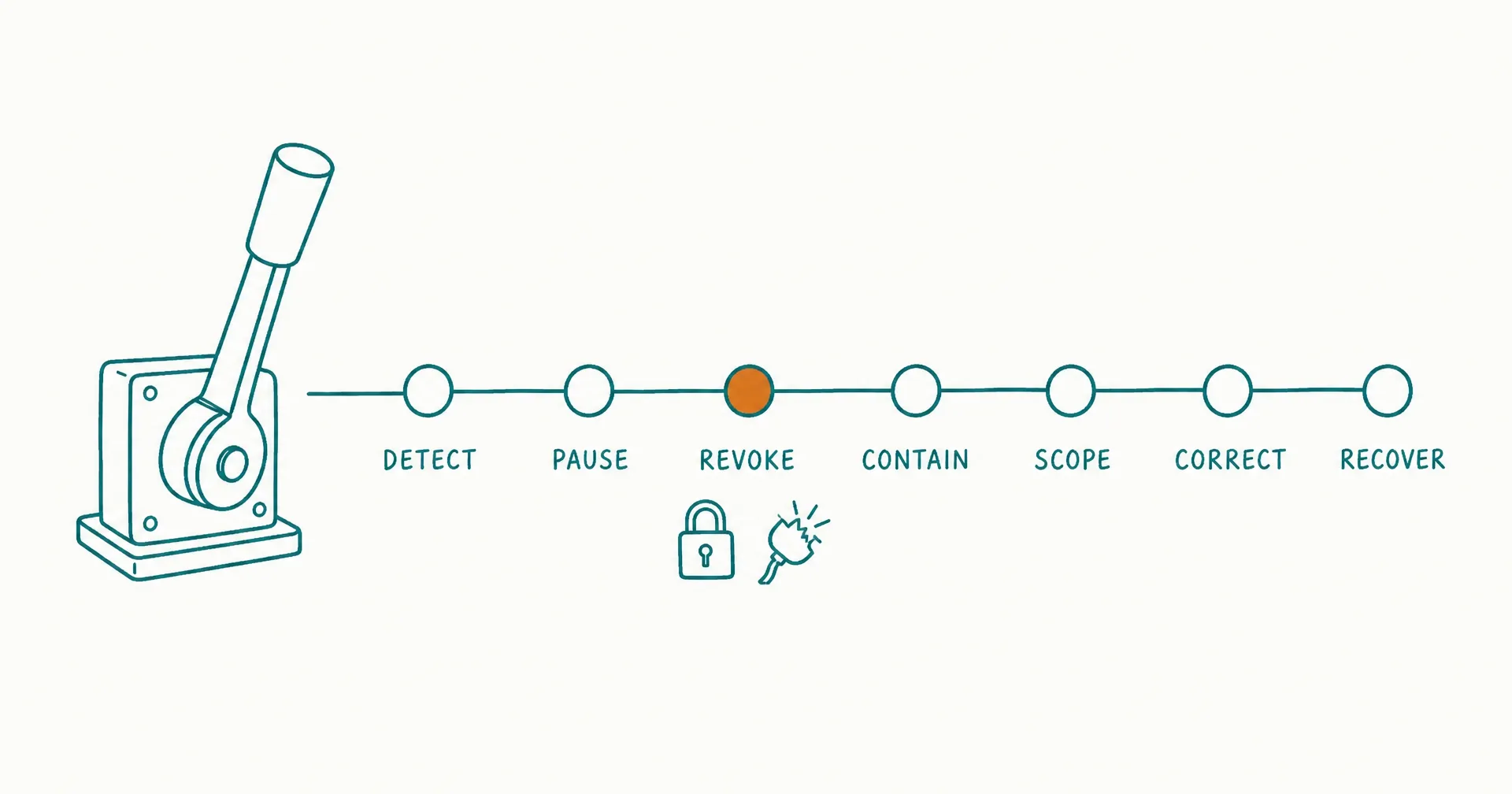
When an AI employee causes or may cause harm, the first question is not:
Why did the model do that?
It is:
What can still happen, which authority remains active, what state may be affected, and how do we stop further effect without losing the evidence needed to recover?
Use this response path:
detect → pause → revoke → contain → preserve → scope → correct → communicate → recover → validate → resume or retire → learn
An AI employee can combine model output with schedules, private context, connected accounts, browser sessions, tools, memory, task state, approvals, and other agents. Response must cover the complete operating system. Closing a chat, editing a prompt, or disabling one workflow may leave active tokens, queued work, child tasks, poisoned memory, sent messages, changed records, or downstream automations.
Prepare the kill path before production. During an incident, safety and containment come first; evidence preservation should support them, not delay urgent action.
This playbook complements the organization’s existing security, privacy, legal, business-continuity, records, communications, and sector response processes. It is not legal advice and does not determine notification or reporting duties.
On this page · 11 sectionsOpen
- The Response Playbook at a Glance
- Define Incident Triggers and Severity
- Prepare Before an Incident
- Pause, Revoke, and Contain
- Preserve Evidence Without Extending Harm
- Scope Cause, Impact, and Propagation
- Correct the System and Business State
- Recover and Validate the Business Service
- Decide Whether to Resume, Narrow, or Retire
- Test the Playbook and Verify CellCog
- Final Checklist
- Treat suspected AI employee harm as a system incident involving identities, sources, models, prompts, context, memory, tools, destinations, people, and business state - not as an isolated bad answer.
- Pause the affected task and role, revoke active identities and sessions, block risky functions and destinations, stop delegation, and suppress suspect memory according to severity.
- Preserve observable evidence: initiating actor, sources, retrieved content, versions, policy decisions, approvals, tool calls, system results, memory operations, handoffs, alerts, and human interventions.
- Scope both backward and forward: determine what influenced the worker and every record, message, artifact, memory, task, agent, or person influenced by its output.
- Correct the authoritative business state, not only the AI configuration. Invalidate derived artifacts, approvals, caches, indexes, open tasks, and downstream automations.
- Recover the minimum safe service, monitor closely, and require an accountable resumption decision with passed tests and explicit residual risk.
- Run tabletop and technical exercises for a harmful action, prompt injection, memory poisoning, credential compromise, log loss, and cascading multi-agent failure before the role receives consequential authority.
§ 01The Response Playbook at a Glance
Use 12 response decisions:
| Phase | Decision | Required output |
|---|---|---|
| 1. Detect | Is there a credible signal of unsafe behavior or effect? | Alert and initial facts |
| 2. Activate | Who owns the incident, and what severity applies? | Incident record and commander |
| 3. Pause | Which tasks, schedules, approvals, and queues must stop? | Work-state containment |
| 4. Revoke | Which identities, tokens, sessions, connectors, and tools must lose authority? | Access containment |
| 5. Preserve | Which volatile and durable evidence must be protected? | Evidence manifest |
| 6. Scope | What caused, received, stored, or propagated the effect? | Impact and lineage map |
| 7. Correct | Which unsafe content, configuration, memory, and business state must change? | Remediation record |
| 8. Communicate | Who needs operational, contractual, legal, vendor, or affected-party notice? | Communication decisions |
| 9. Recover | What minimum safe service and data state can return? | Recovery plan |
| 10. Validate | Which controls, postconditions, and absence-of-effect tests must pass? | Validation evidence |
| 11. Decide | Resume, narrow, redesign, switch, or retire? | Signed disposition |
| 12. Learn | Which control, test, ownership, and vendor changes follow? | Improvement plan |
The final NIST SP 800-61 Revision 3, published in April 2025, integrates incident response across the NIST Cybersecurity Framework rather than treating it as a standalone sequence that begins after detection. The NIST Cybersecurity Framework 2.0 organizes that lifecycle across Govern, Identify, Protect, Detect, Respond, and Recover. That is especially useful for persistent workers: governance, asset knowledge, protection, detection, response, recovery, and improvement determine whether an incident can be contained at all.
Use three simultaneous clocks
| Clock | Question | Example objective |
|---|---|---|
| Harm clock | How quickly can another harmful effect occur? | Stop outbound action immediately |
| Evidence clock | Which volatile evidence may disappear? | Preserve task, session, and connector state promptly |
| Service clock | Which essential business work is interrupted? | Restore a safe manual or read-only path |
Do not let evidence collection keep an unsafe capability active. Do not let pressure to restore service erase the facts needed to understand whether the path remains dangerous.
Separate four kinds of containment
| Containment type | Examples |
|---|---|
| Work | Pause task, schedule, queue, retry, approval, child task |
| Authority | Revoke identity, token, session, connector, function |
| Information | Isolate source, context, memory, index, output, destination |
| Business effect | Freeze record, transaction, publication, message, access change |
One may succeed while another fails. A paused task with a valid browser session and queued downstream automation is not contained.
§ 02Define Incident Triggers and Severity
An incident is an event that violates or may violate the role’s accepted security, privacy, safety, operational, legal, or contractual boundary and requires coordinated response. A model error becomes an incident when it creates or threatens a material effect, control failure, or propagation that ordinary task correction cannot safely handle.
Trigger categories
| Trigger | Examples |
|---|---|
| Unauthorized access | Wrong tenant, account, object, field, or identity |
| Unauthorized action | Send, update, publish, purchase, delete, deploy, or change access outside policy |
| Data exposure | Private content reaches wrong recipient, model context, log, artifact, or vendor |
| Prompt injection | External content redirects goal, data use, tool, destination, memory, or delegation |
| Memory integrity | False, hostile, stale, or cross-scope content influences later work |
| Identity compromise | Token, session, connector, or agent account is exposed or misused |
| Approval failure | Action executes without review, after expiry, or with changed parameters |
| Tool failure | Duplicate, partial, ambiguous, or unexpected side effect |
| Delegation failure | Child exceeds authority, loops, propagates tainted context, or remains active after parent pause |
| Monitoring failure | Required logs stop, correlation breaks, or critical alert does not arrive |
| Resource abuse | Runaway spend, calls, messages, tasks, retries, or compute |
| Human-control failure | Reviewer cannot understand, stop, correct, or contest the action |
| Vendor/system change | Model, prompt, tool, connector, or policy change weakens a control |
| Affected-party report | Customer, employee, partner, or public complaint reveals possible impact |
The prompt-injection guide for persistent AI employees covers the source-to-effect and memory-poisoning threat in depth. During response, the priority is to identify the source, every context in which it appeared, which sinks it reached, and whether its influence persists.
Use severity based on effect and remaining reach
| Severity | Condition | Default action |
|---|---|---|
| S0 - Observation | Suspicious signal; no credible control breach or effect | Record, monitor, close with rationale |
| S1 - Contained deviation | Low-consequence issue; effect reversible and boundary holds | Pause task, correct, validate |
| S2 - Material control failure | Unauthorized proposal, data access, memory write, or near miss | Pause role, revoke affected capability, investigate |
| S3 - Confirmed material effect | Wrong recipient, record change, disclosure, production action, or propagation | Activate coordinated incident response |
| S4 - Critical/widespread | Sensitive disclosure, privileged compromise, irreversible harm, cross-tenant or cascading effect | Enterprise crisis process and broad containment |
Severity should consider:
- actual and potential harm;
- people and organizations affected;
- data sensitivity;
- system criticality;
- authority still reachable;
- reversibility;
- detectability;
- duration;
- affected volume;
- propagation through memory, tasks, and agents;
- public or regulatory exposure; and
- confidence in the current scope.
When scope is unknown and the worker retains consequential authority, contain at the higher plausible severity until evidence supports narrowing.
Triage and declare the incident
Create one incident record:
| Field | Initial answer |
|---|---|
| Incident ID | Stable reference |
| Reporter/signal | Person, monitor, vendor, customer, or system |
| Detection time | First known signal |
| First possible exposure | Earliest known source or event |
| Role/task | Affected AI employee and current work |
| Suspected effect | Data, tool, memory, destination, or person |
| Remaining reach | Active identity, connector, session, queue, child |
| Severity | Current grade and rationale |
| Commander | Person with containment authority |
| Owners | Business, security, privacy, legal, system, vendor |
| Immediate actions | Pause, revoke, isolate, preserve |
| Unknowns | Facts that could change severity or scope |
Do not require certainty before stopping a credible high-consequence path.
§ 03Prepare Before an Incident
Response capability is built during role design and pilot testing.
The AI employee production security checklist makes kill paths, logging, memory controls, denial tests, incident ownership, recovery, supplier evidence, and change review launch gates. Complete those controls before live authority.
Assign the response team
| Role | Authority and responsibility |
|---|---|
| Incident commander | Sets severity, coordinates decisions, controls resumption |
| Technical lead | Contains platform, identities, tools, connectors, and infrastructure |
| Workflow owner | Understands intended task, sources, business state, and fallback |
| Security investigator | Reconstructs event, access, execution, and compromise |
| Privacy/data lead | Scopes people, data, use, retention, and privacy actions |
| Legal/compliance lead | Determines applicable duties, privilege, reporting, and preservation |
| Communications lead | Coordinates internal, customer, partner, and public messaging |
| Vendor lead | Coordinates provider evidence, containment, support, and commitments |
| Records/evidence custodian | Protects chain, access, retention, and disposition |
| Executive/risk owner | Accepts major continuity, notification, and resumption decisions |
Define alternates, 24/7 contacts where needed, and who may:
- pause a role;
- revoke tokens and sessions;
- block tools and destinations;
- isolate memory;
- freeze downstream business state;
- preserve restricted evidence;
- contact the vendor;
- notify affected parties; and
- authorize resumption.
Maintain an incident asset sheet
For each AI employee, keep current:
| Asset | Required record |
|---|---|
| Role | Purpose, owner, prohibited outcomes, severity ceiling |
| Identity | Agent, user delegation, administrator, reviewer |
| Credentials | Token/session owner, scope, expiry, revocation |
| Sources | Mailboxes, repositories, websites, queues, other agents |
| Data | Classes, tenants, accounts, regions, restrictions |
| Memory | Stores, indexes, scopes, write/read/deletion controls |
| Tools | Functions, executors, objects, destinations, limits |
| Schedules | Triggers, retries, queues, paused-state behavior |
| Delegation | Children, maximum depth, shared state, return path |
| Logs | Event sources, retention, access, export |
| Vendors | Model, platform, connector, subprocessor, escalation |
| Recovery | Authoritative systems, rollback, manual fallback |
If responders must discover these during a live incident, containment will be slower and less reliable.
Predefine kill paths
Test:
| Kill path | Expected effect |
|---|---|
| Pause current run | No new plan step or tool request |
| Pause role | New and queued work cannot start |
| Disable schedule/trigger | External events cannot create work |
| Revoke agent identity | Connected systems deny access |
| Revoke connector/token | Existing credential and session stop working |
| End browser/desktop session | Authenticated state and downloads are isolated |
| Block tool/function | Exact effect becomes unavailable |
| Block destination | External transmission is denied |
| Freeze approval | Existing approval cannot execute |
| Stop delegation | No child task can start or continue |
| Suppress memory | Suspect records cannot retrieve |
| Freeze business object | Downstream change cannot advance |
Record the effective containment time and the owner who can execute each step.
Prepare safe continuity
For important work, define:
- manual owner;
- last known safe queue;
- read-only or draft-only mode;
- source-of-truth access;
- customer and internal service message;
- backlog handling;
- duplicate prevention;
- recovery order; and
- maximum tolerable interruption.
Continuity should not require re-enabling the suspect worker.
§ 04Pause, Revoke, and Contain
Contain based on credible risk, not organizational convenience.
Use a containment ladder
| Level | Action | When |
|---|---|---|
| C1 | Stop one action; hold task | Unsafe proposal with no effect |
| C2 | Pause one task; freeze approval and retries | Ambiguous or partial execution |
| C3 | Pause role; block affected tool/destination | Material control failure |
| C4 | Revoke identity, connector, sessions; isolate memory | Confirmed effect or compromise |
| C5 | Pause related roles and integrations; freeze downstream objects | Propagation or shared dependency |
| C6 | Enterprise containment and crisis process | Critical or widespread impact |
Choose the smallest scope that reliably stops harm, then expand when lineage or confidence is incomplete.
Stop work state
Check that:
- current execution is stopped;
- queued and scheduled tasks are held;
- automatic retries are disabled;
- pending approvals cannot execute;
- asynchronous jobs and webhooks are blocked;
- child tasks and delegated roles are paused;
- handovers and follow-up tasks are frozen;
- open browser and desktop actions stop;
- downstream automations triggered by the worker are identified; and
- a human owns essential backlog.
The absence of visible activity does not prove the queue is empty.
Revoke authority
The least-privilege guide for AI agents defines the identity, system, resource, field, function, action, destination, time, volume, spend, and delegation boundaries that make targeted revocation possible.
During response:
- revoke the worker identity or affected grant;
- revoke connector tokens and refresh tokens;
- invalidate browser/desktop sessions and cookies;
- rotate any exposed secret;
- block risky functions and destinations;
- invalidate active approvals;
- remove child-agent authority;
- confirm denial from the downstream system; and
- monitor for alternate identity or tool use.
A platform “disconnect” is not proof until the destination denies access.
Isolate information and memory
Depending on scope:
- quarantine source content;
- stop retrieval from affected repository;
- remove suspect content from active context;
- suppress affected memory;
- freeze memory writes;
- isolate tenant, account, project, role, or index;
- block derived summaries and task state;
- stop exports and handoffs;
- protect original evidence; and
- prevent backups or restores from reintroducing unsafe state.
Do not delete evidence impulsively. Suppress use first when deletion would obstruct investigation or conflict with preservation requirements.
Freeze business effects
Possible controls:
- recall or hold unsent messages;
- stop publication;
- freeze account or permission changes;
- pause payment, order, or deployment progression;
- lock affected records against automated update;
- disable downstream automation;
- flag affected artifacts as untrusted;
- notify internal recipients not to rely on the output; and
- route customer or partner work to a human.
Business containment may require owners outside the AI platform.
§ 05Preserve Evidence Without Extending Harm
Preserve what happened, who acted, what authority applied, and what changed. Do not seek or expose private internal model reasoning. Investigate observable evidence.
The AI employee audit-log guide provides the event grammar needed to reconstruct sources, decisions, approvals, tool actions, memory, handoffs, results, and corrections.
Build an evidence manifest
| Evidence class | Examples |
|---|---|
| Origin | Requester, trigger, email, webhook, schedule |
| Role/configuration | Role, goals, instructions, policy, limits |
| Versions | Model, prompt, parser, retrieval, tool, connector, memory policy |
| Sources | Original message, page, file, image, ticket, record |
| Context | Retrieved object IDs, versions, trust labels, scope |
| Decisions | Proposed plan/action, policy outcome, validation |
| Identity | User, agent, service, reviewer, administrator |
| Authority | Grants, denials, tokens, sessions, approval |
| Execution | Tool request, parameters, destination, idempotency |
| Result | Response, before/after state, recipient, affected object |
| Memory | Candidate, write, retrieval, update, suppression, deletion |
| Delegation | Parent, child, context, authority, return |
| Monitoring | Alert, threshold, acknowledgement, breaker |
| Human action | Review, override, pause, correction, resumption |
| Vendor | Status, support response, incident notice, change record |
Preserve exact source and destination identifiers where authorized. Store sensitive content only when necessary for the investigation and under appropriate access, retention, and handling.
Capture volatile evidence
Prioritize:
- active task/run state;
- pending tool request;
- current queues and child tasks;
- token and session metadata;
- current grants and policies;
- in-memory or short-retention events;
- browser tabs, downloads, and network destinations;
- connector responses;
- active approval state;
- current memory retrieval set;
- current downstream object state; and
- alert and monitoring buffers.
Capture before change when it is safe. If delay increases harm, contain first and record the containment action.
Preserve integrity and provenance
For each artifact:
- evidence ID;
- source system;
- collector and time;
- incident and task IDs;
- original object/version;
- acquisition method;
- hash or integrity mechanism where appropriate;
- access restrictions;
- transformations or redactions;
- chain of custody;
- retention/disposition; and
- related evidence.
Separate originals from working copies.
Record every response action
The response itself changes the system. Log:
| Action | Minimum fields |
|---|---|
| Pause | Actor, task/role, time, reason, observed effect |
| Revoke | Identity/token/session, downstream confirmation |
| Quarantine | Source/state, scope, access, owner |
| Suppress memory | Records/query/index, retrieval test |
| Freeze object | Business system, object, owner, release rule |
| Correction | Before, after, authority, propagation |
| Notification | Recipient class, decision, time, content owner |
| Recovery | Restored components, source, validation |
| Resumption | Decision-maker, scope, limits, evidence |
Avoid private drafting notes or speculative narratives in the incident record. Distinguish observed fact, working hypothesis, decision, and confirmed conclusion.
§ 06Scope Cause, Impact, and Propagation
Scope in two directions.
Backward scope asks:
- Which task, source, memory, prompt, policy, version, identity, permission, approval, or tool made the effect possible?
Forward scope asks:
- Which message, record, artifact, person, memory, task, agent, automation, destination, or decision may have been influenced?
Build a lineage map
Use:
source → ingestion → retrieval/context → decision → approval/policy → tool → system effect → memory/task state → handoff → downstream use
For each node, record:
| Field | Required answer |
|---|---|
| Object | Message, file, page, record, task, memory, tool, artifact |
| Actor | Creator, editor, reader, executor, reviewer |
| Time/version | When and which state |
| Scope | Tenant, account, project, role |
| Influence | What decision or effect it informed |
| Authority | Which policy or approval allowed progress |
| Result | Actual observed state |
| Descendants | What reused, copied, summarized, sent, or stored it |
| Status | Clean, suspect, affected, corrected, unknown |
| Owner | Person responsible for disposition |
Use an impact register
| Impact class | Questions |
|---|---|
| Confidentiality | Which data was exposed, to whom, through which channel? |
| Integrity | Which records, memory, artifacts, permissions, or procedures changed? |
| Availability | Which work or systems are unavailable or unreliable? |
| Financial | Which purchase, payment, credit, refund, cost, or liability changed? |
| Operational | Which queues, commitments, SLAs, or dependencies were affected? |
| Human | Whose access, opportunity, reputation, workload, or safety changed? |
| Contractual/legal | Which commitments, restrictions, notices, or records apply? |
| Public/reputational | Which external statements or recipients are involved? |
| Security | Which credentials, systems, controls, or attack paths remain? |
Record confirmed, likely, possible, and ruled-out impacts separately.
Trace memory and derived state
The AI memory privacy and retention checklist maps source, purpose, access, retention, correction, deletion, indexes, caches, summaries, backups, and vendors.
Microsoft’s agentic memory-safety guidance recommends lifecycle observability, provenance, propagation tracking, restriction, correction, deletion, rollback, and retrieval-time checks. These controls are particularly relevant when the original exposure and later harmful action occur in different sessions.
For incident scoping, identify:
- candidate memory;
- active memory;
- retrieval history;
- procedural or preference changes;
- derived summaries;
- vector/search indexes;
- caches;
- open task context;
- handover packets;
- artifacts;
- audit references;
- exports;
- backups; and
- restored copies.
A poisoned item can be absent from the visible memory list and still influence retrieval through an index or derived summary.
Trace agents and automations
The multi-agent failure-mode guide explains how authority, state, retry, memory, and coordination errors cascade.
Check:
- parent and child tasks;
- siblings that share context or memory;
- agent-to-agent messages;
- shared queues;
- repeated retries;
- manager or router decisions;
- downstream workflows;
- scheduled follow-ups;
- artifacts consumed by another role;
- approvals already granted;
- human decisions based on the output; and
- external recipients who may act on it.
Do not stop at the first affected agent.
Reconstruct without inventing certainty
Use evidence labels:
| Label | Meaning |
|---|---|
| Observed | Directly supported by protected evidence |
| Corroborated | Supported by independent evidence sources |
| Inferred | Best current explanation with stated uncertainty |
| Disputed | Credible evidence conflicts |
| Unknown | Required evidence is unavailable |
| Ruled out | Tested evidence excludes the path |
Do not present model-generated incident summaries as authoritative without source verification.
§ 07Correct the System and Business State
Correction must remove the unsafe path and repair its effects.
Correct control state
Possible actions:
- remove excess permission;
- rotate credential;
- fix authorization;
- narrow tool schema;
- block arbitrary destination;
- repair approval binding;
- separate untrusted content;
- update parser or retrieval rule;
- fix tenant/account scope;
- disable unsafe automation;
- patch integration;
- change breaker threshold;
- restore log correlation;
- remove unsupported component; and
- roll back a harmful model, prompt, connector, or policy change.
Test the exact failed condition after remediation.
Correct information and memory
Use:
| State | Response |
|---|---|
| Hostile or unsupported source | Quarantine and block reuse |
| False semantic fact | Supersede from authoritative source |
| Poisoned procedure | Disable, restore approved version, retest |
| Misleading episode | Mark invalid; prevent use as precedent |
| Wrong preference | Confirm scope and correct |
| Derived summary | Regenerate from clean sources |
| Search/vector index | Remove or rebuild affected entries |
| Cache/context | Invalidate and prove absence |
| Open task | Reconstruct from safe state |
| Handoff/artifact | Recall, mark untrusted, replace |
| Backup/restore path | Prevent reintroduction and document disposition |
Do not silently overwrite. Preserve the incident lineage, supersession, and affected downstream references as allowed by policy.
Correct business effects
Examples:
- retract or correct a message;
- contact the actual recipient and affected owner;
- reverse or compensate a transaction;
- restore a record from authoritative state;
- remove an unauthorized publication;
- revert permission or configuration;
- re-run a decision under qualified human review;
- flag an output as invalid;
- replace an artifact;
- reopen a case;
- notify a partner not to rely on the prior output; and
- provide required recourse.
“The agent is fixed” does not mean the customer, employee, record, payment, or publication is fixed.
Validate eradication
Prove:
- suspect identity and token cannot access the system;
- unsafe function or destination is denied;
- source no longer enters trusted instruction channels;
- poisoned memory and derived indexes do not retrieve;
- open tasks do not contain affected state;
- child agents cannot continue;
- duplicate or delayed action cannot execute;
- corrected business object matches authoritative state;
- monitoring detects a controlled recurrence; and
- no alternate path remains in scope.
If new evidence appears, return to scoping and containment.
§ 08Recover and Validate the Business Service
Recovery restores acceptable business operation, not merely technical availability.
CISA’s Cybersecurity Incident and Vulnerability Response Playbooks describe standardized practices for identifying, coordinating, remediating, recovering, and tracking successful mitigations. Some procedures are specific to U.S. federal agencies; the useful operational principle is to predefine response steps, decision thresholds, owners, evidence, and completion criteria.
Choose the recovery mode
| Mode | Capability | Use |
|---|---|---|
| Manual | Human owns source, decision, and action | Scope uncertain or controls unavailable |
| Read-only | Worker retrieves approved data but cannot change state | Validate isolation and context |
| Draft-only | Worker creates an internal artifact | Validate quality and source handling |
| Approval-gated | Exact action requires fresh review | Validate tool and approval path |
| Bounded execute | Low-consequence reversible action inside limits | Only after complete validation |
Restore the minimum mode that meets business need.
Use a clean recovery source
Identify:
- authoritative records;
- last known safe policy and prompt;
- approved tool configuration;
- clean identity and credentials;
- verified memory baseline;
- safe task queue;
- trusted dependency versions;
- unaffected logs;
- correct recipient/destination lists; and
- manual reconciliation records.
Do not restore a backup that reintroduces poisoned memory, excess permission, or unsafe configuration.
Validate before resumption
Run:
| Test | Pass condition |
|---|---|
| Identity | Only approved principal and role authenticate |
| Permission | Adjacent objects and functions are denied |
| Source/context | Untrusted content remains data |
| Memory | Suspect state is absent; clean state retrieves |
| Tool | Parameters and destinations are bounded |
| Approval | Exact-action binding and expiry work |
| Execution | One controlled action creates expected effect |
| Postcondition | Destination state matches accepted outcome |
| Monitoring | Events correlate and alert |
| Kill path | Pause/revoke works during test |
| Delegation | Child scope narrows and stops with parent |
| Recovery | Manual fallback and rollback remain available |
Record model, prompt, policy, connector, tool, memory, and monitor versions.
Monitor the recovery window
Increase review for:
- the same source class;
- the same tool and destination;
- affected accounts or tenants;
- memory writes and retrievals;
- permission and token activity;
- retries and duplicate actions;
- child-agent creation;
- unusual output or correction;
- customer/employee reports;
- log completeness; and
- recurrence indicators.
Set a defined observation period and owner.
Communicate and coordinate
The CISA JCDC AI Cybersecurity Collaboration Playbook supports voluntary coordination and information sharing for AI cybersecurity incidents and vulnerabilities. Its specific processes apply to its participants, but the broader lesson is portable: define who shares what, with whom, under which protection, and for what response purpose before a crisis.
Communication decisions may involve:
- internal security and leadership;
- business and system owners;
- privacy, legal, compliance, and records teams;
- vendor and model/connector providers;
- cyber insurance;
- affected customers, employees, partners, or recipients;
- contractual counterparties;
- regulators, authorities, law enforcement, or sector bodies; and
- public communications.
For each audience, record:
| Field | Decision |
|---|---|
| Purpose | Coordinate, protect, notify, investigate, correct |
| Owner | Authorized communicator |
| Timing | Immediate, threshold-based, periodic, final |
| Facts | Confirmed scope, action, impact, containment |
| Unknowns | Clearly labeled uncertainty |
| Sensitive limits | Personal data, security detail, privilege, contract |
| Requested action | Stop reliance, reset access, preserve evidence, respond |
| Update cadence | Next expected communication |
Do not overstate certainty or speculate about motive. Preserve consistency between internal, vendor, affected-party, and public records.
§ 09Decide Whether to Resume, Narrow, or Retire
Resumption is a new risk decision.
Require a resumption packet
| Field | Required evidence |
|---|---|
| Incident summary | Confirmed facts, severity, affected scope |
| Root/contributing conditions | Technical, human, process, supplier |
| Containment | Effective work, authority, information, business controls |
| Correction | Control, memory, data, artifact, and business remediation |
| Validation | Failed path and adjacent-path retests |
| Residual risk | Remaining uncertainty and potential impact |
| Recovery mode | Manual, read-only, draft, approval-gated, bounded execute |
| Limits | Data, tools, destinations, volume, schedule, delegation |
| Monitoring | Enhanced signals, thresholds, owners, duration |
| Exceptions | Risk owner, compensation, deadline, expiry |
| Exit trigger | Recurrence or evidence that stops operation |
| Decision | Resume, narrow, redesign, switch, or retire |
The incident commander coordinates the packet. The accountable business and risk owners decide within their authority. The affected agent must not authorize its own return.
Use non-compensating resumption gates
Do not resume consequential authority when:
- scope remains materially unknown;
- compromised credentials remain valid;
- unsafe memory can still retrieve;
- business state is not reconciled;
- the failed tool or destination path is untested;
- logs cannot reconstruct the relevant effect;
- kill paths do not work;
- required notification or coordination is incomplete;
- vendor dependency remains uncontrolled;
- the same incident could recur without timely detection; or
- no owner accepts residual risk.
Choose a disposition
| Decision | Use when |
|---|---|
| Resume unchanged | Incident was external to role boundary; all controls proved effective |
| Resume narrower | Some value remains with less data, authority, volume, or delegation |
| Redesign | The workflow, identity, tool, memory, or approval architecture must change |
| Switch provider/component | Supplier control or evidence is insufficient |
| Assist only | Human must retain decision and execution |
| Retire | Risk, recurrence, or recovery burden is unacceptable |
Do not reward a quick recovery by restoring broader authority than the pre-incident role.
Learn without losing accountability
Run a blameless but evidence-based review:
- What happened?
- What first detected it?
- What should have prevented it?
- Which control worked?
- Which control failed or was absent?
- Why did scope or containment take as long as it did?
- Which evidence was missing?
- Which state propagated?
- Which human or vendor dependency slowed action?
- Which test would have found the path?
- Which policy, design, monitoring, and training changes follow?
- Who owns each change, and by when?
Blameless means improving the system without hiding decisions, ignored warnings, or accountability.
§ 10Test the Playbook and Verify CellCog
NIST SP 800-61 Rev. 3 treats exercises and lessons as part of continuous incident-response improvement. OWASP’s GenAI Incident Response Guide 1.0 is designed to complement existing incident processes with GenAI-specific considerations. Use both ideas: keep one enterprise response process, then add the model, prompt, retrieval, memory, tool, and agent evidence it otherwise lacks.
Run six exercises
| Exercise | Test |
|---|---|
| Harmful action | Wrong but reversible record update reaches downstream system |
| Prompt injection | Marked untrusted content tries to redirect a tool or destination |
| Memory poisoning | External claim becomes a candidate persistent rule |
| Credential compromise | Synthetic connector token is treated as exposed |
| Observability loss | Required event stream stops during consequential work |
| Cascading failure | Parent and child agents share tainted task state |
Use synthetic data, controlled systems, harmless markers, and reversible effects.
For each exercise, measure:
- detection time;
- declaration time;
- pause time;
- effective revocation time;
- evidence completeness;
- scope accuracy;
- time to correct business state;
- notification decision time;
- safe-service restoration time;
- resumption decision quality; and
- missed controls.
Run a tabletop
Ask participants to decide:
- Who declares the incident?
- Which tasks and roles pause?
- Which credentials and sessions are revoked?
- Which business object must be frozen?
- Which evidence is volatile?
- How is memory influence stopped?
- How are child agents and queues found?
- Who contacts CellCog and integration vendors?
- Who decides affected-party, contractual, or external communication?
- Which manual service continues?
- What proves the path is removed?
- Who authorizes resumption?
Record disagreements. Ambiguous authority is a response defect.
Test the technical kill path
During a controlled run:
- pause one task;
- pause the role;
- revoke identity;
- revoke connector/session;
- block the tool;
- block destination;
- suppress one memory set;
- freeze approval;
- stop child work;
- verify downstream denial;
- export evidence; and
- restore a safe subset.
The human-in-the-loop guide helps define the manual takeover, evidence packet, reviewer authority, and safe fallback that must remain usable when autonomy is reduced.
Verify current CellCog behavior
CellCog publicly describes AI Employees that can use goals, schedules, permissions, connected accounts, memory, task boards, handovers, browser or desktop access, and employee-to-employee collaboration. As of July 2026, verify in the live product and support process:
- how to stop one active task;
- how to pause one employee and all schedules;
- whether queued, retrying, and delegated work also stops;
- how connector tokens, browser sessions, and connected accounts are revoked;
- how a tool or destination is blocked;
- how pending approvals are frozen;
- how memory writes, retrieval, and affected records are suppressed;
- how parent and child tasks are discovered;
- which source, policy, approval, tool, memory, and effect events are available;
- how logs are exported and preserved;
- how model, prompt, connector, and product versions are identified;
- which support channel handles a security incident;
- which escalation and response commitments apply;
- how data and derived state are corrected or deleted;
- what product or vendor changes require notice; and
- how safe resumption is supported.
Use the current CellCog AI Employees page to confirm documented product mechanics, then test the exact account and deployment configuration.
Review the current CellCog terms of service for contractual allocation, restrictions, support, and responsibility. Verify the current support route directly; do not assume a general help channel is a security-incident channel.
Evaluate the vendor with a live drill
Ask CellCog or any platform vendor to demonstrate:
test alert → task/role pause → token/session revocation → tool denial → memory suppression → evidence export → corrected state → controlled resumption
Record:
- exact plan and environment;
- who can perform each action;
- time to effective control;
- evidence returned;
- customer/vendor responsibility;
- unsupported steps;
- workarounds;
- contract commitments; and
- retest date.
§ 11Final Checklist
Prepare
- Incident triggers and severity criteria are defined.
- Commander, business, technical, security, privacy, legal, communications, vendor, evidence, and risk owners are named.
- Role, identity, credential, source, data, memory, tool, schedule, delegation, log, vendor, and recovery assets are inventoried.
- Manual, read-only, and draft-only continuity modes exist.
- Task, role, trigger, identity, connector, session, tool, destination, approval, memory, delegation, and business-object kill paths are tested.
Detect and activate
- Alerts cover unauthorized access/action, data exposure, prompt injection, memory, identity, approval, tool, delegation, logs, resource, and complaints.
- One incident ID, commander, severity, first-known time, affected role/task, remaining reach, and unknowns are recorded.
- Credible high-consequence paths are contained before certainty.
Contain and preserve
- Current, queued, scheduled, retrying, approved, and delegated work is stopped.
- Identities, tokens, sessions, connectors, tools, and destinations are revoked or blocked.
- Suspect sources, context, memory, indexes, tasks, and outputs are quarantined or suppressed.
- Downstream records, publications, transactions, permissions, and automations are frozen where needed.
- Volatile and durable evidence is preserved without delaying urgent safety.
- Every response action and downstream confirmation is logged.
Scope and correct
- Backward cause and forward propagation are traced.
- Confidentiality, integrity, availability, financial, operational, human, contractual, public, and security impacts are assessed.
- Memory, derived summaries, indexes, caches, tasks, handoffs, artifacts, exports, and backups are included.
- Parent, child, sibling, queue, automation, and human reliance are included.
- Facts, hypotheses, disputes, unknowns, and ruled-out paths are separated.
- Control, information, memory, and business state are corrected.
- The failed condition and adjacent paths are retested.
Recover and decide
- Recovery uses authoritative, clean sources and the minimum safe mode.
- Identity, permission, context, memory, tool, approval, execution, monitoring, kill path, delegation, and rollback tests pass.
- Enhanced monitoring has a defined period and owner.
- Communication and notification decisions are documented by qualified owners.
- Resumption packet includes scope, remediation, validation, residual risk, limits, monitoring, exceptions, and stop conditions.
- Accountable owners select resume, narrow, redesign, switch, assist-only, or retire.
Learn
- Tabletop and technical exercises are completed.
- Detection, declaration, containment, revocation, scope, correction, recovery, and decision times are measured.
- Control, evidence, ownership, supplier, and test gaps have owners and deadlines.
- Threat model, security checklist, tests, training, contracts, and monitoring are updated.
- Recurrence and exception expiry are tracked.
The response is complete only when further harm is contained, the relevant facts are preserved, affected state is corrected, safe service is validated, required coordination is handled, and an accountable owner decides what may operate next.
Q1How do I stop a rogue AI agent?
Pause its active task and role, disable schedules and retries, stop child work, revoke the agent identity, connector tokens, browser or desktop sessions, block risky functions and destinations, freeze approvals, suppress suspect memory, and confirm denial in downstream systems. The exact sequence depends on severity, but a visible pause is not enough if authority or queued work remains.
Q2What evidence should be preserved after an AI employee incident?
Preserve the initiating actor and trigger; role, prompt, model, policy, parser, retrieval, tool, connector, and memory versions; source content and provenance; context and memory selected; identities and permissions; approvals; tool requests and results; before/after business state; handoffs; alerts; and every response action. Minimize sensitive content and protect integrity, access, retention, and chain of custody.
Q3How do you respond to poisoned AI memory?
Stop writes and retrieval, isolate the affected scope, preserve the original source and lifecycle events, identify every derived summary, index, cache, task, handoff, artifact, and output, restore authoritative values or approved procedures, invalidate descendants, rebuild clean indexes, test absence and correct retrieval, and resume cautiously.
Q4When can an AI employee resume work?
Only after containment is effective, affected business state is reconciled, the failed and adjacent paths pass tests, monitoring and kill paths work, required communication is handled, residual risk is documented, and accountable owners approve a specific recovery mode and boundary. Resume at the lowest useful autonomy.
Q5Is a bad AI answer always a security incident?
No. Ordinary quality errors may remain within task correction. Treat the event as an incident when it violates or threatens a security, privacy, safety, operational, contractual, or governance boundary; creates a material effect; exposes a critical control failure; or propagates beyond ordinary correction.
Q6How often should the incident-response playbook be tested?
Test before production, on a risk-based recurring cadence, and after material changes to the role, model, prompt, data, retrieval, identity, connector, tool, memory, approval, monitor, downstream system, vendor, or agent topology. Retest after incidents and near misses.