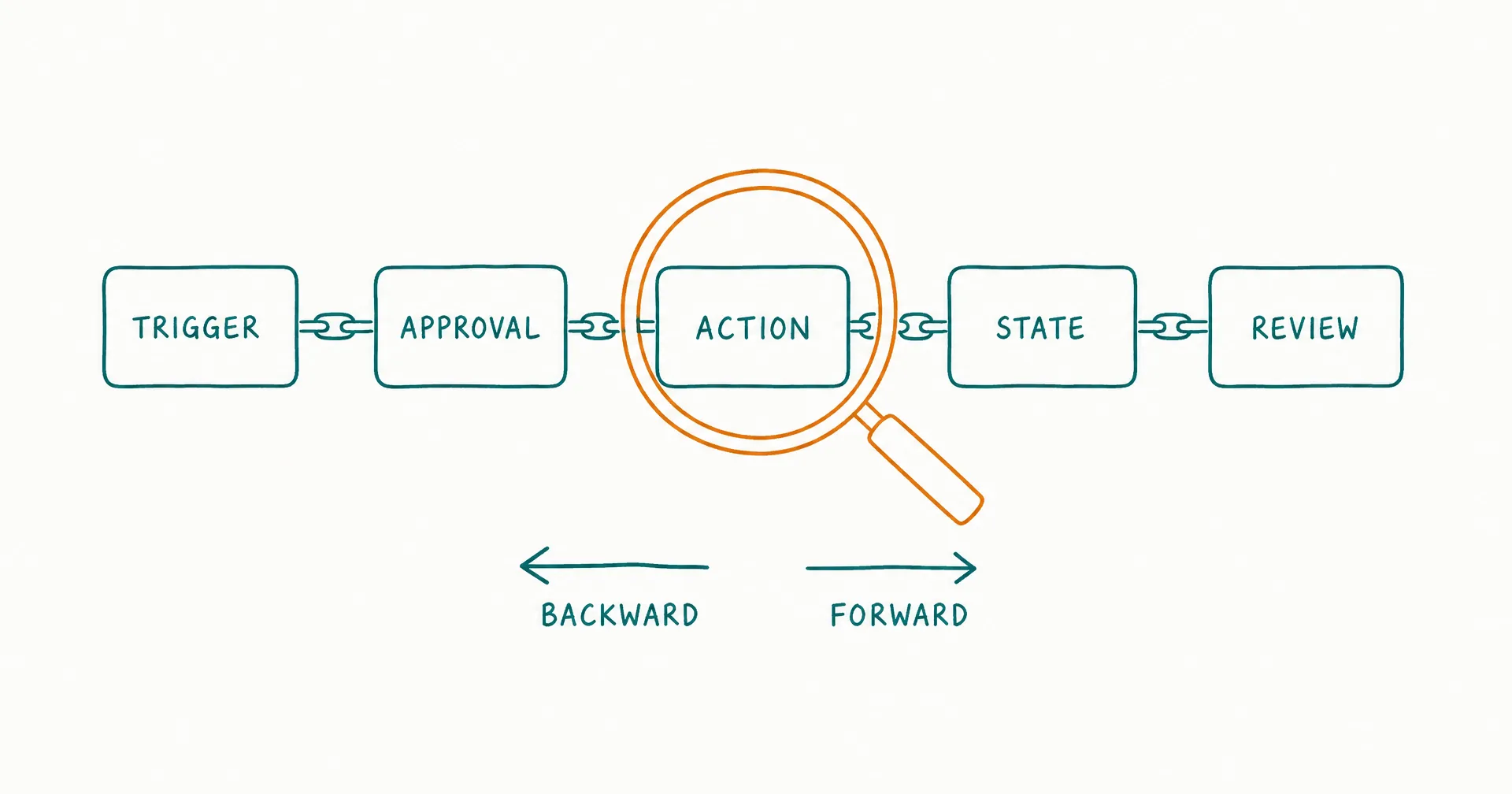
An AI employee audit log should let an authorized reviewer reconstruct a consequential action without guessing.
The reviewer should be able to determine: which person, system, role, and task initiated the work; which instructions, policies, sources, and software versions applied; which data and tools the worker accessed; which action it proposed, attempted, completed, or could not verify; which permission and approval authorized that exact action; what changed in the destination system; which other agents or services participated; what failed, retried, escalated, or was overridden; and whether the final result was verified and accepted.
That is a higher standard than keeping a transcript, displaying a list of tool calls, or recording that a task is “done.” The log must connect intent, authority, execution, and effect.
The practical test is simple:
Starting from one business outcome or one disputed action, can a reviewer move backward to its origin and forward to every material consequence?
If not, the organization has activity data, but it does not yet have a dependable audit record.
On this page · 13 sectionsOpen
- Start With the Reconstruction Standard
- Separate the Audit Record From Nearby Records
- Build One Event Grammar Before Choosing Fields
- Record Sources and Provenance Without Copying Everything
- Make Tool Actions and State Changes Verifiable
- Bind Permissions and Approvals to the Exact Action
- Preserve Delegation Across Agents and Services
- Capture Failures, Retries, Corrections, and Overrides
- Protect Log Privacy, Integrity, Access, and Retention
- Turn Audit Events Into Monitoring and Incident Signals
- Evaluate Vendors With Reconstruction Tests
- Implement the Audit Model in a Controlled Sequence
- Final Checklist
- Design the audit record around reconstruction questions, not around whichever events a vendor happens to expose.
- Give each task, run, approval, tool call, artifact, state change, and delegated subtask a stable identifier.
- Record lifecycle phases separately: proposed, authorized, attempted, acknowledged, verified, accepted, reversed, and closed.
- Preserve actor identity and the accountable human or service principal across every delegation.
- Record source references instead of unnecessary content, and bind approval to the exact action, destination, parameters, limits, source state, and expiry.
- Treat a timeout as uncertain execution until destination state is checked, and protect every record from unauthorized access, alteration, deletion, and secret leakage.
- Test reconstruction with sampled tasks, failures, retries, denied actions, delegated work, and recovery exercises.
§ 01Start With the Reconstruction Standard
An audit log exists to answer a defined set of questions after normal work, a complaint, an unexpected result, a security event, or a control review. This purpose should determine what is captured.
The NIST Guide to Computer Security Log Management describes log management as an organizational discipline rather than a file-format choice. Its scope includes the infrastructure and processes used to generate, transmit, store, access, analyze, and dispose of log data. That lifecycle matters for AI employees because a perfectly formatted event is useless if it never arrives, cannot be correlated, is inaccessible during an investigation, or disappears before the relevant review.
| Reconstruction objective | The record must establish |
|---|---|
| Attribution | Who or what initiated, delegated, approved, executed, reviewed, and accepted the work |
| Intent | Which task, goal, constraints, and instructions governed the action |
| Context | Which source, memory, policy, configuration, model, and tool versions applied |
| Authority | Which identity, permission, limit, and approval allowed or denied the action |
| Execution | Which operation was proposed, attempted, acknowledged, and verified |
| Effect | Which object, recipient, account, record, file, message, or system state changed |
| Sequence | What happened before and after the event across systems and workers |
| Exception | What failed, conflicted, timed out, retried, escalated, or was overridden |
| Recovery | Which pause, revocation, rollback, correction, notification, and verification followed |
| Disposition | Whether the result was accepted, rejected, corrected, reversed, or left unresolved |
Use a two-way test
Run reconstruction in both directions.
Backward reconstruction starts from an outcome: why was this customer record changed? The reviewer moves from the current record to the state-change event, tool call, approval, task, initiating trigger, role, source set, and accountable owner.
Forward reconstruction starts from an initiating event: what happened after this scheduled task started? The reviewer follows the run through sources, decisions, approvals, actions, delegated work, downstream state changes, outputs, review, and closure.
Both paths should converge on the same evidence. If they do not, a correlation boundary is missing.
Define materiality before volume
Not every internal event deserves the same treatment. Start with actions that affect: people, eligibility, access, or service; money, purchases, refunds, credits, or contractual commitments; external communications and public content; customer, employee, partner, or regulated data; production systems, configuration, credentials, or code; deletion, transfer, publication, or irreversible state; other agents’ tasks, permissions, or destinations; and safety, security, legal, or reputational outcomes.
The AI employee risk assessment helps rank actions by consequence, scale, sensitivity, authority, reversibility, detectability, uncertainty, and propagation. Use the result to decide event detail, review frequency, retention, alerting, and autonomy. Do not collect maximum detail everywhere merely because storage is inexpensive.
Set a hard observability boundary
A useful policy is:
If a material action cannot produce the required evidence, the worker may prepare the action but may not execute it autonomously.
That boundary connects auditability to permission. It prevents teams from discovering after an incident that the integration exposes only a generic “success” message, uses an unidentifiable shared account, or cannot show before-and-after state.
§ 02Separate the Audit Record From Nearby Records
Many products put every event on one screen and call it an audit log. The name does not prove the function.
| Record | Primary question | Typical contents | What it cannot prove alone |
|---|---|---|---|
| Task state | What owns the next action now? | Status, owner, due time, blocker, next step | Full history or destination effect |
| Business artifact | What deliverable was produced? | Brief, email, report, ticket, code, data file | Authority, sequence, or hidden downstream changes |
| Operational telemetry | Is the system healthy? | Latency, errors, spans, token use, resource metrics | Business meaning or human authorization |
| Audit evidence | Who did what, under which authority, and what changed? | Attributed, correlated, protected events | The full content of every work product |
| Retained memory | What context may persist for future work? | Approved facts, preferences, summaries, procedures | Complete action history or proof of execution |
Each may reference the others. They should not silently substitute for one another.
The AI employee task-board guide explains why current state and activity history must coexist. A board can correctly show “Ready for Review” while the evidence layer explains which sources, tool calls, validations, and exceptions produced that state.
A transcript is not an audit trail
A conversation transcript can show what a user and system said. It may not establish: the authenticated identity behind the request; which role and policy versions were active; which retrieved content was actually used; whether an action was proposed or executed; whether the destination acknowledged but failed to apply the change; what state existed before or after the action; whether an approval matched the final parameters; which child agent or integration performed the operation; or whether the output was later corrected, rejected, or reversed.
Transcripts can also contain sensitive content that should not be copied into broadly accessible logs.
An explanation is evidence only when it is bounded
Capture a concise decision summary when it helps a reviewer understand: the rule or criterion applied; the evidence references used; the alternatives considered at a business level; the uncertainty or conflict detected; the reason for escalation, refusal, or chosen action; and the policy clause that controlled the outcome.
Do not make unrestricted internal model text an audit requirement. It can be unreliable as an explanation, expose sensitive content, increase retention risk, and distract from evidence that can be verified. The durable record is the combination of versioned instructions, source references, structured decision fields, authority, action parameters, validation results, and state changes.
A screenshot is supporting evidence, not the event model
Screenshots are useful for interfaces that lack reliable APIs, but they are difficult to search, compare, minimize, and correlate. Store a structured event first, then attach a screenshot or page capture when it materially helps prove visible state.
For computer-use execution, record: the application and environment; the authenticated account or session reference; the page or view identifier; the intended control and action; object identifiers visible before the action; validation performed before interaction; the response or visible state after interaction; ambiguity or UI drift detected; and the supporting capture reference.
§ 03Build One Event Grammar Before Choosing Fields
An AI employee action passes through multiple phases. Collapsing them into one completed event creates false certainty.
| Phase | Meaning | Evidence |
|---|---|---|
| Proposed | Worker formed a candidate action | Action type, destination, parameters, expected effect |
| Validated | Preconditions and policy checks passed | Validation rules, source state, limit checks |
| Authorized | Permission and any approval matched | Policy decision, grant, approver, scope, expiry |
| Attempted | Execution request left the worker | Tool, operation, request ID, idempotency key |
| Acknowledged | Destination received or accepted the request | Provider response and external request ID |
| Verified | Destination state was read back or otherwise confirmed | Postcondition result and observed state |
| Reviewed | Required human or automated review occurred | Reviewer, evidence viewed, decision |
| Accepted | Business owner accepted the result | Acceptance status and correction request |
| Reversed | A compensating or rollback action completed | Reverse action, scope, verification |
| Closed | Task met its terminal conditions | Final disposition, artifacts, unresolved items |
An action can stop at any phase. Acknowledged is not Verified. Verified is not Accepted. Accepted is not necessarily irreversible.
Use a consistent event envelope
| Field group | Minimum fields |
|---|---|
| Event identity | Event ID, event type, schema version |
| Time and order | Event time, observed time, sequence number, clock source |
| Execution context | Environment, tenant, workspace, region |
| Work context | Role ID, task ID, run ID, session ID, parent event ID |
| Actor context | Actor type, actor ID, service identity, initiating principal, accountable owner |
| Configuration | Policy, instruction, model, tool, connector, and workflow versions |
| Operation | Phase, action type, resource, destination, parameters reference |
| Authority | Permission decision, grant ID, approval ID, limits, expiry |
| Result | Status, provider response, error class, retry state |
| Effect | Before/after references, changed fields, recipients, downstream events |
| Evidence | Source, artifact, validation, review, and incident references |
| Protection | Sensitivity class, redaction state, integrity proof, retention class |
Stable field names across roles make searches and controls reusable. OpenTelemetry semantic conventions show the value of shared names for traces, logs, metrics, and resources across different services. A buyer does not need to adopt every OpenTelemetry convention, but the underlying lesson applies: correlation breaks when each connector invents incompatible names for the same actor, operation, error, and destination.
Preserve three kinds of identity
One user_id field is usually insufficient. Record:
- Initiating principal: the person, schedule, webhook, system, or upstream agent that created the task.
- Executing identity: the service account, delegated token, agent identity, or human account that performed the operation.
- Accountable owner: the person or function responsible for the role, policy, and response.
These identities may be the same, but often are not.
| Identity layer | Value |
|---|---|
| Initiating principal | Revenue Operations schedule daily-account-review |
| Delegating role | Account Research AI Employee |
| Executing identity | Read-only CRM service account svc-research-prod |
| Accountable owner | Revenue Operations Manager |
| Reviewer | Account Executive assigned to account |
This preserves organizational responsibility without pretending software is a legal employee. The practical definition of an AI employee treats the employee label as an operating metaphor built around a persistent role, while accountability remains with people and organizations.
Preserve time and sequence
Distributed systems do not always report events in the order they occurred. Keep: event time at the source; ingestion or observation time; timezone or UTC offset; source clock; sequence number where available; parent and causal identifiers; and external provider timestamps.
NIST SP 800-53’s Audit and Accountability controls include event logging, audit-record content, time stamps, review, retention, and protection. The appropriate controls depend on context, but accurate time is a basic condition for comparing events across an agent platform, identity provider, destination application, and approval system.
§ 04Record Sources and Provenance Without Copying Everything
When an AI employee produces an answer or takes an action, reviewers need to know which evidence governed the result.
| Provenance field | Example |
|---|---|
| Source ID | CRM account acct_84219 |
| Source type | Internal system of record |
| Location | Canonical object URL or repository path |
| Version | Record version, document revision, commit, or content hash |
| Retrieved at | Timestamp |
| Retrieved by | Worker and executing identity |
| Scope used | Fields, pages, sections, rows, or query |
| Trust class | Approved, untrusted external, user-provided, derived |
| Freshness state | Current, stale, expired, unknown |
| Permission basis | Grant or role that allowed access |
| Transformation | Filtered, normalized, summarized, joined |
| Output relation | Claim, field, decision, or artifact influenced |
The W3C PROV overview defines provenance around entities, activities, and agents involved in producing a thing. That model maps cleanly to AI work: the source record and output are entities; retrieval, normalization, analysis, and drafting are activities; and the human, AI role, and connected service are agents.
You do not need to implement the full PROV family to use this structure. You do need a way to answer which entity was generated from which source through which activity under which actor.
Reference content instead of duplicating it
Copying full emails, documents, records, and prompts into a central log creates avoidable exposure.
Prefer: a stable source identifier; a version or cryptographic hash; a retrieval timestamp; a field or section selector; a sensitivity label; an authorization reference; and a protected artifact location.
Capture content only when the investigation need outweighs the privacy, security, and retention cost. Apply masking or tokenization where exact values are not required.
Record conflicts and exclusions
Auditability includes evidence the worker did not accept. Record: conflicting sources; stale or inaccessible sources; fields intentionally excluded; failed retrievals; unsupported file types; data outside the approved scope; confidence or completeness conditions; and whether a person resolved the conflict.
Otherwise, a polished final artifact can conceal that the worker saw two incompatible records and silently chose one.
Connect citations to claims or fields
A source list at the end of a report is better than no provenance, but it may not show which source supports a particular statement or update.
| Output element | Supporting evidence | Validation |
|---|---|---|
| Customer renewal date | CRM contract record v18, field renewal_date | Exact field read |
| Market-size statement | Published report, page 24 | Reviewer checked quotation and date |
| Ticket priority | Severity rubric v7 + incident facts | Rules passed; human confirmed |
| Refund amount | Order record + refund policy v12 | Limit and calculation verified |
This mapping makes correction local. When one source changes, the reviewer can identify affected outputs without re-reading the whole history.
§ 05Make Tool Actions and State Changes Verifiable
Tool-call visibility is useful, but it does not prove business effect.
| Action field | Why it matters |
|---|---|
| Tool and operation | Identifies what capability was invoked |
| Tool/connector version | Explains behavior changes |
| Destination system and tenant | Prevents environment ambiguity |
| Target object and recipient | Establishes scope |
| Parameters or protected parameter reference | Shows the requested change |
| Idempotency key | Helps prevent duplicate execution |
| Request and response IDs | Correlates with provider records |
| Precondition | Shows what had to be true before execution |
| Before state | Establishes the starting point |
| Provider acknowledgment | Shows the request was received |
| Postcondition | Defines the expected result |
| Observed after state | Confirms what actually changed |
| Side effects | Captures messages, workflows, notifications, or child events |
| Reversal method | Shows whether and how recovery is possible |
Distinguish a command from its effect
Consider an AI employee updating a customer-success ticket.
Weak event:
Updated ticket successfully.
Reconstructable event:
Run run_9021 used role policy v9 to request ticket.update on ticket_1842, changing status from waiting_internal to ready_for_customer, with no recipient change. Approval apr_331 covered that ticket, field, transition, and 15-minute window. Provider request req_778 returned success. A read-back at 14:03:09Z confirmed version 42 and the expected status. No downstream notification fired. Reviewer accepted the update at 14:07:22Z.
The second record separates request, authorization, response, verification, and acceptance.
Treat unknown execution as its own state
Network timeouts create a dangerous ambiguity: the worker does not know whether the destination completed the action. Do not immediately retry a consequential operation.
Use:
- record execution_unknown;
- query destination state using the request ID, idempotency key, or target object;
- compare the observed state with the intended postcondition;
- retry only when policy permits and non-execution is confirmed;
- escalate if state remains ambiguous; and
- preserve the entire sequence.
This is especially important for payments, messages, publishing, deletion, account changes, and batch operations.
Represent batches as parent and item events
“Updated 500 records” hides partial success.
Create: one batch intent event; one authorization covering defined scope and limits; one child event per material item or a queryable item ledger; aggregate counters for attempted, succeeded, verified, failed, skipped, and unknown; exceptions with item identifiers; and a final reconciliation event.
The audit view should show both the batch summary and the item-level exceptions.
Log denied and blocked actions
Successful actions are only half the control story. Record: the action requested; the policy or guardrail that evaluated it; the denial reason code; source and destination; requested scope; whether the worker narrowed, escalated, or abandoned the task; repeated attempts; any override request; and the final disposition.
Denied-action evidence helps buyers verify that controls work under pressure rather than merely existing in configuration.
§ 06Bind Permissions and Approvals to the Exact Action
Authentication proves an identity. Permission defines what that identity may do. Approval authorizes a particular action or action class under stated conditions. The audit record must preserve all three.
The AI employee permissions and approvals model builds the governing matrix per system, object, data scope, action, threshold, destination, time, volume, approver, evidence, and rollback. The log should show how that matrix evaluated the live request.
| Authority evidence | Required question |
|---|---|
| Identity | Which authenticated principal executed the action? |
| Role or grant | Which permission allowed the tool, resource, and operation? |
| Policy version | Which rules were active at decision time? |
| Decision | Allow, deny, require approval, or narrow scope? |
| Approval request | What exact action was presented to the approver? |
| Approver | Who decided, under which role? |
| Approval result | Approved, rejected, edited, expired, or revoked? |
| Binding | Did destination, parameters, source state, limits, and expiry still match? |
| Use | Which execution consumed the approval? |
| Revocation | Was the grant or approval later removed? |
Prevent approval drift
An approval for a draft must not silently authorize a different final action. Bind approval to:
actor + action + target + destination + parameters + source version + limit + time window
If a material field changes, require a new approval or an approved bounded edit rule. Examples of material change: the recipient changed; the amount increased; an attachment was added; the source record updated; the destination moved from test to production; the item count exceeded the preview; an external link changed; the action became irreversible; or a child agent replaced the approved executor.
Preserve what the approver saw
The audit record should identify the review packet: the proposed action; important source references; current and expected state; risks or uncertainty; changed fields; affected recipients or objects; limits; the rollback method; and evidence that was missing.
A bare approved=true field does not show whether the person had enough information or whether the final action matched the preview.
Keep approval independence visible
For high-consequence actions, record whether the approver: was also the requester; had authority for the affected system; had a conflict of interest; received an emergency override; acted after the approval expired; or approved a batch through sampling.
The purpose is not to turn every workflow into regulated compliance. It is to preserve the facts needed for the organization’s own governance and any applicable duties.
§ 07Preserve Delegation Across Agents and Services
Multi-agent work introduces extra boundaries where identity, authority, evidence, and ownership can disappear.
| Delegation field | Meaning |
|---|---|
| Delegation ID | Stable transfer identifier |
| Parent task/run | Work that created the delegation |
| Delegator | Worker or person assigning the work |
| Delegate | Worker, service, or person receiving it |
| Assigned outcome | Exact result requested |
| Context references | Approved sources and artifacts supplied |
| Authority envelope | Maximum tools, data, destinations, limits, and duration |
| Forbidden actions | Explicit exclusions |
| Acceptance | Whether the delegate accepted the task and limits |
| Return contract | Required result, evidence, exceptions, and status |
| Closure | Accepted, rejected, repaired, cancelled, or escalated |
The least-privilege model for AI agents treats delegated authority as an intersection: a child should receive only the subset allowed by the parent role, the current task, organizational policy, and the child’s own capability boundary. The audit record should preserve that calculation.
Maintain one causal chain
Use parent-child links:
human or trigger → role task → manager action → delegated subtask → tool call → state change → result → review
Do not replace the chain with “Agent B completed it.” Reviewers need to know: why Agent A delegated; which human-owned role initiated the work; whether Agent B accepted the limits; which identity Agent B used; whether Agent B delegated again; which evidence returned; who verified the result; and whether the parent accepted or repaired it.
Detect circular and orphaned work
Log and alert on: a task delegated back to an ancestor; repeated delegation without progress; child work without an active parent; parent closure while child actions remain open; results returned to the wrong task or tenant; authority widening between generations; duplicate children for the same work object; and delegated work continuing after pause or revocation.
These are not merely technical curiosities. They can create duplicate customer contact, repeated purchases, conflicting record changes, or unowned failure.
The multi-agent failure-mode guide explains how small local errors can propagate through delegation, shared memory, and downstream action. A reconstructable causal graph is the evidence layer required to contain that propagation.
§ 08Capture Failures, Retries, Corrections, and Overrides
An audit record should make failure easier to understand, not make normal work look flawless.
| Failure field | Example |
|---|---|
| Failure class | Authentication, authorization, validation, source, model, tool, destination, review |
| Operation phase | Proposed, authorized, attempted, acknowledged, verified |
| Error code | Stable machine-readable code |
| Human-readable summary | Concise operational explanation |
| Affected object | Task, record, message, account, file |
| Known effect | None, partial, complete, unknown |
| Retry eligibility | Never, automatic, conditional, human-approved |
| Attempts | Count and links to prior attempts |
| State reconciliation | Read-back result |
| Escalation | Owner, channel, urgency, due time |
| Recovery | Correction, rollback, revocation, notification |
| Closure evidence | Verification and reviewer disposition |
Do not overwrite the first failure
If a retry succeeds, preserve both events. Otherwise, the record can falsely imply: the work succeeded on the first attempt; no duplicate risk existed; the worker never used an expired credential; the original source was valid; no human intervention was needed; or latency and cost reflected one attempt.
Retries also affect the AI employee KPI model. First-pass acceptance, correction rate, intervention rate, and failure recovery cannot be calculated from final status alone.
Record correction as a linked action
Do not edit history to make the original event appear correct. Use:
original event → issue detected → correction decision → corrective action → verification → acceptance
Preserve: what was wrong; who or what detected it; the impact window; affected objects; correction authority; before-and-after state; whether downstream recipients were notified; and whether policy, instructions, access, tests, or monitoring changed.
Make overrides exceptional and reviewable
An override record should include: the control bypassed; reason and urgency; requester and approver; exact temporary scope; start and expiry; compensating controls; actions taken under the override; post-use review; and confirmation that temporary authority was removed.
“Admin override” without scope and expiry is a permanent blind spot disguised as an exception.
Connect evidence to the response path
The audit log provides reconstruction. It does not itself contain, revoke, correct, or recover the system.
The AI employee incident-response plan should define how responders pause work, revoke access, contain affected destinations, preserve evidence, assess impact, correct unsafe state, notify affected parties when required, and return to service deliberately. Audit events should expose the identifiers and state responders need to execute that plan.
§ 09Protect Log Privacy, Integrity, Access, and Retention
Audit logs can become one of the most sensitive datasets in an AI system. They may connect user identities, private sources, tool destinations, business decisions, errors, and security events.
The OWASP Logging Cheat Sheet emphasizes consistent application logging while warning against capturing too much or too little. It recommends protecting log confidentiality, integrity, and availability; restricting and monitoring access; masking or sanitizing sensitive data; testing logging failures; and retaining data only for the required period.
| Data class | Default treatment |
|---|---|
| Passwords, tokens, private keys | Never log |
| Session secrets and authorization headers | Remove before ingestion |
| Personal data | Minimize, mask, tokenize, or reference |
| Source content | Reference by ID/version unless content is necessary |
| Tool parameters | Store selected fields or protected artifact reference |
| Customer identifiers | Use stable internal IDs; limit display |
| Model inputs and outputs | Apply purpose, sensitivity, access, and retention rules |
| Approval evidence | Preserve decision and packet reference; restrict content |
| Security detections | Protect from the actor being investigated |
| Debug data | Separate, time-limit, and disable outside controlled use |
Separate event data from protected payloads
Use two layers:
- Queryable event record: identifiers, types, timestamps, statuses, relationships, classes, and protected references.
- Restricted evidence store: sensitive source excerpts, attachments, screenshots, request bodies, response bodies, and detailed artifacts.
This keeps routine investigation usable without giving every log reader access to raw business content.
Control who can read, search, export, and delete
Audit access is itself an auditable action. Record: viewer identity; query or case purpose; fields and time range accessed; export created; sharing destination; approval where required; deletion or legal hold; and administrative changes to logging rules.
Use role-based views. A workflow owner may need task and action evidence without access to credentials, private customer content, or unrelated tenants. A security responder may need broader system relationships under a case record.
Make alteration detectable
Choose controls appropriate to the risk: append-only ingestion; restricted deletion; write-once or immutable storage; signed batches or hash chaining; protected timestamps; replicated or independent storage; integrity checks; configuration-change logging; and alerting when expected event streams stop.
Do not claim “immutable” because a user interface lacks an edit button. Buyers should ask who can alter records through administrative APIs, retention rules, storage access, or vendor support.
Design retention by purpose
Retention should not be one number for every event. Set periods by: legal and contractual obligations; investigation and dispute windows; operational review cadence; security detection needs; affected-party rights; model and policy change cycles; data sensitivity; storage location; and deletion capability across backups and exports.
The AI memory privacy and retention checklist governs what context may persist for future work. Audit retention has a different purpose, but the same principles of purpose limitation, access, correction, expiry, and deletion still matter.
Verify that logging failure does not create silent autonomy
Define behavior when: the event collector is unavailable; the destination refuses the log; storage is full; timestamps drift; the schema is invalid; redaction fails; a provider response cannot be correlated; or a required state-change event is missing.
For material actions, safe behavior may be: block execution; switch to prepare-only mode; queue within a short protected window; require human approval; alert an owner; or pause the role.
“Work continues and logs catch up later” is acceptable only when the organization has explicitly evaluated the consequence and can prove no evidence will be lost.
§ 10Turn Audit Events Into Monitoring and Incident Signals
Audit and monitoring overlap, but they are not identical. An audit record supports later reconstruction. Monitoring uses current events to detect conditions that need action now.
The NIST AI RMF Core connects deployed-system measurement with monitoring, error reporting, risk response, and ongoing management. Translate that idea into role-specific signals:
| Signal | Possible response |
|---|---|
| Repeated denied action | Pause task and review instruction or misuse |
| Approval requested after execution attempt | Block role and investigate sequencing |
| Action acknowledged but not verified | Reconcile destination before retry |
| Permission expanded during a run | Suspend consequential actions |
| Child authority exceeds parent envelope | Deny delegation and alert owner |
| Unexpected destination or tenant | Block and open security review |
| Large increase in item count or spend | Require fresh approval |
| Source version changed after approval | Invalidate approval and revalidate |
| Required event stream stops | Reduce autonomy or pause role |
| Same idempotency key produces different effects | Contain integration and investigate |
| Sensitive field appears in log | Quarantine record and correct redaction |
| Reviewer repeatedly overrides without evidence | Review governance and role design |
Define thresholds around business meaning
“Error count > 10” may be irrelevant or dangerous depending on the action. Prefer: two unverified payment attempts; one message sent to an unapproved domain; any production deletion without a valid approval; five source-conflict escalations in one shift; child delegation after a parent pause; one personal-data export outside the assigned account set; or a material task closed without acceptance evidence.
Connect thresholds to the role, destination, volume, consequence, and recovery window.
Alert on missing evidence
Absence is a signal. Detect: a run started without an initiating principal; a tool call missing a task ID; an approval consumed without a matching request; destination success without a verification event; a task closed with open child actions; state changed without an actor; a material action missing before-state evidence; a correction without a linked original event; and a log stream missing after a deployment or connector update.
Completeness metrics should be part of operational review, not an annual audit surprise.
§ 11Evaluate Vendors With Reconstruction Tests
Ask vendors to demonstrate one complete chain inside the product and exported data. Do not accept a slide that lists “audit logs” as a feature.
| Buyer question | Required demonstration |
|---|---|
| Can events be correlated? | Search one task across trigger, run, tool, approval, child work, and destination |
| Is identity preserved? | Show initiating, executing, delegating, approving, and accountable identities |
| Are versions recorded? | Show active policy, instruction, model, tool, and connector versions |
| Is approval exact? | Prove the executed parameters match the approved preview |
| Is effect verified? | Show before state, requested action, response, and read-back |
| Are denied actions visible? | Trigger a policy denial and export the event |
| Are retries safe? | Simulate a timeout and show reconciliation before retry |
| Is delegation bounded? | Demonstrate child authority cannot exceed the parent envelope |
| Are logs protected? | Show access roles, administrative boundaries, alteration controls, and access history |
| Can sensitive data be minimized? | Demonstrate redaction, field exclusion, and protected evidence references |
| Can data be exported? | Export documented structured records with stable IDs and timestamps |
| Can retention be configured? | Show policy granularity, holds, deletion behavior, and plan limits |
| Does logging fail safely? | Simulate collector or storage failure and show role behavior |
| Can incidents be investigated? | Reconstruct a test incident without vendor engineering intervention |
Run six acceptance scenarios
Before production, test:
- Normal accepted outcome: one task completes with complete provenance, authorization, verification, review, and closure.
- Denied action: the worker requests an out-of-scope action, the control blocks it, and the event explains why.
- Changed approval: a material parameter changes after approval, and execution is blocked until re-approved.
- Uncertain execution: the destination times out, the worker reconciles state, and no duplicate action occurs.
- Delegated task: a parent assigns bounded work, the child returns evidence, and the causal chain remains intact.
- Correction and recovery: a test error is detected, corrected, verified, and linked to the original event.
| Criterion | Pass condition |
|---|---|
| Completeness | Every required event and field exists |
| Correctness | Event matches observed source and destination state |
| Correlation | Reviewer can traverse the full chain |
| Timeliness | Evidence arrives within the defined window |
| Protection | Sensitive content and access remain controlled |
| Exportability | Structured data remains usable outside the interface |
| Independence | Reviewer does not need undocumented vendor assistance |
| Recovery | Correction or reversal is attributable and verified |
If a platform cannot support the role’s non-compensating evidence requirements, superior output quality should not offset the gap.
Ask plan- and architecture-specific questions
Capabilities may differ by: subscription plan; region; cloud versus customer-managed deployment; native versus third-party connector; API versus computer-use execution; single-agent versus multi-agent mode; retention tier; administrative role; and export or security integration.
Record the exact configuration demonstrated. A “yes” for one premium environment may not apply to the intended deployment.
The AI employee platform RFP checklist turns this type of requirement into comparable proof requests across vendors. Use audit reconstruction as a gate, not a weighted feature that can be canceled by price or interface quality.
Verify CellCog against the same standard
The CellCog AI Employees page is the appropriate product entry point after the role and evidence requirements are clear. Verify current product behavior, plan availability, interfaces, exports, permission granularity, approval binding, event detail, retention, and recovery against the scenarios above. Product pages should start the evaluation; a deployment-specific demonstration should finish it.
§ 12Implement the Audit Model in a Controlled Sequence
Start with one bounded role and its most consequential action.
| Step | Work | Deliverable |
|---|---|---|
| 1. Scope | Name role, owner, environment, tasks, tools, data, and material actions | Audit scope |
| 2. Question | Define backward and forward reconstruction questions | Question set |
| 3. Map | Diagram trigger, task, sources, decisions, approvals, tools, effects, review, and recovery | Event map |
| 4. Classify | Assign materiality, sensitivity, access, retention, and alerting | Event classes |
| 5. Specify | Define schema, identifiers, relationships, phases, and required fields | Event contract |
| 6. Protect | Configure redaction, access, integrity, storage, retention, and export | Protection model |
| 7. Instrument | Emit events across the agent platform and connected systems | Correlated stream |
| 8. Test | Run normal, denial, change, timeout, delegation, and recovery scenarios | Evidence packet |
| 9. Review | Have an independent reviewer reconstruct each scenario | Gap register |
| 10. Decide | Grant, narrow, or withhold execution authority | Signed launch decision |
| 11. Monitor | Measure completeness, latency, unknown execution, and control exceptions | Operating dashboard |
| 12. Improve | Update schema and controls after changes, incidents, and review | Versioned revisions |
Build an event catalog
For each event type, define: business purpose; trigger; producer; required fields; prohibited fields; sensitivity; parent and child relationships; retention class; access roles; expected volume; arrival-time objective; integrity control; alert rules; and a sample record.
| Event type | Purpose | Required relationship |
|---|---|---|
| task.created | Establish work origin | Initiating principal and role |
| source.retrieved | Establish provenance | Task, source ID, version |
| action.proposed | Record intended effect | Task and decision summary |
| policy.evaluated | Record authority decision | Proposed action and policy version |
| approval.decided | Record human authorization | Approval request and approver |
| tool.attempted | Record execution request | Authorized action |
| state.verified | Record observed effect | Tool attempt and destination object |
| delegation.accepted | Record child ownership | Parent task and authority envelope |
| result.accepted | Record business disposition | Artifact and reviewer |
| action.reversed | Record recovery | Original state change |
Measure the audit system
Track: percentage of material actions with complete identity; percentage with valid permission evidence; percentage requiring approval with exact binding; percentage with before-and-after state; percentage verified within the target window; orphan-event rate; unknown-execution rate; duplicate-action rate; event-arrival latency; redaction failures; unauthorized access attempts; integrity-check failures; reconstruction time for sampled tasks; and sampled tasks reconstructed without vendor assistance.
The objective is not 100% event volume. It is dependable evidence for defined decisions and actions.
Assign ownership
| Owner | Responsibility |
|---|---|
| Role owner | Defines material actions and business questions |
| Security owner | Protects event collection, storage, access, and alerts |
| Privacy owner | Sets minimization, purpose, access, retention, and deletion |
| Platform owner | Maintains instrumentation and schema compatibility |
| Integration owner | Preserves destination request, response, and state evidence |
| Reviewer | Samples records and tests reconstruction |
| Incident owner | Uses evidence for containment, assessment, and recovery |
Ownership should survive staff changes. Store the event contract and operating procedures with version control and review dates.
§ 13Final Checklist
- Material actions and consequences are defined.
- Backward and forward reconstruction questions are documented.
- Task state, artifacts, telemetry, audit evidence, and memory are separated.
- Stable IDs connect tasks, runs, approvals, tools, artifacts, state changes, and incidents.
- Initiating, executing, delegating, approving, reviewing, and accountable identities are preserved.
- Policy, instruction, model, tool, connector, and workflow versions are recorded.
- Sources have identifiers, versions, retrieval times, trust classes, and output relationships.
- Proposed, authorized, attempted, acknowledged, verified, reviewed, accepted, reversed, and closed phases remain distinct.
- Before-and-after state is captured for material changes.
- Approval is bound to exact action, destination, parameters, limits, source state, and expiry.
- Denials, failures, retries, corrections, and overrides remain visible.
- Delegated work preserves the parent chain and cannot widen authority.
- Secrets are excluded and sensitive evidence is minimized or stored separately.
- Log access, export, configuration, retention, and deletion are auditable.
- Alteration or missing event streams can be detected.
- Logging failure causes a risk-appropriate pause, downgrade, queue, or alert.
- Six acceptance scenarios pass in the intended plan and architecture.
- An independent reviewer can reconstruct sampled work without guesswork.
- Incident responders can find the identifiers needed to pause, contain, correct, and recover.
- Consequential autonomy is withheld when required evidence is missing.
The buyer’s next step is not “turn on all logs.” It is to choose one consequential action, write the questions an investigator must answer, and require the system to produce that evidence before it receives autonomous execution rights.
Q1What should an AI agent audit trail record?
Record the initiating principal, AI role, accountable owner, task and run IDs, active instruction and policy versions, source references, model and tool versions, proposed action, permission decision, approval, tool request and response, before-and-after state, delegated work, failures, retries, reviewer decision, final disposition, and recovery actions.
Q2Is a conversation transcript enough for an AI employee audit?
No. A transcript may show messages but usually cannot prove authenticated identity, active permissions, exact approval binding, tool execution, destination state, delegation, or later correction. Use transcripts as protected supporting evidence, linked to a structured event record.
Q3Should an audit log store every prompt and output?
Not by default. Full content can expose personal data, confidential information, credentials, and unnecessary business context. Store stable references, versions, selected structured fields, hashes, and protected artifact locations.
Q4How should approval appear in an audit log?
The record should show what action the approver saw, which sources and current state informed it, who approved it, the decision time, scope, limits, destination, parameters, expiry, and which execution consumed the approval. If a material detail changed before execution, the log should show that approval became invalid or was renewed.
Q5How long should AI employee audit logs be retained?
There is no universal period. Set retention according to purpose, applicable law and contracts, dispute and investigation windows, operational review cadence, sensitivity, affected-party rights, and deletion capability. Different event classes may need different periods.
Q6Do AI audit logs guarantee compliance or prevent incidents?
No. Logs support attribution, monitoring, investigation, review, and recovery. They do not replace least privilege, guardrails, human oversight, testing, incident response, or applicable legal analysis.