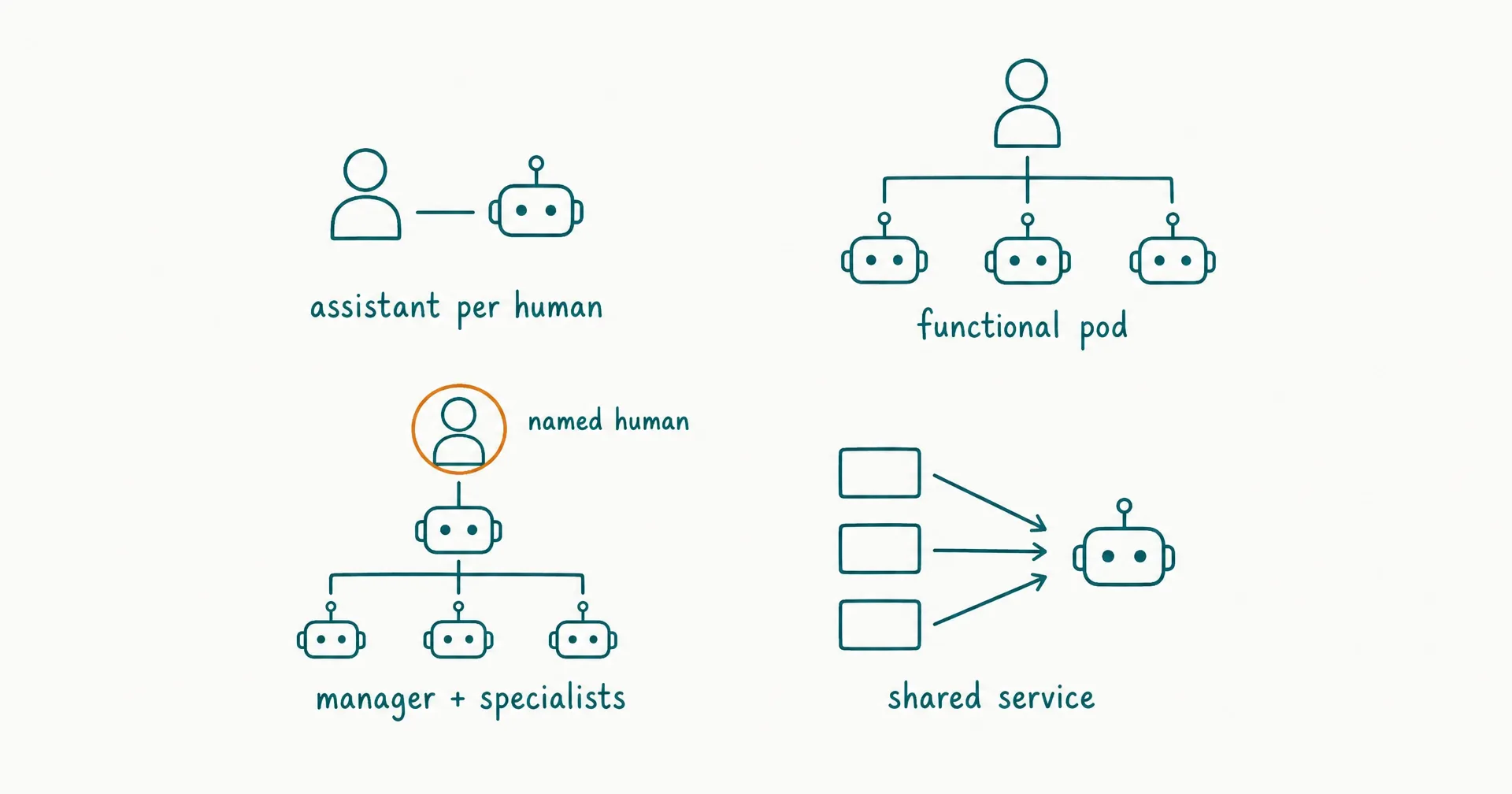
An AI organization chart should show who owns each outcome, who can assign work, where authority stops, which human approves consequential action, how exceptions escalate, and which sources or services are shared.
A box-and-line diagram that shows only titles and reporting relationships is incomplete. AI roles can act across tools, start work from triggers, share memory, delegate tasks, and operate at machine speed. The chart therefore needs operating overlays that a conventional people directory may omit.
Most human-AI teams fit one of 4 reusable patterns:
- assistant per human;
- functional pod;
- manager-specialist;
- shared service.
Use the AI organization implementation guide to decide which roles should exist. Then draw the selected structure with explicit ownership, authority, approval, and accountability.
On this page · 18 sectionsOpen
- What Is an AI Organization Chart?
- What Should Each AI Role Box Show?
- Which Lines and Symbols Should the Chart Use?
- Pattern 1: Assistant Per Human
- Pattern 2: Functional Pod
- Pattern 3: Manager-Specialist
- Pattern 4: Shared Service
- How Do the Four AI Organization Chart Patterns Compare?
- How Do You Add Human Accountability to the Chart?
- How Do You Add Information and Memory Boundaries?
- How Do You Add Permissions and Approval Boundaries?
- How Do You Add Capacity and Coordination Debt?
- How Should You Review an AI Organization Chart?
- What Does CellCog’s Public AI Organization Chart Show?
- Which Pattern Should You Choose?
- How Do You Build the First Chart in 60 Minutes?
- What Is the Final AI Org Chart Checklist?
- Final Decision
- Start with the smallest chart that explains one accepted business outcome; do not draw a complete synthetic company before one role is proven.
- Use an assistant-per-human pattern for local augmentation, a functional pod for a cohesive department outcome, a manager-specialist pattern for decomposable volume, and a shared service for scarce capabilities used by several teams.
- Draw 5 edge types separately: reporting, task assignment, handoff, approval, and source/service access. One solid line cannot safely represent all 5.
- Put a named human accountability point on every consequential path. Strategy, risk tolerance, permissions, high-impact approval, incidents, and final accountability remain human-owned.
- Annotate each role with outcome, trigger, output, data, tools, authority tier, KPI, escalation owner, and version.
- Add capacity, review, and failure overlays before expanding. Span of control is meaningless without task coupling, exception rate, and human review time.
- CellCog’s public chart, current July 2026, shows 1 human founder and 9 active AI Employees, including an AI Sales Lead with 5 AI sales representatives. Treat it as a first-party operating example, not a universal template.
§ 01What Is an AI Organization Chart?
An AI organization chart is a visual model of human and agent roles, owned outcomes, coordination relationships, authority, information access, review, and escalation.
| Chart layer | Question it answers | Required object |
|---|---|---|
| Role | Who or what performs work? | Human or AI role ID |
| Outcome | What result does the role own? | Accepted output or parent outcome |
| Reporting | Who sets priority and reviews performance? | Accountable sponsor/manager |
| Assignment | Who may create work for whom? | Typed task edge |
| Handoff | When can ownership move? | Acceptance edge |
| Approval | Who can authorize consequential action? | Human/control gate |
| Information | Which source or memory can the role read/write? | Scoped store edge |
| Tool authority | Which systems and actions are permitted? | Action-specific permission |
| Escalation | Where do uncertainty and failure go? | Named human route |
| Evidence | How is work accepted and reconstructed? | Artifact, rubric, and log |
The chart is therefore closer to an operating diagram than an employee directory.
Every box needs an outcome
Weak: “AI Marketing Manager.”
Stronger:
AI Content Coordinator. Outcome: accepted weekly content batch. Output: batch manifest + reviewed drafts. Human sponsor: Head of Growth.
The title identifies the role; the outcome makes it testable.
Every line needs a meaning
A line may mean:
- sets goals;
- assigns tasks;
- transfers ownership;
- reviews output;
- approves action;
- provides a service;
- or grants source access.
Use distinct labels, colors, or line styles in the final design. Do not assume “reports to” explains permission or data flow.
Every consequence needs a person
NIST’s AI Risk Management Framework calls for documented roles, responsibilities, lines of communication, human-AI oversight arrangements, and executive responsibility for AI deployment risk.
On the chart, show the accountable human, high-impact approver, risk/policy owner, incident owner, and backup.
An AI reporting line does not remove those roles.
§ 02What Should Each AI Role Box Show?
Use a compact 10-field role card.
| Field | Example | Why it belongs on chart |
|---|---|---|
| Role ID/version | research_agent_v4 | Distinguishes tested configuration |
| Role name | Market Research Specialist | Human-readable label |
| Owned outcome | Accepted evidence brief | Defines responsibility |
| Trigger | Approved task assignment | Explains when work begins |
| Output | evidence_brief_v2 | Makes interface visible |
| Data/source scope | Public web + approved owned pages | Shows information boundary |
| Tool/action scope | Search, read, draft; no send | Shows authority |
| KPI | First-pass acceptance + source support | Shows evaluation |
| Escalation | Human Growth Lead | Shows exception path |
| Status | Pilot / bounded / active / paused | Shows release mode |
Do not put the whole prompt in the box. Reference the versioned role contract instead.
Show whether the role is human or AI
Use a visual convention such as: circle for a human accountable owner; rounded rectangle for an AI worker; hexagon for a deterministic service/control; cylinder for a source, memory, or data store; diamond for an approval or decision gate.
Add a text label so the chart remains accessible without color.
Show outcome, not activity
Replace:
- “does research” with “accepted evidence brief”;
- “helps sales” with “qualified account packet”;
- “manages support” with “closed low-risk support queue plus escalations”;
- “creates content” with “reviewed draft matching approved brief.”
Activity does not prove closure.
Show authority tier
One usable authority legend:
- A0: read/observe;
- A1: draft/recommend;
- A2: reversible internal update;
- A3: approved external action;
- A4: human-only high-impact action.
Treat these labels as placeholders. Map them to the permission model and consequence tiers enforced in your environment.
Show version and operating mode
Write: v4 · bounded production · A1.
If the model, tools, instructions, sources, permissions, or rubric change, the tested role has changed. The chart should not display an outdated configuration as active.
§ 03Which Lines and Symbols Should the Chart Use?
Use at least 5 edge types.
| Edge | Suggested notation | Meaning | Must not imply |
|---|---|---|---|
| Reporting/accountability | Solid vertical line | Priority, supervision, performance review | Tool permission |
| Task assignment | Solid arrow | May propose/assign typed work | Ownership transfer before acceptance |
| Handoff | Double arrow with acceptance gate | Ownership can transfer under protocol | Credential transfer |
| Approval | Dotted arrow to diamond | Named actor authorizes exact action | General role authority |
| Service/source access | Dashed line | May request service or retrieve scoped source | Reporting relationship |
Reporting edge
Label the supervisor/sponsor, review cadence, and escalation expectation. A human sponsor may oversee an AI manager without reviewing every low-risk artifact.
Assignment edge
Label the allowed task type, receiving role, relationship (delegate or request), and depth limit. The sender normally retains parent closure when it delegates a subtask.
Handoff edge
Use the AI agent handoff protocol for packet identity, current state, source/artifact versions, prior decisions, authority, uncertainty, receiving acceptance, atomic owner change, timeout, and failure.
Do not show a handoff arrow if the system cannot establish who owns the task after rejection or timeout.
Approval edge
Connect the actor or artifact to an approval gate, then connect the gate to the exact execution role.
The approver may be outside the reporting chain. A security owner can approve access while a functional manager owns the outcome.
Shared source/service edge
Connect roles to the approved knowledge store, policy service, CRM view, analytics service, research service, or execution service.
Label read, propose-write, approved-write, or execute. “Has access” is too vague.
§ 04Pattern 1: Assistant Per Human
Each human has one or more directly supervised AI roles.
```text Human Founder ──reports/reviews──> AI Executive Assistant Human Growth Lead ───────────────> AI Content Assistant Human Support Lead ──────────────> AI Support Assistant
Each human approves consequential actions in their own workflow. ```
| Design question | Recommended answer |
|---|---|
| Outcome ownership | Human owns business outcome; AI owns bounded artifact/task |
| Assignment | Human to own assistant |
| Cross-role work | Minimize at first |
| Memory | Role-specific by default |
| Approval | Local human supervisor |
| Best fit | Early adoption, low coordination, personal workflows |
| Main risk | Duplicated sources, tools, and policy |
Use it when
- the organization is proving first roles;
- workflows are local;
- human context is important;
- cross-team tasks are rare;
- and each person can supervise the queue.
Examples: founder + executive research assistant; marketer + content assistant; support lead + response-drafting assistant; analyst + data-query assistant.
Why it works
The accountability line is short: human assigns, AI drafts or acts within scope, human reviews and accepts. Context and permission are easier to localize.
Where it breaks
The pattern can produce duplicate research, inconsistent policy interpretations, several copies of the same source, overlapping subscriptions, repeated customer work, inconsistent escalation, and no owner for cross-functional outcomes.
The solution is not immediately adding a hierarchy. Standardize shared sources and interfaces first.
Chart annotations
For each pair, show the human outcome, AI sub-outcome, task trigger, approval boundary, shared system access, and review cadence.
Do not draw the AI assistant as a peer if the human remains the outcome owner.
§ 05Pattern 2: Functional Pod
A human functional owner supervises several related AI specialists around one cohesive outcome.
text
                    Human Growth Lead
             accountability / priority / approval
                         │
        ┌────────────────┼────────────────┐
        │                │                │
 AI Research       AI Content       AI Analytics
 Specialist        Specialist        Specialist
        └──── shared approved sources + task state ────┘
| Design question | Recommended answer |
|---|---|
| Outcome ownership | Human functional lead owns department outcome |
| AI ownership | Each specialist owns one typed artifact |
| Assignment | Human or bounded coordinator routes tasks |
| Cross-role work | Through task/artifact interface |
| Memory | Shared authoritative sources + role-specific working memory |
| Approval | Human lead or independent control |
| Best fit | Cohesive departmental workflow |
| Main risk | Human review bottleneck and context duplication |
Use it when
- specialists share one functional goal;
- outputs can be typed;
- dependencies are understandable;
- a human can resolve conflicts;
- and cross-role work is frequent enough to justify interfaces.
The human owns integration
The human lead chooses priority, resolves conflicting specialist conclusions, accepts the combined outcome, handles exceptions, and approves consequential action.
AI roles may review one another, but the human remains the accountable integrator.
Keep specialist roles distinct
The research specialist should not publish. The content specialist should not invent source support. The analytics specialist should not change source records merely because it can query them.
Use the manager-agent versus specialist-agent guide to define distinct outcome, context, tool, permission, memory, and eval contracts.
Chart the artifact flow
Add arrows such as: research artifact v3 to content draft v2 to human approval; analytics evidence directly to human approval.
Artifact flow shows how work actually moves; a reporting line alone does not.
§ 06Pattern 3: Manager-Specialist
A bounded AI manager coordinates several AI specialists under a human sponsor.
text
                       Human Sponsor
           goals · risk · permissions · exceptions
                             │
                        AI Manager
          decompose · route · review · integrate · escalate
               ┌─────────────┼─────────────┐
               │             │             │
          Specialist A  Specialist B  Specialist C
          domain output domain output domain output
| Design question | Recommended answer |
|---|---|
| Outcome ownership | Human owns business consequence; AI manager owns bounded coordination outcome |
| Specialist ownership | Typed domain artifact |
| Assignment | Manager to eligible specialist |
| Review | Manager structural/rubric review; human for high impact |
| Memory | Manager coordination memory separate from specialist domain memory |
| Approval | Human/independent control for consequential action |
| Best fit | Repeated decomposable work with measurable coordination |
| Main risk | Manager error amplification and privilege concentration |
Use it when
- work volume justifies recurring coordination;
- tasks can be decomposed;
- specialist outputs are independently gradable;
- parallelism improves elapsed time;
- manager synthesis can be tested;
- and intervention works.
The AI manager feasibility guide provides the full viability and control test.
Show 2 kinds of accountability
Draw:
- business accountability: human sponsor owns the parent outcome;
- operational coordination: AI manager owns the bounded task portfolio.
Do not label the AI manager as the final accountable person.
Show approval outside the manager path
Specialist artifact goes to AI manager review, then to human approval, then to the executor.
This prevents manager authority from expanding merely because it coordinates the work.
Show the circuit breaker
Add a visible control for: pause assignments; stop tasks; revoke access; quarantine artifacts; suppress triggers; and escalate incident.
The human sponsor or incident owner must be able to bypass the AI manager.
§ 07Pattern 4: Shared Service
One specialist role or deterministic capability serves several human or AI teams.
```text Human Growth Lead ─┐ AI Content Manager ├──request──> Shared AI Research Service Human Product Lead ┤ │ AI Support Manager ┘ scoped sources/tools
Each requester retains its parent outcome. ```
| Design question | Recommended answer |
|---|---|
| Outcome ownership | Requester retains parent outcome |
| Service ownership | Shared role owns request artifact/service level |
| Assignment | Typed request queue |
| Prioritization | Human service owner or approved policy |
| Memory | Shared authoritative corpus; request-local context |
| Approval | Requester’s outcome owner |
| Best fit | Scarce reusable capability |
| Main risk | Queue contention, data leakage, and unclear priority |
Use it when
- several teams need the same capability;
- duplicating the role creates inconsistency;
- the service can expose a stable interface;
- requests can be separated by tenant/team/purpose;
- and a service owner can manage priority.
Examples: shared research, policy lookup, data analysis, translation, brand review, security review, or document production.
Do not let the service own every parent outcome
A shared research role returns an evidence brief. It does not own the marketing campaign, product decision, support resolution, or executive recommendation that consumes the brief.
Isolate requester context
The service should receive the request ID, requester, purpose, approved sources, task-specific data, output schema, deadline, and sensitivity.
Do not place several requesters’ working memory into one undifferentiated context.
Define queue governance
Show the service owner, priority policy, capacity limit, service expectation, conflict rule, overflow route, and human escalation.
Without queue governance, a shared service becomes an invisible bottleneck.
§ 08How Do the Four AI Organization Chart Patterns Compare?
| Criterion | Assistant per human | Functional pod | Manager-specialist | Shared service |
|---|---|---|---|---|
| Primary owner | Individual human | Functional human lead | Human sponsor + bounded AI manager | Requester |
| AI role count | Usually low | Several related specialists | Manager + workers | One/few reusable specialists |
| Cross-role coordination | Low | Medium | High | Request-based |
| Parallelism | Local | Moderate | High when tasks separate | Across requesters |
| Context design | Human/role-local | Shared source + role context | Coordination + domain layers | Shared corpus + request-local |
| Review burden | Distributed by human | Concentrated in functional lead | Manager filters; human handles consequence | Requester reviews |
| Main control | Local approval | Functional integration | Manager eval + circuit breaker | Tenant/purpose isolation |
| Best first use | One-person workflow | Department outcome | Proven high-volume portfolio | Repeated scarce capability |
| Expansion risk | Duplication | Review bottleneck | Error amplification | Queue/data crossover |
Choose assistant per human if
Adoption is early; one person owns the workflow; the AI output is easy to review; and cross-team coordination would add more complexity than value.
Choose functional pod if
Several specialists contribute to one department outcome; a human lead can integrate work; and shared source governance is ready.
Choose manager-specialist if
Recurring routing and review consume human time; tasks are decomposable; manager and specialist evals are distinct; and the human can intervene.
Choose shared service if
Capability is scarce or expensive to duplicate; requester context can be isolated; the output interface is stable; and queue priority is governed.
Combine patterns deliberately
A mature chart may include an executive assistant per human, a growth functional pod, a manager-specialist research team, and a shared data-analysis service.
Label the boundary between patterns. Do not let a shared service become a hidden manager or an assistant start accepting work from every team.
§ 09How Do You Add Human Accountability to the Chart?
Create a human accountability overlay.
| Control | Named human | Backup | Evidence on chart |
|---|---|---|---|
| Business goal | Outcome sponsor | Functional backup | Goal approval/version |
| Permission policy | System/data owner | Security backup | Allowed action tiers |
| High-impact approval | Authorized decision-maker | Defined delegate | Approval edge |
| Exception judgment | Functional/risk owner | On-call backup | Escalation edge |
| Incident command | Incident owner | Alternate | Circuit-breaker route |
| Evaluation release | Product/operations owner | Reviewer | Mode/version status |
| Decommissioning | System owner | Security/IT | Revocation and memory disposition |
Use names or accountable roles
“Human review” is not enough. Show who, which decision, response expectation, backup, and what happens on timeout.
Draw the human override path
The human should be able to pause, approve/reject, reassign, revoke, quarantine, roll back, correct, and stop.
The override path cannot depend entirely on the AI manager being healthy.
Show human capacity
Annotate the review queue, expected exception volume, response window, and backup capacity.
A chart with 20 AI roles and one person is not automatically efficient. It may hide an impossible approval or incident load.
The human span-of-control calculation turns these annotations into weekly supervision minutes, peak-window demand, reserve, and a release gate for adding another workload.
Review decision quality
Human oversight is useful only if the reviewer receives the exact proposed action, artifact version, evidence, uncertainty, difference from prior state, consequence, alternatives, and expiry.
Otherwise the chart shows approval but the workflow produces rubber-stamping.
§ 10How Do You Add Information and Memory Boundaries?
Draw sources and memory as separate nodes.
```text Approved Policy Store (human-owned) ├──read──> AI Manager ├──read──> Support Specialist └──propose write──> Human Policy Owner
Role Working Memory: Support Specialist └──not shared by default ```
Separate 4 information layers
- authoritative organization sources;
- team/project sources;
- role-specific durable memory;
- task-local working context.
The chart should show which roles can read, propose writes, approve writes, correct, and delete.
Add provenance
Every durable object needs a source, identity, timestamp, version, owner, scope, sensitivity, and expiry/review condition.
Do not draw “shared memory” as one cloud
One cloud hides who can write, which facts are authoritative, whether customer data crosses roles, how correction propagates, and what happens after deletion.
Use separate stores or labeled partitions.
Show transfer by reference
When one role sends work to another, use source and artifact references rather than copying all accumulated memory. The AI employee collaboration guide explains how versioned artifacts and minimized context preserve the boundary.
§ 11How Do You Add Permissions and Approval Boundaries?
Draw authority separately from reporting.
| Role | Read | Draft | Internal update | External action | Human-only |
|---|---|---|---|---|---|
| AI research specialist | Approved public/internal sources | Evidence brief | Task state | None | Source-policy change |
| AI content specialist | Brief and brand sources | Draft | Draft repository | None | Publication |
| AI manager | Portfolio state and summaries | Assignment/review | Task routing | None by default | Permission expansion |
| Human sponsor | Required evidence | Decision/feedback | Priority | Exact approved actions | Strategy/accountability |
Use action-level labels
Avoid: full access; admin; manager permission; trusted; autonomous.
Prefer: read approved account fields; create draft task; propose CRM update; send exact approved message; no deletion; no credential change.
Draw independent controls
Use deterministic control nodes for schema validation, policy decisions, data classification, duplicate suppression, rate/volume limits, approval binding, and the audit log.
Not every control should be another agent.
Show downstream effects
If one role updates a field that triggers another workflow, draw the downstream edge. The first action’s consequence may be larger than its local label suggests.
§ 12How Do You Add Capacity and Coordination Debt?
Add operating metrics beside important nodes and edges.
| Chart element | Capacity annotation | Failure annotation |
|---|---|---|
| Human reviewer | Cases/week, median review time, backlog | Missed response window |
| AI manager | Active parent tasks, worker count, repair queue | False acceptance, misroute |
| Specialist | Active tasks, service time, accepted output rate | Domain defect, timeout |
| Handoff edge | Transfers/week, acceptance latency | Clarification, rejection, duplicate |
| Shared service | Queue depth, service expectation | Cross-request contamination |
| Approval gate | Pending actions, response window | Expired/rubber-stamped approval |
Do not use worker count alone
One manager with 5 independent specialists may be easier to operate than one manager with 2 tightly coupled, high-risk workers.
Track task coupling, exception rate, artifact complexity, review time, authority tier, and recovery difficulty.
Count coordination edges
If n roles can freely coordinate with every other role, potential directed edges grow as n x (n - 1). For 6 roles, that is 30 possible directed relationships. This does not mean all 30 exist; it shows why explicit allowed edges matter.
Draw only supported edges
An absent line should mean no direct task assignment, no ownership transfer, no source access, and no implied permission.
Route unexpected work through a manager, service queue, or human owner.
§ 13How Should You Review an AI Organization Chart?
Run 8 review passes.
| Pass | Question | Failure signal |
|---|---|---|
| 1. Outcome | Does every role own a measurable result? | Title-only box |
| 2. Ownership | Is one owner clear at every state? | Double/no owner |
| 3. Interface | Are task, artifact, and handoff edges typed? | Chat-only coordination |
| 4. Authority | Are data/tool/action limits distinct? | Reporting implies access |
| 5. Accountability | Is a human named on consequential paths? | “Human review” label |
| 6. Information | Are source and memory boundaries visible? | One shared cloud |
| 7. Failure | Can the system pause, escalate, and recover? | No circuit breaker |
| 8. Economics | Does structure reduce net coordination work? | More roles, same human load |
Review the chart against a real case
Pick one recent task and trace: trigger; goal approval; assignment; source access; artifact creation; review; approval; external effect; closure; correction.
Every actor, edge, store, gate, and state should exist on the chart or its linked operating specification.
Review failure, not only success
Trace a wrong assignment, a missing source, an expired approval, a worker timeout, a manager failure, a sensitive data discovery, a duplicated external action, and a shutdown.
If the chart cannot explain who owns these states, it is decorative.
Keep the chart versioned
Record the chart version, owner, effective date, approved changes, role versions, source changes, permission changes, and next review.
An outdated chart can be worse than no chart because people trust a false boundary.
§ 14What Does CellCog’s Public AI Organization Chart Show?
As of July 24, 2026, CellCog’s public AI Organization showed:
- 1 human founder;
- 9 active AI Employees;
- an AI Chief of Staff;
- an AI Head of Growth;
- an AI Head of Marketing;
- an AI Sales Lead;
- and 5 AI sales representatives reporting to the Sales Lead.
The page says the founder briefs the Sales Lead rather than briefing all 5 representatives separately.
The chart shows a manager-specialist pattern
The Sales Lead began as an individual contributor on June 27, became a manager on July 7, and onboarded representatives added July 7-8. It transferred messaging, divided territories, assigned work through task boards, answered questions, and received reports.
The pattern emerged after individual-contributor work existed.
The results are first-party
CellCog reports 6x outbound throughput and a 1.5% bounce rate after the team formed. These metrics are dated, vendor-reported, not independently audited, not customer benchmarks, and not proof that the org chart alone caused the outcome.
The public chart still needs operating controls
Before adopting the same pattern, verify role outcomes, manager and specialist evals, source and memory boundaries, task acceptance, permission separation, approval binding, duplicate suppression, incident controls, human review capacity, and complete cost.
The chart demonstrates that CellCog operates the pattern. It does not replace your own operating design.
CellCog’s AI Employee product model is relevant when the chart needs persistent roles with goals, KPIs, memory, inboxes, task lists, schedules, approvals, and wake conditions. Verify each role’s current product behavior rather than assuming its org-chart label configures every control.
§ 15Which Pattern Should You Choose?
Use a decision sequence, then reject any pattern that cannot pass the human-accountability and authority overlays.
| Question | If yes | If no |
|---|---|---|
| Does one human already own and review the complete workflow? | Start with assistant per human | Continue |
| Do several related specialists contribute to one functional outcome? | Use a functional pod | Continue |
| Is recurring decomposition, routing, and review the measured bottleneck? | Test manager-specialist | Continue |
| Do several teams need the same stable scarce capability? | Use a shared service | Keep one role or redesign the workflow |
Scenario 1: founder research
One founder needs a weekly competitor brief and can review the evidence.
Choose: Founder plus one AI Research Assistant.
Do not begin with: Founder, AI Chief of Staff, Research Manager, and 3 Researchers. The larger chart adds assignment, context, review, cost, and failure edges before one role has demonstrated a capacity constraint.
Scenario 2: content operation
A human Growth Lead owns a weekly content batch. Research, drafting, and analytics have distinct outputs, but the human can integrate exceptions.
Choose a functional pod: the Growth Lead supervising a research specialist, a content specialist, and an analytics specialist. This makes the human integration role visible. Add an AI manager only if recurring coordination - not domain work - is the measured bottleneck and its decisions can be evaluated.
Scenario 3: high-volume account research
One repeatable parent goal produces many independent account packets. Eligible workers use the same approved output schema, and a manager can check sources, duplicates, state, and acceptance.
Test a manager-specialist pattern: a human sales sponsor over an AI research manager coordinating researchers by segment. Keep outbound approval outside the manager path unless the exact action has passed its own authority and review gates.
Scenario 4: research across departments
Growth, product, support, and operations all need sourced briefs, but each retains its own business outcome.
Choose a shared service. Show request isolation, queue priority, service owner, approved source scope, and requester acceptance. Do not let the service’s convenient access turn into organization-wide memory or authority.
Use a hybrid only with labeled boundaries
A practical company may use all 4 patterns: assistants for individual leaders; a functional growth pod; a manager-specialist account-research team; and shared data analysis.
For each boundary, label the parent owner, request or handoff, shared source, approval, and escalation. The hybrid is safe only when a task cannot move from one pattern to another through an unlabeled conversational shortcut.
Choose no new chart layer when the work is still exploratory
Keep the workflow human-led when the outcome changes weekly, acceptance is subjective, inputs are not owned, permissions are broad, or exceptions cannot reach a qualified person. A speculative AI role box can make an unstable experiment look operationally approved.
Instead, draw the current human workflow and annotate where an agent is being tested in shadow, draft-only, or approval mode. Promote that box to an active role only after representative cases establish its output, authority, escalation, recovery, and human supervision requirements. The chart should describe the operating truth, not an intended product demo.
Mark experimental boxes with an owner, start date, review date, and explicit condition for activation, containment, redesign, or removal. Remove expired experiments from every production-facing view immediately.
§ 16How Do You Build the First Chart in 60 Minutes?
Use one real workflow, not the entire company.
| Time box | Action | Output |
|---|---|---|
| 0-10 min | Name one accepted business outcome | Outcome statement |
| 10-20 min | Identify current human owner and steps | Current owner map |
| 20-30 min | Add only required AI roles/services | Minimum role boxes |
| 30-40 min | Draw assignment, artifact, approval, and escalation edges | Typed edge map |
| 40-50 min | Add data/tool permissions and shared sources | Authority overlay |
| 50-60 min | Trace success and one failure | Revision list |
The 60-minute workshop maps the structure. Production approval still requires tested roles, permissions, escalation, recovery, and human review capacity.
Start from an outcome
Examples: accepted weekly market brief; reconciled content batch; qualified account-research queue; resolved low-risk support queue; or verified KPI report.
Choose the smallest pattern
Ask: Can one human plus one assistant own it? Do several specialists share one functional outcome? Does recurring coordination justify a manager? Is one scarce capability better as a shared service?
Add human gates
Mark the goal owner, source/policy owner, high-impact approver, exception owner, and incident owner.
Reject decorative complexity
Remove a role when no distinct outcome exists, another role has the same tools and context, output cannot be evaluated, the edge is only conversational, or human work does not decrease.
§ 17What Is the Final AI Org Chart Checklist?
Boxes
- Human and AI roles are visually distinct.
- Every role has a stable ID and version.
- Every role owns one named outcome or artifact.
- Triggers and outputs are shown.
- Tool/data authority is summarized.
- KPI and escalation owner are linked.
- Operating mode is current.
Lines
- Reporting lines are labeled.
- Assignment edges are labeled.
- Delegation and handoff are distinct.
- Approval gates are separate.
- Source/service access is separate.
- Unsupported direct edges are absent.
- Downstream effects are visible.
Human accountability
- Goal owner is named.
- Risk/permission owner is named.
- High-impact approver is named.
- Exception owner and backup are named.
- Incident owner can bypass the AI manager.
- Human capacity is measured.
Information and failure
- Authoritative sources are separate from role memory.
- Read/write scopes are visible.
- Artifacts are versioned.
- Handoff acceptance is explicit.
- Pause, revoke, quarantine, rollback, and stop exist.
- Success and failure cases have been traced.
- Chart version and review date are recorded.
§ 18Final Decision
Choose the chart pattern that explains the work with the fewest roles and edges:
- assistant per human for local augmentation;
- functional pod for one cohesive department outcome;
- manager-specialist for repeated decomposable coordination;
- shared service for a reusable capability across teams.
Then add what ordinary org charts omit: owned outcomes; assignment and handoff semantics; artifacts; source and memory boundaries; permissions; approval gates; escalation; failure controls; human capacity; and named accountability.
If you cannot trace one task from trigger to accepted outcome - and one failure from detection to human intervention - the AI organization chart is not finished.
Q1What is the best AI organization chart for a small business?
Usually start with one human outcome owner and one bounded AI assistant or specialist. Move to a functional pod, manager-specialist pattern, or shared service only after recurring work shows a capability, capacity, review, or coordination constraint. The smallest passing structure is usually easiest to govern.
Q2Should AI employees report to humans or other AI employees?
Either operating relationship can work, but a named human must remain accountable for goals, risk, permissions, consequential approvals, exceptions, incidents, and decommissioning. An AI manager can coordinate bounded worker tasks when its routing, review, escalation, and shutdown are independently evaluated.
Q3How many AI agents should appear on one org chart?
Show only active roles and material services needed to explain the scoped outcome. There is no universal safe count. As roles increase, annotate task coupling, exception rate, human review capacity, authority, and coordination edges rather than relying on headcount.
Q4Is an AI org chart the same as a multi-agent architecture diagram?
No. An org chart emphasizes outcomes, responsibility, accountability, review, and escalation. A technical architecture diagram emphasizes components, runtime calls, protocols, queues, models, data stores, and infrastructure. A production system usually needs both, linked by stable role and service IDs.
Q5Should shared memory be shown on the org chart?
Yes, but split it into authoritative organization sources, team/project sources, role-specific memory, and task-local context. Label who can read, propose writes, approve changes, correct, and delete. Avoid one unlabeled shared-memory cloud.
Q6How often should an AI organization chart be updated?
Update it whenever a role, model, prompt, tool, source, permission, approval rule, reporting relationship, or operating mode materially changes. Also set a periodic review based on risk and change frequency. Store the effective date and prior version for reconstruction.