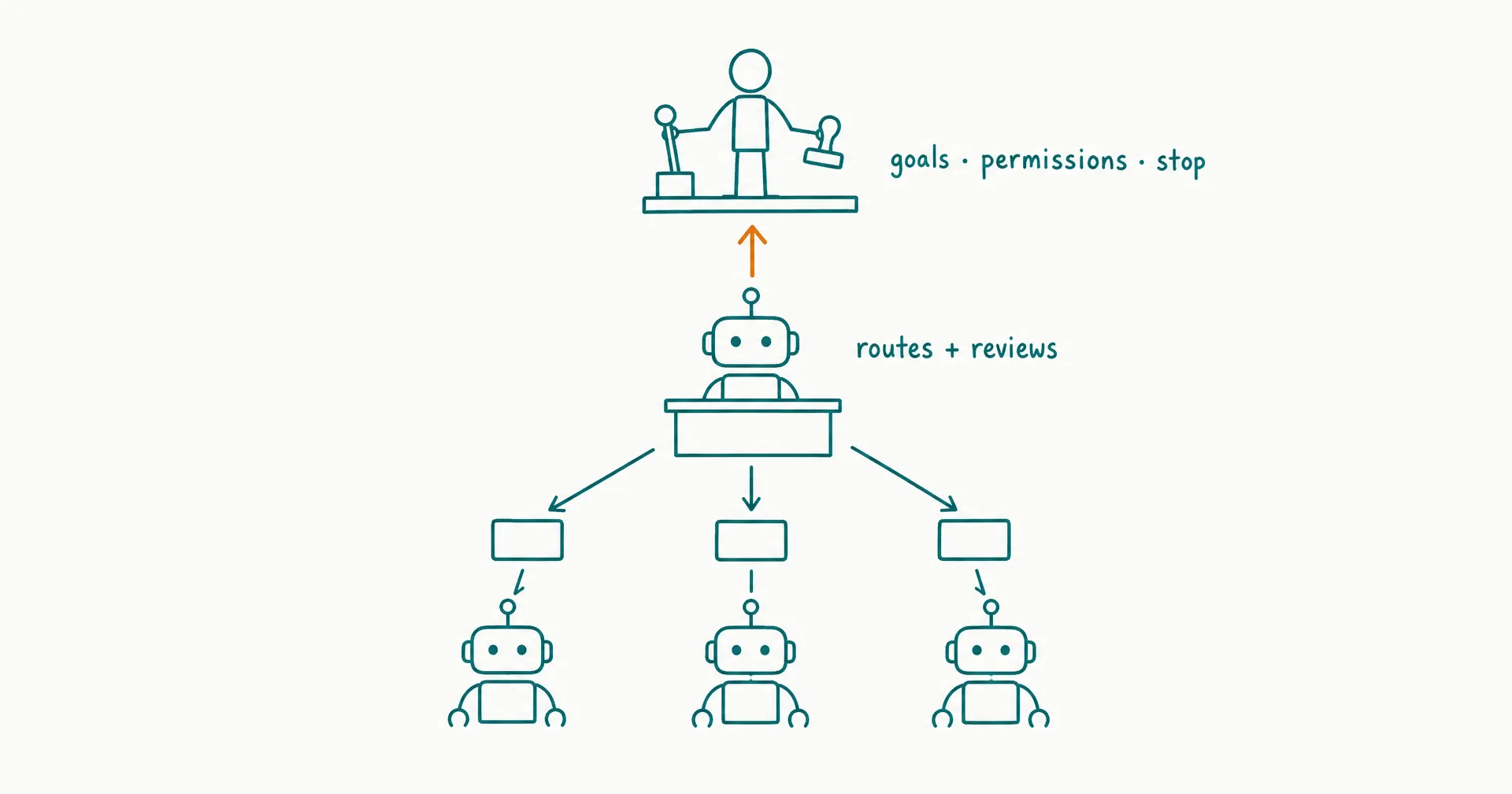
Yes - an AI employee can manage other AI employees when “manage” means bounded coordination: interpret an approved goal, decompose work, assign it to known roles, monitor durable task state, review evidence against a rubric, request repair, and escalate exceptions.
That does not make the AI manager an executive, employer, legal principal, or final accountable decision-maker. The human organization still owns objectives, risk tolerance, access, consequential approvals, performance standards, and intervention.
The practical question is not whether one model can tell another model what to do. It is whether the management loop produces better accepted outcomes without hiding errors, spreading authority, or turning one unreliable judgment into five downstream actions.
The broader AI organization operating model explains how roles, authority, evidence, and escalation fit together. The decision here is narrower: whether one specific coordination loop is safe to delegate.
On this page · 16 sectionsOpen
- What Does It Mean for an AI Employee to Manage Other AI Employees?
- When Can an AI Manager Safely Supervise Other Agents?
- What Should an AI Manager Be Allowed to Decide?
- What Is the Difference Between an AI Manager and an Orchestrator?
- Which Management Pattern Should You Use?
- How Should an AI Manager Assign Work?
- How Should an AI Manager Review Worker Output?
- How Do You Stop an AI Manager From Amplifying Worker Errors?
- What Must Stay Human-Owned?
- How Do You Evaluate an AI Manager?
- What Is a Safe Pilot for an AI Manager?
- When Should You Not Use an AI Manager?
- What Does CellCog’s AI Organization Example Actually Prove?
- What Is the Go/No-Go Checklist for AI Management?
- What Should the Human Review Each Week?
- Final Decision
- An AI manager is viable for bounded assignment, status monitoring, rubric-based review, repair requests, load balancing, and escalation - not open-ended organizational authority.
- Keep 6 decisions human-owned: goals, risk tolerance, permission policy, high-impact approval, exception judgment, and final accountability.
- Separate the manager’s coordination score from each worker’s domain score. A good artifact does not prove good management, and busy workers do not prove a useful manager.
- Treat every worker result as untrusted input until schema, provenance, permission, policy, and acceptance checks pass.
- Start with 1 manager, 2-3 workers, 1 workflow, 20-30 representative cases, reversible actions, and a defined shutdown condition.
- CellCog’s public example shows 1 human founder and 9 active AI Employees as of July 2026, including an AI Sales Lead managing 5 AI sales representatives. The reported 6x throughput and 1.5% bounce rate are first-party operating metrics, not universal benchmarks.
- Delegate coordination only when the AI manager itself can be evaluated, observed, interrupted, and replaced without losing control of the work.
§ 01What Does It Mean for an AI Employee to Manage Other AI Employees?
AI management is a control loop over work, not a job title.
| Management activity | AI manager may do it when bounded | Human remains responsible for |
|---|---|---|
| Interpret an approved goal | Goal, non-goals, constraints, and priority order are explicit | Choosing the business goal and risk appetite |
| Decompose work | Subtasks have typed outputs and stop conditions | Approving the operating model |
| Route assignments | Worker capabilities, access, load, and history are known | Deciding which roles may exist and connect |
| Monitor progress | State comes from durable task events | Defining intervention and shutdown thresholds |
| Review results | A testable rubric and evidence are available | Accepting high-impact or ambiguous outcomes |
| Request repair | Retry count, cost, and time are capped | Judging novel exceptions |
| Escalate | Named human route and packet are mandatory | Making the escalated decision |
| Rebalance capacity | Assignment changes are reversible and logged | Budget and workforce decisions |
The manager is therefore not “the smartest agent.” It is the role that owns a defined coordination outcome.
Management is more than delegation
A delegation call creates work. Management also answers:
- Was the right worker selected?
- Did the worker accept the assignment?
- Is the task blocked?
- Did the result meet the acceptance contract?
- Is rework worthwhile?
- Did authority remain inside policy?
- Should the task be escalated?
- Is the parent outcome actually closed?
If none of those decisions are visible, the system has a dispatcher, not a manager.
Management is less than human accountability
The AI manager cannot absorb the organization’s legal, ethical, financial, employment, or fiduciary obligations.
NIST’s AI Risk Management Framework calls for clear roles, responsibilities, lines of communication, human-AI oversight arrangements, and executive responsibility for deployment risk. An internal agent-to-agent reporting line does not move that responsibility away from people.
Management needs a closed loop
Use this minimum loop:
- receive approved goal;
- create bounded work;
- select an eligible worker;
- verify authority;
- obtain acceptance;
- observe state;
- receive an artifact and evidence;
- evaluate against a rubric;
- repair or escalate;
- record closure.
Remove any step and the “manager” may continue producing activity while the organization loses control.
§ 02When Can an AI Manager Safely Supervise Other Agents?
Use an AI manager when the management decisions are repetitive, observable, bounded, and reversible.
| Condition | Strong fit | Weak fit |
|---|---|---|
| Goal | One approved outcome with explicit constraints | Conflicting strategy that requires executive judgment |
| Work units | Typed tasks with known outputs | Open-ended responsibilities with unclear completion |
| Worker choice | Small eligible pool with capability records | Unknown agents discovered dynamically |
| Quality | Rubric, schema, source, or test can evaluate output | Taste, politics, relationship, or novel judgment dominates |
| Authority | Narrow read/draft/update scopes | Broad spend, deletion, publication, or account control |
| Failure | Detectable before material harm | Silent, delayed, or irreversible harm |
| Recovery | Retry, rollback, quarantine, or reassignment works | No practical reversal |
| Escalation | Named human can respond inside the deadline | No owner or response commitment |
A suitable first use case might be coordinating research briefs, content drafts, CRM-enrichment proposals, recurring reports, or internal support triage. A poor first use case is authorizing payments, making hiring decisions, publishing regulated advice, changing access policy, or negotiating a binding agreement.
The work must be decomposable
The manager must be able to create subproblems that are:
- mutually clear;
- collectively sufficient;
- small enough to evaluate;
- independent enough to avoid constant synchronization;
- assigned to a role with the right context and tools; and
- reassembled without losing provenance.
Anthropic’s description of its multi-agent research system shows why this matters. Its lead agent gives subagents an objective, output format, tool and source guidance, and task boundaries; vague assignments caused duplication and gaps in its early system.
The result must be inspectable
An AI manager should not approve a result because it is fluent or confident.
Require one or more of:
- machine-valid schema;
- cited source support;
- deterministic calculation;
- policy match;
- code test;
- reconciliation;
- duplicate check;
- approved style rubric;
- permission check;
- independent reviewer; or
- human acceptance.
The evaluator must see the artifact, evidence, and relevant constraints - not only the worker’s summary.
The action must be recoverable
A low-risk manager can reassign a draft or request a missing citation. A high-risk manager that sends, pays, deletes, publishes, grants access, or changes customer records needs stronger gates.
OpenAI’s practical guidance on building agents recommends human intervention when failure thresholds are exceeded and for sensitive, irreversible, or high-stakes actions. Use that as the floor, then add organization-specific controls.
§ 03What Should an AI Manager Be Allowed to Decide?
Split management decisions into 4 authority tiers.
| Tier | Decision type | Default authority | Example |
|---|---|---|---|
| 1 | Observe and recommend | AI manager may act | Identify stale task and propose reassignment |
| 2 | Reversible internal coordination | AI manager may act within policy | Assign a research brief to an eligible worker |
| 3 | Material but recoverable change | Human-approved policy or per-case approval | Update selected CRM fields after validation |
| 4 | Irreversible, external, regulated, or high-impact action | Named human approval | Send binding offer, make payment, delete records |
The practical design is action-specific. “Autonomous manager” is too coarse to be a permission.
Safe default decisions
The manager can usually:
- classify a task;
- choose among pre-approved workers;
- set a due time inside an approved service window;
- request clarification;
- pause work missing required inputs;
- compare a returned artifact with a rubric;
- request bounded rework;
- flag a conflict;
- assemble a status report; and
- escalate with evidence.
These are useful because they reduce coordination load without transferring final consequence.
Conditional decisions
Require a validated policy or approval for:
- changing task priority across business owners;
- moving sensitive data to another role;
- increasing token, tool, or financial budget;
- switching an approved source;
- overriding a specialist’s risk flag;
- sending external communications;
- editing a system of record;
- assigning work to a new agent; or
- changing the acceptance threshold.
The manager should be able to ask for authority, not manufacture it.
Human-only decisions
Keep people responsible for:
- organization strategy;
- risk tolerance;
- role creation and termination;
- credential and permission policy;
- binding commitments;
- employee or candidate decisions;
- regulated professional judgment;
- high-impact customer decisions;
- incident declaration;
- final exception acceptance; and
- changes to the manager’s own control policy.
An AI manager reviewing its own permission expansion is not oversight.
§ 04What Is the Difference Between an AI Manager and an Orchestrator?
The words overlap, but operating scope clarifies the decision.
| Pattern | Primary unit | Typical responsibility | Persistent role context | Best use |
|---|---|---|---|---|
| Router | One request | Select destination | Low | Intent routing |
| Orchestrator | One run or workflow | Sequence tools/agents | Low to medium | Technical execution |
| AI manager | Recurring portfolio of work | Assign, monitor, review, repair, escalate | Medium to high | Standing operational coordination |
| Human manager | People, goals, judgment, consequences | Strategy, coaching, accountability, exceptions | Full organizational context | Consequential leadership |
The distinction matters because a recurring manager needs workload state, worker history, policy context, escalation relationships, and performance evidence across runs.
A router does not own closure
A router answers “where should this request go?” It may never see the result.
An AI manager remains responsible for the coordination loop until the parent task is:
- accepted;
- rejected;
- canceled;
- failed;
- or escalated to a named human.
An orchestrator may be deterministic
If every step and branch is predictable, conventional workflow logic may be easier to test than a manager agent. Use model judgment only where language, context, or variable work actually requires it. The orchestration pattern catalog maps sequential, parallel, manager, and peer designs to those conditions.
A manager is not automatically a specialist
The manager should know enough to route and review. It does not need every specialist’s full context, tools, or action rights.
The permission model should attach authority to specific actions rather than inherit it through a reporting line.
§ 05Which Management Pattern Should You Use?
Choose among 4 practical patterns.
| Pattern | Control flow | Best when | Main risk |
|---|---|---|---|
| Manager-as-controller | Workers return results to one manager | One cohesive outcome needs one interface | Manager becomes bottleneck |
| Manager-as-reviewer | Workers execute from independent queues; manager reviews | Work is parallel and quality rules are stable | Review backlog |
| Manager-as-exception desk | Deterministic workflow handles normal path | Exceptions are rare and classifiable | Edge cases exceed policy |
| Human-manager with AI coordinator | AI prepares assignments and reviews; human confirms decisions | Consequence or ambiguity remains high | Human rubber-stamping |
Manager-as-controller
OpenAI describes a manager pattern in which a central agent calls specialized agents and synthesizes their results while retaining control of the user interaction.
Use it when:
- the final result must be coherent;
- workers act as bounded capabilities;
- the manager has the complete parent goal;
- external action stays centralized; and
- one coordinator can fit the necessary evidence in context.
Avoid it when the manager must ingest every worker’s raw history or when one slow worker blocks all progress.
Manager-as-reviewer
Use this when specialists can receive work from a durable queue and return independent artifacts.
The manager reviews:
- completeness;
- policy;
- evidence;
- format;
- duplicate work;
- conflicts;
- and acceptance.
This supports more parallelism but requires versioned artifacts and an explicit reviewer backlog.
Manager-as-exception desk
Keep normal routing and status deterministic. Ask the agent manager to interpret ambiguous cases, propose a resolution, or choose among pre-approved options.
This usually offers a better first deployment because:
- most work follows tested rules;
- the agent is invoked only where judgment adds value;
- exceptions are visible;
- human escalation is easy to preserve; and
- cost tracks actual ambiguity.
Human-manager with AI coordinator
The AI manager prepares:
- priority recommendation;
- assignment packet;
- conflict summary;
- rubric review;
- capacity forecast;
- and escalation options.
The human approves material changes. This pattern is useful when the coordination burden is high but decision consequences are not ready for autonomous management.
§ 06How Should an AI Manager Assign Work?
Routing needs evidence, not personality.
| Routing field | Required evidence | Reject assignment when |
|---|---|---|
| Capability | Tested task and output type | Role has only a title or generic prompt |
| Tool access | Approved tool/version list | Required tool is absent or overly broad |
| Data access | Allowed classification and purpose | Task includes disallowed data |
| Quality history | Recent accepted outcomes | Sample is missing or stale |
| Capacity | Active queue and deadline estimate | Worker cannot meet service window |
| Cost class | Expected run range and cap | Budget is unavailable |
| Independence | Conflict or prior role in artifact | Reviewer produced the work |
| Recovery | Retry/rollback path | Failure is not containable |
Write a typed assignment
Every assignment should include:
- parent task ID;
- requested outcome;
- reason for delegation;
- input references;
- allowed sources;
- required output type;
- definition of done;
- prohibited actions;
- permitted tools;
- sensitivity;
- budget;
- deadline;
- stop condition;
- escalation route; and
- acceptance requirement.
Do not tell a worker to “handle this.” The manager will later have no stable basis for review.
Require explicit acceptance
Acceptance should confirm:
- the worker understands the requested result;
- required inputs are available;
- the deadline is feasible;
- tools and data are permitted;
- conflicts are disclosed;
- and the worker knows when to escalate.
Silence is not acceptance. Starting tool use is not acceptance.
When the manager retains the parent outcome and expects a bounded contribution back, the agent delegation contract defines receiver eligibility, child authority, acceptance, return evidence, retries, and two-level closure.
For an actual ownership transfer, the AI agent handoff protocol defines the full packet, receiver inspection, acceptance event, atomic owner change, timeout, and failure states.
Prevent assignment loops
Enforce:
- maximum delegation depth;
- maximum active children per parent;
- task-level idempotency key;
- duplicate-intent check;
- cycle detection;
- retry cap;
- cost cap;
- and wall-clock deadline.
The AI employee collaboration guide covers the complete task, state, artifact, and closure mechanics between roles.
§ 07How Should an AI Manager Review Worker Output?
Review the acceptance contract, not the worker’s confidence.
Use a layered review
Apply checks in this order:
- identity and task match;
- schema and completeness;
- source and provenance;
- permission and policy;
- deterministic tests;
- domain rubric;
- contradiction and duplicate check;
- risk classification;
- acceptance or repair;
- human approval where required.
Cheap, deterministic failures should be caught before another model reviews the substance.
Separate repair from retry
A repair request should name:
- failed criterion;
- evidence of failure;
- allowed change;
- unchanged constraints;
- new version requirement;
- remaining time and budget;
- and next terminal action.
“Try again” encourages the same failure with more tokens.
Bind acceptance to an artifact version
Approval of version v2 must not authorize execution of v3.
Record:
- artifact ID;
- version;
- content hash where feasible;
- rubric version;
- reviewer identity;
- decision;
- exceptions;
- approval parameters;
- timestamp;
- and expiry.
This stops a worker or manager from changing the material result after review.
Escalate uncertainty, not just errors
Escalation triggers should include:
- conflicting authoritative sources;
- missing required data;
- policy ambiguity;
- unexpected sensitive information;
- novel tool request;
- confidence below a calibrated threshold;
- repeated repair failure;
- cost or time overrun;
- external dispute;
- and any high-impact action.
The manager’s job is not to eliminate escalation. It is to make escalation early, compact, and useful.
§ 08How Do You Stop an AI Manager From Amplifying Worker Errors?
Manager errors can multiply because one routing or review decision affects several workers.
| Amplification risk | What happens | Control |
|---|---|---|
| Bad decomposition | Every worker solves the wrong subproblem | Parent-goal completeness test |
| Wrong routing | Specialist lacks context or access | Capability registry and eligibility filter |
| Shared false assumption | Multiple workers repeat one error | Provenance and independent source check |
| Premature acceptance | Defect becomes downstream input | Version-bound rubric review |
| Permission propagation | Worker inherits manager authority | Separate identities and least privilege |
| Retry storm | Manager spends without learning | Capped repair loop and failure classification |
| Cascade | One compromised result triggers actions | Trust boundaries and circuit breaker |
| False closure | Subtasks finish but outcome fails | Parent-outcome acceptance |
Treat inter-agent output as untrusted
OWASP’s AI Agent Security guidance recommends trust boundaries, validation and sanitization of inter-agent communication, execution isolation, circuit breakers, structured outputs, and prevention of privilege escalation through agent chains.
Do not relax controls because the sender is “internal.”
Preserve independent checks
Three roles may produce one correlated error when the manager, worker, and reviewer all use:
- the same source;
- the same prompt;
- the same context;
- the same model;
- the same tool; and
- the same rubric.
Vary at least one meaningful dimension for high-value review.
Limit the blast radius
Set caps at:
- one task;
- one customer;
- one dataset;
- one channel;
- one time window;
- one financial amount;
- one worker group;
- and one action type.
A manager may coordinate five workers without receiving five workers’ combined permissions.
§ 09What Must Stay Human-Owned?
Human accountability should be visible on the operating chart and in the event log.
Use the four AI organization chart patterns to draw the accountable human, AI manager, specialists, approval gates, shared sources, escalation, and circuit breaker as separate nodes and edges.
| Human-owned control | Required record | Why it cannot disappear |
|---|---|---|
| Goal authorization | Approved objective and non-goals | The system should not choose its own mandate |
| Risk tolerance | Consequence tiers and thresholds | Business risk is not a model preference |
| Permission policy | Action/data/tool scopes | Reporting lines must not grant access |
| High-impact approval | Named approver and exact parameters | Consequence needs accountable judgment |
| Exception decision | Decision, rationale, and conditions | Novel cases exceed the tested policy |
| Incident command | Pause, containment, recovery owner | A manager may be part of the failure |
| Evaluation acceptance | Baseline and release decision | Self-measurement can hide regressions |
| Decommissioning | Revocation and state disposition | Dormant roles retain risk |
Name one accountable human
“The team” is not an owner.
For each management loop, record:
- accountable person;
- backup;
- escalation channel;
- response expectation;
- decisions they alone can make;
- and shutdown authority.
Make intervention operational
The human needs the ability to:
- pause new assignments;
- stop active tasks;
- revoke credentials;
- quarantine artifacts;
- freeze memory writes;
- block outbound actions;
- reassign ownership;
- inspect evidence;
- restore a prior version; and
- decommission the manager.
An escalation inbox without intervention controls is notification, not oversight.
Avoid approval theater
Human review fails when:
- the queue is too large;
- evidence is missing;
- the interface hides changes;
- the deadline pressures approval;
- the approver lacks domain context;
- or every recommendation looks the same.
Design the packet so a reviewer can see the decision, evidence, uncertainty, alternatives, and consequence without replaying the entire run.
§ 10How Do You Evaluate an AI Manager?
Evaluate the manager as a manager.
| Metric | Definition | Bad shortcut |
|---|---|---|
| Routing precision | Eligible assignments that reached the right role | Number of assignments |
| Decomposition completeness | Parent requirements covered by child tasks | Number of subtasks |
| First-pass acceptance | Worker artifacts accepted without repair | Worker output volume |
| False acceptance | Defective artifacts approved | Average model confidence |
| Escalation precision | Escalations that needed human judgment | Total escalations alone |
| Escalation recall | Known human-needed cases escalated | “No escalations” |
| Rework rate | Returned artifacts requiring correction | Retry count without cause |
| Duplicate-work rate | Overlapping tasks divided by assignments | Parallel-agent count |
| Closure integrity | Parent outcomes with all conditions satisfied | Child tasks marked complete |
| Cost per accepted outcome | Total manager + worker + review cost | Cost per run |
| Human intervention time | Reviewer minutes per accepted outcome | Human touches alone |
| Recovery success | Contained failures restored correctly | Absence of logged incidents |
The broader KPI hierarchy should still run from accepted outcome to quality, intervention, time, and cost.
Test ordinary and adversarial cases
A starter 24-case evaluation pack could include:
- 8 normal cases;
- 4 missing-input cases;
- 4 ambiguous-routing cases;
- 3 worker-failure cases;
- 2 permission-conflict cases;
- 2 contradictory-source cases; and
- 1 shutdown case.
The mix is a starting test design, not a benchmark. Replace it with the actual risks, frequencies, and consequences in your workflow.
Score both false acceptance and false escalation
A manager can look safe by escalating everything. It can look efficient by accepting everything.
Track both:
False-acceptance rate = defective artifacts accepted / defective artifacts reviewed.
Unnecessary-escalation rate = policy-resolvable cases escalated / cases escalated.
The release decision should consider quality, risk, reviewer load, time, and cost together.
Measure the system outcome
If research, writing, review, and publishing agents all meet local targets but the published page contains unsupported claims, the management loop failed.
The parent outcome - not local activity - is the final unit of acceptance.
§ 11What Is a Safe Pilot for an AI Manager?
Begin smaller than the proposed organization.
| Pilot element | Initial limit | Expansion evidence |
|---|---|---|
| Manager roles | 1 | Stable routing and escalation |
| Worker roles | 2-3 | Clear capability separation |
| Workflow | 1 | Repeatable accepted outcome |
| Representative cases | 20-30 | Enough normal and edge coverage to diagnose failures |
| External actions | Draft-only or reversible | Verified approval and rollback |
| Delegation depth | 1 | No loops or privilege spread |
| Repair attempts | 1-2 | Failure categories improve |
| Human accountable owners | 1 + backup | Response and intervention work |
Treat these as conservative starter limits, not universal safety thresholds. Expand only when your own evidence supports a larger scope.
Phase 1: shadow management
The AI manager:
- proposes decomposition;
- recommends routing;
- reviews copies of worker results;
- predicts accept/repair/escalate;
- and produces a management report.
The human still assigns and decides. Compare recommendations with actual decisions.
Phase 2: reversible coordination
Allow the manager to:
- create internal tasks;
- assign among pre-approved workers;
- request clarification;
- pause incomplete tasks;
- and request one bounded repair.
Keep external actions and material system changes behind approval.
Phase 3: bounded management
Expand only after:
- routing errors are understood;
- false acceptance is inside the approved threshold;
- escalation reaches the right person;
- duplicate work is controlled;
- budget caps hold;
- logs reconstruct decisions;
- and shutdown has been tested.
Use the same disciplined pilot method: baseline the old workflow, define acceptance, test several modes, and choose expand, contain, redesign, or stop.
Define terminal decisions
End the pilot with one of 4 decisions:
- Expand: evidence supports another worker or action scope.
- Contain: keep the current bounded loop.
- Redesign: change role, routing, evidence, or permission architecture.
- Stop: coordination debt or risk exceeds value.
“Promising” is not a terminal decision.
§ 12When Should You Not Use an AI Manager?
Do not add a manager merely because you have multiple agents.
One agent can still do the work
OpenAI recommends maximizing a single agent first because multiple agents introduce overhead. If one worker with clear tools and instructions can complete the outcome reliably, a manager creates another context boundary and another evaluator to test.
Work is tightly coupled
Avoid a manager-worker split when:
- every step depends on the prior step;
- all roles need nearly identical context;
- one cohesive voice or decision is required;
- splitting creates duplicate research;
- latency matters more than parallelism;
- or the manager must reproduce the full work to review it.
The outcome cannot be evaluated
If reviewers cannot define acceptable evidence, a manager agent will not solve the problem. It may simply make the uncertainty less visible.
Keep novel strategy, relationship work, sensitive judgment, and high-impact exceptions human-led.
Authority cannot be contained
Do not deploy when:
- agents share broad credentials;
- actions are not attributable;
- approvals are reusable or vague;
- downstream agents can expand scope;
- stop controls are absent;
- or rollback is impossible.
The organization is not ready for delegated management.
Coordination costs exceed the benefit
Count:
- manager inference;
- worker inference;
- context transfer;
- review;
- retries;
- waiting;
- observability;
- security controls;
- human intervention;
- and maintenance.
Parallel activity is not automatically cheaper or faster.
§ 13What Does CellCog’s AI Organization Example Actually Prove?
It proves that a vendor is publicly operating a manager-worker pattern. It does not prove that every workflow or customer should copy it.
As of July 24, 2026, CellCog’s public AI Organization page showed:
- 1 human founder;
- 9 active AI Employees;
- 1 AI Sales Lead;
- 5 AI sales representatives reporting to that lead;
- the Sales Lead moving from individual contributor on June 27 to manager on July 7;
- and the 5 representatives being added July 7-8.
CellCog reports that its Sales Lead transferred messaging, divided territories, answered rep questions, and coordinated the team. It also reports a 6x increase in outbound throughput and a 1.5% bounce rate after the team formed.
Treat the numbers correctly
Treat these figures as:
- dated first-party operating facts;
- one company’s workflow;
- one vendor’s own platform;
- not independently audited customer outcomes;
- not a randomized comparison;
- and not a general performance promise.
The useful evidence is the specificity of the reporting line, dates, roles, and coordination mechanics - not a universal ROI claim.
Translate the example into an evaluation contract
Before adopting the same structure, verify:
- What exactly can the manager assign?
- Which actions require approval?
- Which sources define messaging?
- How are territories and duplicates checked?
- What evidence accompanies a completed task?
- What happens when a worker disagrees or fails?
- Who can pause outbound work?
- Which person remains accountable?
- How are manager and worker quality evaluated separately?
The page shows a live pattern. Your deployment still needs its own controls.
Where CellCog fits
CellCog describes AI Employees as standing roles with goals, KPIs, memory, inboxes, task lists, schedules, approvals, and wake conditions. Its AI Organization example adds delegation, team memory, handovers, and manager roles.
That makes CellCog relevant when you want persistent employee-style coordination rather than a one-run orchestration graph. The buying test remains the same: verify the exact task state, permission, evidence, review, escalation, and intervention controls your use case needs.
§ 14What Is the Go/No-Go Checklist for AI Management?
Approve the pattern only when every critical answer is explicit.
Role and outcome
- The manager owns one named coordination outcome.
- Its non-goals are written.
- Worker roles have distinct tested capabilities.
- One human owns the complete outcome.
- Parent closure criteria are measurable.
Tasks and evidence
- Assignments use a typed packet.
- Workers explicitly accept.
- State is durable and observable.
- Results are versioned artifacts.
- Sources and tool actions are attributable.
- Review uses a versioned rubric.
Authority and risk
- Every action has an explicit permission.
- Manager and workers use separate identities where needed.
- Authority does not inherit through reporting lines.
- High-impact actions require a human.
- Delegation depth, retry, time, and cost are capped.
- A circuit breaker stops cascades.
Evaluation and intervention
- Normal and edge cases are represented.
- False acceptance is measured.
- Unnecessary escalation is measured.
- Logs can reconstruct a decision.
- A person can pause, revoke, quarantine, restore, and stop.
- Expand, contain, redesign, and stop criteria are defined.
If a critical box remains unchecked, keep the manager in shadow mode.
§ 15What Should the Human Review Each Week?
A weekly management review should inspect decisions, not read every agent transcript.
| Review view | Question | Evidence | Decision |
|---|---|---|---|
| Outcome | Did the parent work meet acceptance? | Accepted artifact and downstream result | Keep, repair, or reopen |
| Routing | Did work reach the right role? | Assignment and eligibility record | Change capability rule |
| Quality | What defects escaped the manager? | Human audit sample | Tighten rubric or lower autonomy |
| Escalation | Were exceptions raised early enough? | Escalation packet and response time | Change trigger or owner |
| Authority | Did any action approach or cross a limit? | Permission and tool log | Narrow access or add approval |
| Economics | Did coordination improve cost or elapsed time? | Total manager, worker, review, and retry cost | Expand, contain, or simplify |
| Drift | Did priorities, sources, or worker behavior change? | Version comparison | Revalidate the loop |
Review a risk-weighted sample rather than a convenient sample. Include completed work, repaired work, escalations, timeouts, cancellations, and apparently successful outcomes with unusually low evidence.
Ask 7 concrete questions
- Which accepted outcome would a human now reject?
- Which escalation could policy have resolved?
- Which non-escalated case should have reached a person?
- Which worker received a task outside its tested capability?
- Which source, rubric, or permission changed?
- Which retry repeated the same failure?
- Which control would have reduced the largest plausible consequence?
These questions expose false confidence better than an average “manager quality” score.
Sample by consequence
A weekly audit can review:
- all high-consequence actions;
- all permission denials;
- all human escalations;
- all second repairs;
- all manager overrides;
- a random sample of accepted low-risk work; and
- one end-to-end reconstruction from goal to closure.
The correct sample depends on volume and risk. The invariant is that rare, consequential paths must not disappear inside a random average.
Reauthorize after material change
Return the manager to shadow or approval mode when any of these changes:
- model;
- manager instructions;
- worker roster;
- tool definition;
- source-of-truth collection;
- permission;
- acceptance rubric;
- data classification;
- external channel;
- or business objective.
A passing evaluation belongs to a versioned system, not to the permanent label “AI manager.”
§ 16Final Decision
AI employees can manage other AI employees when management is designed as a bounded, observable, testable control loop.
Delegate:
- task decomposition;
- routing among approved roles;
- state monitoring;
- rubric-based review;
- bounded repair;
- and compact escalation.
Keep humans responsible for:
- goals;
- risk tolerance;
- permissions;
- consequential approval;
- novel exceptions;
- incidents;
- and final accountability.
If the manager cannot be evaluated independently, interrupted immediately, or replaced without losing task state, it is not ready to supervise other agents.
Use CellCog’s live AI Organization example as evidence that the pattern exists, then apply your own acceptance, authority, and intervention tests before you delegate coordination.
Q1Can an AI agent legally be a manager?
Software may coordinate work, but calling it a ‘manager’ does not make it a legal employer, officer, principal, or accountable person. Employment, regulatory, contractual, and corporate duties remain with the organization and qualified humans. Use ‘AI manager’ as an operating-role description, not a transfer of legal responsibility.
Q2How many AI employees should one AI manager supervise?
There is no evidence-based universal span. Calculate the limit from review sampling, exceptions, approvals, correction, task consequence, concurrency, and response deadlines. Begin with 2-3 workers in a limited pilot, then expand only if routing, review latency, false acceptance, escalation, cost, and human intervention remain inside your approved thresholds.
Q3Should the AI manager also perform specialist work?
Usually not as a default. Combining coordination and domain execution can create context overload, self-review, permission overlap, and unclear metrics. A small system may combine them temporarily, but record which mode produced each decision.
Q4Can an AI manager approve another agent's work?
It can accept low-risk, reversible work against a tested rubric. High-impact, irreversible, regulated, financially material, or ambiguous outcomes should require a named human or independently authorized reviewer. Bind every approval to the exact artifact version and action parameters.
Q5What is the biggest risk of AI managing AI?
Error amplification. One bad decomposition, source, permission decision, or acceptance can influence several workers and downstream actions. Reduce the blast radius with provenance, independent checks, separate identities, depth and budget caps, circuit breakers, version-bound approvals, and human intervention.
Q6What is the first management task to delegate?
Start with shadow routing and review for one repeatable internal workflow. Let the AI manager propose assignments, identify blockers, and score artifacts while a human makes the actual decisions. Move to reversible task creation only after the comparison shows useful accuracy and appropriate escalation.