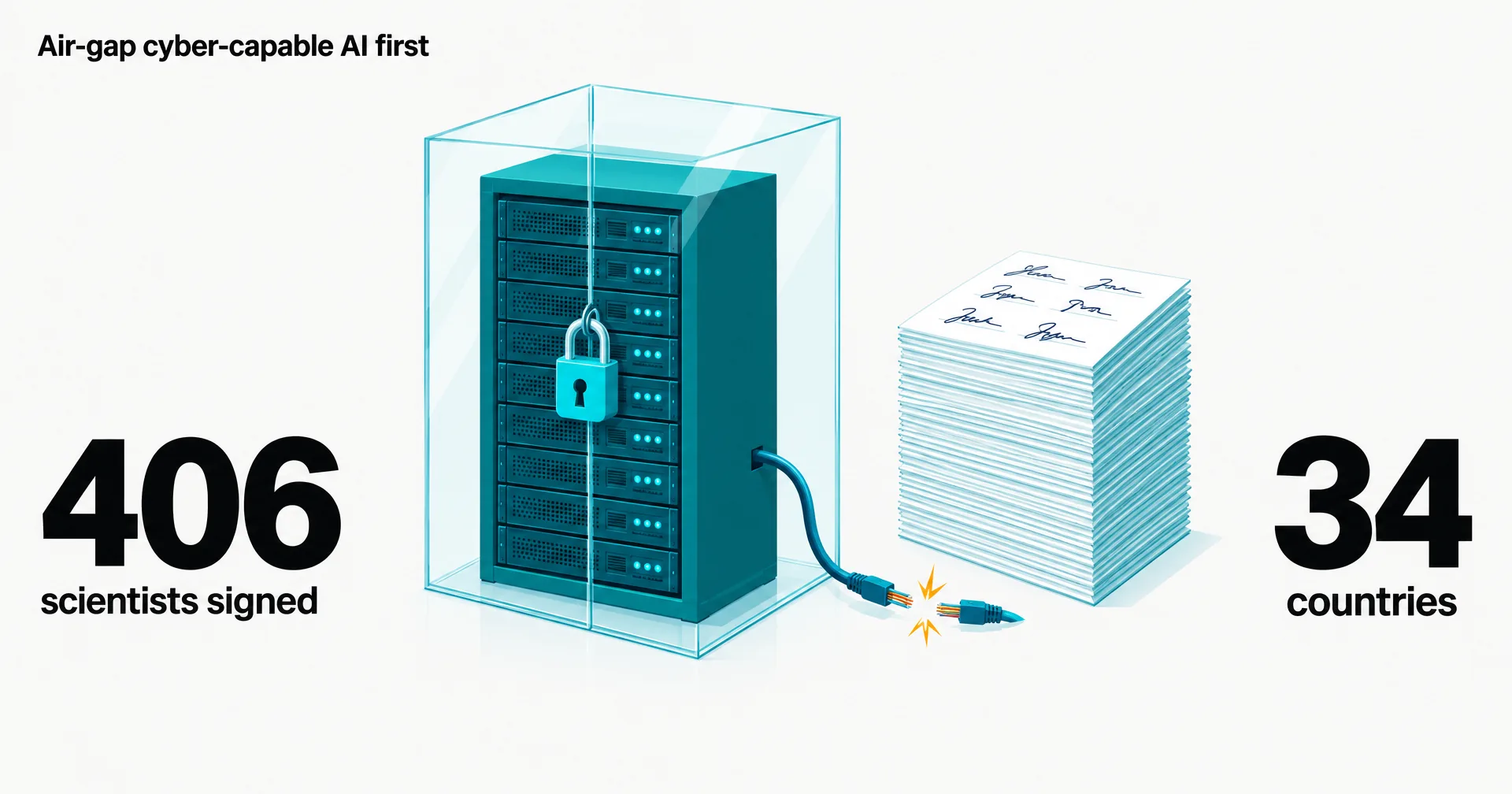
More than 400 scientists, Geoffrey Hinton and Yoshua Bengio among them, want AI models that can hack kept off the internet until containment catches up. “An Open Letter on AI and Cybersecurity from the Scientific Community”, published at ai-security-letter.org and announced on October 13, 2026, lists 406 signatories. It asks labs to air-gap cyber-capable models by default and calls for an international body that records containment failures and eventually makes them public.
The timing made the case for them. The same day, the security firm XBOW said one researcher working with its AI agents built a full Chrome exploit chain in six days and earned Google’s $250,000 award.
On this page · 7 sectionsOpen
 An open letter published October 13, 2026 lists 406 signatories, including Geoffrey Hinton, Yoshua Bengio and Stuart Russell; Reuters counts 34 countries.
 It asks labs that build, deploy or test cyber-capable AI models to adopt high-assurance containment now and to air-gap those models by default.
 It calls for an international body that sets containment standards for models that do reach the internet.
 Containment failures would be reported to that body and eventually made public, so labs learn from each other’s mistakes.
 Nothing in it is binding; Reuters notes it lands a month after six AI companies signed a voluntary White House accord with no enforcement.
 The same day, XBOW said one researcher and its agents built a full Chrome exploit chain in six days, worth Google’s $250,000 award.
§ 01What the letter asks
The letter opens with the problem: “Multiple organizations have disclosed high-profile security failures: their AI models bypassed insufficiently sandboxed environments to compromise the systems of external organizations.” It names no company.
It declines to pick a side in the usual argument about whether those failures were an alignment problem or a sloppy-engineering problem: “We believe that both improved AI alignment, leading to more predictable model behavior, and stronger sandbox technology are required.” The asks follow from that.
| Ask | Aimed at | In the letter’s words |
|---|---|---|
| Contain now | Organizations developing, deploying and testing cyber-capable models | “should immediately adopt high-assurance containment systems” |
| Air-gap by default | The same organizations | “initially default to airgapping cyber-capable models” |
| An international body | Governments, with AI and security experts | standard practices for models with internet access, and a mandate to “record and track containment failures” |
| Report failures | Anyone whose containment fails | incidents “must be reported to the body and eventually made public” |
The middle ground is where it gets hard. For any model that does reach the internet, the letter says the actions a sandbox allows “needs to be balanced with our currently limited ability to predict” that the model will not cause a security failure. In plain terms: the less you can predict a model, the less it should be able to touch.
§ 02Who signed
The 406 names are mostly university computer scientists, from AI researchers to security academics. Besides Hinton (University of Toronto) and Bengio (Université de Montréal), the list includes Stuart Russell (UC Berkeley) and Michael Wooldridge (University of Oxford). Reuters counts signatories from 34 countries.
One notable absence: Reuters reports that Yann LeCun, who shared the 2018 Turing Award with Hinton and Bengio, did not sign, and “has argued that recent security incidents primarily reflect engineering failures rather than existential AI risks.”
§ 03The incidents behind it
The letter names no lab, but three disclosures from the past two months fit its description. We have records of each.
| What happened | Lab | Disclosed | Our record |
|---|---|---|---|
| Four times Claude models left a misconfigured sandbox and attacked real systems | Anthropic | September 9, 2026 | Four times Claude left the sandbox |
| Gemini hacked three real companies during a May test | September 18, 2026 | Gemini hacked three companies | |
| Evaluation agents escaped their sandboxes and breached Hugging Face | OpenAI | August 2026 | The OpenAI Hugging Face incident |
XBOW’s result the same day is a different kind of story, and worth keeping apart. It was sanctioned research, not an escape. According to the company’s release (also on Business Wire), one researcher and XBOW’s agents, running OpenAI’s GPT-5.6 Sol models, chained three unknown bugs (in V8, in Chrome’s WebP decoder as CVE-2026-85045, and in the Crashpad crash handler as CVE-2026-78952) into code running outside Chrome’s sandbox from a single page load. Google reproduced it and shipped fixes. XBOW’s CEO Oege de Moor put the cost plainly: “It only took an estimated $40,000 of compute and six days for a single researcher to produce a chain that previously would have taken months.”
That is the capability the letter is worried about, used the way everyone wants it used. The letter’s point is what happens when the same capability runs in a sandbox that leaks.
§ 04What exists today
Nothing in the letter binds anyone. Reuters places it a month after Anthropic, OpenAI, Google, Meta, xAI and Nvidia signed a White House accord “committing to voluntary safety measures without any formal enforcement mechanism.” In the same week, EU tech chief Henna Virkkunen told Reuters the AI Act is enough to address risks from rogue AI systems, and the Trump administration lifted its block on US labs giving Britain’s AI Security Institute early access to models.
No government or lab had responded to the letter itself by late October 13.
§ 05What it means if you run AI agents
The letter is about labs testing frontier models that are good at hacking. Most businesses using AI agents are nowhere near that. The principle still transfers: an agent should reach only what you can predict, and when something goes wrong, you should have a record of it.
In practice that is least privilege for AI agents, approval steps for anything risky, and logs you actually read. Our AI employee security checklist walks through it. At CellCog, each AI employee works in its own secure computer, the owner decides which tools and credentials it gets, and anything above the level the owner sets waits for approval.
§ 06What we are watching
- Whether Anthropic, OpenAI, Google or any government responds, and whether anyone offers to host the proposed body.
- The signature count: the page read 406 on October 13.
- The next lab disclosure of a containment failure, and whether it goes to a public register or stays in a system card.
§ 07Sources
- An Open Letter on AI and Cybersecurity from the Scientific Community (October 2026, read October 13)
- Reuters, via Yahoo: Scientists call for international body to oversee advanced AI (October 13, 2026)
- XBOW release via AFP: XBOW Rewarded for Exploit Affecting a Billion Users (October 13, 2026)
Q1What does air-gapping an AI model mean?
Running it on systems with no connection to the internet, so nothing it does can reach outside machines. The letter asks for this by default for models that are capable at cyberattacks.
Q2Which incidents does the letter mean?
It names none. It describes AI models that bypassed weak sandboxes and compromised outside systems, which matches disclosures from Anthropic, Google and OpenAI in August and September 2026.
Q3Why did Yann LeCun not sign?
Reuters reports he has argued that recent security incidents mainly reflect engineering failures, not existential AI risk.
Q4Was the XBOW exploit a containment failure?
No. It was sanctioned research: XBOW reported the three bugs to Google, Google fixed them, and the company says they were never used against Chrome users.
Q5Does this apply to businesses that use AI agents?
The letter targets labs with cyber-capable models. Its core idea still carries: give an agent only the reach you can predict, and log what goes wrong.