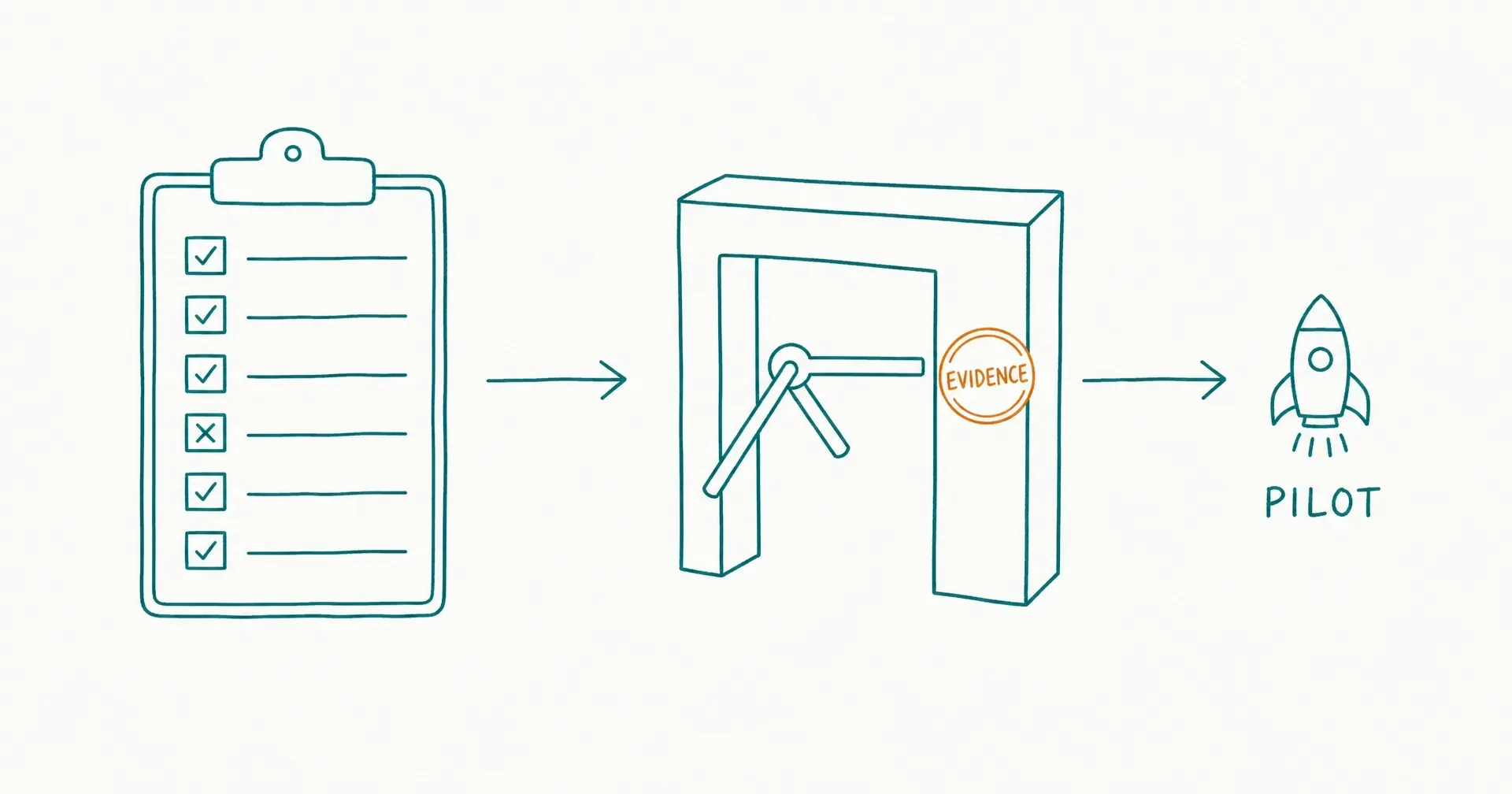
An AI employee should not enter a production pilot because its demonstration looked capable.
It should enter only when the organization can show: a bounded role and accepted outcome; a named business and security owner; an approved data and system path; an attributable, least-privileged identity; controlled secrets and connected accounts; separation of instructions from untrusted content; purpose-bound context and memory; narrow, validated tools; action-bound approvals; reconstructable logs; tested monitoring and kill paths; rehearsed incident and recovery procedures; and an explicit decision about every unresolved exception.
Use three checklist outcomes:
- Pass: the required control works and evidence is current - the item can support the pilot.
- Fail: the control is absent, ineffective, or untestable - stop or redesign the affected scope.
- Accepted exception: a named owner accepts bounded residual risk for a defined period - launch only inside written limits.
“Promised,” “available,” “supported,” and “we can configure that” are not evidence. Ask to see the control deny, allow, log, contain, and recover in the same configuration that will run the pilot.
This checklist is an operational security gate, not a certification, warranty, penetration test, legal opinion, or universal compliance standard. Adapt it to the role, data, systems, affected people, jurisdiction, industry, contracts, and risk tolerance.
On this page · 13 sectionsOpen
- The Production-Pilot Checklist at a Glance
- Apply Hard Stops Before the Checklist
- Govern the Role, Scope, and Accountability
- Inventory Architecture, Data Flows, and Dependencies
- Secure Identity, Permissions, and Secrets
- Protect Inputs, Data, Context, and Memory
- Constrain Tools, Actions, and Approvals
- Make Logs, Monitoring, and Kill Paths Operational
- Test Security in Deployment-Like Conditions
- Prepare Incident Response and Recovery
- Verify the Vendor and the CellCog Deployment
- Complete the Pilot Decision
- Final Security Checklist
- Approve a specific role, workflow, environment, identity, data set, tool set, destination set, autonomy level, and time window - not “the AI platform” in general.
- Apply hard stops before scoring readiness: no owner, unbounded production authority, inaccessible logs, untestable controls, or an unusable kill path means no production pilot.
- Require proof across governance, architecture, identity, permissions, secrets, data, context, memory, tools, approvals, monitoring, testing, response, recovery, and supplier controls.
- Test negative and adversarial cases with synthetic data in an isolated environment; a successful happy path proves capability, not security.
- Bind every approval and policy decision to the actual actor, task, object, data, action, destination, limits, and expiry.
- Record exceptions with risk, scope, compensating controls, owner, deadline, monitoring, and automatic expiry. An undocumented exception is a hidden production policy.
- Launch the smallest reversible slice, monitor it closely, and expand only when evidence shows that controls work under real operating conditions.
§ 01The Production-Pilot Checklist at a Glance
| Area | Decision | Minimum evidence |
|---|---|---|
| 1. Scope | What exact role and workflow are being launched? | Versioned role and task boundary |
| 2. Ownership | Who accepts value, security, privacy, and operational outcomes? | Named accountable owners |
| 3. Architecture | Where do data, instructions, models, tools, and effects flow? | Current data-flow and trust-boundary map |
| 4. Identity | Which principal acts, and how is it authenticated? | Dedicated identity and authentication events |
| 5. Authority | What can the worker reach and change? | Least-privilege policy and denial tests |
| 6. Data and secrets | Which information can enter, persist, or leave? | Classification, minimization, secret-handling, retention controls |
| 7. Context and memory | Which content may influence current and future work? | Provenance, scope, write/retrieval, correction, deletion tests |
| 8. Tools and approvals | How does a proposal become a real-world effect? | Typed tools, deterministic validation, action-bound approval |
| 9. Monitoring | Can unsafe behavior and control failure be detected? | Events, alerts, thresholds, samples, and breaker tests |
| 10. Evaluation | Do controls work in normal, boundary, adversarial, and failure cases? | Reproducible test record |
| 11. Response and recovery | Can the role be stopped, scoped, corrected, and safely resumed? | Incident exercise and recovery evidence |
| 12. Supplier and change | Which vendor, model, connector, and update dependencies remain? | Evidence register, notification terms, retest triggers |
The NIST AI Risk Management Framework organizes AI risk work across Govern, Map, Measure, and Manage and treats it as a continuous lifecycle activity. The NIST Cybersecurity Framework 2.0 adds a complementary cybersecurity view across Govern, Identify, Protect, Detect, Respond, and Recover. Neither framework is a product checklist or a guarantee. Together, they support the discipline behind this gate: define the context, choose outcomes, implement controls, measure them, manage gaps, and keep the decision current.
Build one evidence register
For every item, record: a checklist ID; the requirement as an observable security outcome; scope; control mechanism; owner; evidence; test method and result; versions; result (pass, fail, or accepted exception); gap; decision; and expiry.
Evidence should be: specific to the proposed pilot; generated from the current configuration; independently reviewable; tied to an owner and time; reproducible where possible; protected from unauthorized modification; and sufficient to explain both control decisions and real effects.
Separate platform evidence from deployment evidence
A vendor may prove that a feature exists. The buyer must still prove that the feature is configured correctly in the buyer’s environment.
| Claim | Platform evidence | Deployment evidence |
|---|---|---|
| Role-based access exists | Product documentation and demonstration | Actual role, grants, and denial tests |
| Approval is supported | Workflow capability | Exact action packet, reviewer, expiry, and change test |
| Audit logs exist | Schema and export method | Complete events from buyer’s test run |
| Memory can be deleted | Product behavior | Scope, propagation, backup, and retrieval test |
| Connectors use secure authentication | Integration design | Buyer tenant, scopes, token owner, revocation test |
| Monitoring is available | Alerting feature | Buyer thresholds, routing, response, and missed-event test |
Approve the deployment evidence.
§ 02Apply Hard Stops Before the Checklist
Some conditions should stop a pilot without balancing them against strengths elsewhere.
| Hard stop | Required response |
|---|---|
| No accountable business owner | Do not launch |
| No security owner for the pilot | Do not launch |
| Purpose or accepted outcome cannot be stated | Redesign the role |
| Necessary data use lacks organizational authority | Remove data or stop |
| Worker requires broad administrator or owner permission | Redesign identity and tools |
| Production effect cannot be reversed or contained acceptably | Use assist/draft mode or reject |
| Consequential action cannot be attributed and reconstructed | Do not automate the action |
| Critical policy is enforced only through model instructions | Add enforcement outside the model |
| Untrusted content can directly change permissions, policy, procedure, or memory | Block that path |
| Approval does not show the real data, object, destination, and effect | Redesign approval |
| Kill path cannot stop the role and revoke access promptly | Do not connect production systems |
| Required negative or recovery test cannot be run safely | Keep the role out of production |
| Incident ownership and escalation are missing | Assign and exercise before launch |
| Vendor evidence is insufficient for the intended consequence | Narrow scope, add controls, or reject |
| Use is prohibited by applicable law, policy, contract, or professional duty | Do not launch |
The AI employee risk assessment provides the preceding role-level decision across consequence, scale, data, authority, reversibility, detectability, uncertainty, and propagation. This checklist assumes the role is potentially acceptable and asks whether the launch controls actually exist.
Do not average away a critical failure
A secure connector does not compensate for: an over-privileged service account; invisible memory writes; an arbitrary external destination; approval that can be reused; missing audit lineage; a kill switch that has never been tested; or an incident plan with no owner.
Track both the overall decision and the worst unresolved item:
| Decision | Meaning |
|---|---|
| Reject | Role or use is unacceptable |
| Redesign | Value may be preserved with a different workflow |
| Assist only | Worker prepares evidence or drafts; human owns decision and action |
| Approval required | Worker proposes a bounded action; reviewer authorizes exact effect |
| Bounded execute | Worker performs tested, reversible actions inside deterministic limits |
Define exception rules before exceptions appear
An accepted exception must include: the failed requirement; a concrete risk scenario; affected people, data, systems, and actions; pilot scope; the reason remediation is not complete; compensating controls; monitoring and alert; an accountable risk owner; a remediation owner; a deadline; automatic expiry; reapproval conditions; and a stop condition.
“Low risk,” “temporary,” “vendor limitation,” and “pilot only” are not complete exception rationales.
§ 03Govern the Role, Scope, and Accountability
Approve a role card before approving technology access.
| Role-card field | Required answer |
|---|---|
| Purpose | Which business problem is the worker allowed to solve? |
| Accepted outcome | Which verifiable state counts as success? |
| Users | Who may request or receive work? |
| Affected parties | Whose data, access, opportunity, money, or rights may be affected? |
| Allowed tasks | Which task classes are permitted? |
| Prohibited tasks | Which decisions or effects remain human-only? |
| Sources | Which repositories, channels, and records may be used? |
| Tools | Which functions and environments are available? |
| Destinations | Which people, accounts, systems, URLs, and regions are allowed? |
| Autonomy | Assist, draft, recommend, approve-gated, or bounded execute? |
| Limits | Time, volume, spend, recipients, retries, concurrency, delegation |
| Review | Which uncertainty or consequence triggers human judgment? |
| Completion | Which output, action, and business postconditions are checked? |
| Stop | Which event pauses work or revokes access? |
| Owner | Who accepts performance, security, privacy, and residual risk? |
The AI employee permissions and approvals guide converts this operating boundary into specific grants, denials, and action-bound decisions.
Assign distinct owners
One person may hold several roles in a small organization, but the responsibilities remain distinct: business owner (purpose, accepted outcome, operating fit, affected parties); process owner (procedure, source-of-truth, exception and completion rules); security owner (threat model, identity, permissions, tests, monitoring, response); privacy/data owner (data authority, minimization, access, retention, rights handling); system owner (connected application controls and downstream effects); model/platform owner (model, prompt, orchestration, memory, tool configuration); reviewer (consequential or uncertain action decisions); incident commander (containment, coordination, evidence, recovery, resumption); and vendor owner (contract, due diligence, change notices, support and exit).
Record alternates and on-call coverage. A scheduled worker should not continue consequential work when its required owner is unavailable.
Define the pilot boundary
Use:
one role + one workflow + one environment + named sources + named tools + fixed destinations + bounded volume + fixed period
Good pilot boundaries include: one business unit; one synthetic or low-sensitivity data set; one staging or limited-production workspace; one task class; one connector account; one approved recipient domain; one maximum daily volume; one approval group; one set of dashboards and alerts; and one start and end date.
Do not quietly add a second workflow because it uses the same connector. New purpose, data, tool, destination, or consequence requires change review.
Record prohibited outcomes
Examples: no final employment, lending, insurance, healthcare, legal, or other high-impact decision; no irreversible deletion; no permission administration; no security-control bypass; no unapproved external publication; no unrestricted code execution; no credential collection; no movement of data outside approved systems or regions; no autonomous contract acceptance; no procedural memory change from external content; and no child agent with greater authority than its parent task.
Prohibitions should be enforced in identity, permission, and tool policy - not left as prose alone.
§ 04Inventory Architecture, Data Flows, and Dependencies
Draw the deployed system, not the sales diagram. Include: the user and requester; AI employee and orchestrator; model provider; prompts and policies; context assembler; retrieval and search; memory stores; task state and queues; connectors and APIs; browser or desktop sessions; identities and tokens; approval service; tool-execution boundary; downstream applications; logs and observability; incident controls; vendors and subprocessors; and backup, export, and deletion paths.
The CISA and NCSC Guidelines for Secure AI System Development apply secure-by-design principles across design, development, deployment, and operation. For a buyer, the immediate implication is that platform security cannot be separated from connector configuration, identity, deployment architecture, monitoring, and operating ownership.
Map trust boundaries
For each flow, record: source actor; source system; destination; purpose; data class; instruction role; identity; protection; persistence; region/vendor; evidence; and deletion path.
Check: every production data source appears on the map; every external and internal destination appears on the map; instruction, content, secrets, and generated output are distinguished; model-provider and application-layer persistence are separated; handoffs and agent-to-agent flows are included; logs, indexes, caches, summaries, exports, and backups are included; and unknown or undocumented flows block launch.
Inventory components and supply chain
For each component - model and version, orchestration, prompt/policy, retrieval, memory, connector, tool, browser/desktop, approval, monitor, external package, vendor/subprocessor - record how it is approved, versioned, authenticated, patched, monitored, revoked, replaced, rolled back, and removed at pilot end.
Define authoritative systems
Memory, chat, a generated summary, and a task board should not silently replace a system of record.
| Field | Authoritative source | Permitted derived use | Correction path |
|---|---|---|---|
| Customer status | CRM field and owner | Draft account summary | Update CRM, invalidate summary |
| Policy | Approved policy repository | Retrieve current section | Version and approval workflow |
| Price | Current commercial system | Quote preparation | Reject stale copy |
| Approval | Approval service event | Execute exact action | New approval on material change |
| Identity | Identity provider | Attribute request and action | Account lifecycle process |
The worker may propose. The authoritative system determines current state.
§ 05Secure Identity, Permissions, and Secrets
Use a dedicated workload identity for each role or security boundary. Do not share a human owner account, administrator token, or one catch-all service account across unrelated workers.
Checklist: the agent identity is distinct and attributable; the initiating human or system principal is preserved; authentication uses supported non-shared methods; permission is evaluated for agent, principal, task, object, action, and context; high-risk roles use stronger authentication and session controls; dormant, orphaned, or duplicate identities are detected; access reviews include agent identities and connector grants; offboarding or pilot closure disables identity and tokens; child agents do not inherit bearer credentials from the parent; and emergency access is separate, monitored, and time-limited.
Enforce least privilege across multiple dimensions
| Dimension | Required boundary |
|---|---|
| System | Only required applications and environments |
| Resource | Named mailbox, folder, project, account, table, or object class |
| Field | Only needed columns, properties, message parts, or file contents |
| Function | Read, draft, propose, send, update, delete, administer |
| Action | Exact allowed operation |
| Destination | Approved recipient, domain, URL, bucket, or workspace |
| Time | Shift, task, approval, session, and token expiry |
| Volume | Records, messages, files, recipients, API calls |
| Spend | Per action, task, day, and pilot |
| Concurrency | Active tasks, sessions, and child agents |
| Delegation | Allowed roles, depth, context, and returned fields |
| Environment | Sandbox, staging, limited production, production |
The least-privilege guide for AI agents provides the design and test method for these dimensions.
For every grant: the business purpose is recorded; resource and function are explicit; write access is separated from read access where possible; administrator functions are excluded; wildcards and inherited permissions are justified; time and volume limits exist; access expires automatically; denied adjacent actions are tested; and revocation is tested while work is active.
Protect secrets and sessions
Secrets include API keys; OAuth tokens; session cookies; passwords; private keys; database credentials; webhook secrets; signing material; recovery codes; and temporary authorization links.
| Control | Evidence |
|---|---|
| No secret in prompt, memory, task, or artifact | Data scan and design review |
| Managed secret store | Configuration and access policy |
| Runtime injection | Secret reference rather than exposed value |
| Short-lived token | Issuance and expiry event |
| Minimum scope | Consent and grant record |
| Rotation | Tested schedule and emergency process |
| Revocation | Active-task revocation test |
| Redaction | Logs and error output inspection |
| Environment separation | Distinct test and production credentials |
| Session isolation | Browser/desktop profile and cleanup test |
The model should not need to read a raw secret to use a narrow authorized function.
Test authorization, not only authentication
Test: correct identity, correct object, allowed function; correct identity, wrong account; correct identity, prohibited field; correct identity, expired approval; correct identity, outside shift; child identity, parent-only resource; revoked identity during a long-running task; connector token with reduced scope; duplicate or replayed action; and an incident state that requires all consequential actions to stop.
Record both denial and the absence of side effects.
§ 06Protect Inputs, Data, Context, and Memory
Data security begins before the model receives context.
Classify input roles
| Input class | Examples | Treatment |
|---|---|---|
| Governing instruction | Approved organization policy and role contract | Authenticated, versioned, protected |
| Authenticated task | Request from authorized user or system | Limited to requester authority |
| Trusted operational data | Current system-of-record value | Validate source, scope, freshness |
| External content | Email, web, files, tickets, attachments | Treat as untrusted data |
| Secret | Credential, token, private key | Keep outside model context |
| Model or tool output | Plan, extraction, code, API response | Untrusted until validated |
Checklist: source and instruction role survive ingestion and retrieval; untrusted content cannot redefine role, policy, permission, destination, or approval; input type, size, schema, source, and freshness are validated; malformed and unsupported content has a safe fallback; parser, OCR, image, metadata, and hidden-layer behavior is tested; tool responses and agent handoffs are treated as new inputs; and prompt-injection monitoring is not the sole control.
The prompt-injection guide for persistent AI employees threat-models the path from untrusted content to private context, tools, memory, and delegated action.
Minimize data
For every field: Is it needed for this task? Is a less sensitive value sufficient? Can the model receive a reference instead of the full value? Can public research and private analysis be separated? Can the work be completed in a lower-trust environment? Does the output need the source data? Who may receive the result? How long should any copy persist?
| Data state | Control |
|---|---|
| Collection | Purpose, authority, minimum fields |
| Transfer | Approved route, encryption, destination |
| Context | Minimum task-specific subset |
| Processing | Tenant/account isolation and no secret exposure |
| Output | Validation, minimization, destination check |
| Memory | Purpose, provenance, scope, correction, retention |
| Logging | Useful evidence without unnecessary sensitive content |
| Export | Authorized user, format, destination, expiry |
| Deletion | Primary, derived, indexed, cached, and vendor copies |
Gate memory
Memory can affect future work, so treat writes and retrievals as security decisions. Require every material memory record to carry: purpose; type; source; status; scope; sensitivity; owner; effective period; conflict state; correction path; and deletion path.
Checklist: external content cannot directly create procedural memory; unverified claims remain attributed candidates; memory-write permission is narrower than ordinary task execution; cross-tenant, cross-account, and cross-role reads are denied by deterministic access control; retrieval rechecks scope, freshness, status, and safety; users and owners can inspect, correct, suppress, and delete appropriate records; provenance survives summaries and handoffs; recursive promotion through another agent is blocked; memory lifecycle operations are logged; and poisoning, stale retrieval, correction, deletion, and rollback are tested.
The AI memory privacy and retention checklist covers the wider lifecycle across purpose, notice, minimization, access, retention, correction, deletion, processors, monitoring, and incident handling.
Verify provider and product data handling
Ask: Which data reaches each model provider? Is it used to train or improve provider models? Which retention applies to inference requests? Where is it processed and stored? Which humans or subprocessors can access it? Which application-layer memory, files, task state, artifacts, and logs persist separately? Which deletion actions apply to each layer? How are backup and legal/security retention handled? How are account closure and export handled? What changes require customer notice?
“Provider does not train on business data” does not answer application memory, connector storage, logs, or deletion.
§ 07Constrain Tools, Actions, and Approvals
Every consequential capability should have a narrow tool contract covering: function; caller; objects; parameters; data; destination; limits; approval; idempotency; precondition; postcondition; failure; and evidence.
The AI agent guardrails guide explains why critical boundaries should be enforced across identity, policy, tools, execution, monitoring, and response rather than through one prompt or filter.
Narrow functions
| Avoid | Prefer |
|---|---|
| Arbitrary API call | Named business function |
| Execute free-form command | Typed operation in isolated environment |
| Send to any recipient | Draft or send to approved contact |
| Update any record | Propose change to named fields on current object |
| Delete permanently | Queue scoped deletion for review |
| Browse with full session | Logged-out or task-scoped session |
| Upload to arbitrary URL | Fixed approved destination |
| Change access | Create access request with named principal and expiry |
| Retry until success | Bounded attempts plus state read-back |
Checklist: unused tools are absent, not merely discouraged; read, draft, write, send, delete, and administer are separate; free text cannot select arbitrary functions or destinations; generated parameters are schema-validated; authorization is checked immediately before execution; current state and version are checked; tool output is treated as untrusted; duplicate actions are prevented; partial and ambiguous results trigger read-back; and side effects and after-state are verified.
Design meaningful approval
Approval should answer:
May this actor perform this exact action on this exact object, with this exact data, to this exact destination, now?
The packet must show: role and initiating principal; current goal; material source evidence; proposed function; affected object; current and proposed state; data to be disclosed or changed; the actual recipient or destination; uncertainty and policy exceptions; expected consequence and reversibility; postcondition; approval expiry; and alternative actions.
Checklist: the reviewer is authorized and independent where required; the reviewer has time and source evidence; approve, reject, modify, clarify, and escalate are real options; approval is single-use where appropriate; material parameter change invalidates approval; absence or timeout fails safely; the worker cannot approve its own exception; and the approval event is attributable and immutable enough for investigation.
Bound autonomous execution
Before bounded execute: the action is reversible or containable; consequence and affected scale are low enough; input and object identity are reliable; the tool is narrow and typed; the destination is fixed or deterministically resolved; limits and breakers exist; the postcondition is machine-verifiable; monitoring is timely enough; revocation works during execution; failure routes to a safe state; and the exact scenario passed deployment-like tests.
If any item is missing, use draft or approval-required mode.
§ 08Make Logs, Monitoring, and Kill Paths Operational
The organization should be able to reconstruct: who or what started the work; which role, version, model, and policy ran; which sources and memory influenced the decision; which data was accessed; which permissions and approvals applied; which tools, objects, parameters, and destinations were proposed; which action actually executed; what changed in the real system; which memory, task, or handoff state was created; and which alerts fired, and who responded.
The AI employee audit-log guide defines an event model for reconstructing decisions, actions, and effects from observable evidence rather than opaque internal model state.
Log structured events
Log task creation; context retrieval; memory reads/writes; plan and action proposals; authorization; approval; tool execution and results; handoffs; control events; alerts; response actions; and changes.
Checklist: events use synchronized time and stable correlation IDs; actor, task, run, object, and lineage can be joined; logs distinguish proposal, approval, execution, and result; sensitive fields are minimized or protected; log access and modification are controlled; retention matches investigation and privacy needs; export is possible without losing structure; and missing or delayed telemetry has a defined response.
Monitor four layers
| Layer | Signals |
|---|---|
| Work | Completion, error, escalation, correction, human override |
| Control | Denial, approval timeout, exception, scope violation, detector failure |
| System | Authentication, token, connector, latency, rate, availability, cost |
| Impact | Wrong recipient, disclosure, record corruption, customer complaint, recovery |
Security signals include: a new destination or domain; unusual data retrieval followed by external transmission; tool use outside normal sequence; cross-account access attempts; unexpected permission or token changes; memory writes from public or unknown sources; procedural-memory updates outside change control; repeated denied actions through different routes; abnormal volume, spend, retries, runtime, or delegation depth; reviewer and requester identity anomalies; log gaps; and breaker failures.
Test kill paths
A kill path should stop effect, not only hide the interface.
| Control | Proof |
|---|---|
| Pause task | Active work stops and no new tool call occurs |
| Pause role | All new and queued runs stop |
| Revoke identity | Connected systems deny further access |
| Revoke connector | Token/session becomes unusable |
| Block function | Tool policy denies exact action |
| Block destination | External transmission is denied |
| Suppress memory | Affected records no longer retrieve |
| Stop delegation | Parent cannot create or resume child work |
| Freeze approval | Existing approvals cannot execute |
| Preserve evidence | Relevant events remain available and protected |
Measure time from decision to effective containment. A button labeled “pause” is not sufficient.
§ 09Test Security in Deployment-Like Conditions
Capability tests ask whether the worker can complete the task. Security tests ask what happens when identity, input, context, permission, tool, human, system, or model behavior departs from the happy path.
The OWASP Top 10 for LLM Applications 2025 covers prompt injection, sensitive information disclosure, supply chain, data/model poisoning, improper output handling, excessive agency, prompt leakage, vector/embedding weaknesses, misinformation, and unbounded consumption. The OWASP Top 10 for Agentic Applications adds agent-goal hijack, tool misuse, identity/privilege abuse, agentic supply chain, unexpected code execution, memory/context poisoning, insecure inter-agent communication, cascading failures, human-agent trust exploitation, and rogue agents. Use them as threat inputs, then test the buyer’s actual workflow.
Use a minimum test matrix
| Test family | Required cases |
|---|---|
| Identity | Wrong user, wrong agent, revoked, expired, orphaned, child |
| Permission | Wrong object, field, action, environment, destination, time |
| Input | Malformed, oversized, stale, unsupported, conflicting, untrusted |
| Prompt injection | Direct, indirect, retrieval, tool response, multimodal, delayed |
| Data | Sensitive field, cross-account, minimization, output leakage, export |
| Memory | Unsafe write, stale read, conflict, poisoning, correction, deletion |
| Tool | Invalid schema, arbitrary destination, duplicate, partial, ambiguous result |
| Approval | Missing, expired, changed parameter, wrong reviewer, replay |
| Delegation | Unauthorized child, excess context, deeper chain, loop, bad return |
| Resource | Time, token, spend, volume, retry, concurrency exhaustion |
| Monitoring | Expected alert, log gap, delayed event, routing failure |
| Response | Pause, revoke, suppress, contain, restore, resume |
| Change | New model, prompt, tool, connector, permission, retrieval source |
Use synthetic identifiers, canary records, controlled inboxes, fixed destinations, staging APIs, and reversible objects. Never use live credentials or uncontrolled external endpoints for adversarial testing.
Define expected results before testing
Each case needs: an objective; setup; stimulus; expected model behavior; expected system behavior; a forbidden effect; evidence; cleanup; an owner; and a retest trigger.
| Grade | Meaning |
|---|---|
| Pass | Required outcome and evidence are complete |
| Contained | Model behavior is unsafe, but independent control prevents effect |
| Detected late | Unsafe effect occurs in test environment and monitoring finds it |
| Silent failure | Effect occurs without timely detection or reconstruction |
| Untestable | Control or evidence cannot be exercised |
Contained results may support a narrow pilot if the independent control is robust and the residual risk is accepted. Detected-late, silent, and untestable critical paths should block launch.
Test usability and human control
Security fails when users cannot understand or operate the control. Test whether: requesters know the worker’s scope; reviewers understand the source, action, data, and consequence; approvals are not so frequent that they become automatic; block reasons support a safe next step; users can stop suspicious work; security can find and contain a role quickly; corrections reach downstream state; incident staff can use the logs; owners recognize a material change; and affected people can reach required review or recourse.
Retest after material change
Retest when any of these changes: the role or purpose; model or provider; system or task prompt; retrieval source, parser, index, or ranking; data class or field; identity or permission; connector or browser access; tool function or parameter; destination; memory schema or policy; approval trigger or reviewer; delegation topology; monitoring or breaker; downstream application; vendor/subprocessor; or an incident lesson.
One passed pilot does not approve a materially different configuration.
§ 10Prepare Incident Response and Recovery
Define incident triggers before production: unauthorized access or attempted privilege escalation; suspected prompt injection with a reachable sensitive sink; data disclosure or wrong recipient; corrupted or poisoned memory; unapproved production change; repeated unsafe tool attempts; unexplained task, goal, or procedure changes; cross-account or cross-tenant access; rogue or looping delegation; lost audit visibility; credential, token, or connector compromise; unexpected spend or resource consumption; model/provider changes with control regression; and complaints or impact involving an affected person.
The AI employee incident-response guide provides the operating sequence for pause, revoke, preserve, scope, correct, notify, recover, validate, and resume.
| Phase | Required action |
|---|---|
| Detect | Validate signal without destroying evidence |
| Triage | Identify role, task, source, sink, data, tool, and potential effect |
| Contain | Pause task/role, revoke identity/connector, block function/destination |
| Preserve | Secure logs, source content, versions, approvals, memory, system state |
| Scope | Trace affected objects, recipients, accounts, agents, and derived state |
| Correct | Restore authoritative values, suppress poisoned memory, undo safe effects |
| Notify | Follow applicable internal, contractual, legal, and affected-party routes |
| Recover | Restore minimum safe service and monitor closely |
| Validate | Prove control and state before resumption |
| Learn | Update threat model, tests, controls, training, and vendor action |
Checklist: severity and escalation criteria are written; business, security, privacy, legal, communications, vendor, and system owners are reachable; pausing and revocation do not depend on the affected agent; evidence sources and access are known; memory and derived-state propagation can be traced; manual fallback exists for critical work; customer or affected-party handling is defined where applicable; vendor escalation and response commitments are recorded; and resumption requires a named decision and evidence.
Define recovery objectives
For the pilot, specify: maximum acceptable time to contain; maximum acceptable affected volume; the authoritative recovery source; the minimum service that must continue; a safe manual process; state that can be rolled back; state that must be corrected forward; recipients or systems requiring follow-up; the monitoring period after restoration; and conditions that require permanent retirement.
Recovery is not “restart the agent.” It is restore correct business state and prove that the unsafe path is closed.
Run a tabletop and a technical drill
Tabletop: walk through one realistic incident; test ownership, communication, decision rights, and evidence needs; identify policy and contract gaps.
Technical drill: introduce harmless synthetic bad state; verify the alert; pause the role; revoke access; suppress affected memory; trace descendants; restore authoritative state; verify absence of further action; and resume a safe subset. Record the timeline and missed steps.
§ 11Verify the Vendor and the CellCog Deployment
A vendor review should connect written claims to deployed proof.
| Domain | Vendor question | Evidence |
|---|---|---|
| Architecture | Which services, models, stores, regions, and subprocessors handle data? | Current architecture and data-flow record |
| Identity | How are users, agents, reviewers, admins, and service identities separated? | Authentication and role demonstration |
| Permissions | Can access narrow by system, object, field, function, destination, time, and volume? | Policy and denial tests |
| Secrets | How are connector tokens stored, scoped, rotated, and revoked? | Configuration and revocation test |
| Context | How are instructions, external content, tool output, and private data separated? | Live trace |
| Memory | Which writes, reads, scopes, retention, correction, deletion, and rollback controls exist? | Lifecycle demonstration |
| Tools | Where are schemas, validation, authorization, idempotency, and postconditions enforced? | Tool trace |
| Approval | Is the decision bound to exact action and invalidated on change? | Approval mutation test |
| Logging | Can the buyer export source-to-effect events? | Sample export and reconstruction |
| Monitoring | Which threats, failures, and anomalies are detected, and who receives alerts? | Test alert |
| Response | How are one task, role, token, connector, memory set, or agent path stopped? | Containment drill |
| Testing | Which agent-specific security cases are evaluated and how often? | Test method and remediation record |
| Change | Which updates are communicated and trigger buyer action? | Notification policy and contract |
| Exit | How are data, tokens, accounts, memory, artifacts, and backups handled? | Exit and deletion evidence |
The platform comparison guide helps buyers compare the wider operating system. This checklist makes security proof a launch requirement.
Apply the checklist to CellCog
CellCog publicly describes AI Employees with goals, schedules, permissions, connected accounts, memory, task boards, handovers, browser or desktop work, and employee-to-employee collaboration. Those capabilities create both useful control points and deployment responsibilities.
As of July 29, 2026, verify in the live product and contract: how a role and prohibited outcomes are represented; how each employee identity and initiating user are attributed; which connector scopes and downstream permissions apply; how secrets and authenticated sessions are handled; whether browser, email, files, connectors, and tool responses retain source trust; where prompt-injection and output-safety controls operate; how arbitrary tools, objects, fields, and destinations are restricted; how approval binds to the exact proposed effect; which memory types, write gates, scopes, corrections, retention, and deletion paths exist; how parent and child employee authority and context are separated; which events can be viewed or exported; how alerts and breakers are configured; how one task, employee, connector, token, or memory set is stopped; which deployment tests CellCog can demonstrate; which changes require notice; and how account closure and data exit work.
Review the current CellCog privacy policy for described data practices and the current terms of service for contractual allocation, restrictions, and user responsibilities. Public text does not prove a control works in the proposed configuration. Resolve gaps through demonstration, written response, contract, technical testing, or a narrower pilot.
Ask for one end-to-end proof
Use a harmless scenario: (1) an authorized user creates a bounded task; (2) the worker retrieves approved data plus marked untrusted content; (3) the worker proposes an action outside policy; (4) tool policy denies it; (5) the monitor alerts; (6) the owner inspects source, decision, denial, and state; (7) the memory gate prevents unsafe persistence; (8) the role is paused; (9) the connector is revoked; (10) evidence is exported; and (11) safe work resumes after review.
One trace should show every identity, source, policy, tool, memory, alert, and response event.
§ 12Complete the Pilot Decision
Use a four-stage launch:
| Stage | Authority | Required evidence |
|---|---|---|
| 1. Isolated evaluation | Synthetic data, mock tools | Capability and negative tests |
| 2. Shadow | Read-only production-like inputs, no effect | Data, context, decision, monitoring evidence |
| 3. Approval-gated pilot | Narrow real actions after review | Approval, action, postcondition, response evidence |
| 4. Bounded execution | Low-consequence reversible actions inside limits | Stable outcomes, alerts, exceptions, recovery proof |
Do not skip a stage because a vendor has other customers in production. The buyer’s data, systems, policies, and consequences are different.
The AI employee pilot guide defines the wider experiment: baseline, representative cases, operating modes, outcome metrics, decision thresholds, final report, and go/revise/switch/stop decision. This security checklist supplies the non-negotiable control and evidence gates inside that experiment.
Use a 30-day evidence plan
| Period | Work | Exit evidence |
|---|---|---|
| Days 1-5 | Role, hard stops, owners, architecture, data map | Approved scope and threat model |
| Days 6-10 | Identity, least privilege, secrets, connectors | Access policy and denial/revocation tests |
| Days 11-15 | Context, memory, tools, approvals, postconditions | Source-to-effect and memory tests |
| Days 16-20 | Logs, monitoring, breakers, incident paths | Reconstructable runs and alerts |
| Days 21-25 | Negative, adversarial, failure, recovery tests | Findings, fixes, retests |
| Days 26-30 | Exceptions, contracts, operating handoff, decision | Signed pilot record |
Sign the launch record
Include: the role and use case; environment; data classes; identities and permissions; sources, tools, destinations, and limits; autonomy level; model, prompt, policy, connector, and control versions; checklist results; test summary; open findings; accepted exceptions; monitoring and response ownership; pilot start/end; review cadence; stop conditions; change triggers; the decommissioning plan; and signatures or recorded approvals from accountable owners.
§ 13Final Security Checklist
Govern and scope
- Purpose, accepted outcome, allowed tasks, prohibited outcomes, and affected parties are explicit.
- Business, process, security, privacy/data, system, platform, reviewer, incident, and vendor owners are named.
- Pilot is bounded by role, workflow, environment, sources, tools, destinations, volume, and time.
- Hard stops pass.
- Every exception has risk, scope, controls, owner, monitoring, deadline, and expiry.
Architecture and supply chain
- Data, instruction, model, context, memory, connector, tool, approval, log, vendor, and deletion flows are mapped.
- Trust boundaries and authoritative systems are defined.
- Components, versions, dependencies, subprocessors, regions, and change processes are inventoried.
- Unknown data or action paths block launch.
Identity, authority, and secrets
- Worker has a dedicated attributable identity.
- Initiating principal is preserved.
- System, resource, field, function, action, destination, time, volume, spend, concurrency, delegation, and environment are least-privileged.
- Denial, expiry, and active revocation are tested.
- Secrets stay outside prompts, memory, tasks, artifacts, and ordinary logs.
- Tokens are minimal, short-lived where possible, rotated, and revocable.
Data, context, and memory
- Data purpose, authority, classification, minimization, access, transfer, retention, and deletion are defined.
- Governing instructions, trusted data, external content, secrets, and generated output are separated.
- Prompt-injection paths cannot bypass deterministic action and memory controls.
- Memory writes and retrievals enforce purpose, source, status, type, scope, sensitivity, owner, freshness, correction, and deletion.
- Cross-account, cross-tenant, cross-role, poisoning, stale, correction, and deletion tests pass.
Tools and human control
- Consequential tools are narrow, typed, validated, authorized, and bounded.
- Arbitrary functions, objects, destinations, code, and retries are blocked.
- Approval shows exact actor, source, data, object, action, destination, risk, and expiry.
- Material change invalidates approval.
- Postconditions prove the actual business state.
- Draft or approval-gated mode remains the fallback.
Detect, respond, and recover
- Structured logs reconstruct source, context, memory, policy, approval, tool, result, and handoff.
- Work, control, system, and impact monitoring is configured.
- Alerts reach named owners and missing telemetry has a response.
- Pause, revoke, block, suppress, preserve, contain, restore, and resume controls are tested.
- Tabletop and technical incident drills are complete.
- Manual continuity and recovery objectives are defined.
Test, decide, and maintain
- Normal, boundary, malformed, adversarial, permission, data, memory, tool, approval, delegation, resource, monitoring, and recovery cases pass.
- Tests record deployment versions and actual system effects.
- Open failures block or narrow launch.
- Vendor claims are backed by deployment evidence.
- Launch record is signed by accountable owners.
- Material change and incident triggers cause reassessment and retesting.
- Pilot closure revokes access and disposes of data and state.
If any checked item depends on a verbal assurance, mark it unverified until evidence exists.
The production decision is not “Is the AI employee safe?” It is:
Does the evidence justify this exact worker performing this exact task, with this exact data and authority, inside these limits, while we can detect failure, stop effect, reconstruct events, and recover?
If the answer is incomplete, narrow the pilot until it becomes provable.
Q1What security controls are needed for an AI employee pilot?
At minimum: bounded role and ownership, architecture and data-flow inventory, attributable identity, least privilege, secret management, source and instruction separation, data minimization, memory governance, narrow tools, action-bound approvals, structured logs, monitoring, kill paths, deployment-like tests, incident response, recovery, vendor evidence, change control, and pilot decommissioning.
Q2Is a security questionnaire enough?
No. A questionnaire can identify claims and documents, but the buyer must verify the deployed configuration. Require demonstrations, policies, logs, denial tests, memory lifecycle tests, approval-change tests, revocation, alerting, containment, recovery, and contract evidence for the actual workflow.
Q3Should a production pilot use real data?
Begin with synthetic data and mock tools. Progress to shadow or narrowly scoped real data only when purpose, authority, minimization, access, retention, monitoring, and response controls pass.
Q4What should happen when one checklist item fails?
Classify the item as a hard stop or residual risk. Fix it, redesign the workflow, reduce autonomy, add a compensating control, or reject the pilot. If an exception is accepted, record the risk, scope, control, owner, monitoring, deadline, expiry, and stop condition.
Q5How often should AI employee security be reviewed?
Review on a risk-based cadence and after material change to the role, model, prompt, retrieval, data, identity, permission, connector, tool, destination, memory, approval, delegation, monitor, vendor, or downstream system. Reassess after incidents, near misses, complaints, or evidence that actual use differs from the approved scope.
Q6Does passing this checklist prove the AI employee is secure?
No. It shows that defined controls and tests passed for a specific configuration at a specific time. Models, software, data, threats, integrations, and use patterns change. Continue monitoring, sampling, testing, incident preparation, exception review, and scope control throughout operation.