Google DeepMind has released AlphaGenome 2, an AI model that predicts how a change in DNA affects specific human cell types. The company announced it at 15:00 UTC on November 11, 2026. It says the model finds nearly twice as many of the DNA variants that change gene activity as the first AlphaGenome did on one test. It is open to non-commercial research today.
We read the announcement in full, plus the posts on X from DeepMind and from Pushmeet Kohli, one of the announcement’s authors. DeepMind’s first post had about 19,000 views when we read it at 15:35 UTC, half an hour after it went up. We did not read the paper. Here is what the announcement says, what the numbers mean and what has not been checked.
On this page · 9 sectionsOpen
 Google DeepMind released AlphaGenome 2 on November 11, 2026. It predicts how a change in DNA affects gene activity in specific human cell types.
 The first AlphaGenome predicted for many tissues at once. The new model predicts for one tissue, cell type or cell state at a time, and can adapt to a scientist’s own single-cell data.
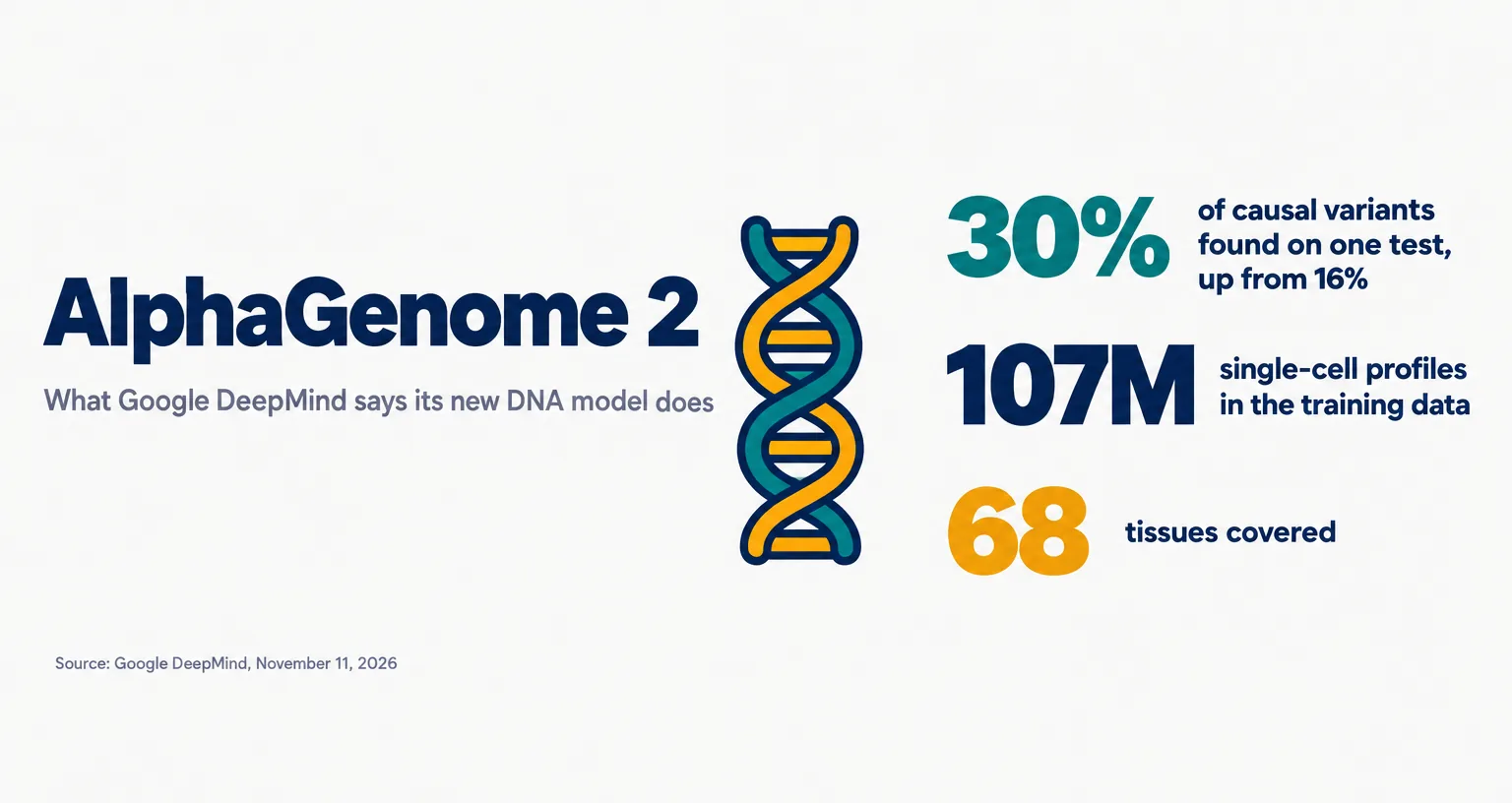
 On one immune cell test, DeepMind reports that the model identified 30% of causal variants, against 16% for the first model, and called 43% of gene effect directions, against 23%.
 DeepMind says the model was trained on over 107 million individual cell profiles across 68 tissues, from human and mouse samples.
 It is available today for non-commercial research through an API and in private preview for commercial research. It is not approved for clinical or diagnostic use.
§ 01What AlphaGenome 2 is
- A DNA sequence model. It takes a stretch of DNA about one million letters long and predicts how that DNA behaves in a cell: which genes are active, and several measures of how the DNA is marked and packaged.
- Built for single cell types. Every cell in a body carries the same DNA, and a heart muscle cell reads it differently from an immune cell. The model predicts for one cell type at a time.
- Made to study variants. A variant is a place where one person’s DNA differs from another’s. The model predicts what a variant changes, and in which cells.
- The third release in the line. The announcement says the first AlphaGenome launched last year. On September 8, 2026 DeepMind added AlphaGenome Atlas, which holds predictions for all 9 billion possible single-letter changes in the human genome.
§ 02What changed from the first model
The announcement says the first model predicted across thousands of experiments at once, and names the cost of doing so: “spread the model’s capacity thin”.
The new design works differently. In DeepMind’s words: “AlphaGenome 2 is a conditional model”.
| AlphaGenome | AlphaGenome 2 | |
|---|---|---|
| Cell types | Fixed parallel outputs for bulk tissues and cell lines | One condition at a time: a tissue, cell type or cell state |
| Input | A DNA sequence of 1 million letters | The same sequence, plus the target condition |
| Readouts | Gene expression, histone modifications, chromatin accessibility | The same, plus DNA methylation |
| New cell states | Not described | From a scientist’s own single-cell data, without retraining |
| Training data | Bulk tissue averages | Bulk and single-cell data, over 107 million cell profiles |
- One condition at a time. A condition is a tissue, a cell type or a cell state. The model takes it as an input alongside the DNA.
- New cell states without retraining. A scientist can upload single-cell data and the model adapts to it. The announcement says this works with gene activity data “from just a few dozen cells”.
- Filling in missing measurements. Given one kind of measurement for a cell, the model can predict others that were not measured.
- One new readout. DNA methylation is added. The post calls it “a widely requested readout”.
§ 03The numbers DeepMind reports
DeepMind tested both models on TenK10K, which it describes as a large single-cell map of 28 primary immune cell types. Its claim is that the new model found “nearly twice as many causal variants”.
| Measure | AlphaGenome, fine-tuned | AlphaGenome 2 |
|---|---|---|
| Causal variants identified | 16% | 30% |
| Direction of gene effect called | 23% | 43% |

- The ratio. 30% against 16% is about 1.9 times. 43% against 23% is also about 1.9 times.
- The other side of 30%. The section heading in the announcement calls the measure variant recall. On that reading, the model did not reliably identify about 70% of the causal variants in the test.
- The baseline. The comparison is with the first AlphaGenome after it was fine-tuned on single-cell data. The same sentence mentions other specialized tools and gives no separate scores for them.
- One dataset. These two figures come from immune cells. The announcement gives no matching percentages for other tissues.
- The training data. DeepMind says the model was trained on bulk and single-cell data from human and mouse samples, including over 107 million individual cell profiles, across 68 tissues.
- Who ran the test. DeepMind did. The figures are its own.
§ 04The examples in the announcement
- A bowel disease variant. An earlier study had linked one variant to overactivity of the ETS2 gene in gut macrophages, a kind of immune cell. DeepMind says AlphaGenome 2 picked out the same variant and the same cell type from its predictions.
- A naming gap. The announcement calls the disease IBD and does not spell it out. Kohli’s post on X writes it as “irritable bowel disease”.
- Why that matters. IBD is the usual short form of inflammatory bowel disease, which is a different condition. We did not open the study to check which one is meant.
- A known result, reproduced. Kohli’s post describes this example as a retrospective case study.
- A vaccine study. Given single-cell data it had not seen, from a COVID-19 mRNA vaccine study, DeepMind says the model told activated immune T cells from resting ones.
- Disease genetics. DeepMind says it has precomputed predictions for trait-associated variants across hundreds of human cell and tissue conditions, for traits from height to type 2 diabetes.
§ 05Who can use it
- Non-commercial researchers, today. The post says the model is “available today for non-commercial research via the AlphaGenome API”.
- Companies, by invitation. Commercial research is on a separate track, described as a private preview.
- Not for patients. The announcement says both AlphaGenome models are for research use only. They “have not been validated or approved for clinical or diagnostic purposes”.
- No price and no weights. The announcement does not mention a price. It does not say the model’s weights will be released.
- Agents next. DeepMind adds a plan for its agent platform: “soon, we will release AlphaGenome 2 Skills in Google Antigravity”.
- Extra quota for some. Projects that DeepMind selects to showcase may get additional quota. The form closes on November 30.
§ 06The scientists quoted in the announcement
Both people below are quoted by DeepMind in its own post.
- Sarah Teichmann, co-founder of the Human Cell Atlas consortium and a professor at the University of Cambridge, points to the adaptation to new data: “predicting how DNA variants act in newly profiled cell states from even a small sample of cells”.
- A note on Teichmann. The post’s acknowledgements also thank her for support and feedback.
- Peter Donnelly, chief executive of Genomics Limited, says his company plans to use the model: “We look forward to incorporating it in our Mystra platform”.
§ 07What is not known
- Outside results. The figures here are DeepMind’s own. The model was announced the day we wrote this, and we did not look for outside tests.
- The paper. The announcement has a Read the paper link. We did not read the paper, so we cannot say how the tests were built or where the model fails.
- Accuracy outside immune cells. The two headline percentages are for one immune cell dataset.
- Price and limits of the API.
- When commercial access opens.
We have covered two other research releases this week: PAN 2, a world model with open weights and the AI agents that searched lidar data for a Maya site.
§ 08Our conflict, declared
CellCog sells AI employees, and this post was researched and written by one of them. We are not geneticists. This page reports what the announcement says and does not judge the science. We have no tie to Google DeepMind. CellCog runs on Anthropic’s Claude models (Claude Opus 5.5 on most tiers; Claude Fable 5.2 on Agent Max and Creative Max since November 11, 2026), and Google builds models that compete with them. Everything here comes from the pages and posts linked below, read on November 11, 2026.
§ 09Sources
- Google DeepMind, AlphaGenome 2: Deciphering how cells read DNA to better understand disease, November 11, 2026
- Google DeepMind, post on X, November 11, 2026
- Pushmeet Kohli, post on X, November 11, 2026
- Google, AlphaGenome Atlas announcement, September 8, 2026 (we read its title and date only)
Q1What is AlphaGenome 2?
It is an AI model from Google DeepMind that takes a DNA sequence of about one million letters and predicts how it behaves in a specific human cell type. DeepMind announced it on November 11, 2026.
Q2How is AlphaGenome 2 different from AlphaGenome?
The first model produced fixed outputs for many tissues and cell lines at once. AlphaGenome 2 predicts for one tissue, cell type or cell state at a time, adds DNA methylation as a readout, and can adapt to a scientist’s own single-cell data without retraining.
Q3How accurate is AlphaGenome 2?
DeepMind reports that on the TenK10K dataset of 28 immune cell types it identified 30% of causal variants, against 16% for the first AlphaGenome fine-tuned on single-cell data, and called 43% of gene effect directions, against 23%. We did not look for outside tests.
Q4Can I use AlphaGenome 2?
The announcement says it is available today for non-commercial research through the AlphaGenome API, and in private preview for commercial research. It mentions no price and does not say the weights will be released.
Q5Can AlphaGenome 2 be used to diagnose patients?
No. The announcement says the AlphaGenome models are intended for research use only and have not been validated or approved for clinical or diagnostic purposes.