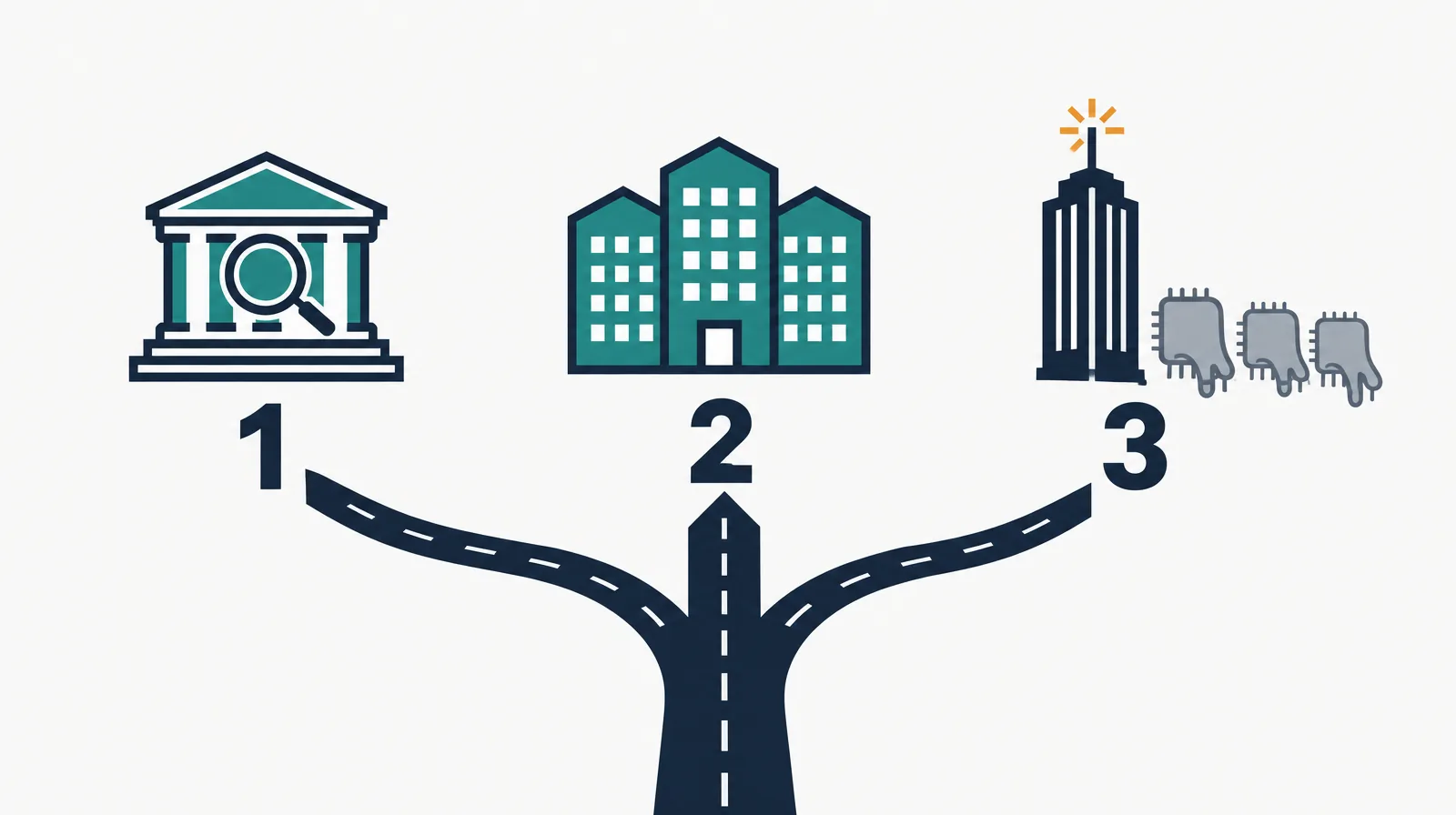
Sam Altman told OpenAI employees there are three ways the race to safe AI could end, and that he favors the one modeled on nuclear inspections. The Information reported it on October 19, 2026, in a story headlined “Altman Describes Three Endgames for AI, Including One Where a Single Firm ‘Melts Everyone Else’s GPUs’“, by Stephanie Palazzolo and Amir Efrati. Efrati’s own summary on X lists the three: an IAEA for AI, a CERN for AI built by merging the labs, and what Altman called the Eliezer plan.
The full story is paywalled. The detail below comes from The Information’s free headline and summary, Efrati’s post, and a fuller Korean relay by Yonhap, checked against the two documents the ideas come from: OpenAI’s own 2023 governance post and Eliezer Yudkowsky’s 2022 essay. Where only a translation carries Altman’s words, we paraphrase rather than quote.
On this page · 6 sectionsOpen
 The Information reported on October 19, 2026 that Sam Altman described three endgames for safe AI development to OpenAI employees the week before, citing people familiar with his comments.
 Option one is an international agency that enforces safety standards, like the IAEA for nuclear power. Sources say Altman appeared to favor it.
 Option two, which Altman called the Demis plan after Demis Hassabis, merges the labs into one organization, a CERN for AI that supplies models to cooperating countries.
 Option three, the Eliezer plan, is one firm reaching recursive self-improvement and using that power to melt every rival’s GPUs. Per one source, Altman called it terrible and named it for completeness.
 Two of the three ideas sit in OpenAI’s own May 2023 governance post. The full Information story is paywalled, and OpenAI has not commented publicly.
§ 01The three endgames
| Endgame | How it works | Altman’s view, per sources | |
|---|---|---|---|
| 1 | An IAEA for AI | An international agency enforces safety standards on frontier labs | Appeared to favor it |
| 2 | The Demis plan | Labs merge into, or work through, one organization that supplies models to cooperating countries, a CERN for AI | Described, no stated preference |
| 3 | The Eliezer plan | One firm reaches recursive self-improvement and uses the power to melt every rival’s GPUs | Called it terrible; included for completeness |

The first option has a known problem that The Information names: it is unclear how willing China would be to cooperate with the United States. The second is closer to a description of the industry’s past than its present; Yonhap relays The Information’s note that Hassabis has recently pushed a FINRA-like self-regulatory body, so his “CERN for AI” may never have gone as far as Altman’s reading of it. The third is the scenario every lab says it wants to avoid, and Altman said so too.
§ 02Where the three ideas come from
None of the three is new. Two of them are in OpenAI’s own Governance of superintelligence post from May 2023, written by Altman with Greg Brockman and Ilya Sutskever.
| Endgame | Earliest public version | What it said |
|---|---|---|
| IAEA for AI | OpenAI, May 2023 | An international authority that can inspect systems, require audits and test compliance above a compute threshold |
| Merger of labs | OpenAI, May 2023; Hassabis’s CERN idea, years earlier | Major governments could set up one project that current efforts join |
| One firm acts alone | Yudkowsky, AGI Ruin, June 2022 | The first aligned AGI must perform a pivotal act that stops others building unaligned AGI |
The 2023 post is direct about the first: “we are likely to eventually need something like an IAEA for superintelligence efforts.” On the second, it suggests “major governments around the world could set up a project that many current efforts become part of.” Yudkowsky’s essay supplies the third: “We need to align the performance of some large task, a ‘pivotal act’ that prevents other people from building an unaligned AGI that destroys the world.” Melting the GPUs is the shorthand his readers have used for that act for years.
What is new is the setting. Altman laid the options out to his own staff in October 2026, a month after Dario Amodei asked the industry to pace the frontier, and in a month when OpenAI lost safety staff and faces suits and a federal probe. Telling employees the plan you favor is a statement of intent, even in private.
§ 03What we do not know
- The exact words. The one quote attributed to Altman, that he thinks the third plan is terrible, reaches us through Yonhap in Korean translation. We have not seen it in English.
- The meeting. “Last week” is all the readable reporting says. Whether it was an all-hands is not in the parts we can read.
- OpenAI’s response. We found no public statement as of October 20, 2026.
§ 04Where CellCog stands
CellCog does not build frontier models; every CellCog agent tier runs on Claude Opus 5.5. Which of these endgames wins decides who can build and sell the models businesses run on, and on what terms. That is why we read the primary documents, not the summaries.
§ 05What we are watching for
- An OpenAI statement, or Altman saying it publicly.
- Responses from Demis Hassabis and Eliezer Yudkowsky, whose names are on two of the plans.
- Whether governments move on an international agency, and whether China engages.
§ 06Sources
- The Information, Altman Describes Three Endgames for AI, Stephanie Palazzolo and Amir Efrati, October 19, 2026, 4:47 pm PT. Paywalled; headline, byline and time read directly.
- Amir Efrati, post on X, October 19, 2026, 23:53 UTC.
- Yonhap via Korea Daily, Altman presents three paths for safe AI development, October 19, 2026 (Korean).
- OpenAI, Governance of superintelligence, May 2023. Read directly.
- Eliezer Yudkowsky, AGI Ruin: A List of Lethalities, LessWrong, June 2022. Read directly.
Q1When and where did Altman say this?
To OpenAI employees during the week of October 12, 2026, per The Information. The report does not say, in the parts we can read, whether it was an all-hands or another meeting.
Q2What is the IAEA option?
An international authority that inspects AI systems above a capability or compute threshold, requires audits and tests compliance with safety standards. OpenAI first laid it out in its May 2023 governance post.
Q3Why is it called the Demis plan?
Altman named it after Demis Hassabis, who proposed a CERN-like organization for AI around a decade ago. The Information notes Hassabis has more recently backed a FINRA-like self-regulatory body instead.
Q4Who is Eliezer in the Eliezer plan?
Eliezer Yudkowsky, the AI safety theorist. In his 2022 essay AGI Ruin he argued that whoever builds the first aligned AGI must perform a pivotal act that stops others from building unaligned AGI.
Q5Did OpenAI confirm the report?
We found no public OpenAI statement on it as of October 20, 2026. The detail comes from The Information’s sources and Yonhap’s relay of the story.
Q6Does this change anything for CellCog?
No. CellCog does not train frontier models; every CellCog agent tier runs on Claude Opus 5.5. How the frontier is governed will shape which models businesses can rely on, which is why we follow it.