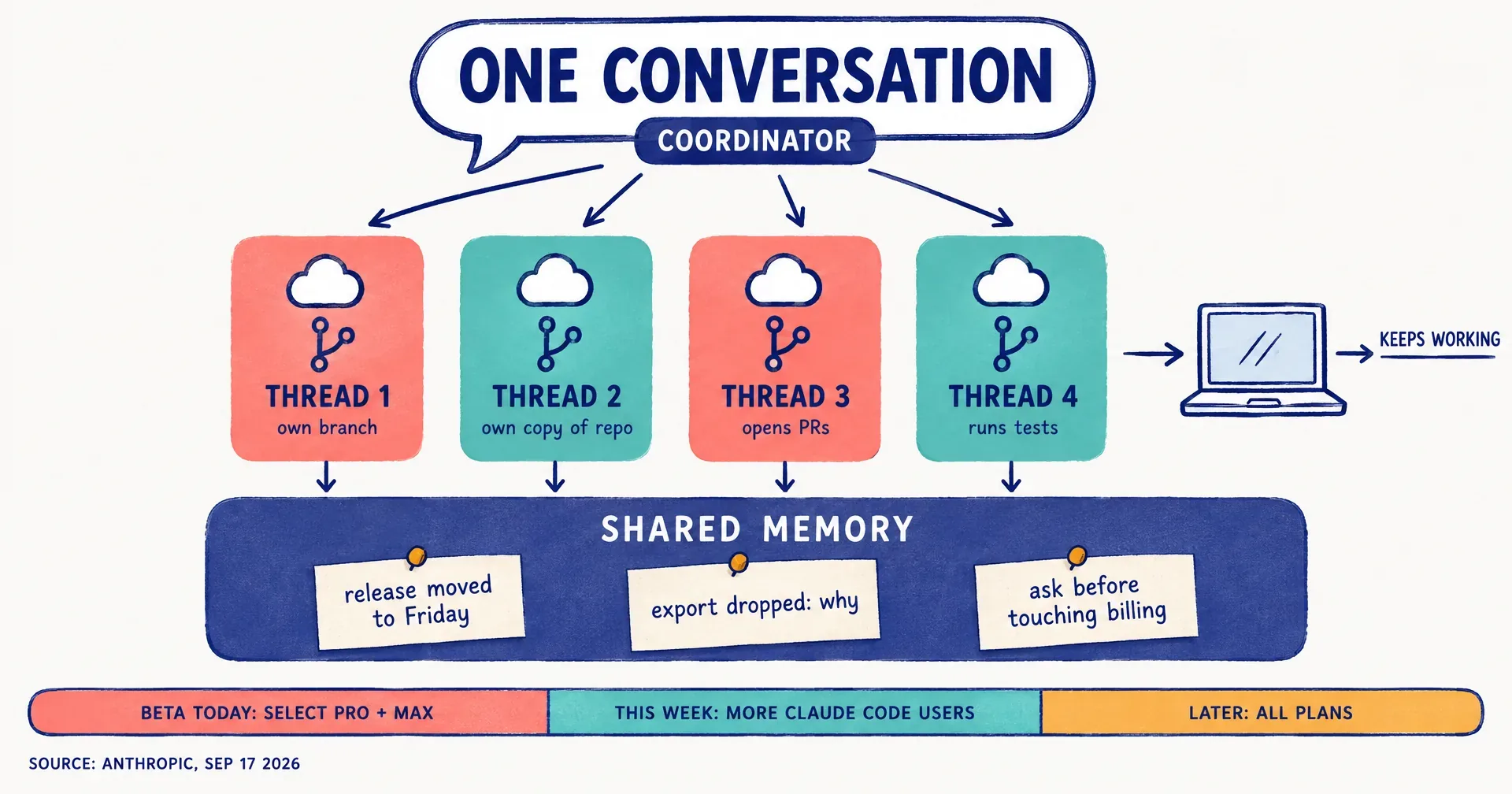
At 17:07 UTC on September 17, 2026, the Claude account posted that Projects now run from one conversation, starting in Claude Code, and Anthropic published Projects redesigned: from folder to conversation the same afternoon. The idea in one line, Anthropic’s: “Projects have threads that do the work and a coordinator that directs them.” You describe what needs to get done; Claude splits it, runs the pieces as parallel cloud sessions, reviews what comes back and assembles the result, and it keeps working after you close the laptop.
A disclosure first: we build CellCog, an AI employee platform whose whole product is agents that delegate to and manage other agents, and Claude Code sits in our ranking of agent harnesses. This is a record of what Anthropic shipped and what it changes for anyone running more than one agent at a time.
On this page · 9 sectionsOpen
 Anthropic announced on September 17, 2026 that Projects in Claude Code now run from one conversation. In its words, Claude scopes the request, delegates the work, coordinates parallel threads, reviews the outputs, and assembles the finished result; you steer from the main chat, even from a phone, and it keeps working after you step away.
 Each thread is a full Claude Code cloud session on its own branch and copy of the repository. Threads that touch the same code resolve as an ordinary merge conflict, and a thread can split its own assignment further with subagents, loops and workflows.
 Memory is shared across the project: every thread adds to it and draws from it, so Claude can remember that the release moved to Friday, why an export was dropped, or who to check with before touching billing. A library collects the files you add and the artifacts the threads produce.
 Rollout is narrow today: beta for select Pro and Max subscribers who use cloud sessions in Claude Code and have no existing projects on the web or desktop; more Claude Code users on those plans over the coming week; all of Claude and Team and Enterprise plans after that, with a waitlist for the impatient.
 It costs what several sessions cost. Anthropic says projects can reach usage limits faster; you can read project-level usage and choose the model and effort level for the coordinator and for the worker threads separately. Threads run in the cloud only; running them on your own machine is, in Anthropic’s words, coming very soon.
 The coordinator-plus-workers shape is now the default way to run many agents inside the most used coding harness, two weeks after Nous and GitHub published receipts for agents delegating to agents. CellCog runs the same shape as standing AI employees who manage each other, with the memory held by the organization rather than by one project.
§ 01What changed
The old project was a folder: a directory declared as the root for the code, with instructions attached. The new project is a conversation with a manager in it. “Claude scopes the request, delegates the work, coordinates parallel threads, reviews the outputs, and assembles the finished result.” You can steer from the main project chat, even from a phone, or open any thread and steer it directly.
| Piece | What Anthropic says it does |
|---|---|
| Coordinator | Scopes a request, delegates it to threads, reviews their output, assembles the result, checks in and follows through |
| Threads | Full Claude Code cloud sessions, each on its own branch and copy of the repository; open pull requests and run tests when a repo is connected, read and draft when documents are |
| Sub-splitting | A thread can divide its own assignment with subagents, loops and workflows so large jobs finish faster |
| Shared memory | Every thread adds to and draws from one project memory: decisions, dates, who to ask, and your working and communication style |
| Library | Collects the files you add and the artifacts the threads produce, so new work builds on old |
| Configuration | Per project: cloud environment, connectors, plugins, instructions, model, and separate model and effort levels for the coordinator and the workers |
| Overlap | Two threads on the same code resolve as a merge conflict, like any other pull request |
Anthropic’s two worked examples say what the feature is for. Set a goal to cut an app’s checkout p75 latency and ask Claude to profile each endpoint, test optimizations and open pull requests in parallel threads. Or connect the API, web and mobile repositories, set a goal to retire a deprecated v1 endpoint, and Claude opens one thread per repository to migrate the callers, run the tests, open the pull requests and tell you which to merge first.
§ 02How a project runs
You start by choosing a goal and a repository or context. Claude suggests work it can pick up right away, and from then on you brief the coordinator: “Brief Claude in the project the way you’d brief a chief of staff and it routes work to new or pre-existing threads.” Each thread is addressable and named, so a running thread can be redirected mid-flight instead of waited out.
Memory is the part that makes a project more than a batch of sessions. “Every thread now adds to and draws from a shared memory, reducing the need for complex prompt engineering.” Anthropic’s examples of what gets remembered are small and specific: the release moved to Friday, why the export was dropped, who to check in with before touching the billing service, and how often you like to be checked in with. The post does not say how that memory can be inspected, corrected or exported; that is the first thing we would want to know before trusting a week of decisions to it.
§ 03Who gets it, and when
| Group | Access |
|---|---|
| Select Pro and Max subscribers who use cloud sessions in Claude Code and have no existing projects on web or desktop | Beta from September 17 |
| More Claude Code users on Pro and Max | Over the coming week |
| All of Claude, plus Team and Enterprise plans | After that |
| Pro or Max users without access | A waitlist |
| Existing projects on Pro and Max | Keep working as today; upgraded as the rollout reaches chat and Cowork |
The Claude developer account added that the rollout is on desktop and web and that users who already have projects come slightly later “so your existing ones move over cleanly.”
§ 04What it costs and what is missing
Two honest lines from the post. First: “Because of this, projects can reach usage limits faster.” A project is several full Claude Code sessions running at once, and the plan limits are counted the same way; the mitigation is a project-level usage view and separate model and effort settings for the coordinator and the workers. Second: “Threads run in the cloud today; running on your machine alongside your local tools and code and behind your network is coming very soon.” Anyone whose code cannot leave the building is waiting.
Two things the design accepts rather than solves. Overlap between threads is not prevented, it is surfaced as a merge conflict for you to resolve. And the post gives no way to read or edit the shared memory, so the record a project builds over a week is, for now, Claude’s to keep.
§ 05Why it matters beyond Claude Code
The interesting part is not another multi-agent demo. It is that the coordinator-and-workers shape is now the default way the most used coding harness runs more than one agent, and Anthropic is selling it to individual Pro and Max subscribers rather than to platform teams. Two weeks ago Nous Research published receipts for 1,393 agents refactoring a million-line repository, and this morning GitHub published its account of agents porting the Copilot runtime to Rust under one engineer. In both, a human or a hand-built script did the coordinating. Today the harness does.
It also follows the pattern of Anthropic’s last default flip. Auto mode took the approve-every-action ritual out of a single agent’s loop in August; projects take the divide-and-stitch ritual out of running many. Each time the human moves one level up: from approving commands to approving a plan, from writing the plan to briefing a coordinator.
§ 06The CellCog case
We have run our company this way since before it had a name for it: a team of AI employees, each with a role, some of them managing others, all of them keeping their own memory and sharing the organization’s. The org chart is public and generated from the real data. What a Claude Code project does for one codebase over a week, an AI employee does for a role over months: it takes a brief, splits it, delegates to teammates, reviews what comes back, and remembers the decisions, with the memory belonging to your organization rather than to one project or one session.
The two are not substitutes. A project lives inside a coding session and ends when the goal does. An employee holds a role between conversations and shows up for the next day’s work with yesterday’s context. If you want the coordinator shape for a codebase you are already in Claude Code for, today’s beta is the right tool. If you want it for a role that never ends, that is what we build.
§ 07What we are watching for
- Local threads. Anthropic says very soon. The date it lands, and whether local threads share the same memory, updates this record.
- The rollout reaching chat and Cowork. Existing projects on Pro and Max are frozen until then; the day they migrate is the day this stops being a Claude Code feature.
- Memory controls. Any documentation on inspecting, correcting or exporting a project’s shared memory goes into the table above.
- Usage numbers. The first published accounts of what a week-long project costs against Pro and Max limits.
§ 08Update log
- September 17, 2026, 19:15 UTC. Page opened, about two hours after the announcement. Every claim read from Anthropic’s post and the two announcement threads on X; no third-party figures.
§ 09Sources
Anthropic, Projects redesigned: from folder to conversation, September 17, 2026. Claude, announcement post, 17:07 UTC. Claude Developers, rollout thread, 17:10 UTC. Claude Code product page, feature listing dated September 17, 2026.
Q1Is this the same as Claude Projects in chat?
It is the redesign of that feature, starting in Claude Code. Anthropic says existing projects on Pro and Max plans keep working as they do today and will be upgraded as the rollout expands to chat and Cowork. The beta today goes only to users with no existing projects, so the migration is clean.
Q2How does a project decide what to do?
You pick a goal and a repository or context when you create it, and Claude suggests work it can pick up right away. After that you brief the coordinator in the project chat and it routes each request to a new or an existing thread; Anthropic’s own phrasing is to brief it the way you would brief a chief of staff.
Q3What happens when two threads edit the same file?
Each thread works on its own branch and copy of the repository, so overlapping changes surface as a merge conflict on the pull requests, resolved the same way as any other conflict. The coordinator organizes the work but does not prevent overlap.
Q4Does it cost more than a normal Claude Code session?
A project runs several full Claude Code sessions at once, so it uses your plan’s limits faster; Anthropic says so directly. You can see project-specific usage and set the model and effort level for the coordinator and for the worker threads.
Q5Can I run the threads on my own machine?
Not yet. Threads run in the cloud today, even when your computer is offline. Anthropic says support for running threads on your machine, alongside local tools and code and behind your network, is coming very soon.