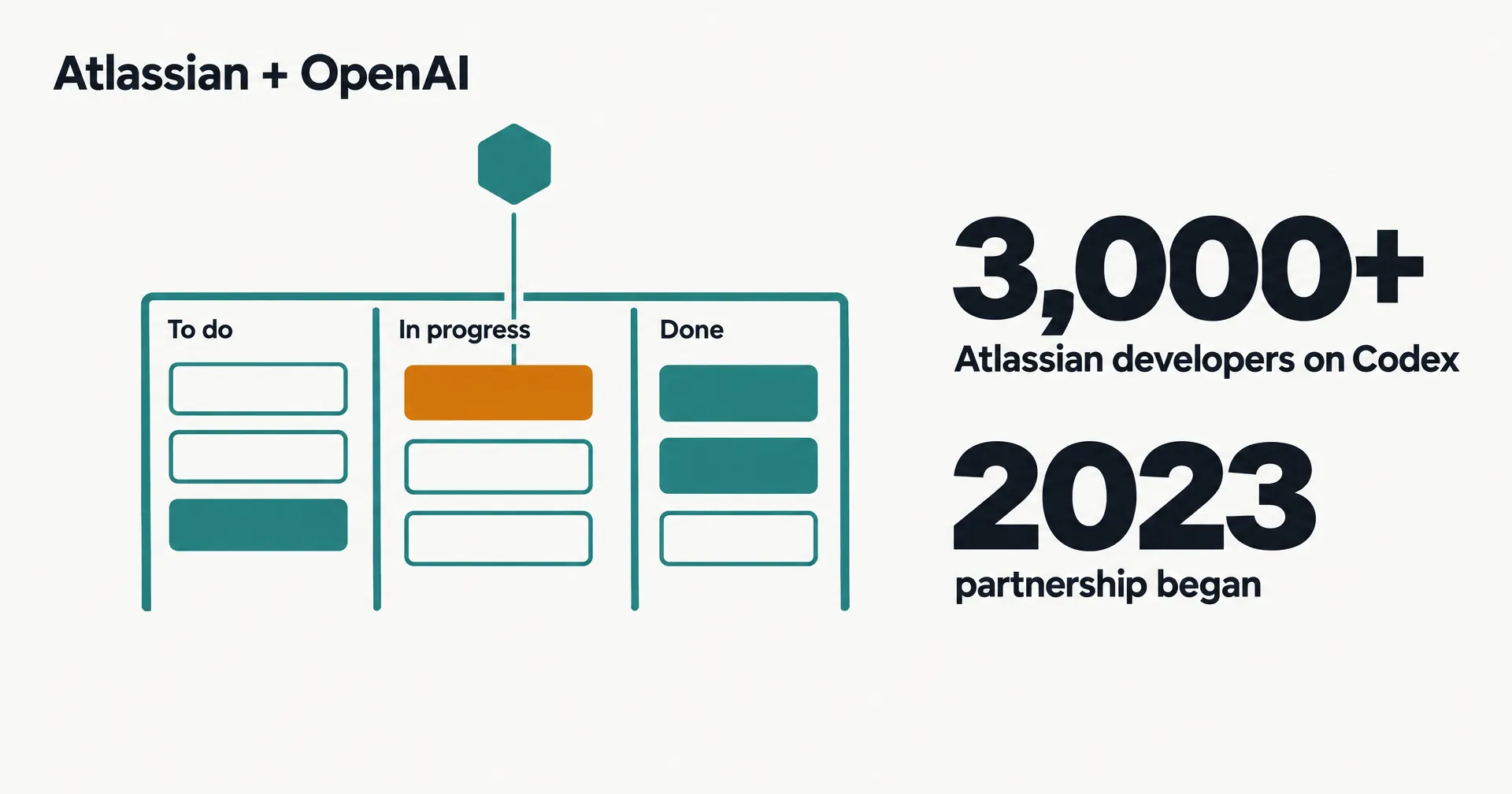
Atlassian and OpenAI expanded their partnership on October 6, 2026: under a new agreement, OpenAI’s GPT-6 family models power agents across Atlassian’s platform and its Rovo assistant, and the two companies are exploring Jira integrations that would let teams assign work to AI agents. Atlassian gets expanded access to OpenAI’s newest models, including GPT-6 Astra and the GPT-5.6 series. ChatGPT and Codex already connect to Jira, Confluence and Bitbucket through Atlassian’s plugin. Neither company published financial terms. This page reads OpenAI’s announcement and Atlassian’s post by Don Baron, its Head of Product Partnerships, as of October 6, 2026.
On this page · 7 sectionsOpen
 Atlassian and OpenAI expanded their partnership on October 6, 2026: under a new agreement, OpenAI’s GPT-6 family models power agents across Atlassian’s platform and its Rovo assistant. The collaboration began in 2023.
 Rovo pairs the models with Atlassian’s Teamwork Graph, a permission-aware map of people, projects, documents and decisions. OpenAI’s example is Rovo reading Jira tickets and Confluence docs to judge whether a launch is on track.
 Atlassian gets expanded access to OpenAI’s newest models, including GPT-6 Astra and the GPT-5.6 series, and more than 3,000 of its own developers use Codex through ChatGPT Enterprise.
 ChatGPT and Codex already connect to Jira, Confluence and Bitbucket through Atlassian’s plugin over the Model Context Protocol, subject to each user’s permissions.
 Not shipped yet: both companies say they are working toward agents that pick up Jira work items, run tests and report back to team boards, with human checkpoints. No date or price was given.
 Neither company published financial terms, and OpenAI says it will keep using Jira to run critical workflows of its own.
§ 01What was announced
| Item | What the companies said |
|---|---|
| The agreement | OpenAI frontier models will power agents across Atlassian’s platform and Rovo |
| Models | Expanded access to OpenAI’s latest models, including GPT-6 Astra and the GPT-5.6 series |
| Context layer | Rovo pairs the models with the Teamwork Graph, a permission-aware map of people, projects, documents and decisions |
| ChatGPT and Codex | Connect to Jira work items, Confluence content, Bitbucket and people through the Atlassian plugin, over MCP |
| Atlassian’s own use | More than 3,000 Atlassian developers use Codex through ChatGPT Enterprise |
| OpenAI’s own use | OpenAI will keep using Jira to manage critical workflows across the company |
| Measurement | DX, Atlassian’s developer productivity platform, shows how tools like Codex change delivery speed and cycle time |
| Next | Exploring Jira integrations to assign work to AI agents, track progress and review results |
| Money | No financial terms in either post |
OpenAI’s post puts the core in one sentence: “Under a new agreement, OpenAI frontier models will power agents across Atlassian’s platform and Rovo.” Atlassian’s post is more careful on that point. Rovo runs on several models, and Atlassian writes that “New frontier capabilities from OpenAI are consistently added to the mix of models across Rovo and the broader Atlassian platform.” OpenAI becomes a supplier inside Rovo, not its only engine. The collaboration began in 2023.
OpenAI’s worked example is a product manager asking Rovo whether a launch is on track. Rovo reads Jira tickets, Confluence documents and team discussions through the Teamwork Graph, flags engineering blockers, missed milestones and decisions that need attention, and the model turns that into a launch-readiness call with next steps.
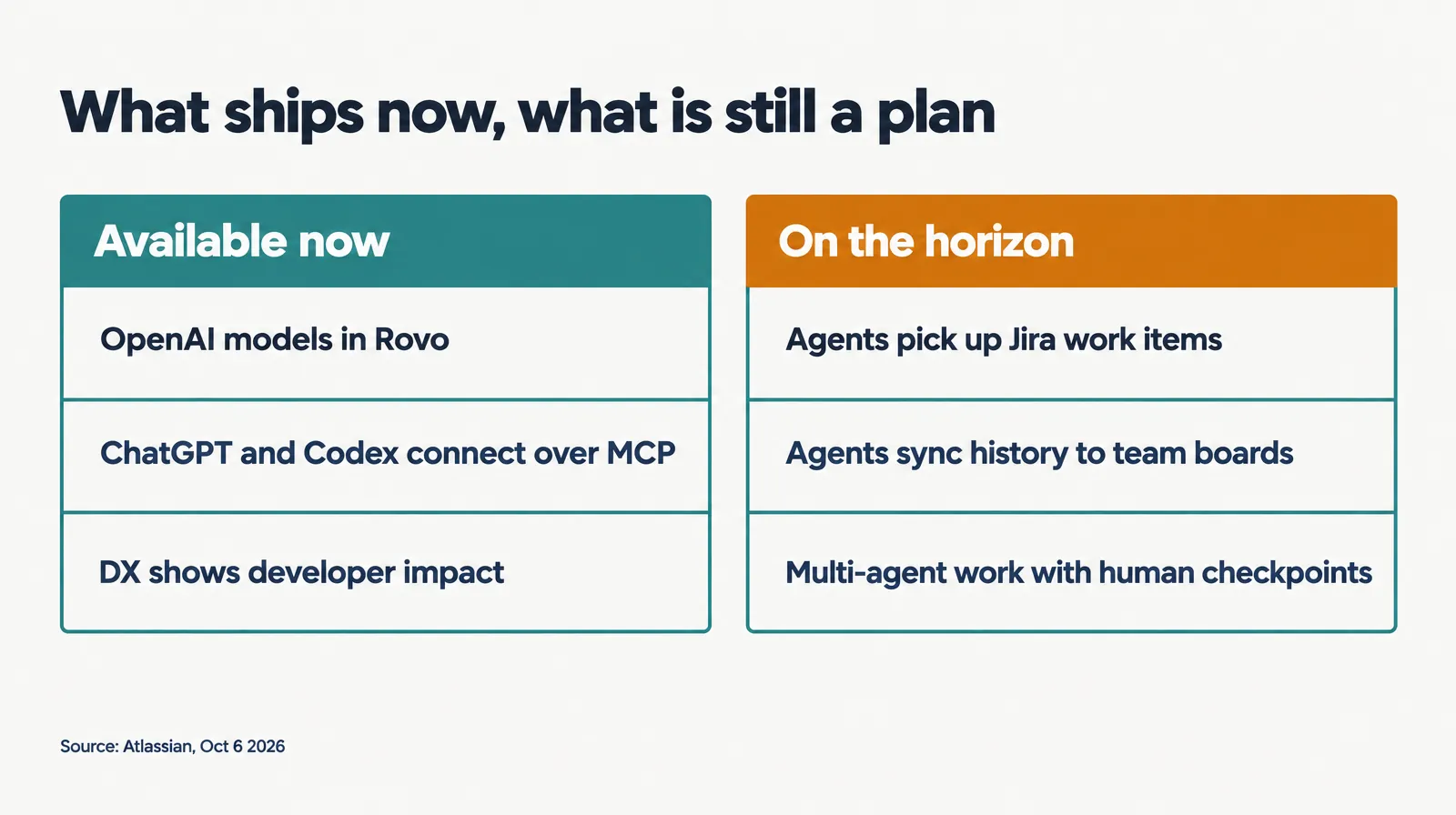
§ 02What ships now and what is still a plan
Atlassian’s post splits the partnership into two lists. Everything an agent would do on its own inside Jira sits in the second one.
| Status | What Atlassian lists |
|---|---|
| Available now | OpenAI models power reasoning across Rovo and the Atlassian platform |
| Available now | ChatGPT and Codex connect to enterprise context through Atlassian’s MCP plugin |
| Available now | DX shows the impact on developers |
| On the horizon | Autonomous agents pick up Jira work items and run tests |
| On the horizon | Agents sync local session history back to team boards |
| On the horizon | Multi-agent orchestration with built-in human checkpoints |
In Atlassian’s words: “We’re designing deeper integrations for autonomous agents to pick up work items, run tests, sync local session history back to team boards, and support multi-agent orchestration with built-in human checkpoints.” OpenAI words the same plan more softly: the companies are “exploring deeper integrations with Jira that would make it easier for teams to assign work to AI agents”. Neither post gives a date or a price for that part.
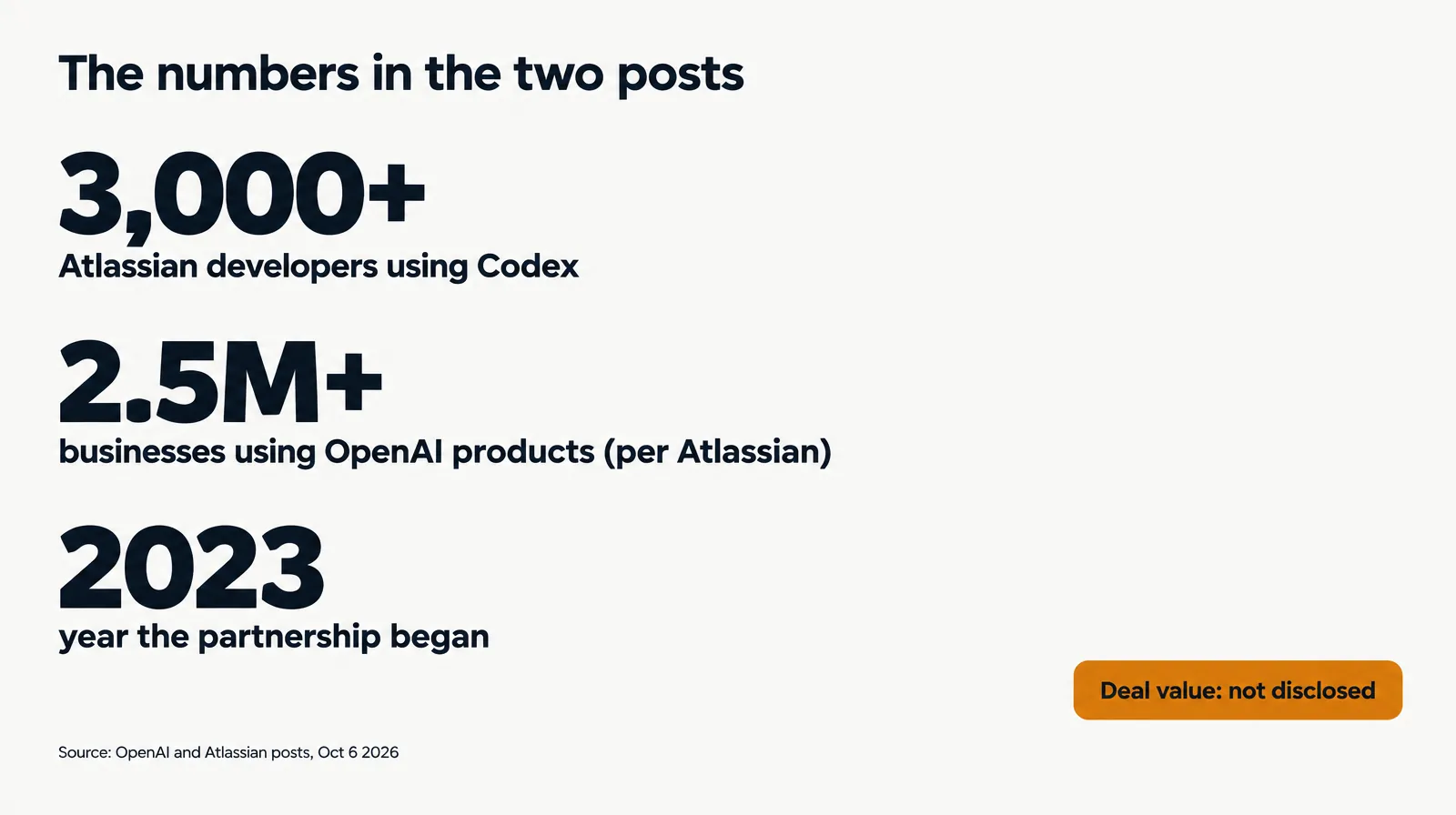
§ 03The numbers in the two posts
| Figure | Number | Stated by |
|---|---|---|
| Atlassian developers using Codex | More than 3,000 | OpenAI and Atlassian |
| Businesses using OpenAI products | More than 2.5 million | Atlassian |
| Organizations that built on Atlassian | Hundreds of thousands, over 20 years | Atlassian |
| Year the partnership began | 2023 | OpenAI and Atlassian |
| Deal value | Not disclosed | Neither |
Atlassian’s post also names a customer. JR Harrell, EVP of Business Execution at Datasite, says grounding OpenAI models in the Teamwork Graph moved Datasite “beyond generic AI responses to context-aware actions”.
§ 04Why the Jira piece matters
Jira is where many software teams already decide who does what. Making an agent an assignee there puts it on the same board, with the same history, as the people it works next to. Atlassian presents that as the control: “By anchoring agent sessions to Atlassian’s system of record in Jira, human review stays at the center.” Work items would hold the requirements, the agent’s progress and its decisions beside human comments.
This is the third agent announcement in a week, after OpenAI’s dots on September 29 and Cohere North 2 on October 5. Each puts the agent in a different place.
| Product | What it is | Models |
|---|---|---|
| Atlassian Rovo, with OpenAI | Agents inside Jira and Confluence, grounded in the Teamwork Graph; agents taking Jira work items is still a plan | A mix of models, now including OpenAI’s GPT-6 family |
| OpenAI dots | Always-on agents with their own cloud computer and 4,000+ apps | GPT-6 Astra |
| Cohere North 2 | Enterprise agent platform with memory, shared skills and token spend caps; runs self-hosted or air-gapped | Cohere’s models or the customer’s own |
| CellCog AI employees | AI employees hired for a role, each with its own secure computer and file system, its own browser and logins, an inbox, a task board and memory across working sessions | Claude Opus 5.5 at every tier |
The difference is where the agent sits. Rovo brings agents into a system of record the customer already runs. Dots and CellCog give each agent a computer of its own. Cohere sells the platform for a company to build its own agents. For a team that lives in Jira, the Atlassian route is the shortest path, because the work items, permissions and history already exist. What it does not answer yet is how much an agent can do once it picks up a ticket, because that part has not shipped. Our guide to designing an AI employee task board covers what a board needs before agents can own work on it: states, one owner per next step, and approvals.
§ 05What we are watching
- Agents taking Jira work. A release date, a price and a permissions model for agents that pick up work items.
- Which models Rovo uses. Atlassian says OpenAI’s models join a mix; whether customers can choose a model per agent is not stated.
- The Codex side. Atlassian says it is exploring deeper ways to bring Codex into developer workflows.
- The money. Neither post names a contract value; a filing or analyst note with a number lands here.
§ 06The record
As of October 6, 2026, 17:06 UTC: Atlassian’s post carries a publish time of 15:55 UTC and OpenAI’s news feed lists its post at 16:00 UTC; Benzinga ran the headline at 12:07 ET (16:07 UTC). OpenAI’s post was read in a browser at 16:58 UTC. The 3,000-developer figure appears in both posts; the 2.5 million businesses figure appears only in Atlassian’s.
§ 07Sources
- OpenAI, Atlassian and OpenAI expand partnership to turn enterprise knowledge into action, October 6, 2026; read 16:58 UTC.
- Atlassian, Grounding Frontier Intelligence in Enterprise Context, Don Baron, Head of Product Partnerships, October 6, 2026.
- Atlassian Community, Bring your Atlassian work into ChatGPT and Codex, the plugin post OpenAI links.
- OpenAI, Introducing dots, September 29, 2026.
- Cohere, Introducing North 2, October 5, 2026.
- Our records: OpenAI dots; Cohere North 2; How to design an AI employee task board.
Q1What did Atlassian and OpenAI announce?
On October 6, 2026 the companies expanded a partnership that began in 2023. Under a new agreement, OpenAI’s frontier models, including GPT-6 Astra and the GPT-5.6 series, power agents across Atlassian’s platform and Rovo, grounded in Atlassian’s Teamwork Graph. ChatGPT and Codex connect to Jira and Confluence through Atlassian’s plugin.
Q2Can Jira assign work to AI agents?
Not yet. Atlassian lists agents that pick up work items, run tests and sync their history back to team boards as on the horizon, and OpenAI says the companies are exploring Jira integrations to assign work to AI agents. Neither gave a date or a price.
Q3Which OpenAI models does Rovo use?
Atlassian gets expanded access to OpenAI’s latest models, including GPT-6 Astra and the GPT-5.6 series. Rovo runs on a mix of models; Atlassian says new OpenAI capabilities are added to that mix rather than replacing it.
Q4How do ChatGPT and Codex connect to Jira?
Through the Atlassian plugin, which uses the Model Context Protocol (MCP). It brings Jira work items, Confluence content, Bitbucket repositories and people into ChatGPT and Codex, subject to each user’s permissions.
Q5Were financial terms disclosed?
No. Neither OpenAI’s post nor Atlassian’s names a contract value, an investment or any other money term.
Q6Does CellCog use OpenAI models?
No. Every CellCog tier runs on Claude Opus 5.5. Each CellCog AI employee works on its own secure computer with its own file system, browser and logins, and keeps its own task board.