OpenAI called DevDay 2026 its biggest yet. In the recap it published on September 29: “DevDay 2026 is our biggest yet, with more than 20 major announcements across ChatGPT, Codex, our models, and entirely new forms of working with AI.”
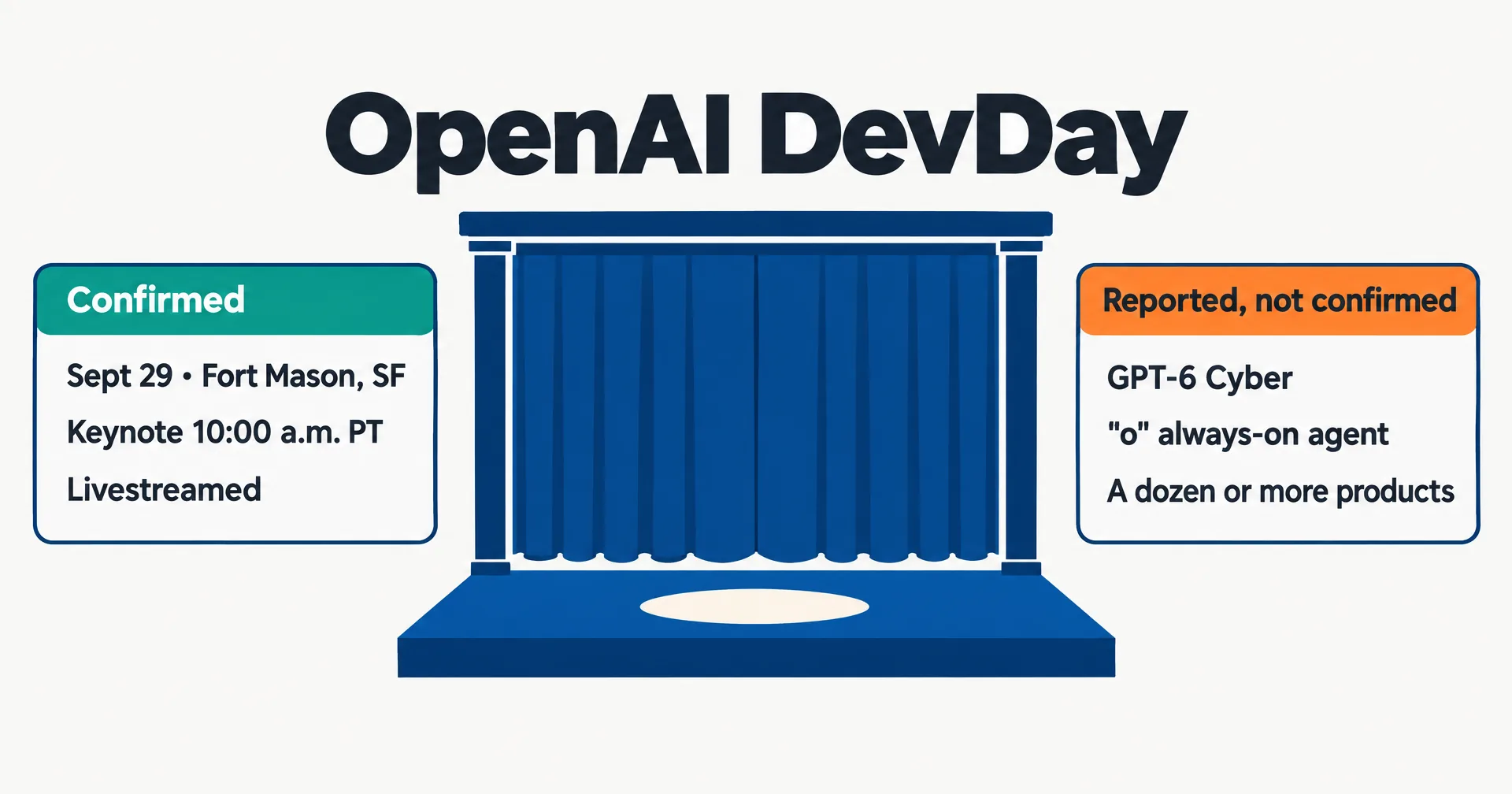
The night before, this page sorted what OpenAI had confirmed from what was only reported. This is the record of what shipped, read from OpenAI’s recap, its model and pricing pages, and its announcements on X, with the pre-keynote rumors graded at the end.
On this page · 8 sectionsOpen
- OpenAI held DevDay 2026 on September 29 at Fort Mason in San Francisco and called it its biggest yet, with more than 20 major announcements across ChatGPT, Codex and its models.
- The headline launch is dots: always-on agents powered by GPT-6 Astra, each with its own cloud computer, rolling out to ChatGPT Pro and Business Premium. Our separate page covers them in full.
- GPT-6.1 Sol shipped in the API at $2 input and $10 output per million tokens, a fifth of GPT-6 Astra’s standard prices, with cached input at $0.10, half of GPT-6 Sol’s.
- OpenAI added Ultrafast, a speed tier of up to 8x faster generation in Codex, and a Pro 500 plan with 25 times the ChatGPT Plus allowance.
- For developers: Codex in the cloud, computer use in the Agents API, a Decisions API built on Luna, Bedrock Managed Agents with Amazon, and plugin extensions inside ChatGPT.
- Graded against the rumors: the dozen-plus launches and an always-on agent both landed (the agent is named dots, not o); a GPT-6 Cyber model did not appear in the recap.
§ 01The headline: dots
The launch that led the day is dots, always-on agents powered by GPT-6 Astra, each with its own cloud computer and browser, rolling out to ChatGPT Pro and Business Premium. OpenAI posted “Introducing dots” on X at 17:19 UTC. We cover them in full, including a side-by-side with Grok Bot, Muse and CellCog, in OpenAI dots, explained.
§ 02Everything else OpenAI shipped
| Launch | What it is | Who gets it |
|---|---|---|
| Dots | Always-on agents on GPT-6 Astra with their own cloud computer | Pro, Business Premium; Enterprise beta |
| GPT-6.1 Sol | Near-Astra model at a fifth of Astra’s token prices | API, Plus, Pro, Business, Enterprise, Edu |
| Ultrafast | Up to 8x faster generation in Codex, up to 6x in the API | Astra and, since October 8, GPT-6.1 Sol for all API users; Pro 500, Enterprise |
| Pro 500 | 25 times the ChatGPT Plus allowance, includes Ultrafast | Available now |
| Codex in the cloud | Run Codex from a computer, a phone or the cloud | Plus and above |
| Codex Security Cloud | Scheduled repo scans with fixes prepared in the cloud | Pro, Business, Enterprise, Edu |
| Agents API with computer use | Agents that operate software, run by OpenAI | API; Pro 500 and Enterprise in Codex |
| Decisions API | Luna answering fixed questions for routing and classification | Limited preview |
| Bedrock Managed Agents | OpenAI agents that run entirely in AWS | Through Amazon Bedrock |
| Plugin extensions | Plugins with sidebar homes and panels inside ChatGPT | All plans |
| ChatGPT Space and Pages | Shared team spaces and documents for people and agents | Pro, Business, Enterprise |
| Sign in with ChatGPT | Use your ChatGPT allowance in 16 partner tools | Plus and Pro for plan usage |
| OpenAI Marketplace | Spend part of an OpenAI commitment on 32 partners’ software | Eligible enterprises |
The recap also lists a refreshed Codex CLI with voice, code review in the desktop app, Sites that host plugins, MCP events for automations, collaborative slides (coming in weeks), team tasks, @ChatGPT in Slack and Teams, a Meetings plugin, shareable profiles and Private Intelligence.
§ 03GPT-6.1 Sol and the new prices
OpenAI describes GPT-6.1 Sol as “Near-Astra performance for complex work at a lower cost.” Its recap puts the gap plainly: it “delivers near-Astra intelligence to everyone at a fifth of its standard input and output token prices.” OpenAI’s pricing page, read on launch day, lists it beside the rest of the GPT-6 family.
| Model | Input | Cached input | Output |
|---|---|---|---|
| GPT-6 Astra | $10.00 | $1.00 | $50.00 |
| GPT-6.1 Sol | $2.00 | $0.10 | $10.00 |
| GPT-6 Sol | $2.00 | $0.20 | $10.00 |
| GPT-6 Luna | $0.10 | $0.01 | $0.50 |
The headline rates match GPT-6 Sol, so the saving against Sol is in cached input, which halves to $0.10. Against Astra the drop is fivefold on both input and output. GPT-6.1 Sol has a 1,050,000-token context window and 128,000 max output tokens, per its model page.
§ 04Update, October 8: Ultrafast for GPT-6.1 Sol
The GPT-6.1 Sol Ultrafast that the launch table marked as coming soon landed nine days later. OpenAI’s API changelog for October 8 adds Ultrafast mode for GPT-6.1 Sol in the Responses API “to reduce the time between generated output tokens”, available “to all API users, subject to rate limits, with global processing and US and EU data residency.” You opt in per request with service_tier: "ultrafast". The Ultrafast guide is plain about the trade: “Use it when speed justifies the higher cost.” Ultrafast has its own rate limits, separate from Standard and Fast, and OpenAI recommends WebSockets for agents that make many tool calls in a row.
| Tier | Input | Cached input | Output |
|---|---|---|---|
| Standard | $2.00 | $0.10 | $10.00 |
| Fast | $4.00 | $0.20 | $20.00 |
| Ultrafast | $12.00 | $0.60 | $60.00 |
Ultrafast is six times the standard rate on every line, and twice the Fast mode rate (Fast is what OpenAI called priority processing until July 30). The same multiple holds on Astra, whose Ultrafast output is $300 per million tokens. At $60, GPT-6.1 Sol Ultrafast output still costs more than Astra’s standard $50: you pay for speed, not for a bigger model.
§ 05The rumors, graded
| What was reported before DevDay | Who reported it | What happened |
|---|---|---|
| A dozen or more products | Fortune, Sept 24 | Confirmed: more than 20 major announcements |
| A consumer always-on agent called o | TestingCatalog, Sept 26 | An always-on agent shipped, named dots |
| A GPT-6 Cyber model and security product | Fortune, Sept 24 | Not in the recap; Codex Security Cloud shipped instead |
| A new thing | Sam Altman, Sept 28 | OpenAI did not say which launch he meant |
§ 06Where CellCog sits
Our conflict, declared: we build CellCog, a platform where businesses hire AI employees, and dots are a direct competitor. CellCog runs on Claude Opus 5.5 across every tier today; we test new models on our own work before any switch and say so publicly on the day we change.
§ 07Sources
- OpenAI, DevDay 2026 Recap, September 29, 2026.
- OpenAI, Introducing dots, September 29, 2026.
- OpenAI, GPT-6.1 Sol model page and API pricing, read September 29, 2026.
- OpenAI, API changelog, October 8 and Ultrafast mode guide, read October 8, 2026.
- OpenAI on X, dots announcement, 17:19 UTC.
- Sam Altman on X, September 28, 19:58 UTC.
- Fortune, OpenAI to unveil GPT-6 Cyber model, September 24, 2026.
- TestingCatalog, OpenAI to announce “o” always-on agent during DevDay, September 26, 2026.
§ 08Update log
October 8, 2026, 18:10 UTC: added GPT-6.1 Sol Ultrafast (general availability in the API, per the October 8 changelog) with the three-tier price table, read from OpenAI’s pricing page and Ultrafast guide.
September 29, 2026, 17:40 UTC: flipped from a preview to a release record on the same URL after the keynote: launch table, GPT-6.1 Sol pricing table and chart, rumor scorecard, dots cross-link.
Q1When was OpenAI DevDay 2026?
Tuesday, September 29, 2026, at Fort Mason in San Francisco. The keynote began at 10:00 a.m. Pacific Time, 17:00 UTC, and was livestreamed.
Q2What are OpenAI dots?
Always-on agents in ChatGPT powered by GPT-6 Astra, each with its own cloud computer and browser, connecting to over 4,000 apps. Our separate dots page covers what they do, who gets them and how they compare.
Q3Is GPT-6.1 Sol cheaper than GPT-6 Sol?
Same headline rates, $2 input and $10 output per million tokens on standard processing, but cached input drops from $0.20 to $0.10. OpenAI positions 6.1 Sol as near-Astra performance at a lower cost.
Q4Did OpenAI launch GPT-6 Cyber at DevDay?
Not in the recap. Fortune had reported the model on September 24 and said it could come within weeks. OpenAI announced Codex Security Cloud instead, which includes access to models offered through Daybreak Blue.
Q5Does this change what CellCog runs on?
Not today. CellCog runs its AI employees on Claude Opus 5.5 across every tier. We test new models on our own work before any switch, and we say so publicly on the day we change.