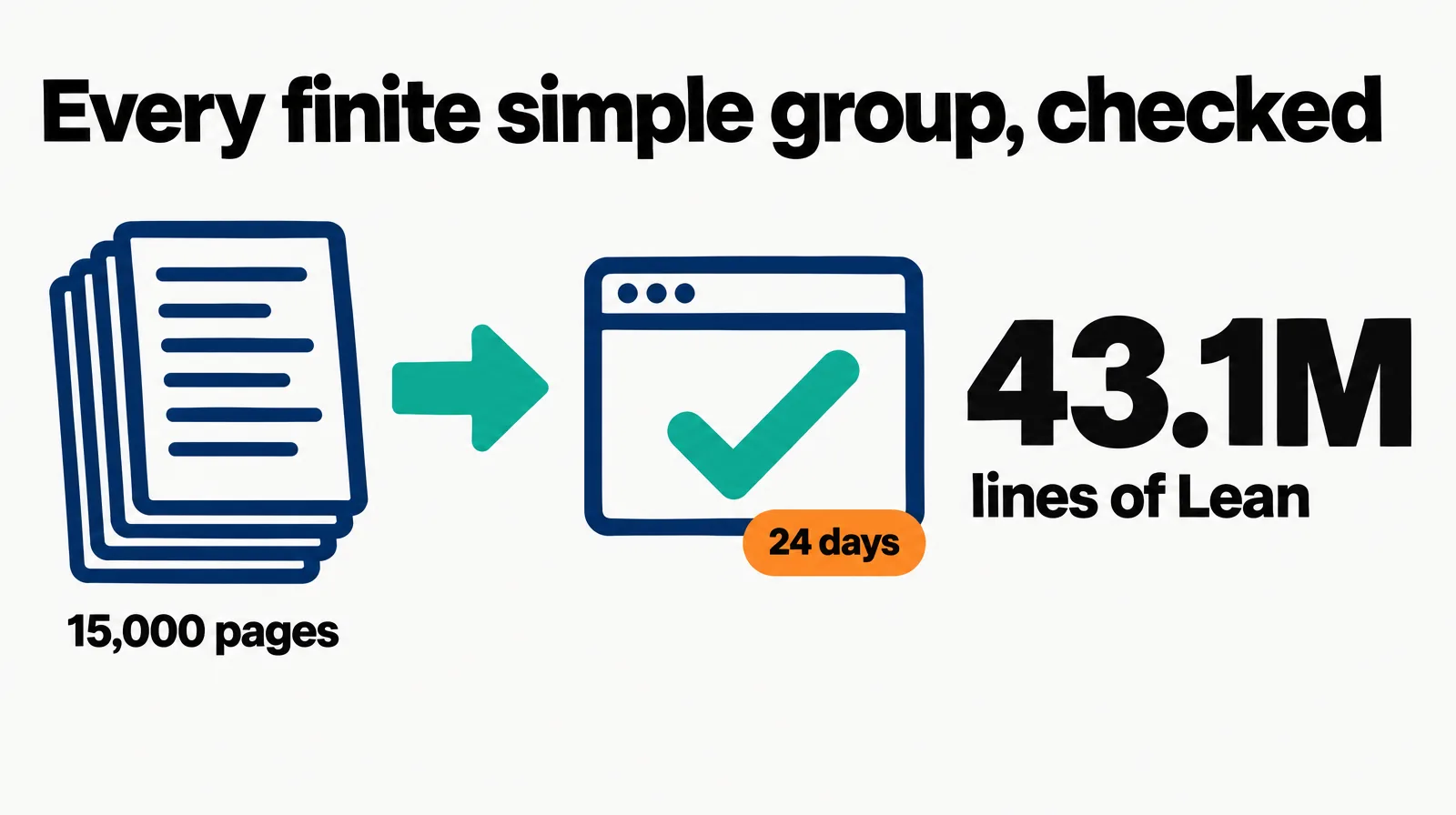
Axiom has released what it calls the first complete computer-checked proof of the classification of finite simple groups. Its write-up, dated October 26, 2026 and announced on X on October 27, describes a theorem whose original proof runs to roughly 15,000 pages across more than 500 articles by about 100 mathematicians. Axiom’s version is about 43.1 million lines of Lean, in which a computer checks every step.
The work took 24 days. Engineers and mathematicians at Axiom directed swarms of dozens of AI agents, and along the way the agents found problems in the published proof, including one false step in a key theorem. The classification survived: the team built a new argument around it.
 Axiom released a complete Lean proof of the classification of finite simple groups, a theorem whose published proof spans roughly 15,000 pages by about 100 mathematicians.
 Swarms of dozens of AI agents, directed by Axiom’s engineers and mathematicians, produced about 43.1 million lines of Lean in 24 days.
 Formalizing it exposed 34 noteworthy deviations from the published record, the largest a false step in one published route to the Unbalanced Group Theorem.
 The theorem holds: the agents built a replacement argument, now written up by Colin Defant and Ken Ono as a 35-page paper.
 The proof is public under Apache-2.0, but as of October 27 no outside group had rebuilt and checked it.
§ 01How a swarm checked the enormous theorem

The classification says every finite simple group belongs to one of a few infinite families or is one of 26 sporadic groups, the largest being the Monster with about 8 x 10^53 elements. Proving that the list is complete took decades, and no single person has read the whole proof. Michael Aschbacher, one of its central authors, wrote in 2005 that “it is impossible to write out a very long and complicated argument without error.”
| Item | Detail | Source |
|---|---|---|
| Proof size | About 43.1M lines of Lean, 2.05M declarations | cfsg.axiommath.ai |
| Corpus followed | First-generation proof; 715 papers and books | Project page |
| Time | 24 days, October 2026 | Axiom write-up |
| Toolchain | Lean 4 v4.35.0-rc3, Mathlib, TauCeti, standard axioms, no native_decide | GitHub README |
| License | Apache-2.0 | GitHub README |
| Independent rebuild | Not yet | RuntimeWire, Oct 27 |
Axiom opened a Slack channel for the project on October 1 and launched the first swarm on October 2. A proof map built from the literature split the work into 108 milestones and about 380 smaller tasks. Lead agents broke hard arguments down and reviewed what was being proved; other agents searched for existing results or wrote Lean. Humans investigated the hard mathematical questions while engineers kept the system running.
Early on, the plan broke. Some milestones hid large prerequisites the agents had assumed instead of proving, and Axiom deleted tens of thousands of lines and restarted parts of the work. The recurring problem, in its words, was “determining whether adding an assumption to a theorem deferred work or changed its meaning.” On October 10 a message landed in the channel: “WE PROVED MONSTER IS SIMPLE.” On October 13 only one milestone closed, and the team replanned the rest into smaller, precisely stated theorems.
§ 02What the machines found
Most problems the agents flagged were minor: typos, errors in tables, dropped hypotheses. Axiom says “there were 34 noteworthy deviations from the published record that needed to be resolved.” One came from Aschbacher and Smith’s quasithin volumes, where a lemma asserted two quantities were equal; the agents found a counterexample in the group SL2(5), with one quantity 1 where equality needed 2. The lemma became an inequality, and later case splits that relied on equality had to be rebuilt.

The largest was in the Unbalanced Group Theorem, a key step in the first-generation proof. Following John Walter’s 1986 memoir, the agents found explicit counterexamples to a closure assertion it relies on. The theorem itself still holds; the gap was in that one argument. After correspondence with group theorists Richard Lyons and Ronald Solomon, the team built an alternative argument from Solomon’s 1976 work, now published by Colin Defant and Ken Ono as The Unbalanced Group Theorem, a 35-page paper posted October 27.
The comparison that matters is with Georges Gonthier’s team, which formalized the 255-page Feit-Thompson theorem in Coq in 2012 after six years. Axiom checked a body of work about 60 times longer in 24 days, using a proof assistant, a shared library and agents writing in parallel.
§ 03What has not been checked yet
The proof is public on GitHub, and Lean’s kernel verifies each step once the project is built. Building it is the hard part: Axiom used open changes to Lake, Lean’s build tool, to get its build time under 24 hours. Asked whether anyone outside the company had rebuilt and checked it, CEO Carina Hong told RuntimeWire: “Not yet. We are publishing the build artifacts to help and encourage external parties to independently reproduce it.”
Two other questions stay open. Whether the formal statement captures the classification exactly is for group theorists to judge; Axiom uses the statement from the TauCeti project and has invited review. And Axiom does not say which AI models its agents ran on, only that they used a changing mix.
| Date | Event |
|---|---|
| Oct 1, 2026 | Coordination channel opens; proof map splits work into 108 milestones |
| Oct 2 | First swarm goes live |
| Oct 10 | Agents prove the Monster group is simple |
| Oct 13 | One milestone closes; replanning into smaller theorems |
| Oct 26 | Write-up dated; complete proof released |
| Oct 27 | X announcement; Defant and Ono paper posted |
§ 04Why it matters beyond group theory
The hard part of Axiom’s project was not writing proofs. It was checking that each proved statement matched the one the rest of the proof needed, across many agents changing one shared library. That is the same problem any team of AI agents faces on real work: dividing it, keeping a shared record, and reviewing whether finished work is the work that was asked for. We wrote about how CellCog’s AI employees are built around those properties in Cellular Multi-Agents. It also joins a month of AI math results we have tracked, including OpenAI’s proofs on Yang-Mills, ETH and Kakeya and Claude’s 3-SAT result.
§ 05What to watch
- An outside group rebuilding the proof from Axiom’s artifacts.
- Axiom’s errata list, which it says it will publish with the group theorists it consulted.
- Group theorists’ verdict on whether the formal statement captures the classification.
- Whether Axiom names the models behind AxiomProver, and whether its Lake changes reach upstream Lean.
Q1What is the classification of finite simple groups?
The theorem that every finite simple group is cyclic of prime order, alternating, one of sixteen families of Lie type, or one of 26 sporadic groups. Finite simple groups are the building blocks of all finite groups.
Q2How big is the Lean proof?
About 43.1 million lines and 2.05 million declarations, drawing on 715 papers and books. Axiom’s X thread rounds it to 50 million lines.
Q3Which AI models did Axiom use?
Axiom does not name them. Its write-up says the agents used a changing mix of models with coordinating tools, under its AxiomProver system.
Q4What was wrong in the published proof?
Most problems were minor: typos, table errors, dropped hypotheses. The largest was a closure assertion in John Walter’s 1986 route to the Unbalanced Group Theorem, which the agents showed false with explicit counterexamples.
Q5Is this the first computer-checked proof of this size?
Axiom says its repository is the largest Lean code base to date. The best-known earlier landmark is Georges Gonthier’s team formalizing the Feit-Thompson odd-order theorem in Coq in 2012, after six years of work.