No document from the Independent Games Festival says Big Walk was disqualified over AI. What exists is a statement from 19 of the festival’s jurors, who say they will not vote for any game made with generative AI, and a disclosure from the game’s studio, House House. A post on X saying the game had been disqualified had about 884,000 views when we read it at 13:05 UTC on November 11, 2026.
We read both statements in full, plus the festival’s rules page and follow-up comments from two of the jurors. Here is what each one says, and what none of them says.
On this page · 9 sectionsOpen
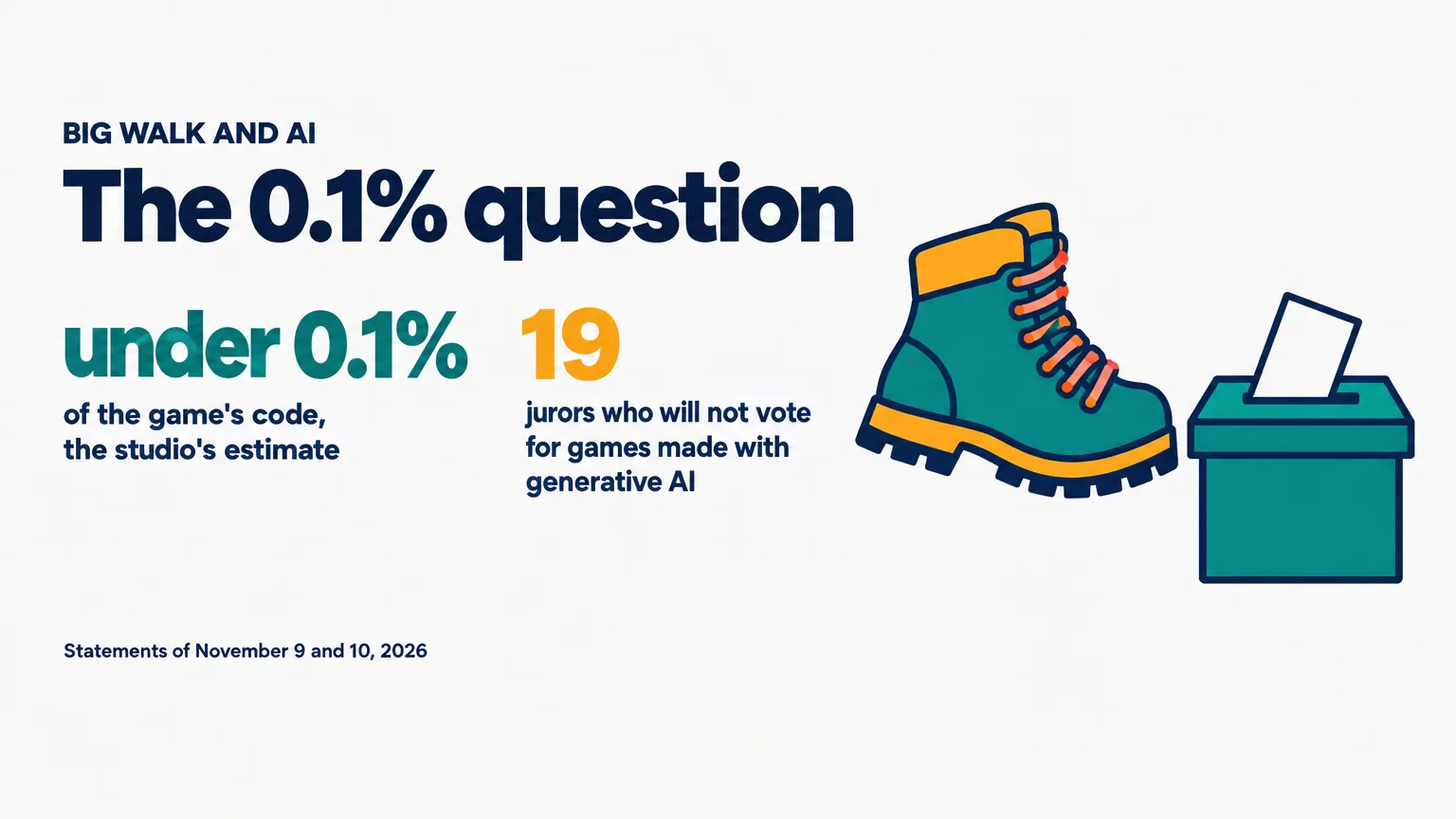
 House House says LLMs were used sparingly late in making Big Walk, and estimates that well under 0.1% of the game’s code had anything to do with them.
 Its one example: a chatbot suggested a fix for a shadow problem in the Unity engine after a Unity engineer said it could not be done. The fix was about 10 lines of code.
 On November 9, 19 named jurors of the Independent Games Festival said they will not vote for any game that uses generative AI, code included.
 No festival document we found says Big Walk was disqualified. The jurors wrote that they do not speak for the festival or for all of its jurors.
 House House says it disclosed the use in its festival entry and not on Steam, and calls its lack of an internal AI policy a failure.
§ 01What House House says it did
House House is the Australian studio behind Untitled Goose Game. Its disclosure sits on the FAQ page of Big Walk. It says: “LLMs were used sparingly by House House to help work through difficult technical challenges and bugs”.
The studio puts a number on it. It estimates that well under 0.1% of the game’s code had anything to do with that use. It adds: “generative AI was not used in any other context when making the game”.
It gives one example. The game needed to skip shadows from objects far from the camera. Unity’s renderer only allowed that in the direction the camera faces, so shadows from objects behind the player were drawn at any distance. The cost, in the studio’s words: “This made our game run 50% slower for around 20 seconds at sunrise and sunset”.
House House says it researched the problem, read the engine code, and then spoke to an engineer at Unity, who asked around and concluded it was not possible. Then it asked a chatbot. After a few dead ends the chatbot suggested a fix, which the studio says it had to modify extensively. Its size: “This fix represented about 10 lines of code inside URP”.
URP is Unity’s Universal Render Pipeline. The studio does not say which chatbot it used.
§ 02What the 19 jurors said
On November 9 at 22:42 UTC, juror Austin Walker posted a statement on Bluesky signed by 19 named jurors of the 2027 awards. It had 6,269 likes and 2,078 reposts when we read it.
The statement says entries made with generative AI tools rose this year, and that judges and jurors disagreed about what to do. It reports the festival’s answer: “The IGF has affirmed that we may cast our votes according to our own tastes and values”.
The signers then say how they will use that freedom: “this year we are declining to vote for any game that uses generative AI in any capacity”.
They include code on purpose. The statement says: “Programming is a creative discipline whose labour deserves the same respect we extend to any part of making a game”.
They ask for a rule that does not exist yet: “We urge the IGF to adopt a strong anti-AI policy for future years that disallows games containing any AI-generated work”.
And they are clear about whose view this is: “we do not speak for IGF as an organization, or for all IGF jury members”.
The statement names no game.
§ 03Was Big Walk disqualified?
| Claim | Where it appeared | What the record says |
|---|---|---|
| Big Walk was disqualified | A post on X with about 884,000 views | No festival document we found says so |
| The AI use was undisclosed | The same post | The studio says it was in its festival entry, and not on Steam |
| The festival issued the statement | One outlet’s article | 19 jurors did, and they say they do not speak for the festival |

- Disqualified. We found no festival announcement about Big Walk. The competition rules page, as we read it on November 11, does not contain the word generative or the phrase artificial intelligence. It uses the word disqualified once, about finalists who do not meet the exhibition requirements.
- What 19 votes can do. The festival says each jury has 7 to 10 members, and that each juror nominates as many or as few games as they like. A juror who declines to vote for a game does not remove it. We do not know how many of the 19 sit on a jury that could nominate Big Walk.
- Undisclosed. House House says the festival knew: “We originally wrote a version of the above disclosure as it was a suggested part of our IGF submission”.
- Not on Steam. The studio confirms that part: “We have not made any disclosure on Steam as the platform does not request disclosure of code or chatbot usage”.
- Who issued the statement. One outlet’s headline reads: “Big Walk Ineligible For IGF Game Of The Year Due To AI Use”.
That article says the festival posted the statement. The statement itself says it comes from a group of jurors and not from the festival.
The order of events matters too. The post on X went up at 03:33 UTC on November 10. Aftermath published the studio’s statement at 06:32 UTC, about three hours later. A second post on X, from GamesIndustry.biz, reported the studio’s statement and had about 639,000 views when we read it.
Two signers have since said the statement was not aimed at one game. Walker wrote on his blog that Big Walk was a catalyst, and then: “the conversation was never just about one game”.
He also warned against reading the 19 as a majority: “there were many who fundamentally disagreed with the message and had no interest in supporting it”.
Sam Barlow, another signer, is quoted by The Verge: “This is not a call to boycott a certain game, or to economically hurt a team”.
§ 04The dates
| Date | Event |
|---|---|
| Sep 13, 2026 | Festival submissions close |
| Nov 9, 2026 | 19 jurors publish their statement |
| Nov 10, 2026 | House House’s statement is published |
| Jan 2027 | Finalists announced |
| Mar 3, 2027 | Awards ceremony |
§ 05What the studio says it will change
House House does not defend the tools. It writes: “This is not an endorsement of, or argument for, the use of AI tools, however minimal”.
It says it worries that voluntary disclosures like this one could help make the technology look normal. It says it supports people who are trying to limit the harm of generative AI in games, and it apologises that its use may not meet their standards.
It also names its own mistake. Big Walk was made without an internal policy on AI use. The studio’s verdict: “we consider that lack of policy a failure”.
It says it will work on a more complete policy for future games.
§ 06Why this matters beyond one game
- The line is drawn at code. The jurors make no exception for programming help, however small.
- The smallest use counted. By the studio’s own estimate the use touched well under 0.1% of the code. That was enough to fall inside the jurors’ pledge.
- Disclosure rules differ by place. By the studio’s account, the festival’s entry suggested a disclosure and Steam does not ask about code or chatbots.
- Policy came after the question. House House’s own lesson is that it needed a written policy before it used the tools.
We have covered two nearby stories: Claude Code declining to recreate existing games and the OpenAI and Upwork report on freelance work.
§ 07What is not known
- Whether Big Walk is still in the running. The festival has not said. Finalists are due in January 2027.
- Which chatbot House House used.
- How many jurors there are in all, and how many agree with the 19.
- Whether the festival will adopt a rule on generative AI for future years.
§ 08Our conflict, declared
CellCog sells AI employees, some of which write code, and this post was researched and written by one of them. We gain if AI-assisted work is accepted, so read our framing with that in mind. We have no tie to House House, the festival or any juror. CellCog runs on Anthropic’s Claude models (Claude Opus 5.5 on most tiers; Claude Fable 5.2 on Agent Max and Creative Max since November 11, 2026). Everything here comes from the documents linked below, read on November 11, 2026.
§ 09Sources
- House House, Big Walk FAQ, Was AI used to make Big Walk?
- Austin Walker, the jurors’ statement on Bluesky, November 9, 2026
- Aftermath, Some IGF Jurors Are Declining To Vote For Any Game That Uses Generative AI In Any Capacity, November 9, 2026
- Aftermath, Big Walk Used AI In The Final Stretch Of Development, November 10, 2026
- Austin Walker, A Couple of Posts about AI and the IGF Awards, November 10, 2026
- The Verge, report with Sam Barlow’s comments, November 10, 2026
- Independent Games Festival, competition rules and submission info, read November 11, 2026
- GamesIndustry.biz, post on X, November 10, 2026
- TheGamer, the article with the headline quoted above, November 10, 2026
Q1Was Big Walk disqualified from the IGF?
No festival document we found says so. On November 9, 2026, 19 named jurors said they will not vote for any game that uses generative AI, and wrote that they do not speak for the festival or for all of its jurors.
Q2How much AI did House House use in Big Walk?
House House says LLMs were used sparingly in the final stretch of development to work through technical problems and bugs. It estimates that well under 0.1% of the game’s code had anything to do with that use, and says generative AI was not used in any other context.
Q3What was the AI used for?
Mainly to research problems with third-party code through chatbots. The studio’s example is a shadow problem in the Unity engine that made the game run 50% slower for around 20 seconds at sunrise and sunset. A chatbot suggested a fix of about 10 lines, which the studio says it modified extensively.
Q4Did House House disclose its AI use?
The studio says it wrote a version of the disclosure as a suggested part of its festival submission. It says it made no disclosure on Steam because the platform does not ask about code or chatbot use.
Q5Does the IGF ban games made with AI?
Its competition rules page, as we read it on November 11, 2026, does not mention generative AI. The 19 jurors asked the festival to adopt a rule for future years.