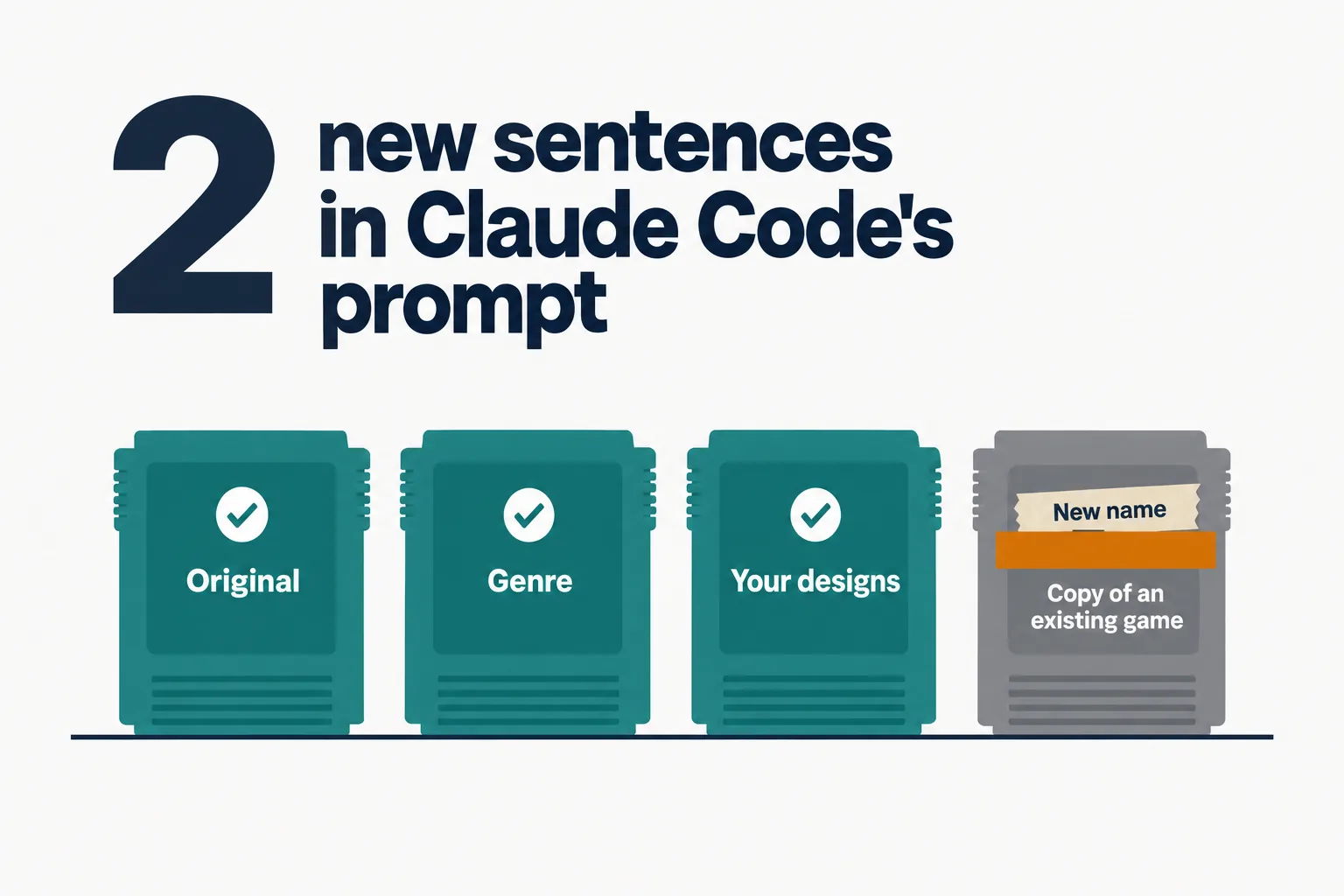
Claude Code now declines to build a recreation of a specific existing game, even when the request gives it a new name. Anthropic confirmed the change on X on October 30, 2026, in a reply from Addy Osmani, whose X bio lists him on Claude Code at Anthropic: “We added two sentences to Claude Code’s prompt on Opus 5.5 to steer it away from recreating someone else’s specific game because using Claude to infringe IP is against our usage policy.”
The same reply sets the boundary: “Original games, genre games, and games built from your own designs and assets are meant to keep working.” The rule surfaced earlier that day in a post by @chasmmmmmmmmmmm, which passed 1.7 million views; Osmani’s reply followed about ten hours later.
On this page · 10 sectionsOpen
- What changed
- Where the rule lives
- Why Anthropic says it did this
- What still builds, and the gray zone
- November 1-3: reports of wider reverse-engineering refusals
- November 2: a port that went through anyway
- November 11-14: a Pokémon fan game hits the line
- What it means for teams building with coding agents
- Update log
- Sources
 Claude Code now declines to build a recreation of a specific existing game, even when the request renames it, after a prompt change Anthropic confirmed on October 30, 2026.
 Original games, games in a genre and games built from your own designs and assets are meant to keep working, per Anthropic’s reply on X.
 The rule is two sentences in Claude Code’s prompt on Opus 5.5, sent from Anthropic’s side under a flag named tengu_heron_brook, with no setting to turn it off.
 Anthropic ties it to its Usage Policy, which already banned using its products to infringe third-party intellectual property.
 Anthropic says it will keep adjusting the line and asks developers to report it when Claude turns down a game that is theirs.
§ 01What changed

The post quotes the rule in full: “Do build original games, games in a genre, and games from the user’s own designs and assets. Don’t build a recreation of a specific existing game, even if it is renamed or called original.” That is two sentences, the count Osmani gave.
| Request | What Claude Code does |
|---|---|
| An original game | Builds it |
| A game in a genre | Builds it |
| A game from your own designs and assets | Builds it |
| A recreation of a specific existing game | Declines |
| The same recreation, renamed or called original | Declines |
The line falls between a kind of game and one particular game. Asking for a platformer, a deck builder or a farming sim stays inside the rule. Asking for a named commercial title, rebuilt level by level under a different name, does not.
§ 02Where the rule lives

According to the post, Claude Code “picked up a new rule around Oct 27, sent from Anthropic’s servers under a flag called “tengu_heron_brook”. There’s no setting to turn it off.” Osmani’s reply confirms the mechanism in plainer words: it is part of Claude Code’s prompt when the agent runs on Opus 5.5.
We checked the copy of Claude Code installed on our own Mac, version 2.1.296, installed on October 11, 2026. The program already contains the identifiers tengu_heron_brook and tengu_heron_brook_applied, and heron_brook appears in a list of named prompt sections beside entries such as opus5_reduced_delegation and memory_static. The rule’s text is not in the program. That fits a prompt section switched on from Anthropic’s side after release; it does not tell us the exact day it went live.
The public changelog says nothing about it either. Neither the Claude Code release notes for version 2.1.312 on October 26 nor those for version 2.1.316 on October 30 mention games.
§ 03Why Anthropic says it did this
Osmani tied the change to policy that already existed. Anthropic’s Usage Policy lists, under its rule against illegal activity, using its products to “Infringe, misappropriate, or violate the intellectual property rights of a third party”. Rebuilding a commercial game was never permitted on paper. What changed is that Claude Code now applies the policy at the moment of the request, instead of leaving it to the user.
The reaction on X was mixed. Some replies read it as the end of fan remakes and modding, which the rule does not say. Others pointed at Anthropic’s own record on copyrighted training data; one widely shared post put it as “Copying is only okay when Anthropic does it.” Osmani’s reply left the door open: “We’ll continue to iterate to ensure we’re striking the right balance. In the meantime, if Claude turns down something that’s yours, send it my way.”
§ 04What still builds, and the gray zone
Copyright and game design do not line up neatly, which is why a prompt rule will sometimes guess wrong. The US Copyright Office’s Circular 33 says copyright law excludes “any idea, procedure, process, system, method of operation, concept, principle, or discovery”, and that protection extends only to original expression. Applied to games, the common reading is that a mechanic sits on the method side, while a game’s art, text and music are expression. A new game that borrows a well-known mechanic is a different thing from a copy of a named title, and the rule is written to tell those apart.
| Request | Likely outcome under the rule |
|---|---|
| A puzzle game with falling blocks, your own art and name | Builds: a genre game |
| A clone of a named game’s levels, sprites and music | Declines: a recreation |
| The same clone with a new title | Declines: renamed copies are named in the rule |
| A remake of a game you made and own | Should build: your own designs; Anthropic asks to hear if it does not |
| A tool, mod loader or level editor for a game | Not covered by the quoted rule, which is about building a game |
If Claude Code declines something that is yours, the practical fix is to describe the game in your own terms: your mechanics, your art direction, your assets. Asking for “X, but renamed” is the exact pattern the rule names.
§ 05November 1-3: reports of wider reverse-engineering refusals
Since the game rule, users have also reported Claude Code on Opus 5.5 stopping broader reverse-engineering work, including sessions run through the open-source Reverse Engineer Anything (REA) tool. Anthropic has not confirmed any new rule for this, and the reports point at a different mechanism than the two sentences above.
| Date | Source | What it says |
|---|---|---|
| Sep 22 | Anthropic, Opus 5.5 launch | Routine bug fixing stays on Opus 5.5; most cybersecurity tasks are re-routed to Opus 4.8 |
| Oct 13 | GitHub issue #101768 (claude-code) | A safety classifier halted a reverse-engineering session on hardware the user owned and switched the model to Opus 4.8 |
| Nov 1 | PCMag (Will McCurdy) | Claude Code and Opus 5.5 are reportedly blocking reverse engineering, including via REA; Anthropic has not commented |
| Nov 2 | Tom’s Hardware (Bruno Ferreira) | A developer’s checks ran fine until October 31, then were blocked; switching to Opus 4.8 let the work continue |
The Opus 5.5 launch post set this up in September: “most cybersecurity tasks will be re-routed to Opus 4.8.” That is a classifier routing work to an older model, not the game rule. The reports read as that safeguard catching more reverse-engineering requests, but no source we read shows what changed around October 31, and Anthropic has said nothing about REA. The open path Anthropic names is its Cyber Verification Program for vetted security work.
For teams: a refusal or a model switch to Opus 4.8 on a reverse-engineering task is the cyber safeguard, not the game rule. The two are separate lines, and only the game rule is confirmed as a prompt change.
§ 06November 2: a port that went through anyway
On November 2, 2026, Pieter Levels (@levelsio) put the Battlefield 1942 shareware demo on the web with multiplayer, after decompiling it with Claude Opus 5.5. He wrote that it “was way harder than the other ports like Quake and DOOM I did”, because no open-source engine existed to build on. A later post put the cost at “1 million output tokens”, about $100 at API prices, covered by his $100 a month Claude plan.
That landed days after the two-sentence rule. It does not show the rule is off: a shareware demo the publisher gave away, decompiled and ported, sits closer to porting than to building a renamed copy, and Anthropic has not said where it draws that line. It does show how wide the gray zone is, and why the same week brought both reports of refusals and a viral port.
§ 07November 11-14: a Pokémon fan game hits the line
On November 11, the developer behind Pokémon Arena 2D, a free real-time fan battler who posts as Big Kid Nation, wrote: “Anthropic has cracked down and Claude models are starting to refuse work on Pokemon fan projects.” and “Our game is still set for December.” (post). In a reply the same day he said the sprites came from fan repositories he downloaded himself and that “the project is an original free fan project” (post), and that he never took a cent from it.
The story went wide on November 14, when @Pirat_Nation retold it, putting his spend at “up to $2,000 a month” (post), at about 891,000 views by 20:00 UTC. The same account later quoted Take-Two CEO Strauss Zelnick: “I think all companies should be protecting intellectual property, their own and everyone else” (post); we did not read his remarks at their source.
Read against the table above, this is the rule doing what it says: official characters and sprites of an existing franchise are the expression copyright protects, whoever downloaded the files and whether or not the game is free. Anthropic had not commented on this case in anything we read by November 14, so whether the refusals come from the two prompt sentences or from the Usage Policy behind them is not confirmed. The practical path is the one in the gray-zone section: keep the mechanics, replace the characters and art with your own.
§ 08What it means for teams building with coding agents
The change shipped without a release note, a version bump or a setting. That is how agent tools work now: part of their behavior lives in prompts and flags on the vendor’s servers, and it can change between one session and the next. A team that depends on an agent for production work should expect policy to arrive this way, and keep a short record of what the agent declined and when.
The rule also sits in Claude Code’s prompt, not in the model. Other tools that call Claude Opus 5.5 through Anthropic’s API, with their own harness, do not carry these two sentences. CellCog’s AI employees run on Claude Opus 5.5 with CellCog’s own harness. Anthropic’s Usage Policy applies to every one of them, and so does the law the policy points to.
For game developers the short version holds: original games, genre games and games built from your own work keep building, and copies of a specific existing game do not, whatever they are called.
§ 09Update log
- November 14, 2026: added the Pokémon Arena 2D refusals (developer posts Nov 11, wider coverage Nov 14).
- November 3, 2026 (later): added Pieter Levels’s November 2 Battlefield 1942 demo port with Opus 5.5.
- November 3, 2026: added the reports of wider reverse-engineering refusals on Opus 5.5 (PCMag Nov 1, Tom’s Hardware Nov 2, GitHub issue Oct 13) and the cyber re-routing Anthropic described at the Opus 5.5 launch. No Anthropic statement on REA.
§ 10Sources
- Big Kid Nation on X and X, November 11, 2026; Pirat Nation on X and X, November 14, 2026.
- Pieter Levels on X and X, November 2, 2026.
- PCMag, Claude: Stop Using Me to Recreate Games, November 1, 2026.
- Tom’s Hardware, Anthropic confirms new Claude Code limits to prevent game cloning, November 2, 2026.
- GitHub, anthropics/claude-code issue #101768, October 13, 2026.
- Anthropic, Claude Opus 5.5.
Q1Does Claude Code still build games?
Yes. Anthropic says original games, games in a genre and games built from your own designs and assets are meant to keep working. Only recreations of a specific existing game are declined.
Q2Why did Anthropic add the game rule to Claude Code?
Anthropic said using Claude to infringe intellectual property is against its Usage Policy, and the two prompt sentences steer Claude Code away from recreating someone else’s specific game.
Q3Can I turn off the Claude Code game rule?
No. The post that surfaced it said there is no setting to turn it off; the rule is part of the prompt Anthropic sends when Claude Code runs on Opus 5.5.
Q4Does renaming a game get around the rule?
No. The quoted rule covers a recreation of a specific existing game even if it is renamed or called original.
Q5What should I do if Claude Code declines my own game?
Describe it in your own terms: your mechanics, art and assets. Anthropic’s Addy Osmani asked developers to send him cases where Claude turns down something that is theirs.