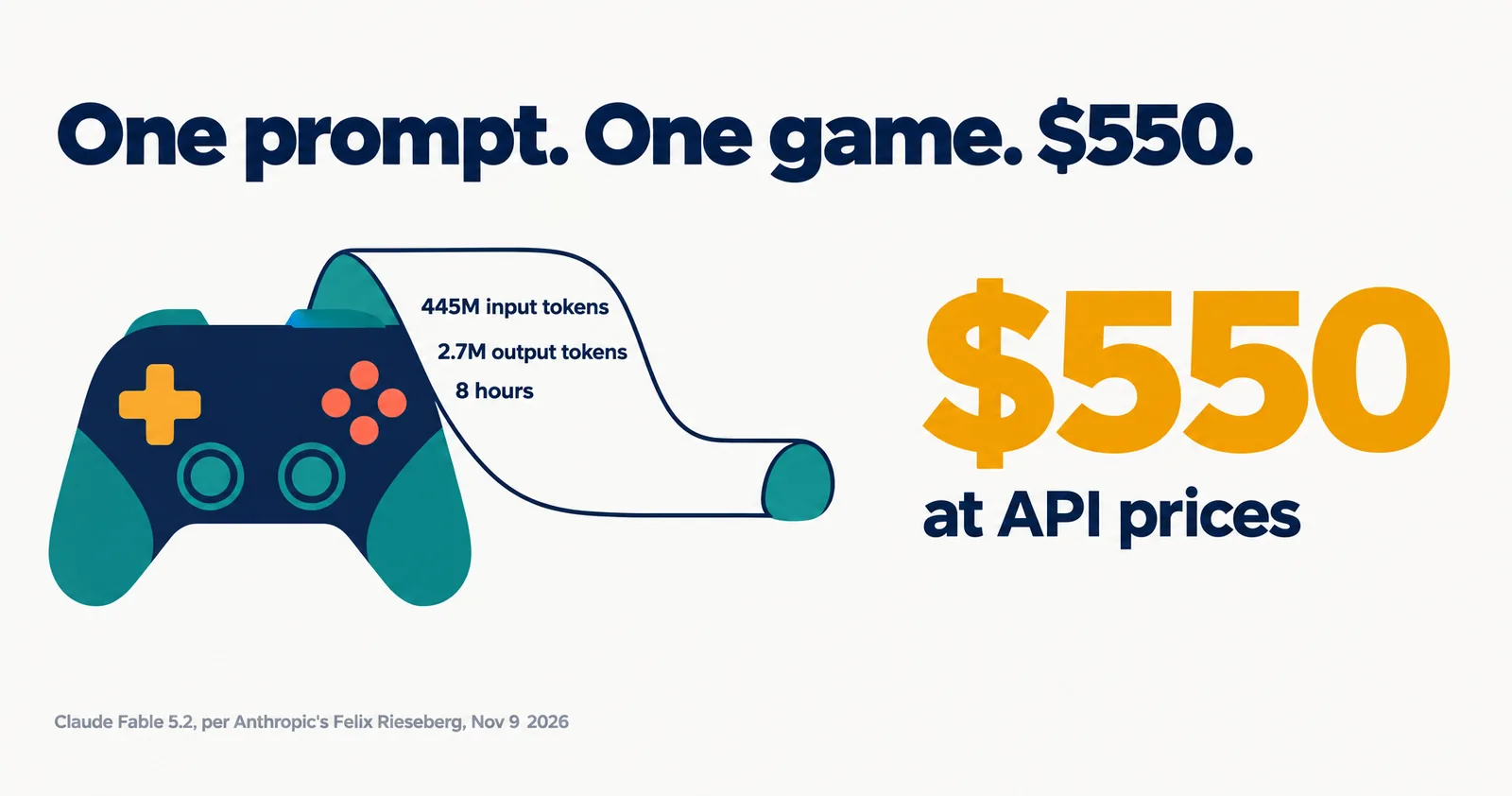
Claude Fable 5.2 was a few hours old when the game demos started. The one with numbers attached came from Felix Rieseberg, who builds products at Anthropic. On November 9, 2026 he posted a playable first-person shooter and the bill for making it: one prompt, eight hours, about $550 at API prices.
By 04:30 UTC on November 10 his post had about 428,000 views. A clip from the account @TokenGremlin, captioned “Created with Fable 5.2 by an Anthropic engineer.” and linking Rieseberg’s earlier games in its replies, had about 655,000. This post sticks to what was reported, then does the arithmetic on the bill, because the bill is the useful part. The model itself is covered in our Fable 5.2 release record.
On this page · 8 sectionsOpen
 Anthropic’s Felix Rieseberg says Claude Fable 5.2 built Saltline, a playable first-person shooter, from one short prompt with no human feedback, in about 8 hours.
 His reported bill: about $550 at API prices, for about 445 million input tokens and 2.7 million output tokens, heavily cached.
 Input outnumbers output about 165 to 1. At list prices the output is about $108 and the input about $442 of the bill, by our arithmetic.
 Caching decides the price. The same tokens with no caching would cost about $3,668. With every input token read from cache, about $197.
 The figures are self-reported and rounded, the tool is not named, and the prompt asked for a tiny level. Other viral demos used detailed prompts or outside tools.
§ 01What Rieseberg reported

Rieseberg’s bio on X reads “I build things @AnthropicAI”. His post opens: “I wanted to test Fable 5.2’s quality with one-shot prompts without human feedback.” Then the claim and the bill: “Everything in this game is from scratch: models, sounds, textures.” and “~$550 at API pricing, ~2.7M output and 445M input tokens, heavily cached.” It ends with “Took 8 hours!” and a link to a public Claude artifact. The artifact page is titled Saltline.
Seven minutes later he posted the prompt, with the comment “I’m slowly discovering that the age of prompt engineering is basically over.” The whole prompt:
“You know, you should also build me a FPS. Insanely detailed quality pls, something that looks visually like it can keep up with AAA. Make it small in scope (like a tiny level) but otherwise impressive photorealistic graphics”
Asked about his setup, he replied that “my claude.md is empty”. A claude.md is the instruction file Claude Code reads at the start of a session. He did not say which tool ran the eight hours.
This was his second batch of the day. Three minutes after Anthropic’s launch post he had shared a first set: “I’ve asked it to make some games, keeping the very first draft.” That artifact is titled Three Games.
| Item | Reported |
|---|---|
| Model | Claude Fable 5.2 |
| What it made | Saltline, a first-person shooter that plays in the browser |
| Human input | One prompt, no feedback during the run |
| Time | About 8 hours |
| Input tokens | About 445 million, heavily cached |
| Output tokens | About 2.7 million |
| Cost | About $550 at API prices |
| Made from scratch, per the post | Models, sounds, textures |
| Not stated | The tool that ran it, the effort setting, whether fast mode was on |
§ 02The bill, line by line
Anthropic’s price list for Fable 5.2 is $8 per million input tokens and $40 per million output tokens. Input that is read back from the prompt cache costs $0.20 per million, which is 0.025 times the base price. Writing to the cache costs $10 per million for a five-minute cache or $16 for a one-hour cache.
Apply those prices to the reported counts. This is our arithmetic, and his figures are rounded, so treat every result as approximate:
- Output. 2.7 million tokens at $40 is about $108.
- Input. That leaves about $442 for 445 million input tokens, or about $0.99 per million. That is roughly one eighth of the full input price.
- Cache share. An average that low only works if roughly 90% to 95% of the input tokens were cache reads, depending on how the rest were billed.
So about 80% of the bill is input, and almost all of that input was the model re-reading text it had already seen.
| Scenario | Input cost | Output cost | Total |
|---|---|---|---|
| No caching: all input at $8 per million | $3,560 | $108 | $3,668 |
| As reported: heavily cached | about $442 | $108 | about $550 |
| Floor: every input token a cache read | $89 | $108 | $197 |
§ 03What the bill tells you
Long agent runs read far more than they write. The run used about 165 input tokens for every output token. An agent that works for hours sends its context again on every step: the code so far, the tool results, the plan. Writing the game was the small part. Re-reading it was the large part.
Cache pricing sets the price of autonomous work. With no caching, the same tokens would cost about $3,668, about 6.7 times the reported bill. Anthropic’s docs put a normal cache read at 10 percent of the input price. On Fable 5.2 it is 2.5 percent. If you are budgeting a long agent run, the cache hit rate matters as much as the headline price per token.
The unit is hours, not prompts. One prompt bought eight hours of unattended work, at about $69 for each hour the model ran. A one-line request is cheap to type. It is not cheap to run.
§ 04What one-shot covers, and what it does not
- One prompt is not a short job. The run took eight hours and hundreds of millions of tokens. One-shot here means nobody steered it, not that it was quick.
- The prompt asked for a small thing. It says “Make it small in scope (like a tiny level)”. A tiny level is not a full game, and AAA is what the prompt asked for, not a measured result.
- The numbers are self-reported. They come from an Anthropic employee on launch day, each with a tilde in front. No logs are published. Claude’s own artifact page carries the notice “Content is user-generated and unverified.”
- We have not audited it. We opened both artifact pages and read the posts. We did not inspect the code or the assets.
§ 05The other viral demos are not the same thing
Several write-ups blur the launch-day games into one demo. They are different people, different games and different amounts of human input.
- Sholto Douglas, Anthropic (bio: “Scaling RL @AnthropicAI”). He posted “An arena FPS with portals” and wrote that “Fable 5.2 is the first model that passes my bar for seriously fun and beautiful games.” This one had a detailed brief. In a reply he wrote: “i said I wanted an arena shooter and described the mechanics, weapons, level layout I wanted in a lot of detail”. It had also been played before launch: “We have had a few fun evenings playtesting this against eachother at the office”.
- Kevin Ngo (bio: “Creative coding with AI”). His post, about 220,000 views, reads “Claude Fable 5.2 made this game demo, playable in the browser” and “It’s a boat ride through 8 dreamlike worlds”. It was not Fable alone. In replies he named Tripo 3D, and wrote that “the music in the actual game was generated with suno v6”.
- The @TokenGremlin clip. The most-viewed post names no author and gives no source in the post itself. Its replies link Rieseberg’s Three Games artifact.
Only Rieseberg’s Saltline post comes with a prompt, a time and a token bill.
§ 06What to watch
- Whether Rieseberg or Anthropic publishes the logs, or names the tool and settings behind the run.
- Reproductions by people outside Anthropic, with their own cost reports.
- Whether other labs start quoting cached and uncached costs for long runs side by side.
Related on this blog: Which Claude model to use and Fable 5.2 designs electronics.
§ 07Where CellCog sits
CellCog’s agents run on Claude Opus 5.5 today, not Fable 5.2. Our Fable 5.2 release record covers the price, the benchmarks and what changed.
§ 08Sources
- Felix Rieseberg on X, the Saltline post (22:50 UTC, November 9, 2026; about 428,000 views at 04:34 UTC on November 10)
- Felix Rieseberg on X, the prompt (22:57 UTC, November 9)
- Felix Rieseberg on X, the claude.md reply (03:18 UTC, November 10)
- Felix Rieseberg on X, the first batch of games (19:00 UTC, November 9)
- Claude artifacts: Saltline and Three Games
- Anthropic, API pricing, read November 10, 2026
- Sholto Douglas on X (23:29 UTC, November 9) and his reply on the prompt
- Kevin Ngo on X (19:05 UTC, November 9) and his reply on the music
- @TokenGremlin on X (20:35 UTC, November 9; about 655,000 views at 04:29 UTC on November 10)
Q1Did Fable 5.2 really make a game from one prompt?
That is what Anthropic’s Felix Rieseberg reports: one prompt, no human feedback, about 8 hours. It is his account. Nobody outside Anthropic has audited the run.
Q2What would it cost without caching?
About $3,668 by our arithmetic at list prices: 445 million input tokens at $8 per million plus 2.7 million output tokens at $40 per million.
Q3Can I play the game?
Yes. Rieseberg shared it as a public Claude artifact, linked in the sources. Claude labels artifact pages as user-generated and unverified.
Q4Which tool ran the eight hours?
He did not say. He wrote that his claude.md file is empty, and gave no other detail on the tool or settings.
Q5Does CellCog run on Fable 5.2?
No. CellCog’s agents run on Claude Opus 5.5 today.