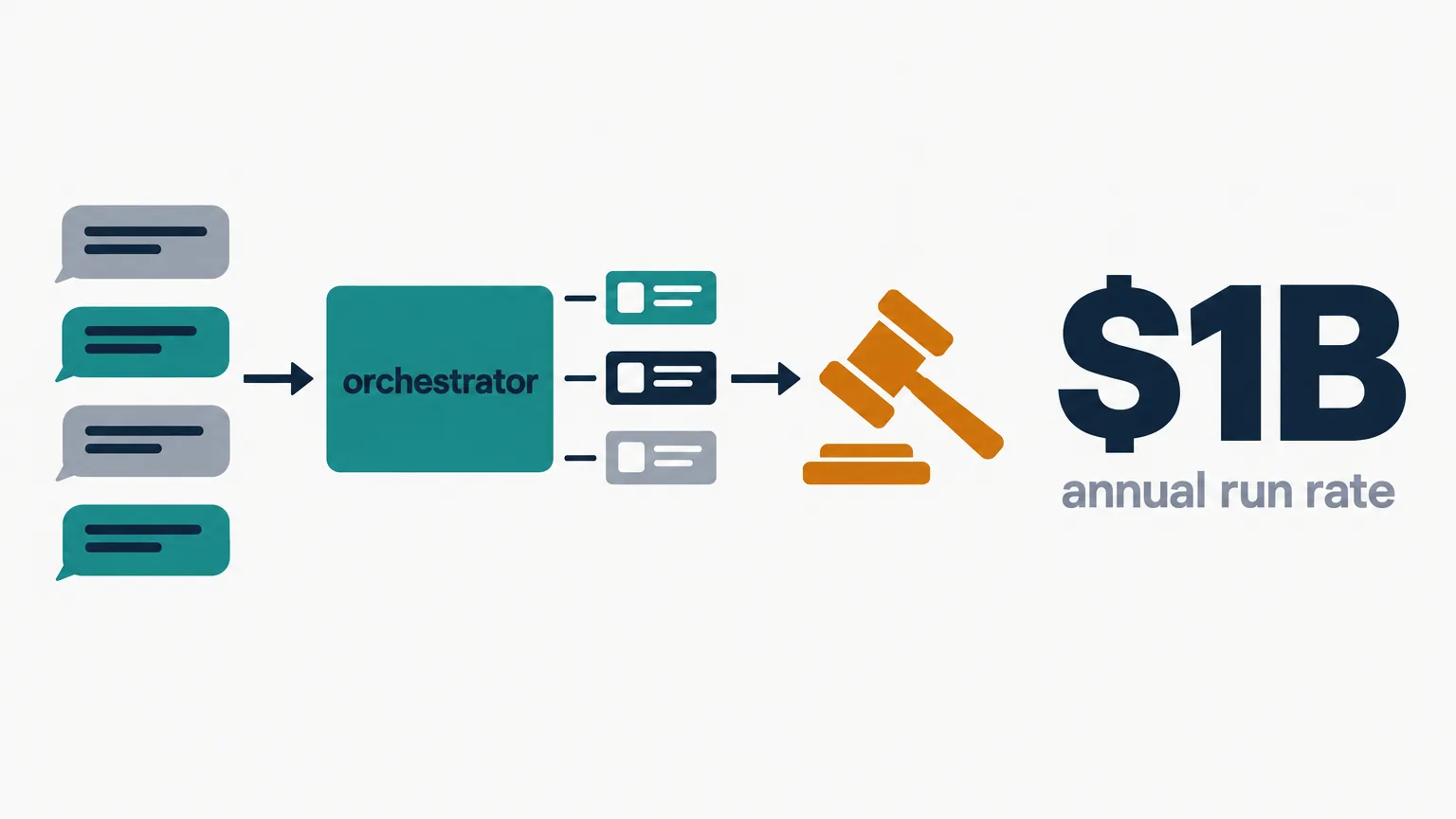
OpenAI says ChatGPT Ads reached a $1 billion annualized revenue run rate less than 200 days after launch, and on October 21, 2026 it expanded the program from 63 to 89 countries. The same day its engineers published a write-up of the ad stack: a post-trained LLM that reads a conversation as it unfolds and calls tools to retrieve, rank and auction ads. Ads appear only on the Free and Go plans; Plus, Pro and Enterprise stay ad-free.
This page reads that engineering post and OpenAI’s expansion announcement.
 OpenAI says ChatGPT Ads reached a $1 billion annualized revenue run rate less than 200 days after launch, and more than 100,000 advertisers have run campaigns.
 On October 21, 2026 ads expanded to 26 more countries, from 63 to 89, including 14 more in Latin America.
 Ads appear only on the Free and Go plans; Plus, Pro and Enterprise stay ad-free.
 A post-trained LLM called the orchestrator reads the whole conversation and calls tools for retrieval, ranking, relevance and the auction.
 The ad system runs as a separate service from ChatGPT’s answers, and showing no ad counts as a normal outcome.
§ 01The numbers
| Measure | Figure |
|---|---|
| Annualized revenue run rate | $1 billion, reached less than 200 days after launch |
| Advertisers since launch | More than 100,000 |
| Countries with ads | 89 (26 added October 21) |
| Weekly ChatGPT users | More than 1.2 billion |
| Plans that show ads | Free and Go only |
The new markets include 14 more Latin American countries such as Argentina, Chile, Colombia and Peru, plus Nigeria, South Africa, Serbia, Ukraine, Cambodia, Bangladesh and Pakistan. The program launched “just over eight months ago” and followed Europe in August and Southeast Asia and Taiwan in September.
§ 02Why a search-style ad system did not fit
A search ad answers one event: a query or a page view. A ChatGPT conversation builds intent over many turns, and sometimes never reaches a buying moment. OpenAI’s example is a user asking how to train for a race and, several turns later, asking about shoes. An ad fired on the first message would have read the wrong intent. So OpenAI made three design choices:
- Stateful sessions. The ad system remembers and updates context across turns, and across conversations.
- An LLM orchestrator. “We call this LLM the orchestrator.” It has to recognize hypotheticals and “avoid treating every mention of a product or service as a request to buy something.”
- A separate service. Ads are selected outside ChatGPT’s answer path, with separate models and code. If the ad system is slow or down, the answer arrives anyway.

§ 03How one ad gets chosen
| Step | What happens |
|---|---|
| Queries | The orchestrator rewrites the conversation into one or more short intent queries, e.g. hiking shoes for a Yosemite trip |
| Retrieval | Embedding search (approximate nearest neighbor) over several ad indices pulls a broad candidate pool |
| Filtering | Drops ads failing availability, targeting, policy, budget, pacing, placement or per-advertiser limits |
| Scoring | Tools score semantic relevance, predicted engagement and past performance |
| Auction | The orchestrator nominates finalists; the auction ranks by quality and bid and sets the price |
| Final checks | Last eligibility pass before the ad shows at the end of the answer |
The division of labor in the last steps is deliberate: “The orchestrator doesn’t directly decide which ad will be served, nor does it set a price.” And the system is allowed to come back empty: “Returning no ad is an ordinary, successful outcome.”

Personalization is opt-in. If a user chooses it, the orchestrator also considers nonsensitive information from past conversations. OpenAI’s principles say conversations stay private from advertisers and customer data is not sold.
§ 04What it means for businesses
Advertisers in the 89 countries can sign up through technology partners or self-service at ads.openai.com. For advertisers, the unit is no longer a keyword. It is a conversation that may eventually land on what you sell, judged by a model that decides whether an ad helps at all. That rewards clear product data and honest relevance over bidding on terms. For anyone building with agents, the architecture is the more lasting story: one model running a loop of narrow tools, each step checkable, the final money decision left to a separate mechanism. CellCog’s AI employees follow the same pattern for your work: each runs its own loop of tools on its own secure VM, and spending or publishing waits for your approval.
§ 05What to watch
- The new formats, objectives and measurement OpenAI says come next, including the image ad format it is testing.
- Whether ads ever reach paid plans, which OpenAI says stay ad-free today.
- Independent data on how often a conversation actually shows an ad.
Q1How much revenue do ChatGPT Ads make?
OpenAI says ChatGPT Ads reached $1 billion in annualized revenue run rate less than 200 days after launch. It has not published quarterly revenue.
Q2In how many countries are ChatGPT Ads available?
89 countries as of October 21, 2026, after an expansion to 26 more, including Argentina, Chile, Colombia, Peru, Nigeria, South Africa, Ukraine, Bangladesh and Pakistan.
Q3How does ChatGPT choose which ad to show?
A post-trained LLM orchestrator summarizes the conversation into retrieval queries, retrieves candidates by semantic search, filters them, scores relevance and engagement, and nominates finalists to an auction that sets the price.
Q4Does ChatGPT use my past conversations for ads?
Only if you choose to personalize ads; then the orchestrator also considers nonsensitive information from past conversations. OpenAI says conversations are not shared with advertisers.
Q5Can an AI employee run ads on ChatGPT for my business?
A CellCog AI marketing manager can plan campaigns, write ad copy and track results across your channels; spend and publishing stay behind your approval.